VC·Lawyers®
North York SABS accident benefits lawyer, VC Lawyers

North York

North York SABS Benefits Lawyer

Toronto Lawyers Association
Ontario Trial Lawyers Association (OTLA)
The Canadian Bar Association
Love Toronto
Consulate General of the Republic of Korea in Toronto
Korean Legal Clinic
Ontario Bar Association
Toronto Lawyers Association
Ontario Trial Lawyers Association (OTLA)
The Canadian Bar Association
Love Toronto
Consulate General of the Republic of Korea in Toronto
Korean Legal Clinic
Ontario Bar Association
Toronto Lawyers Association
Ontario Trial Lawyers Association (OTLA)
The Canadian Bar Association
Love Toronto
Consulate General of the Republic of Korea in Toronto
Korean Legal Clinic
Ontario Bar Association

Trusted by accident victims and businesses across Ontario

Overview

Accident benefits claims in North York

Fighting your own insurance company for accident benefits? Our experienced SABS lawyers in North York represent motor vehicle accident victims across the GTA at every stage of the accident benefits system. We get first applications done right, pursue treatment plans and income benefits, contest Minor Injury Guideline classifications, fight catastrophic impairment designations, and dispute every wrongful denial, reduction, and termination at the Licence Appeal Tribunal. Our team has recovered over $30M+ for accident victims across North York, Ontario and the GTA, and the accident benefits file runs underneath every single one of those recoveries. In Ontario's system, SABS is where every injury claim begins. It is the stream that funds your treatment and replaces your income now, while everything else takes years.

Understand how the system is built, because it explains both your rights and your fights. The Statutory Accident Benefits Schedule is a regulation under Ontario's Insurance Act. It is the no-fault benefits package that sits behind every auto insurance policy in the province.

North York SABS Benefits Lawyer, VC Lawyers

The tiers, the forms, and the fights

No-fault means exactly that. You claim from your own insurer, or, if you have no policy of your own, through a priority sequence that identifies which insurer covers you, regardless of who caused the accident. At-fault drivers, single-vehicle crashes, passengers, and the pedestrians and cyclists struck by cars are all covered. For the three mandatory benefits, eligibility turns on one question only: did you suffer an impairment from the use or operation of a motor vehicle? That question is tested strictly. In *Bidima v Northbridge* (2026 LAT), a pedestrian who fell while running from an approaching truck was denied benefits because her injuries came from the fall itself, not from the use or operation of the vehicle. The benefits that became optional in 2026 ask a second question on top of it, and that is the next paragraph's subject.

What the package contains changed on July 1, 2026, and the split matters more than the headline. Medical, rehabilitation, and attendant care remain mandatory on every Ontario auto policy, so an injured person has all three whatever coverage was bought. Other benefits moved the other way, into optional coverage a policyholder either bought or did not: income replacement, non-earner, caregiver, housekeeping and home maintenance, and death and funeral. Each of those now carries a second condition on top of the purchase, and it is the part almost nobody has been told about. Eligibility for those optional benefits narrowed to a defined class. Only these people can claim them: the named insured on the policy (the person the policy is issued to), that person's spouse, dependants of the named insured or the spouse, and drivers listed on the policy. Auto insurance also pays first for medical and rehabilitation claims now, in full from the start, so your own extended health or employer plan is no longer drawn down ahead of it.

Between that mandatory core and the optional purchases, the benefits still span the aftermath of a collision. Medical and rehabilitation benefits, which every policy carries, cover physiotherapy, chiropractic, psychology, occupational therapy, equipment, and more, beyond OHIP (Ontario's public health plan), with the auto insurer now paying ahead of your own private plans. Income replacement benefits run at generally 70% of gross income where the coverage was purchased and the claimant is one of the people it covers, capped at the policy's weekly limit.

Attendant care, the third mandatory benefit, covers those who need help with personal care, and it is there for every insured person regardless of what else the policy bought. These are all optional purchases now: non-earner benefits for those who weren't working, caregiver benefits, housekeeping and home maintenance benefits, and the death and funeral benefits that go to families after fatal collisions. Each one exists only where it was bought, and only for the people the narrowed rules still reach: the named insured, the spouse, their dependants, and listed drivers.

But the Schedule also sets limits, and those limits are where claims are won and lost. Your injuries are classified into one of three tiers that control the money.

The Minor Injury Guideline (MIG) caps medical-rehabilitation funding at $3,500 for sprains, strains, and whiplash-type injuries. The non-catastrophic tier provides combined medical, rehabilitation, and attendant care funding of $65,000 over five years. Catastrophic impairment unlocks up to $1 million in combined lifetime benefits for the most serious injuries.

Insurers fight the boundaries of every tier, because the classification is worth more than almost any individual benefit. Those ceilings govern the three mandatory benefits, so every insured person can reach them. Your Certificate of Automobile Insurance, the document that lists what your policy covers, decides two other things: which optional benefits were bought, and who on that policy is allowed to claim them. So the optional side has a two-part test, and it is worth stating plainly. First, did the policy that pays your claim actually buy the coverage? Second, are you one of the people it covers, meaning the named insured, a spouse, a dependant, or a listed driver? You can pass the first test and fail the second. That is how someone injured as a passenger in a generously insured car ends up with the mandatory three benefits and nothing further.

The process runs on Ontario Claim Forms (OCFs) and hard deadlines. Notice goes to the insurer within 7 days. The OCF-1 application follows within 30 days. Your health practitioner completes the OCF-3 Disability Certificate, and OCF-18 treatment plans cover each course of care.

The process also runs on the insurer's main tool: section 44 insurance examinations, or IEs. These are the insurer-selected assessments whose reports terminate benefits across the province every day. When the denial comes, and in contested claims it comes, the dispute route is the Licence Appeal Tribunal (LAT), filed within 2 years of the denial, where evidence and advocacy decide outcomes.

This is precisely the system VC Lawyers works in daily, visible across every accident and injury page in our practice, and consolidated here. Based right here in North York at 1110 Finch Ave W, minutes from Sunnybrook, North York General, and Humber River, we bring 70+ years of combined experience to every accident benefits file. Applications are built right from week one, treatment plans fought line by line, IEs answered with treating evidence, classifications escalated, and denials taken to the LAT.

Get in touch

Looking for legal help? Speak directly with a lawyer

Tell us what happened and a lawyer will personally review your case. Personal injury consultations are free and there are no fees unless we win. For all other practice areas, a consultation fee applies.

  • $30M+ recovered for injury clients
  • Available 24/7, including weekends
  • Service in English, Korean, and 6+ more languages

Prefer to call? (416) 661-4529

A VC Lawyers lawyer in consultation with a client at the North York office

Background

Accident benefits in North York: what you need to know

Every collision on the 401, every struck pedestrian on Finch or Steeles, every cyclist doored on Keele, and every passenger hurt in a sudden stop generates the same first claim: the accident benefits application to an auto insurer, due within days, governing the treatment and income of the months ahead. The tort lawsuit, the claim against whoever caused it, comes later and pays later. SABS is the system that answers now.

Which is why insurers contest it so hard at the front end. Every MIG classification, every denied OCF-18, and every IE-driven termination is money saved on a claimant who may never push back. This page, and this practice, exists for the push-back.

The benefits, plainly

Medical and rehabilitation benefits. These pay for the treatment itself: physiotherapy, chiropractic, massage, psychology, occupational therapy, medications, assistive devices, and more, beyond what OHIP and private plans cover. They are claimed through OCF-18 treatment plans your providers submit, and insurers approve, deny, or send to IE. The auto insurer now pays first and your own extended health or employer plan pays after. This benefit stayed mandatory in the 2026 reform, so every insured person has it, and the funding ceiling is set by your tier.

Income replacement benefits (IRBs). Now an optional purchase. Where the policy carries it, the benefit is generally 70% of gross pre-accident income, to the policy's weekly cap, after the first week.

The calculation itself is a battlefield. Employment income is proven through the OCF-2 and tax records, and self-employment income through the financial records insurers love to discount. Every termination is tested against the Schedule's actual disability tests: inability to perform the essential tasks of your employment, tightening after 104 weeks to a stricter complete-inability test that mirrors the LTD world's two-year switch.

Non-earner benefits. For those not working at the time, including students, retirees, and caregivers at home, who suffer a complete inability to carry on a normal life. It is an optional purchase now, and the narrowed rules confine it to the named insured, the spouse, dependants of either, and listed drivers, so it exists where a policy bought it and counts the claimant among those people. Where both are true, insurers deny it near-reflexively and the LAT awards it on proper evidence.

Attendant care benefits. Payment for the personal care the injury demands, assessed via Form 1 and quantified hour by hour. It is mandatory coverage on every policy, which is worth stating plainly now that so much else is not, and it is fought hardest in serious and catastrophic cases, where it is the largest line in the claim.

Caregiver, housekeeping, and home maintenance benefits. Optional purchases now, so they are available where that coverage was bought, and enhanced within the catastrophic tier where the designation is made. They replace the labour the injury took from a household.

Death and funeral benefits. Lump sums to a surviving spouse and dependants, plus funeral cost contributions, both optional purchases since the reform, so a family whose policy never bought them has no such benefit. The eligibility narrowing reaches here as well, because the person who died has to have been the named insured on the policy that bought the coverage, that person's spouse, a dependant of either, or a driver listed on it. Grief-counselling funding reaches the family through the mandatory medical and rehabilitation benefit instead. This is the no-fault layer our wrongful death practice files in the first days for every family.

Not sure where you stand? One conversation will tell you.

A VC Lawyers lawyer meeting a client at the North York office

The tiers, and the wars over them

The MIG ($3,500). Sprains, strains, and whiplash-associated disorders, the default classification insurers apply to soft tissue claims, and the cap that ends real treatment in months. The documented escape routes are pre-existing conditions a physician confirms prevent recovery within the Guideline, psychological injury, chronic pain development, and concussion. Our soft tissue and chronic pain practices live in this fight.

Non-catastrophic ($65,000 / 5 years). The middle tier combines medical, rehabilitation, and attendant care funding that serious-but-not-catastrophic injuries must budget across five years. That makes every approved and denied OCF-18 consequential.

Catastrophic impairment ($1 million combined, lifetime). These are the designations that change everything: paraplegia and tetraplegia, severe brain injury with distinct and more protective criteria for children, amputations meeting the criteria, blindness, and the combined physical-psychological route assessed on whole-person impairment. Each engages enhanced attendant care and the case management funded out of the mandatory medical and rehabilitation benefits, plus enhanced housekeeping where the policy bought that optional coverage.

Note that the $1 million is a single combined limit for medical, rehabilitation, and attendant care, not separate pots. Insurers contest these designations with their own assessors as a matter of course. Our brain injury, spinal cord, amputation, and burn practices fight them as a matter of course right back.

The insurer's tools, and yours

Section 44 insurance examinations. The insurer's statutory right to assess you, through paper reviews and in-person examinations by assessors of their selection. Attendance is generally mandatory, the examinations must be reasonably scheduled, and they are behind most terminations. You have three counterweights. The first is preparation, so you attend informed and are never coached into playing down your injuries or exaggerating them. The second is your treating team's evidence, built up across the whole course of your treatment, against the assessor's one-time snapshot. The third is the LAT, for when the report does what the insurer commissioned it to do.

The LAT (Licence Appeal Tribunal). The exclusive forum for most accident benefits disputes: applications within 2 years of each denial, case conferences, and written and oral hearings, decided on medical evidence and advocacy. That two-year clock is subject to discoverability, which means it can start running when you knew, or reasonably should have known, that you had something to dispute. The Court of Appeal confirmed this in *Tagoe* (2024 ONCA 894). And when the LAT gets it wrong, there may still be a way to challenge the decision. In *Yatar v TD* (2024 SCC 8), the Supreme Court of Canada held that judicial review (a higher court's power to correct a Tribunal error) remains available on questions of fact and on mixed questions of fact and law, even though the statutory appeal route is limited to questions of law. Unrepresented claimants face insurer counsel alone. Represented ones, with files built for the hearing, win back benefits every week. We prepare LAT matters like trials because functionally they are.

The priority and edge rules. No policy of your own? The ladder runs through a spouse's or family member's policy, the vehicle's insurer, any insurer involved, and finally the Motor Vehicle Accident Claims Fund. Since July 1, 2026 that ladder does two different jobs, and the difference decides real money. It always finds a payer for medical, rehabilitation and attendant care, which is why nobody injured by a motor vehicle in Ontario is left without treatment and personal care funding. What it cannot do on its own is qualify you for the optional benefits. Those reach only the named insured, the spouse, dependants of either, and drivers listed on the policy. So a pedestrian claiming through the striking vehicle's insurer has the mandatory three, and unless one of those four connections exists somewhere, nothing on the income side. Establishing every policy you connect to, your own, a spouse's, a parent's, or one that lists you as a driver, is front-end legal work rather than paperwork, and it is where these files now start.

The edges have rules too. You may be hit as a pedestrian by an uninsured driver. You may be hurt in a non-collision transit incident, excluded from SABS since 2011, so you sue the transit authority instead. You may be injured outside Ontario as an Ontario insured, in which case SABS claims travel with you. You may be convicted of certain driving offences, where some benefits are excluded and others preserved. Every edge case has a rule, and the rule has consequences worth getting right in week one.

By the numbers

SABS facts every North York accident victim should know

The rules, the tiers, and the deadlines that govern every accident benefits claim.

  • SABS is no-fault and near-universal

    It is attached to every Ontario auto policy as a regulation under the Insurance Act, and payable regardless of fault. It reaches at-fault drivers, single-vehicle crash victims, passengers, pedestrians, and cyclists alike, whenever an impairment results from the use or operation of a motor vehicle. Even the uninsured can claim medical, rehabilitation and attendant care through the priority rules and, as a last resort, the Motor Vehicle Accident Claims Fund.
  • Since July 1, 2026, three benefits stayed mandatory

    Medical, rehabilitation, and attendant care are still on every Ontario auto policy. Income replacement, non-earner, caregiver, housekeeping, death and funeral, and the rest became optional purchases, and narrowed eligibility now limits them to the named insured, that person's spouse, dependants of either, and drivers listed on the policy. The reform also put auto insurance first for medical claims, ahead of your own extended health or employer plan, which now stays intact for everything else. So the Schedule sets your core entitlement, while the certificate and your own place on the policy decide what can be added to it.
  • Three tiers control the money

    The MIG allows $3,500 of medical-rehabilitation funding for "minor injuries". The non-catastrophic tier allows $65,000 combined medical, rehabilitation, and attendant care over five years. Catastrophic impairment allows up to $1 million combined for life. Tier classification is therefore the single highest-stakes question in most claims.
  • Income replacement is now an optional purchase

    Where it was bought, it runs at 70% of gross income, capped at the policy's weekly limit, commonly cited around $400/week at the base tier. Buying it is only half the question, because the benefit now runs to the named insured, the spouse, their dependants, and listed drivers, so a passenger or a struck pedestrian outside that class cannot claim it off someone else's policy. Your Certificate of Automobile Insurance shows what you actually bought, and the policy shows who it covers. Most claimants have never checked either.
  • The deadlines are short and unforgiving

    Notice goes to your insurer within 7 days of the accident. The OCF-1 application follows within 30 days of receiving the forms. Treatment plans are submitted and responded to on regulated timelines, and LAT disputes are filed within 2 years of each denial.
  • The forms are the claim

    OCF-1 is the application. OCF-2 is the employer's income confirmation. OCF-3 is the Disability Certificate that opens income and non-earner benefits. OCF-18 covers treatment and assessment plans, and OCF-6 covers expenses. Insurers parse each one for reasons to deny, so each is worth completing with advice.
  • Section 44 examinations are the insurer's main tool

    These are insurer-selected paper reviews and in-person assessments that you are generally required to attend, and their reports drive the majority of benefit terminations. Attendance is mandatory. Going in unprepared is optional, and unwise.
  • The LAT is the only road for most disputes

    Accident benefits disagreements go to the Licence Appeal Tribunal, not the courts, within 2 years of the denial. Written and oral hearings there are decided on medical evidence and advocacy.
  • Special rules cover the edges

    Non-residents injured in Ontario and Ontarians injured outside the province, the anchor of our cross-border practice, each have their own rules. So do excluded benefits after certain driving convictions, and the 2011 rule that excluded non-collision transit incidents from SABS coverage.
Boardroom at VC Lawyers, 1110 Finch Avenue West, North York

Recovering in North York

The benefits stream and the North York recovery map

Accident benefits are not abstract. They are the funding behind every node of a North York recovery. The physiotherapy and rehabilitation clinics along Finch, Sheppard, and Yonge run on approved OCF-18s. The psychologists treat the post-collision anxiety the MIG pretends doesn't exist.

Then there are the attendant care hours in a Willowdale apartment after a catastrophic designation, the income replacement holding a Downsview household through the months off work, and the hospital corridor, Sunnybrook, North York General, and Humber River, where the file began.

Our office at Finch and Keele sits in the middle of that map, and our accident benefits practice is built on its logic. Every approved plan is treatment delivered. Every defended benefit is a household held. The claim and the recovery are the same project, run together.

The deadlines here are shorter than most people expect.

Step by step

What to do about your accident benefits

  1. 01

    Notify the auto insurer within 7 days

    Notify yours, or the correct one up the priority ladder, sticking to basic facts.
  2. 02

    Submit the OCF-1 within 30 days

    Submit it within 30 days of receiving the package, completely, accurately, and ideally with advice. The application frames everything after.
  3. 03

    Get the OCF-3 done by a practitioner who understands the tests

    The Disability Certificate opens income and non-earner benefits, and a thin one closes them.
  4. 04

    Check your Certificate of Automobile Insurance for optional benefits

    Medical, rehabilitation, and attendant care are on every policy, so start from there. Income replacement, non-earner, caregiver, housekeeping, and the death and funeral benefits are among those that exist only where they were bought, and only for the named insured, the spouse, their dependants, and listed drivers, so check whose names are on the policy as well as what it carries. Tell us either way, because we audit every certificate and every policy you might connect to.
  5. 05

    Document income properly from day one

    The OCF-2 from your employer, tax returns, and, for the self-employed, the business records that defeat the insurer's discounting.
  6. 06

    Treat consistently and route every treatment plan (OCF-18) strategically

    Gaps become "recovery," and denied plans have response and dispute timelines.
  7. 07

    Never skip a section 44 examination, and never attend one unprepared

    Attendance is generally mandatory. Preparation is your right, and ours to provide.
  8. 08

    Keep every receipt and expense

    This is OCF-6 territory: medications, devices, travel to treatment, and the help you hired.
  9. 09

    Date every denial letter

    Each one starts its own 2-year LAT clock, and partial approvals are denials of the rest.
  10. 10

    Contact a North York SABS lawyer early

    At the application stage if possible, and at the first denial without fail. The benefits written in the Schedule are claimed, defended, and litigated into existence, and every week earlier is a week of treatment and income protected.

Our process

How our North York SABS lawyers handle your accident benefits file

  1. 01

    Free consultation, at any stage

    Contact us in the week of the accident, on the day of a denial, or anywhere between. Our North York SABS lawyer team will map your file: the correct insurer under the priority rules, your tier classification and the case for escalating it, the optional benefits on your certificate and whether you are inside the class entitled to claim them, every deadline live, and the strategy. Zero obligation and zero cost.
  2. 02

    Build the claim properly from the start

    We set up or repair the foundation. We complete the OCF-1 strategically and frame the OCF-3 Disability Certificate to the disability tests it actually serves. We assemble the income documentation, meaning the OCF-2, tax records, and self-employment proof, the claims insurers love to underpay. We build treatment plans, the OCF-18s, with your providers, to the evidence standards that survive scrutiny. We document MIG-escape evidence early where the injury warrants, covering pre-existing conditions, psychological injury, chronic pain, and concussion. In serious cases we open the catastrophic designation file from the start, because the $1 million tier is built over months of evidence, not requested in a letter. We audit the certificate at the same time, and we map every policy that might name you, because the three mandatory benefits are the floor while the optional coverages sit on top only where they were purchased and only where you are the named insured, a spouse, a dependant of either, or a listed driver.
  3. 03

    Fight the denials: IEs, terminations, and the LAT

    We prepare you for every section 44 examination and answer every adverse IE report with treating-team and specialist evidence. We contest wrongful MIG classification, treatment-plan denials, income terminations, and attendant care reductions. Where the insurer won't move, we file at the Licence Appeal Tribunal within the 2-year window and run the hearing, with its documentary record, witness preparation, and advocacy, like the trial it functionally is. Throughout, the benefits file is coordinated with your injury lawsuit (the tort claim) so each strengthens the other.
  4. 04

    Benefits flowing, and how our fee is charged

    Accident benefits aren't a single cheque but a stream, and our job is keeping it flowing. Treatment funded, income replaced, care paid, at the tier your injuries warrant and the coverage your policy provides, for as long as the Schedule allows. Our fee is a percentage of what is recovered, set out in a written contingency fee agreement at the start, payable out of the recovery and not payable at all if the claim does not succeed, with the disbursements explained before you sign.

Important

The SABS clock starts at the crash. Notice goes to the insurer within 7 days and the OCF-1 within 30 days, with treatment-plan and examination timelines running throughout. You then have 2 years from each denial to dispute at the LAT. These deadlines forgive nothing and pause for no internal review. Whether your accident was last night or your denial was last month, the time to get advice is now. Contact a SABS lawyer in North York today.

Every situation is different. Yours deserves a specific answer.

Know their playbook

Insurer tactics in accident benefits claims

  • The MIG default

    Every soft tissue claim slotted into the $3,500 cap on day one, with escape evidence ignored until forced. Answered with documentation, covering pre-existing conditions, psychology, chronic pain, and concussion, and with the LAT.
  • Termination by insurer examination

    Benefits cut on insurer-selected assessments, the one-hour snapshot against your treating team's years. Answered with preparation, longitudinal evidence, and tribunal proceedings that put the assessor's report in context.
  • The paper war

    OCF-18s denied for technicalities, "incomplete" applications bounced, and surveillance commissioned around examination dates. Process deployed as attrition. Answered by taking over the process entirely.
  • The income discount

    IRBs calculated low, with self-employment income skeptically slashed and the 70% applied to the wrong base. Answered with the financial record built properly and the calculation contested.
  • The classification ceiling

    Catastrophic designations resisted with competing assessments, because the gap between $65,000 and $1 million justifies the fight. Answered with the full medical-legal record, built early, by lawyers who fight these designations across every injury type.
  • The quiet termination

    Benefits stopped on notice, betting the claimant won't find the LAT inside two years. Answered by dating every denial and filing inside every window.

In the news

A benefits system in permanent reform, and permanent dispute

Ontario auto insurance is a standing policy story. Benefit levels and tiers have been reshaped across successive reforms. The MIG's cost-containment design has been debated since its introduction, and catastrophic-definition changes have been fought by the injury bar.

A long drumbeat of proposals traded mandatory coverage for optionality, and those proposals took effect on July 1, 2026. From that date, income replacement, non-earner, caregiver, housekeeping and home maintenance, and death and funeral are optional purchases, bought on the policy or absent from it. Three benefits stayed mandatory on every Ontario auto policy, namely medical, rehabilitation, and attendant care, and auto insurance moved ahead of extended health and employer plans on medical and rehabilitation claims. Meanwhile the LAT's published decisions document the system's daily reality: classification fights, IE battles, and terminations reversed on evidence, file after file.

For claimants, the reform churn carries one practical warning and one assurance. The warning: the benefits you assume you have may reflect a version of the Schedule that no longer exists, because income replacement, non-earner and the other optional benefits are now purchased rather than given, and confined to the named insured, that person's spouse, dependants of either, and drivers listed on the policy. Medical, rehabilitation and attendant care are the three that stayed standard, and they still reach everyone a motor vehicle injures. Beyond them, what governs is which policies you connect to, what those policies bought, and the SABS as of your accident date.

The assurance: whatever the version, what wins these claims does not change. Evidence built to the Schedule's actual tests, deadlines kept, examinations answered, and a tribunal that decides on the record in front of it. We build that record.

Rather ask someone who handles these matters every week?

Why VC Lawyers

Why hire a SABS lawyer in North York at VC Lawyers

  • Accident benefits run through our entire practice

    Every car, truck, motorcycle, pedestrian, cycling, and transit file we handle carries a SABS claim alongside it. The classifications, the insurer examinations, the adjuster's tactics, and the LAT are our daily work, not an occasional detour.
  • We fight the tier, not just the benefit

    MIG escapes built on documented evidence, and catastrophic designation claims, the $1 million question, opened early and built deliberately in every serious injury.
  • We treat IEs like the cross-examinations they are

    Preparation before, treating-team answers after, and LAT proceedings when the report does what it was commissioned to do.
  • Contingency fee basis

    No upfront legal fees and a free consultation. The fee is an agreed percentage of the recovery, written down at the start, and nothing is charged in legal fees where nothing is recovered.
  • We find the money you didn't know you had

    Optional benefits on your certificate, the correct insurer up the priority ladder, coordination across your different benefit sources, and every policy that names you as insured, spouse, dependant, or listed driver, because the optional benefits now turn on that too. It is the audit most claimants never get, and the one that matters most now.
  • We run SABS and your injury lawsuit together

    The benefits pay for treatment and income now, and the lawsuit values the long-term losses later, with statements and settlements sequenced so neither undercuts the other.
  • Multilingual service

    English, Korean (한국어), Hebrew, Mandarin, and more, reflecting the communities of North York, in a forms-driven system where language barriers cost real money.

Choosing wisely

How to choose the right SABS lawyer in North York

Before hiring any firm, ask a few hard questions. Do they live in this system, with OCFs, IEs, classifications, and the LAT, or visit it occasionally? Will they fight the tier, through MIG escapes and catastrophic designations, where the real money sits? Do they prepare clients for every section 44 examination and answer every adverse report with treating evidence? Will they audit your certificate for optional benefits and run the priority rules properly? Do they coordinate SABS with the tort claim as one strategy? And are they genuinely prepared to run a LAT hearing like the trial it is?

At VC Lawyers, the answer to each is yes, from an office in the heart of North York, on a contingency fee agreement set out in writing at the start, in your language.

Still weighing what to do next? That is what a first conversation is for.

Testimonials

What our North York clients say

4.8★★★★★·140 on Google
After my car accident, I went through an incredibly challenging time. Thanks to Lawyer Jun Lee and his exceptional team, I received tremendous support and strength.

Jay Kim

Personal Injury Client

When my mother suffered a serious head injury, I was devastated. After meeting Lawyer Jae Hyon Cho, my family was able to receive substantial compensation.

Minkyung Park

Personal Injury Client

Avi Vaturi was professional, responsive, and thorough. When the transaction became complex, his calm communication and practical solutions navigated us to a smooth close.

Jordan Glaser

Real Estate Co-Counsel

Mr. Avi Vaturi did a fantastic job. The whole process was seamless — timely, detailed, and professional from start to finish.

Howard Huang

Real Estate Client

He helped me with both my car accident case and the buying and selling of my home. Everything was handled professionally and efficiently.

Yoon Jung

Personal Injury & Real Estate Client

Jae Cho was great to deal with and very attentive to my case. His associate Sunny was also very helpful. I would highly recommend.

Jordan Ungerman

Personal Injury Client

Their professionalism, attention to detail, and commitment to clients truly stand out. Whether handling urgent matters or guiding me through complex issues, the team delivered.

Charles Hong

Long-time Client

It has been my pleasure to work with Jae Cho and his team. Knowledgeable, clear in their explanations, and the process was smooth and stress-free.

Joanne Jeong

Real Estate Client

Vaturi & Cho LLP is an outstanding law firm. They explain even complex matters clearly, and their dedication to achieving the best outcomes is truly impressive.

Jong Ko

Client

The team was not only knowledgeable but also very kind and attentive throughout the entire process. Highly recommended.

Tobi

Client

After my car accident, I went through an incredibly challenging time. Thanks to Lawyer Jun Lee and his exceptional team, I received tremendous support and strength.

Jay Kim

Personal Injury Client

When my mother suffered a serious head injury, I was devastated. After meeting Lawyer Jae Hyon Cho, my family was able to receive substantial compensation.

Minkyung Park

Personal Injury Client

Avi Vaturi was professional, responsive, and thorough. When the transaction became complex, his calm communication and practical solutions navigated us to a smooth close.

Jordan Glaser

Real Estate Co-Counsel

Mr. Avi Vaturi did a fantastic job. The whole process was seamless — timely, detailed, and professional from start to finish.

Howard Huang

Real Estate Client

He helped me with both my car accident case and the buying and selling of my home. Everything was handled professionally and efficiently.

Yoon Jung

Personal Injury & Real Estate Client

Jae Cho was great to deal with and very attentive to my case. His associate Sunny was also very helpful. I would highly recommend.

Jordan Ungerman

Personal Injury Client

Their professionalism, attention to detail, and commitment to clients truly stand out. Whether handling urgent matters or guiding me through complex issues, the team delivered.

Charles Hong

Long-time Client

It has been my pleasure to work with Jae Cho and his team. Knowledgeable, clear in their explanations, and the process was smooth and stress-free.

Joanne Jeong

Real Estate Client

Vaturi & Cho LLP is an outstanding law firm. They explain even complex matters clearly, and their dedication to achieving the best outcomes is truly impressive.

Jong Ko

Client

The team was not only knowledgeable but also very kind and attentive throughout the entire process. Highly recommended.

Tobi

Client

After my car accident, I went through an incredibly challenging time. Thanks to Lawyer Jun Lee and his exceptional team, I received tremendous support and strength.

Jay Kim

Personal Injury Client

When my mother suffered a serious head injury, I was devastated. After meeting Lawyer Jae Hyon Cho, my family was able to receive substantial compensation.

Minkyung Park

Personal Injury Client

Avi Vaturi was professional, responsive, and thorough. When the transaction became complex, his calm communication and practical solutions navigated us to a smooth close.

Jordan Glaser

Real Estate Co-Counsel

Mr. Avi Vaturi did a fantastic job. The whole process was seamless — timely, detailed, and professional from start to finish.

Howard Huang

Real Estate Client

He helped me with both my car accident case and the buying and selling of my home. Everything was handled professionally and efficiently.

Yoon Jung

Personal Injury & Real Estate Client

Jae Cho was great to deal with and very attentive to my case. His associate Sunny was also very helpful. I would highly recommend.

Jordan Ungerman

Personal Injury Client

Their professionalism, attention to detail, and commitment to clients truly stand out. Whether handling urgent matters or guiding me through complex issues, the team delivered.

Charles Hong

Long-time Client

It has been my pleasure to work with Jae Cho and his team. Knowledgeable, clear in their explanations, and the process was smooth and stress-free.

Joanne Jeong

Real Estate Client

Vaturi & Cho LLP is an outstanding law firm. They explain even complex matters clearly, and their dedication to achieving the best outcomes is truly impressive.

Jong Ko

Client

The team was not only knowledgeable but also very kind and attentive throughout the entire process. Highly recommended.

Tobi

Client

After my car accident, I went through an incredibly challenging time. Thanks to Lawyer Jun Lee and his exceptional team, I received tremendous support and strength.

Jay Kim

Personal Injury Client

When my mother suffered a serious head injury, I was devastated. After meeting Lawyer Jae Hyon Cho, my family was able to receive substantial compensation.

Minkyung Park

Personal Injury Client

Avi Vaturi was professional, responsive, and thorough. When the transaction became complex, his calm communication and practical solutions navigated us to a smooth close.

Jordan Glaser

Real Estate Co-Counsel

Mr. Avi Vaturi did a fantastic job. The whole process was seamless — timely, detailed, and professional from start to finish.

Howard Huang

Real Estate Client

He helped me with both my car accident case and the buying and selling of my home. Everything was handled professionally and efficiently.

Yoon Jung

Personal Injury & Real Estate Client

Jae Cho was great to deal with and very attentive to my case. His associate Sunny was also very helpful. I would highly recommend.

Jordan Ungerman

Personal Injury Client

Their professionalism, attention to detail, and commitment to clients truly stand out. Whether handling urgent matters or guiding me through complex issues, the team delivered.

Charles Hong

Long-time Client

It has been my pleasure to work with Jae Cho and his team. Knowledgeable, clear in their explanations, and the process was smooth and stress-free.

Joanne Jeong

Real Estate Client

Vaturi & Cho LLP is an outstanding law firm. They explain even complex matters clearly, and their dedication to achieving the best outcomes is truly impressive.

Jong Ko

Client

The team was not only knowledgeable but also very kind and attentive throughout the entire process. Highly recommended.

Tobi

Client

Our team

Meet your North York legal team

Our personal injury lawyers bring decades of combined experience in Ontario's accident benefits system, covering applications, classifications, IEs, and LAT hearings across every injury type. Every client at VC Lawyers works directly with a dedicated North York SABS lawyer who keeps the benefits coming, so treatment is funded, income continues, and your recovery never waits on an adjuster.

Who handles your file

The people on your matter

  • Avi Vaturi, Partner

    Senior personal injury lawyer with extensive experience in benefits litigation and catastrophic designation disputes.
  • Jae Hyon Cho, Co-Managing Partner

    Experienced accident lawyer focused on serious injury files, including combined SABS-tort strategies and catastrophic-tier claims.
  • Jun Ki Lee, Associate

    Dedicated personal injury associate handling accident benefits applications, OCF disputes, IE responses, and LAT proceedings across North York and the GTA.
  • Allan Weiss, Associate

    Experienced lawyer providing strategic guidance on high-value benefits disputes and appeals.

Not sure where you stand? One conversation will tell you.

Key metrics

In the numbers

Recovered for accident victims
$30M+
Personal injury cases handled
4,000+
Years combined experience
70+
No fee, contingency basis
No Win
VC Lawyers Toronto legal team, Vaturi & Cho LLP

Talk to us

Every accident benefits problem deserves a careful look, at any stage

The first 30-minute consultation is free and confidential. You may be filling out the OCF-1 this week, holding a treatment-plan denial, or staring at an IE report that just terminated your income benefit. We will tell you where your file stands and what to do next, the same day.

There is no fee unless we recover. Home and hospital visits are available across North York and the GTA, including at Sunnybrook, North York General, and Humber River.

Book Free Consultation

Frequently asked questions

We answered all

  • The accident was my fault. Can I really still claim benefits?
    Yes, and that is the entire point of no-fault. SABS pays regardless of fault: at-fault drivers, single-vehicle crashes, everyone. Limited exceptions exist, because certain benefits can be excluded after specified driving convictions, but medical and rehabilitation benefits survive even most of those. Those two and attendant care are mandatory on every policy, so they are yours whatever the certificate says. Income replacement, non-earner and the rest became optional purchases on July 1, 2026, and now reach only the named insured, a spouse, a dependant of either, or a listed driver, so those depend on what was bought and on where you sit on the policy. Don't let fault talk you out of the claim that funds your treatment.
  • I was a pedestrian, cyclist, or passenger and I don't even own a car. Who pays my benefits?
    The priority ladder finds an insurer for you. It runs from your own policy, to a spouse's or family member's policy you're covered under, to the insurer of the vehicle involved, to any insurer of any involved vehicle, and finally to the Motor Vehicle Accident Claims Fund. Medical, rehabilitation and attendant care come to you through whichever of those responds, so nobody injured by a motor vehicle in Ontario is outside that part of the system. The income side is a separate question now, because since July 1, 2026 income replacement, non-earner and the other optional benefits are payable only to the named insured on a policy, that person's spouse, dependants of either, and drivers listed on it. Plenty of people who own no car are still a dependant or a listed driver on a household policy, which puts them inside. Someone with no such connection anywhere has the mandatory three and nothing further, whatever the driver who hit them bought. So the work is identifying the right payer fast, and every policy that connects to you, and it's ours.
  • What's the difference between the Minor Injury Guideline, non-catastrophic, and catastrophic tiers, and why does it matter so much?
    The tiers are the money. The Minor Injury Guideline allows $3,500 of medical-rehabilitation funding. The non-catastrophic tier allows $65,000 combined over five years. Catastrophic designation allows up to $1 million combined for life, plus the enhanced attendant care and case management that tier funds. Those ceilings govern medical, rehabilitation, and attendant care, the three benefits every policy still carries, so the tier alone decides how much of that funding you can reach. Housekeeping and the other optional benefits are a separate question, answered by your certificate and by whether the policy counts you as insured, spouse, dependant, or listed driver. Classification is therefore the highest-stakes question in most claims, insurers know it, and we build the Minor Injury Guideline escape and the catastrophic impairment designation evidence deliberately.
  • The insurer put me in the Minor Injury Guideline but I'm still in pain months later. Am I stuck at $3,500?
    Often not. The documented routes out of the MIG are pre-existing conditions your physician confirms prevent recovery within the Guideline, psychological injuries, chronic pain development, and concussion. Wrongful MIG classification is among the most common disputes we take to the Licence Appeal Tribunal. Bring us the file.
  • What is a "section 44 examination" and do I have to go?
    It is the insurer's statutory right to have you assessed, through paper reviews and in-person examinations by assessors they select, and generally yes, you must attend. Refusal suspends benefits, and the examinations must be reasonably scheduled with travel accommodations where applicable. What you should never do is attend unprepared, because these assessments drive most terminations. Preparation means knowing the process and presenting honestly and completely, neither minimizing nor performing. Speak to us before every IE.
  • My benefits were cut off after the insurer's assessment, but my own doctors say I'm not recovered. What now?
    You dispute it, and this is the classic file. Insurer examinations are snapshots, your treating team's evidence is longitudinal, and the Licence Appeal Tribunal weighs exactly that contrast. We respond to the IE with treating and specialist evidence, demand reinstatement, and file at the LAT within the 2-year window when the insurer holds. Terminations are reversed on proper records constantly, and the records are the work.
  • What income replacement am I actually entitled to?
    It depends on your policy, because income replacement became an optional purchase on July 1, 2026. Where the policy bought it, the benefit is generally 70% of your gross pre-accident income, after the first week, capped at your policy's weekly limit. The base is commonly cited around $400/week, rising where higher optional limits were purchased. It also depends on your place on that policy, because the benefit now reaches the named insured, the spouse, dependants of either, and listed drivers, which is the question passengers and struck pedestrians should ask before assuming anything. Check your certificate, and we will too. The calculation is its own battleground, especially for the self-employed, and the disability test hardens at 104 weeks, both moments where representation pays for itself.
  • I wasn't working when the accident happened. Is there anything for me?
    Yes, and start with the part that is certain. Medical, rehabilitation, and attendant care are mandatory on every policy and never depended on employment, so treatment and personal care funding are yours from the start. The non-earner benefit, for those who suffer a complete inability to carry on a normal life, sits on the other side of the July 1, 2026 line, because it became an optional purchase and its eligibility narrowed to the named insured, that person's spouse, dependants of either, and drivers listed on the policy. So it exists where a policy bought it and counts you among those people, which for a student or an at-home parent is usually a policy in their own household, and it does not exist at all for someone with no such connection to any policy. Where it does exist, these claims are denied reflexively and won on evidence. Students, retirees, and at-home caregivers should never assume the system has nothing for them, and should never assume the answer without the policies being read.
  • How do accident benefits relate to my lawsuit against the other driver?
    They are parallel streams of one recovery. SABS funds treatment and income now, regardless of fault. The tort claim prices pain and suffering, full income loss, and future care later, against the at-fault parties. Offsets and coordination between them must be managed so the streams add rather than cancel. We run both together on every file, and it is the core design of our practice.
  • Is there a deadline to dispute a denial?
    Yes, 2 years from each denial to file at the Licence Appeal Tribunal. Each denied benefit, terminated payment, and refused treatment plan starts its own clock. Internal reviews don't pause anything. Date every letter, and bring them to us early.
  • Do SABS apply if my accident happened outside Ontario, or if I'm a visitor injured here?
    Yes, both edges are covered. Ontario insureds claim their SABS for accidents anywhere in Canada and the U.S., which is the foundation of our cross-border practice. Non-residents injured in Ontario have defined routes into the system. The rules are technical and the stakes are the whole benefits stream, so week-one advice matters most at the edges.
  • How much does a SABS lawyer cost in North York?
    Nothing upfront. VC Lawyers works on a contingency fee basis, no win and no fee, so there are no fees unless we win. The initial consultation is always free, at any stage of your benefits file: application, denial, or LAT.

North York SABS lawyers

The benefits are written in the Schedule and in your policy. Getting them is the fight.

Ontario promised every accident victim a no-fault foundation: treatment funded, income replaced, care paid, regardless of blame. Since July 1, 2026 that foundation comes in two parts. Medical, rehabilitation and attendant care are still standard on every policy. Income replacement and the rest are optional coverage, which a policyholder either bought or didn't, and which now reaches only the named insured, a spouse, a dependant of either, or a listed driver. Which policies you connect to, and how, is the first thing worth establishing. Your insurer's version of the promise still arrives as classifications, examinations, forms, and deadlines, a system that pays what the Schedule says mainly to the claimants equipped to insist on it. That's the entire job of this practice, and the first conversation is free. The first consultation is free, and you pay no legal fees unless we win your case.

Toronto Office

Vaturi & Cho LLP

1110 Finch Ave W #310
North York, ON M3J 2T2
info@vclawyers.ca
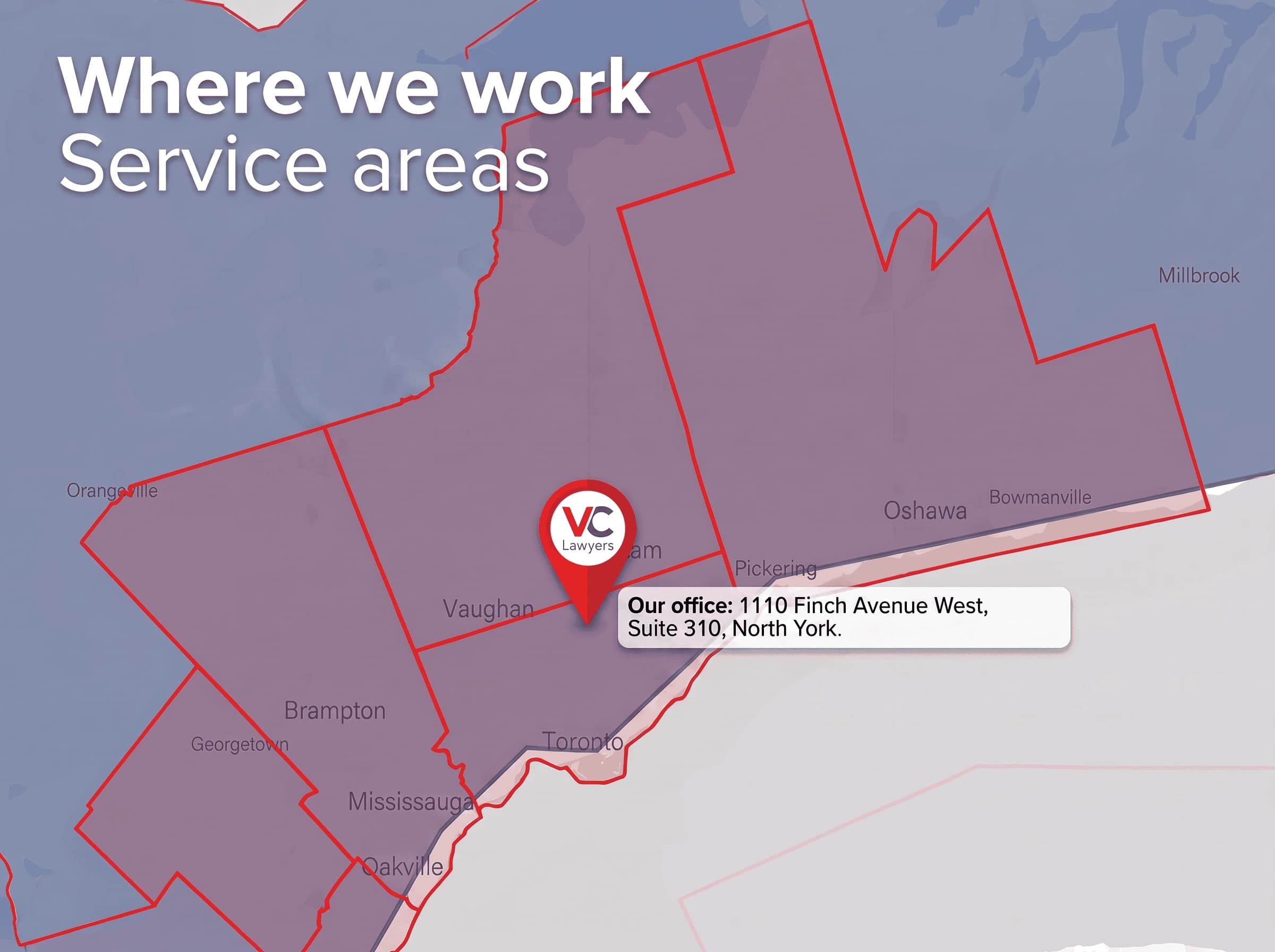
VC Lawyers service area map, Toronto and the Greater Toronto Area, with our North York office marked

Service areas

North York SABS lawyers serving every neighbourhood

From our office at Finch Ave W and Keele, we represent accident benefits claimants across all of North York, including Willowdale, Don Mills, Downsview, York Mills, Bathurst Manor, Lansing, Newtonbrook, Bayview Village, Flemingdon Park, Jane and Finch, Yorkdale and Glen Park, Clanton Park, Parkwoods, and Victoria Village, plus neighbouring communities in Vaughan, Thornhill, Richmond Hill, Markham, Scarborough, Etobicoke, and Downtown Toronto.

Whatever the accident, whether as driver, passenger, pedestrian, or cyclist, on the 401 or in a parking lot on Sheppard, and whatever the stage, whether application, denial, or hearing, our North York SABS lawyers provide the experience your benefits file requires. Home and hospital visits are available.

Our office is at 1110 Finch Ave W #310, near Finch and Keele, with parking on site. By transit, take the Finch West LRT or the bus network connecting from Finch West Station on Line 1. If your injuries or circumstances make travel difficult, we come to you at home or in hospital, anywhere in North York.

Related practice areas

Continue exploring