
Wills & Estates
Toronto Probate Lawyer
Overview
If you have been named an executor or need to settle the estate of someone who has died, our Toronto probate lawyers make the court process straightforward. We prepare and file the application for the Certificate of Appointment of Estate Trustee, calculate the Estate Administration Tax accurately, and guide you through every requirement so the estate can be administered without delay.
Probate can feel daunting at the worst possible time. Our probate team handles the paperwork, the deadlines, and the court so you can focus on your family. Where an estate is simple, we keep it simple. Where complications arise, we have the estate administration and estate litigation experience to resolve them.
Key metrics
In the numbers
- Google reviews
- 140+
- Years combined experience
- 70+
- Languages spoken
- 8+
- Calls answered, every day
- 24/7
What Is Probate in Ontario?
Probate is the court process that confirms a will is valid and formally authorizes an estate trustee, also called an executor, to administer the estate. In Ontario, this authority is granted through a Certificate of Appointment of Estate Trustee issued by the Superior Court of Justice.
The Certificate of Appointment gives the estate trustee the legal authority to deal with estate assets, collect what is owed to the estate, pay debts and taxes, and distribute the remainder to beneficiaries. Banks, investment firms, and the land registry commonly require this certificate before they will release or transfer significant assets.
When Is Probate Required, and When Is It Not?
When probate is required
Probate is generally required when a third party will not act without proof of the estate trustee's authority. Common situations include:
- A financial institution holds significant funds and will not release them without a Certificate of Appointment
- The estate includes real property held in the deceased's name alone that must be sold or transferred
- There is no will, and someone must be formally appointed to administer the estate
- The validity of the will, or the right to act as estate trustee, is disputed
- An investment firm or pension plan requires the certificate before releasing assets
When probate is often not required
Probate is often not required where assets pass outside the estate automatically. This commonly includes:
- Assets held jointly with right of survivorship, which pass to the surviving owner
- Registered accounts such as RRSPs, RRIFs, and TFSAs with a named beneficiary
- Life insurance and pension benefits payable to a named beneficiary
- Smaller estates where every institution involved agrees to release assets without a certificate
The Small Estate Certificate: Estates of $150,000 or Less
Since April 1, 2021, Ontario has offered a simplified Small Estate Certificate for estates valued at $150,000 or less. The application is shorter, and in many cases no administration bond is required, which makes settling a modest estate faster and less expensive.
We confirm whether an estate qualifies as a small estate, prepare the streamlined application, and handle the required notice to beneficiaries. If the estate's value later proves higher than expected, we advise on converting to a regular Certificate of Appointment.
Estate Administration Tax (Probate Tax) in Ontario
The Estate Administration Tax, often called probate tax, is calculated on the value of the estate that passes through probate:
- No tax is payable on the first $50,000 of estate value
- Above $50,000, the tax is roughly 1.5%, about $15 for every $1,000 of value, with no upper cap
- The tax is paid when the application for a Certificate of Appointment is filed
- Only assets that pass through the estate are counted, so planning that moves assets outside the estate can reduce the tax base
We calculate the Estate Administration Tax precisely and advise on legitimate strategies to reduce it, including multiple wills, beneficiary designations, and joint ownership.

Certificate of Appointment
Probate and estate administration tax
Probate in Ontario is formally called the Certificate of Appointment of Estate Trustee. The process confirms the executor's authority, validates the will, and triggers the Estate Administration Tax, roughly 1.5% on the value above $50,000 with no upper cap.
We file probate applications efficiently, advise on legitimate estate-planning structures that reduce the probate tax base (joint ownership with right of survivorship, designated beneficiaries, and multiple wills), and handle the inventory and accounting the Superior Court of Justice requires throughout administration.
How Our Toronto Probate Lawyers Handle Your Application
Book a Consultation
We review the will and the estate, confirm whether probate is required, and map the fastest route to the Certificate of Appointment.
Value the Estate
We inventory the assets and debts and calculate the Estate Administration Tax precisely, so there are no surprises and no penalties.
Prepare and File
We prepare the application for the Certificate of Appointment of Estate Trustee, give the required notice to beneficiaries, and file with the Ontario Superior Court of Justice.
Pay Tax and Obtain the Certificate
We arrange payment of the Estate Administration Tax and obtain the Certificate of Appointment that gives the estate trustee legal authority to act.
Administer and Report
We help collect assets, pay debts, file the Estate Information Return with the Ministry of Finance within 180 days, and distribute to beneficiaries.
How Long Does Probate Take in Ontario?
How long probate takes in Ontario depends on the completeness of your application and the current workload of the court office where it is filed. A straightforward, complete application is often processed within a few weeks to a couple of months. Applications with missing documents, valuation questions, or a contested appointment take longer.
The Estate Administration Tax is payable when the application is submitted. After the Certificate of Appointment is issued, the estate trustee has 180 days to file the Estate Information Return with the Ministry of Finance. We manage each of these deadlines for you so nothing is missed.
Probate With a Will vs Without a Will
Probate with a Will
Where the deceased left a valid will naming an executor, that executor applies for a Certificate of Appointment of Estate Trustee With a Will. The court confirms the will's validity and the executor's authority to administer the estate according to its terms.
Probate without a Will (Intestacy)
Where there is no valid will, the estate is distributed under Ontario's Succession Law Reform Act. An eligible person, usually the closest next of kin, applies for a Certificate of Appointment of Estate Trustee Without a Will, and the court may require an administration bond. We guide applicants through every additional step intestacy requires.
Why Choose VC Lawyers for Probate in Toronto?
Probate should be efficient, accurate, and free of surprises. Our Toronto probate lawyers deliver a clean process from the first filing to the final distribution.
Clear, Fixed Fees
We set out probate fees in a written retainer up front, so you know the cost before we begin. No surprises.
Estate Administration Tax Minimization
We advise on legitimate planning that reduces the probate tax base, from multiple wills to beneficiary designations and joint ownership.
Fast, Accurate Filing
Deficient applications are the biggest cause of probate delay. We prepare complete, court-ready applications the first time.
Bilingual Service
We serve clients in English and Korean, and several other languages, so nothing is lost in translation during a difficult time.
Full Estate Support
Probate is one step. Our estate administration and estate litigation teams are ready if your matter grows into administration or a dispute.
Frequently Asked Questions: Probate Lawyer Toronto
Do I always need probate in Ontario?
No. Probate is required when a financial institution, the land registry, or another third party will not release or transfer an asset without a Certificate of Appointment. Assets held jointly with right of survivorship or with a named beneficiary usually pass outside the estate and may not require probate.
How much is probate tax in Ontario?
The Estate Administration Tax is roughly 1.5%, about $15 for every $1,000, on the value of the estate above $50,000. There is no tax on the first $50,000 and no upper cap. We calculate it precisely as part of the application.
What is the Small Estate Certificate?
For estates valued at $150,000 or less, Ontario offers a simplified Small Estate Certificate process with a shorter application and, in many cases, no administration bond. We confirm whether your estate qualifies and prepare the streamlined application.
How long does probate take?
A complete, straightforward application is often processed within a few weeks to a couple of months, depending on the court office. Missing documents, valuation questions, or a contested appointment extend that timeline.
Can I avoid probate?
Sometimes, through planning such as joint ownership with right of survivorship, beneficiary designations on registered accounts and insurance, and multiple wills for private-company shares. We advise on what is appropriate for your situation.
What happens if there is no will?
The estate is distributed under Ontario's Succession Law Reform Act, and an eligible person applies to be appointed estate trustee without a will. We handle the added requirements, including any administration bond the court may order.
Contact Our Toronto Probate Lawyers Today
Whether you need a Certificate of Appointment, help with the Estate Administration Tax, or guidance settling an estate anywhere in Toronto or across Ontario, our probate lawyers are ready to help. We keep the process moving so the estate can be administered without unnecessary delay.
Contact our Toronto probate lawyers today for a consultation with no obligation. We are available 24/7 and serve clients throughout the Toronto area and across Ontario.
Types of Wills and Estate Cases We Handle in Toronto
Why people choose VC Lawyers
The right firm handles the details so you can move forward with confidence
From property and business deals to family and estate matters, the right law firm gives you clear advice, transparent fees, and a lawyer who is genuinely in your corner.
Clear, Upfront Fees
We explain your fee arrangement before we start. No surprises.
Full-Service Firm
One firm for your property, business, family, and estate matters.
Multilingual Legal Team
Services in 8 languages so nothing gets lost in translation.
Boutique Firm, Direct Access
You’re never just a file number. Reach your lawyer directly.
Trusted Ontario Counsel
Members in good standing with the Law Society of Ontario.
Decades of Combined Experience
Senior counsel on every matter we handle.
Get in touch
Looking for legal help? Speak directly with a lawyer
Tell us what happened and a lawyer will personally review your case. Personal injury consultations are free and there are no fees unless we win. For all other practice areas, a consultation fee applies.
- $30M+ recovered for injury clients
- Available 24/7, including weekends
- Service in English, Korean, and 6+ more languages
Prefer to call? (416) 661-4529
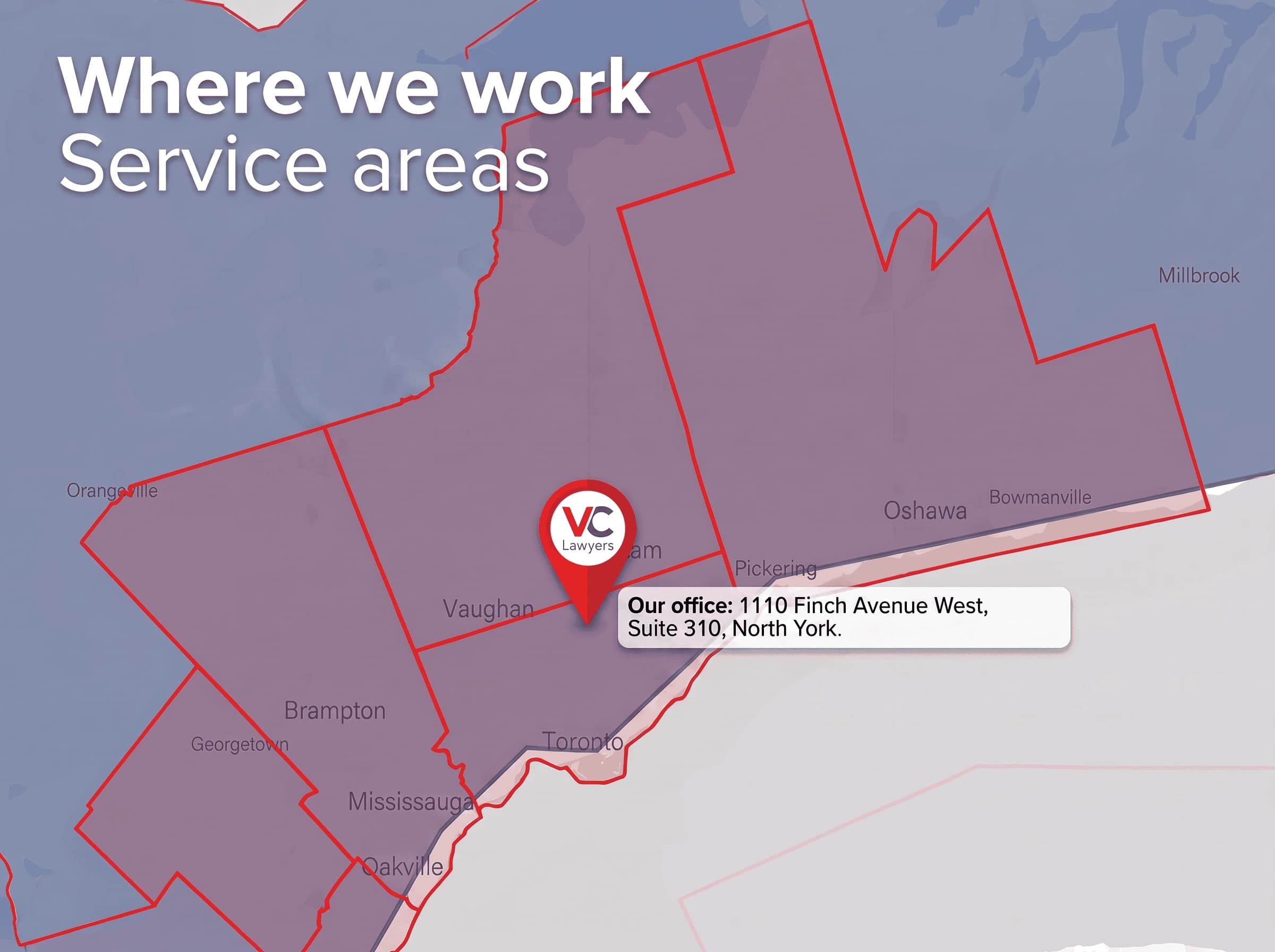
Where we work
Service areas
VC Lawyers serves clients throughout the Greater Toronto Area, including Toronto, North York, Scarborough, Etobicoke, Mississauga, Brampton, Oakville, Burlington, Vaughan, Richmond Hill, Pickering, Ajax, Whitby, Oshawa, Newmarket, and Aurora. We also represent clients across Ontario through video consultations and home/hospital visits when needed.
Languages spoken at the firm include English, Korean (한국어), Hebrew, Mandarin, and others depending on lawyer assignment.
Our office is located at 1110 Finch Avenue West, Suite 310, in North York, with parking and TTC access (Finch West subway and bus connections).
Also serving North York