
Disability Claims
Toronto Critical Illness LawyerInsurance Claim Denials, ESA Leave Rights, and Wrongful Dismissal Protection




Trusted by critical illness claimants across Ontario
Overview
When the Diagnosis Comes, the Last Thing You Need Is a Legal Fight
Cancer. Heart attack. Stroke. Multiple sclerosis. The phone call from the specialist that changes everything in fifteen seconds. People who walk into our office after a critical illness diagnosis are not the same people they were six months earlier. Their priorities have collapsed into a much shorter list: get well, protect their family, hold onto financial stability long enough to recover. Adding a fight with an insurance company or an employer to that list is the cruelest joke imaginable.
And yet, that is exactly what happens to thousands of Ontarians every year. The statistics are stark: a recent Munich Re survey found that 17% of critical illness insurance claims in Canada were denied between 2019 and 2023. Not delayed. Denied outright. Behind every one of those denials is a person already dealing with chemotherapy schedules, cardiac rehabilitation, or the cognitive aftermath of a stroke. That person is now forced to argue contract interpretation with a multi-billion-dollar insurer. The same system that accepted their premiums for years is now the one telling them their diagnosis does not “fit the policy definition.”
Critical illness insurance arrived in Canada in the late 1990s and spread quickly, as employers added it to group benefits packages and individuals bought standalone policies. The structure is simple. You pay premiums, and if you are diagnosed with a covered illness and survive a defined waiting period, the insurer pays a tax-free lump sum. Common payouts run from $25,000 to $500,000, and some executive policies go higher.
That lump sum exists to fill the gap that OHIP and long-term disability insurance leave open. OHIP covers the doctor and the hospital bed. LTD replaces a portion of lost income. Critical illness benefits are meant to cover everything else: drug costs that are not on the formulary, private nursing, modifications to the home, travel for specialized treatment, and replacement income through the months when working is simply not possible. For a family with a mortgage, school-aged children and limited savings, that payment is often the difference between recovering with dignity and losing the house.
Most policies cover a defined list of illnesses. The core four appear in virtually every policy: cancer, heart attack, stroke and coronary artery bypass surgery. More comprehensive policies extend to multiple sclerosis, Parkinson's disease, ALS, Alzheimer's, kidney failure, major organ transplants, paralysis, severe burns, blindness, deafness, loss of speech, and HIV contracted through a medical procedure. Children's policies often add cerebral palsy, type 1 diabetes, congenital heart defects and certain inherited conditions. The product was sold to Canadians as a safety net. For 17% of claimants between 2019 and 2023, that net had a hole in it.
Denials rarely arrive as a flat refusal to honour the contract. They arrive as an argument about wording. The most common one is that the diagnosis does not meet the policy's own definition of the illness. Those definitions are written narrowly by the insurer's legal team, so a cancer diagnosis from an oncologist becomes “carcinoma in situ” or a “tumour of low malignant potential” in the reviewer's hands. Other denials turn on the survival period, which is typically 30 days after diagnosis. Others rely on a 90-day initial exclusion period or a pre-existing condition clause. Others still point to the absence of confirmation from a specialist of a defined category, or to a procedural failure such as late notice or an incomplete attending physician statement. Each of those is an argument, not a verdict, and each of them can be answered.
One deadline matters more than any other. Under the Limitations Act, 2002, you generally have two years from the date your claim was officially denied to sue the insurer, and internal insurer appeals do not pause that clock. Many people spend the first year submitting more information through the insurer's own reconsideration process. They start looking for a lawyer around the eighteen-month mark, which leaves very little room to develop the medical evidence properly. The earlier a lawyer reads the policy and the denial letter, the more options remain. A well-supported demand letter often resolves the dispute before a Statement of Claim is ever filed.
The other half of the critical illness legal landscape involves what happens at work. A parent is diagnosed with stage IV cancer. A child is hospitalized in the ICU at SickKids. A spouse has a stroke. When a family member becomes critically ill in one of these ways, Ontario law gives employees specific job-protected leave rights under the Employment Standards Act, 2000 (ESA). But the fact that a right exists in legislation does not mean every employer respects it. We see three situations regularly: wrongful dismissal during a critical illness leave, denied accommodation, and constructive dismissal triggered by an employer's response to a serious diagnosis.
ESA critical illness leave is unpaid and job-protected. Within a 52-week period, it runs up to 37 weeks to care for a critically ill minor child under 18, and up to 17 weeks to care for a critically ill adult. The ESA treats a person as critically ill where their baseline state of health has significantly changed and their life is at risk because of an illness or injury. Both elements have to be present. Eligibility requires six consecutive months with the employer, a family member who fits the ESA definition, and a certificate from a qualified health practitioner. The maximum is shared among every Ontario employee taking leave for the same family member, so two siblings caring for the same parent divide 17 weeks between them rather than taking 17 weeks each.
Where an employer pushes back, more than one legal response is available. Refusing the leave outright is an ESA violation. Terminating during the leave, or shortly after the employee returns to find the role “restructured,” invites the inference that the leave was the real reason. Section 74 of the ESA makes reprisal for exercising a statutory right independently actionable. And when the critically ill person is the employee, the Human Rights Code duty to accommodate to the point of undue hardship applies on top of the leave right. A failure to engage in the accommodation process can then produce human rights damages alongside wrongful dismissal damages.
This page covers both sides of critical illness law as it affects Toronto residents and Ontario workers: denied critical illness insurance claims and ESA critical illness leave rights. They are governed by different statutes, run on different deadlines, and are argued in different forums. Many people are dealing with both at once, which is precisely why they are worth reviewing together rather than one at a time.
VC Lawyers handles critical illness matters across the Greater Toronto Area. The first 30-minute consultation is free, most insurance denial cases are handled on contingency (no fee unless we recover), and we work in English, Korean, and several other languages. Call (416) 661-4529 at any point while reading this page if your situation is urgent.
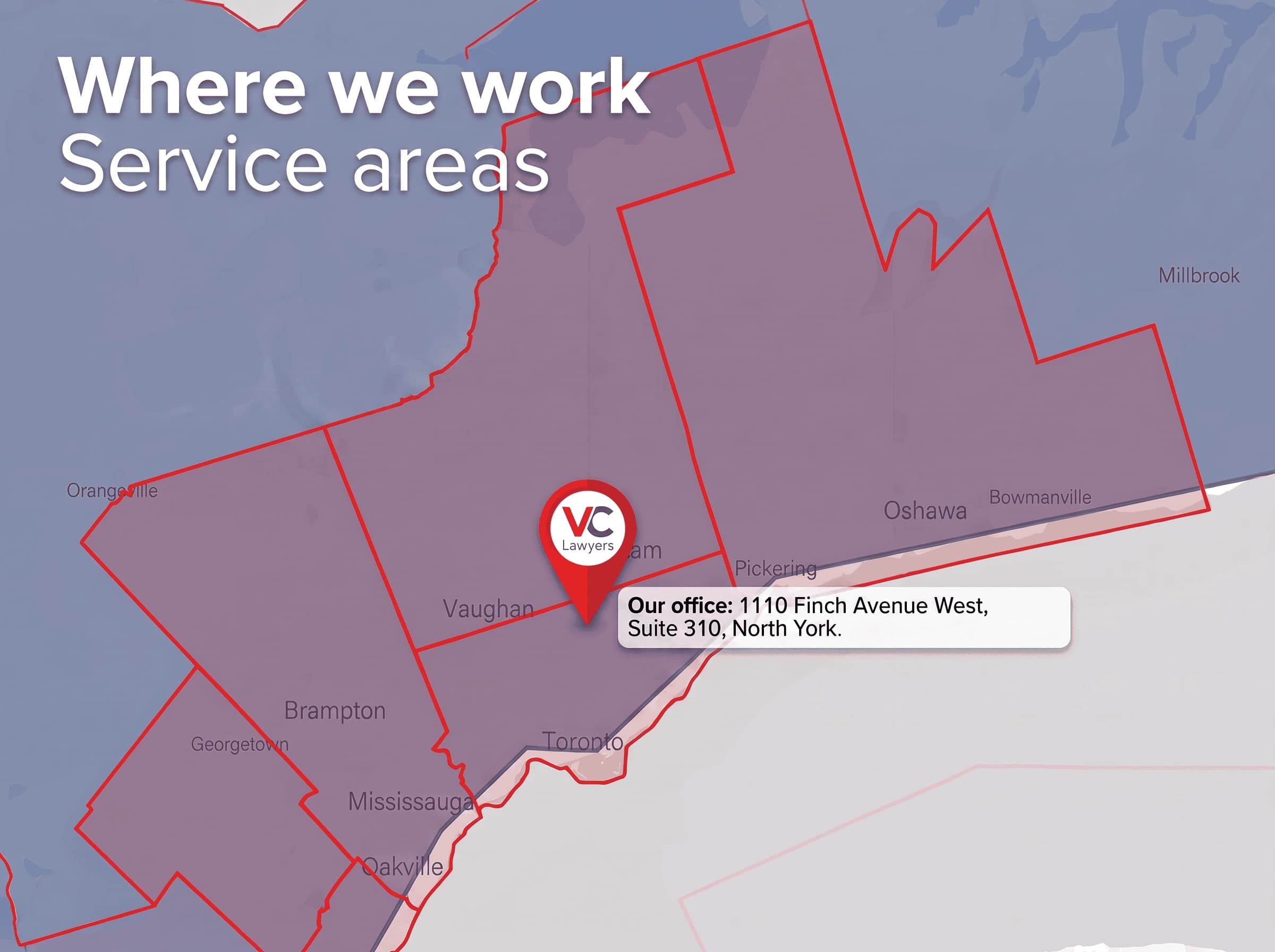
Where we work
Service areas
VC Lawyers serves clients throughout the Greater Toronto Area, including Toronto, North York, Scarborough, Etobicoke, Mississauga, Brampton, Oakville, Burlington, Vaughan, Richmond Hill, Pickering, Ajax, Whitby, Oshawa, Newmarket, and Aurora. We also represent clients across Ontario through video consultations and home/hospital visits when needed.
Languages spoken at the firm include English, Korean (한국어), Hebrew, Mandarin, and others depending on lawyer assignment.
Our office is located at 1110 Finch Avenue West, Suite 310, in North York, with parking and TTC access (Finch West subway and bus connections).
Frequently Asked Questions: Critical Illness Claims
We answered all
My critical illness insurance claim was denied. How long do I have to take legal action?
Under the Limitations Act, 2002, you generally have two years from the date of the formal denial letter to commence a lawsuit against the insurer in the Ontario Superior Court of Justice. This is a strict deadline. Internal insurer appeal processes, where you submit additional information and ask for reconsideration, do not pause or extend the limitation clock. Many people spend the first year going through internal appeals and then discover they have very little time left to litigate. The earlier you involve a lawyer, the more options you have. A pre-litigation legal review can identify whether the denial is contestable on the policy wording, whether an internal appeal is likely to produce a different result, and whether to start preparing for litigation immediately. Waiting until month 22 to seek legal advice usually means a rushed Statement of Claim and a weaker case. A different limitation trigger sometimes applies. One example is an insurer that strings you along and never issues a formal denial letter. The discoverability rule may extend the timeline in that situation. It is fact-specific, and it requires legal review.What does it cost to hire a critical illness insurance lawyer?
Most critical illness insurance disputes are handled on a contingency fee basis at our firm, which means no fee unless we recover compensation for you. The contingency percentage is agreed upon in writing at the start of the file. It typically ranges from 25% to 33% of the recovery. Where it lands depends on how complex the case is and on the stage at which it resolves, whether that is a negotiated settlement or litigation through trial. Disbursements, the out-of-pocket costs of running a case, are usually advanced by the firm and recovered from the settlement at the end. They include court filing fees, medical expert reports, mediation fees and examination transcript costs. The first 30-minute consultation is free, with no obligation. During that consultation we will tell you whether we believe your case is winnable, what kind of recovery to expect, and what timeline to anticipate. If we do not believe your case is strong enough to take on contingency, we will tell you that too. Contingency arrangements are also typically available for employees pursuing wrongful dismissal during critical illness, on the same general terms.The insurer says I “misrepresented” my medical history on the application. Can they really refuse to pay?
Possibly, but not always. Critical illness coverage is accident and sickness insurance in Ontario, and section 308 of the Insurance Act requires an applicant to disclose every fact within their knowledge that is material to the insurance. A failure to disclose a material fact, even an unintentional one, can entitle the insurer to deny the claim or to rescind the policy and refund the premiums as though it never existed. Several legal nuances cut the other way. The misrepresentation has to be material, meaning the kind of fact a reasonable insurer would actually weigh in deciding whether to issue the policy or how to price it. The insurer has to establish the misrepresentation through evidence, because a bare allegation is not enough. The application questions must have been clear. Ontario courts have rejected attempts to read an ambiguous question broadly in order to support rescission. Under section 309, once two years have run from the commencement of the contract, the insurer must prove fraud. That is a far higher bar than an innocent or negligent omission. And where the alleged misrepresentation has no causal connection to the illness now being claimed, courts have sometimes refused rescission even inside that two-year window. This matters in Toronto. People here are treated across several hospital systems, and they carry conditions their family doctor managed informally. They answer the application questions in good faith and forget a consultation from decades earlier. If your insurer is alleging misrepresentation, do not assume the denial is final. A legal review of the application, the original medical records and the alleged misrepresentation often reveals real weaknesses in the insurer's position. Many misrepresentation denials are overturned through negotiation or litigation.My employer fired me while I was on critical illness leave caring for my child. What can I do?
This is potentially actionable on several grounds at the same time. Section 74 of the ESA prohibits reprisal. Terminating, threatening, demoting or otherwise penalizing an employee for exercising a statutory leave right is illegal. You can file a complaint with the Ministry of Labour, which can order reinstatement, back pay and other remedies. Wrongful dismissal at common law entitles you to damages where the employer terminates without cause and fails to provide reasonable notice or pay in lieu. The notice period is calculated using the Bardal factors: length of service, age, character of employment and availability of similar work. For long-tenured employees in mid-to-senior roles, that can run from six months to more than 24 months of compensation, well beyond the ESA minimums. Aggravated damages may follow from the manner of dismissal. Under Honda Canada Inc. v Keays (2008 SCC 39) an employer owes a duty of good faith in how it terminates, and firing someone while they are caring for a critically ill child often breaches that duty. Human Rights Code damages are available where the termination is connected to family status. The Human Rights Tribunal of Ontario can award damages for injury to dignity, feelings and self-respect. Typical awards range from $10,000 to $50,000, with higher awards in egregious cases. Layered together, these claims can be substantial, often well into six figures for long-tenured employees in senior roles. The first step is preserving evidence: keep every employment document, the termination letter, all communications with the employer about the leave, and the names of anyone who witnessed how you were treated. Then get a legal review urgently, because limitation periods apply. Wrongful dismissal is generally two years. An HRTO application is one year from the last incident, and the room to extend that is limited.I have both group critical illness coverage and an individual policy. The group insurer denied. Should I file with the individual insurer too?
Yes, file both claims, but coordinate the strategy carefully. Each policy has its own definitions, exclusions and procedural requirements, so the fact that one insurer denied does not mean the other will. Two policies can define the same covered illness differently, apply different exclusion or waiting periods, and set stricter or more generous evidence requirements. That is why the same diagnosis can be refused by one insurer and paid by another. Sometimes the strongest claim under one policy can be used to bolster the claim under the other. Sometimes fighting one insurer's denial turns up information that changes how the second claim should be presented. In practice, that means four things. File both claims promptly, so neither limitation period is lost. Track which insurer asked for which evidence, so that medical records gathered once can serve both files. Be careful about statements made to one insurer that the other could later use. And if both claims are denied, decide whether the litigation should run as consolidated or sequential proceedings. Multi-policy critical illness situations are common in Toronto, particularly among professionals who hold employer group benefits alongside individual coverage purchased through a broker.What is the difference between Critical Illness Leave, Family Medical Leave, and Long-Term Illness Leave under the ESA?
These three leaves confuse employees and employers because the names sound alike while the legal triggers are different. Critical Illness Leave covers a critically ill family member. Within a 52-week period it provides up to 37 weeks for a minor child under 18, or up to 17 weeks for an adult. It requires that the family member's baseline state of health has significantly changed and that their life is at risk. The employee also needs six consecutive months of employment. Family Medical Leave covers a family member with a serious medical condition that carries a significant risk of death within 26 weeks. It provides up to 28 weeks within a 52-week period, and it has no minimum employment requirement. Long-Term Illness Leave took effect on June 19, 2025. It covers the employee's own serious medical condition, provides up to 27 weeks within a 52-week period, and requires 13 consecutive weeks of employment. Applied to real situations, the sorting is usually clear. A spouse with terminal cancer expected to pass within six months points to Family Medical Leave. An adult parent who has had a stroke and needs months of caregiving points to Critical Illness Leave at 17 weeks. A child diagnosed with cancer and hospitalized at SickKids points to Critical Illness Leave at 37 weeks. Your own serious diagnosis points to Long-Term Illness Leave. These leaves can be stacked where each applies. Family Caregiver Leave is a separate entitlement. It gives eight weeks per calendar year per family member, and it covers chronic conditions that never meet the higher thresholds. Putting these leaves in the right order is part of the legal analysis, because getting it wrong can cost weeks of protection you were entitled to.Can my employer require me to provide medical certificates for critical illness leave?
Yes. Critical illness leave specifically requires a certificate from a qualified health practitioner, which means a physician, a registered nurse or a psychologist. The certificate has to confirm that the family member is critically ill and set out the period during which they require care or support. Without that certificate the leave entitlement does not arise at all. If the certificate covers a period shorter than the 37-week or 17-week maximum, the entitlement matches the certified period. A new certificate can be obtained if the family member is still critically ill when the first one expires. Ordinary ESA sick leave works differently. That leave is the three unpaid days per calendar year for your own illness, injury or medical emergency. As of October 28, 2024, employers cannot require a medical note for it. The restriction applies only to that basic three-day sick leave. Longer or different leaves still require certificates. For Long-Term Illness Leave, which covers your own serious medical condition, a certificate is required from the start. Workplace accommodation under the Human Rights Code is a separate question. There, an employer may be entitled to enough medical information to assess accommodation needs, even where no formal leave has been requested. Privacy law and human rights principles govern how far that inquiry can go, and the permitted scope is typically narrower than employers initially demand.What happens to my health benefits while I am on critical illness leave?
Under the ESA, employers must keep paying the employer's share of the contributions to benefit plans during all statutory leaves, unless the employee elects in writing not to continue the benefits. Those plans include life insurance, extended health and dental. The employee remains responsible for their own share of the premiums. This is an important right that is easy to overlook and expensive to lose. Losing coverage at the exact moment a family member is most ill would be devastating, because that is when extended drug coverage and mental health support matter most. The ESA is written to prevent it. Some collective agreements give benefit continuation rights beyond the ESA minimum, and individual employment contracts sometimes add enhanced benefits as well. Read your contract alongside the statute. If your employer threatens to discontinue benefits during a statutory leave, that is itself a violation. Depending on what follows, it may also support a wrongful dismissal or constructive dismissal claim.I am a small business owner and one of my employees has a critically ill child. What are my obligations?
Most Ontario employers are subject to the ESA, and if you are, you have four obligations. Grant the leave where the employee qualifies. Qualifying takes six months of service, a family member who fits the ESA definition, and a certificate from a qualified health practitioner. Maintain benefits during the leave, with the employee paying their own portion. Reinstate the employee when the leave ends, to the same position if it still exists, and to a comparable position if it does not. And do not retaliate against the employee for taking the leave, whether by termination, demotion or harassment. You are entitled to require a medical certificate, to ask reasonable questions to verify that the leave qualifies, and to plan coverage for the absence. What you cannot do is refuse the leave, penalize the employee for taking it, demand more documentation than the ESA permits, or restructure the position during the leave so that returning to it becomes impossible. Where the absence creates genuine operational hardship, the workable options are to hire a temporary replacement or to redistribute duties across the team. A compliance review with an employment lawyer before you act is far cheaper than defending a wrongful dismissal claim afterward.My family member's diagnosis happened in another province. Can I still take ESA critical illness leave in Ontario?
Yes. The ESA applies based on where the employee works, not where the family member's illness occurs. If you are an Ontario employee covered by the ESA, you are entitled to critical illness leave to care for a qualifying family member regardless of where that person is located. That includes another Canadian province, the United States, Korea, China, or anywhere else in the world. The medical certificate requirement still applies, but the certificate can be issued by a qualified health practitioner in the jurisdiction where the family member is being treated. A specialist in Seoul, Beijing or New York can issue a certificate that satisfies the ESA. Translation may be needed, but the substantive certificate is acceptable. This comes up constantly in Toronto, where a critically ill parent or sibling is often still in the country of origin. Employees want to travel to provide care, and the ESA entitles them to go without putting their job at risk.
Why people choose VC Lawyers
The right firm handles everything so you can focus on recovery
Choosing the right personal injury law firm after an accident in Toronto can mean the difference between a lowball settlement and the full compensation you deserve.
No Fees Unless We Win
Personal injury cases run on a contingency basis. You pay nothing upfront.
Free Personal Injury Consultation
Speak with an injury lawyer today at zero cost. Other practice areas are quoted before we start.
24/7 Emergency Hotline
We’re available around the clock when you need us most.
Home & Hospital Visits
Too injured to come to us? We’ll come to you.
Multilingual Legal Team
Services in 8 languages so nothing gets lost in translation.
Boutique Firm, Big Results
You’re never just a case number. Get direct access to your lawyer.
Get in touch
Looking for legal help? Speak directly with a lawyer
Tell us what happened and a lawyer will personally review your case. Personal injury consultations are free and there are no fees unless we win. For all other practice areas, a consultation fee applies.
- $30M+ recovered for injury clients
- Available 24/7, including weekends
- Service in English, Korean, and 6+ more languages
Prefer to call? (416) 661-4529
Take the next step
Take the First Step
The first consultation is free and confidential. There is no obligation to retain us. Many people find that 30 minutes with a knowledgeable lawyer transforms their understanding of the situation. They leave knowing what their rights are, what the realistic outcomes look like, and what to do tomorrow morning.
Free consultation · Contingency fee available · Confidential · Korean and other languages.
Related practice areas
Continue exploring
Critical Illness Lawyer in North York
The same practice, served from our office in North York.
Toronto Long-Term Disability Lawyers
LTD denials, the own/any occupation test, and bad-faith insurance handling.
Toronto Short-Term Disability Lawyer
Denied STD benefits, mental health claims, and the STD-to-LTD transition.
Toronto CPP Disability Lawyer
Federal disability benefits, denials, and Social Security Tribunal appeals.
Toronto Insurance Claim Lawyer
Bad-faith insurance handling and the broader denial framework.
Ontario SABS Accident Benefits Lawyer
Statutory accident benefits, mandatory coverage and the optional purchases.
Toronto Non-Earner Benefits Lawyer
$185/week under the standard option. Now optional SABS coverage for retirees, students and stay-at-home parents.
Toronto Traumatic Brain Injury Lawyer
Traumatic brain injury claims often paired with critical illness coverage.
Toronto Chronic Pain Lawyer
Long-term pain syndromes that intersect with disability denials.
Toronto Soft-Tissue Injury Lawyer
Soft tissue claims that the insurer characterizes as “minor.”