
Family Law
Toronto Spousal Support Lawyer
Overview
If you need an experienced spousal support lawyer in Toronto or anywhere across Ontario, our dedicated Toronto spousal support lawyers are ready to protect your financial rights following a separation or divorce. At VC Lawyers, our family law firm represents both payors and recipients in every type of spousal support matter. That work runs from establishing initial entitlement and calculating support under the Spousal Support Advisory Guidelines, to enforcing spousal support orders, pursuing variation applications, and resolving complex spousal support claims involving business income, executive compensation, and self-employed spouses. We offer transparent pricing, 24/7 strategic support, and a consultation with no obligation.
Navigating the complexities of spousal support in Ontario requires an experienced spousal support lawyer who understands the full scope of Ontario's Family Law Act, the Divorce Act, and the Spousal Support Advisory Guidelines that govern every spousal support case in this province. Our Ontario spousal support lawyers bring deep experience in family law, forensic income analysis, and support negotiation, giving every client the strategic legal counsel needed to achieve a fair and reasonable support outcome.
Key metrics
In the numbers
- Google reviews
- 140+
- Years combined experience
- 70+
- Languages spoken
- 8+
- Calls answered, every day
- 24/7
What Is Spousal Support in Ontario?
Spousal support is money paid by one spouse to the other following a separation or divorce, intended to address the economic consequences of the marriage and its breakdown. Spousal support in Ontario is not automatic. A spouse seeking support must first establish entitlement, then demonstrate the appropriate amount and duration of spousal support based on the specific circumstances of their relationship.
Ontario's Family Law Act and the Divorce Act both govern spousal support in Ontario, depending on whether the parties were married or in a qualifying common-law relationship. Understanding the legal framework applicable to your spousal support claim is the first step our spousal support lawyers take in every file.
The three grounds for spousal support entitlement in Ontario:
Compensatory support: compensating a spouse for economic disadvantages they suffered as a result of the roles assumed during the marriage, such as leaving employment to care for children while the other spouse advanced their career. Compensatory support is the most commonly litigated ground for entitlement to spousal support in Ontario.
Non-compensatory support: addressing the basic needs of a spouse who is unable to achieve self-sufficiency following a divorce or separation, based on their means and needs relative to the standard of living established during the marriage. Non-compensatory spousal support reflects the obligation to provide support to a spouse in genuine financial need.
Contractual support: based on the terms of a marriage contract or separation agreement that explicitly governs whether and how much spousal support should be paid. Our spousal support lawyers review every contractual document carefully to determine whether a contractual support obligation exists and how it should be applied.
Spousal Support Advisory Guidelines: How Support Is Calculated
The Spousal Support Advisory Guidelines (SSAG) provide the framework Ontario courts and family lawyers use to calculate the amount and duration of spousal support. The SSAG are advisory only. They are not legislation, they are not binding, and no court is obliged to award a figure inside their range. What they are is the starting point in almost every negotiation and most judgments, which is why running them correctly matters so much to the outcome.
How spousal support is calculated under the SSAG:
The SSAG calculates spousal support based on the income difference between the spouses, the length of the relationship, and the presence of dependent children. The guidelines produce a low, mid, and high range for both the support amount and the duration of spousal support payments. Our spousal support lawyers run multiple SSAG scenarios using specialized software to identify the full range of outcomes and advise every client on their realistic expectations.
Amount and duration of spousal support: The duration of support is typically calculated as 0.5 to 1 year of support for every year of marriage. Two SSAG rules push that to an indefinite, meaning open-ended, duration: a marriage of 20 years or more, and a marriage of five years or more where the recipient's age at separation plus the years of marriage total 65 or more, which is the “Rule of 65.” The amount of spousal support is based on the income differential between the spouses and the support arrangement formula applicable to the specific fact pattern.
Factors considered when determining spousal support: Beyond the SSAG formula, Ontario courts consider a wide range of factors when determining spousal support, including:
- The length of the marriage or cohabitation
- The roles each spouse played during the marriage, such as who was the primary earner and who managed the household
- The age and health of each spouse and their ability to achieve financial self-sufficiency
- The economic advantages and disadvantages flowing from the marriage and its breakdown
- Each spouse's current income, earning capacity, and financial resources
- The standard of living established during the marriage
- Any existing support obligations to children or prior relationships
- The economic impact of child-rearing responsibilities on the spouse seeking support
Our Ontario spousal support lawyers apply every relevant factor to calculate the amount of spousal support and duration of spousal support most likely to be accepted by an Ontario court.
Types of Spousal Support: Understanding Your Options
Our spousal support lawyers advise clients on every type of spousal support arrangement available in Ontario:
Periodic support (monthly payments): the most common form of spousal support, paid as regular monthly payments for a defined or indefinite duration. Monthly spousal support payments are taxable income for the recipient and tax-deductible for the payor, providing a tax advantage that our family lawyers structure into every support arrangement.
Lump sum support: a one-time payment that provides a clean break and eliminates ongoing financial entanglement between former spouses. A lump sum spousal support payment is generally not taxable to the recipient and not deductible to the payor, making it appropriate in specific circumstances. Our spousal support lawyers calculate whether a lump sum or periodic support arrangement produces the better after-tax outcome for every client.
Compensatory support: awarded to compensate a spouse for career sacrifices, reduced earning capacity, or economic disadvantages arising directly from the marriage. This is particularly relevant for spouses who reduced their workforce participation to care for children or support the other spouse's career.
Non-compensatory support: awarded to address basic financial needs where one spouse cannot achieve self-sufficiency following the separation or divorce. Our Ontario spousal support lawyers assess whether a spouse qualifies for spousal support on non-compensatory grounds and quantify the support accordingly.
Determining Spousal Support: Income Issues and Hidden Assets
Income determination is the most contested aspect of many spousal support cases, particularly those involving self-employed spouses, business owners, and high-income earners with complex compensation structures. Spousal support is calculated based on a spouse's true income, not just their T4 employment income. Our Ontario spousal support lawyers work with forensic accountants to ensure every income calculation is accurate and complete.
Imputing income: where a payor has deliberately reduced their income to minimize their support obligation, Ontario courts have the authority to impute income, treating the payor as if they were earning at a higher level. Intentional under-employment or under-reporting of corporate perks, benefits, and distributions are regularly addressed by our spousal support lawyers in complex income cases.
Corporate income and business owners: many high-income earners in Toronto manage their compensation through corporations, retaining earnings in the corporation rather than drawing a personal income. Our family lawyers work with specialized accountants to analyze corporate tax returns, management fees, shareholder loans, and lifestyle spending to determine the payor's actual income for support purposes.
Hidden income and asset disclosure: the financial statement disclosure process in Ontario family law requires complete disclosure of all income, assets, and liabilities. Where a spouse is suspected of hiding income or assets, our spousal support lawyers pursue forensic disclosure through the court's production and discovery processes.
Enforcement and Variation of Spousal Support Orders
Family Responsibility Office enforcement: All periodic spousal support orders in Ontario are automatically filed with the Family Responsibility Office (FRO) unless both parties opt out. The FRO collects support from the payor and distributes it to the recipient, and has significant enforcement powers where support is unpaid, including garnishing wages and bank accounts, suspending a driver's licence, and referring the payor to the federal licence denial scheme that can withhold or revoke a passport. Our spousal support lawyers assist clients in dealing with FRO matters efficiently on both sides of the support arrangement.
Variation of spousal support: spousal support can be varied where there has been a material change in circumstances since the original order or agreement. A material change might include a significant change in either spouse's income, a health issue affecting the recipient's ability to work, or the recipient entering a new cohabiting relationship. Our Ontario spousal support lawyers advise on every variation application, both for those seeking to reduce their support obligation and for those seeking to protect their ongoing entitlement.
Variation upward or downward: Support can be varied upward or downward depending on the changed circumstances. Our family lawyers build every variation application on the financial evidence an Ontario court will expect to see.
Retroactive spousal support: where a spouse has been entitled to support and no order or agreement has been in place, retroactive spousal support dating back to the date of separation may be available. Our spousal support lawyers pursue retroactive claims aggressively for clients who have been entitled to support but have not been receiving it.
How Our Toronto Spousal Support Lawyers Handle Your Case
Step 1: Initial Consultation and Entitlement Assessment
We review your family and financial circumstances, assess whether the legal threshold for entitlement to spousal support has been met, and advise on the range of support outcomes likely under the SSAG. Our consultation is confidential and without obligation.
Step 2: Income Verification and Financial Disclosure
We exchange Form 13.1 financial statements and audit every available source of income, including employment income, investment income, business income, and imputed income where appropriate. Accurate income determination is the foundation of every spousal support calculation.
Step 3: SSAG Calculation and Strategy
We run the SSAG calculation across multiple scenarios, using the low, mid, and high ranges to establish the realistic boundaries of every spousal support case. From there we advise on the negotiation strategy most likely to achieve a fair support outcome for our client.
Step 4: Negotiation, ADR, and Final Order
We pursue spousal support resolution through direct negotiation, mediation, or, where both parties consent, the binding judicial dispute resolution process available under rule 43 of the Family Law Rules since January 2025. Where a negotiated resolution cannot be achieved, our family lawyers pursue a spousal support order through Ontario family court proceedings.
Why Choose VC Lawyers as Your Spousal Support Lawyer in Toronto?
When individuals across Toronto and Ontario need an experienced spousal support lawyer who combines forensic financial analysis with determined advocacy, VC Lawyers is ready to act.
Every SSAG Range, Calculated
Our spousal support lawyers use SSAG software and detailed knowledge of the guidelines' nuances, including the “with child” formula, the “Rule of 65,” and the post-separation income adjustments, to calculate every spousal support range accurately and to argue for the end of the range that fits the client's facts.
Forensic Income Analysis
We work with specialized accountants to audit corporate tax returns, lifestyle spending, and shareholder distributions. That work uncovers the true income of high-earning and self-employed spouses and ensures every support calculation reflects the actual financial reality.
A Demanding Area of Family Law
Spousal support is a complicated area of family law that requires lawyers with deep knowledge of Ontario's Family Law Act, the Divorce Act, and the SSAG. Our Toronto family lawyers bring extensive experience in every type of spousal support matter, from straightforward separation cases to the most complex business-owner support disputes in the GTA.
Clear Fees, in Writing
We set out our fees in a written retainer at the start of your matter, so you always know what to expect and there are no surprises.
24/7 Availability
A payor who has stopped payments, or who is attempting to hide assets, is a spousal support emergency that requires immediate action. Our legal team is available around the clock to obtain urgent relief.
Frequently Asked Questions About Spousal Support: Ontario Spousal Support
Does spousal support apply to common-law couples in Ontario?
Yes. In Ontario, if you have lived together for at least 3 years, or have a child together and a relationship of some permanence, you have the same right to apply for spousal support as a married person. Spousal support is money paid based on the economic consequences of the relationship, not just formal marriage status.
How long does spousal support last?
The duration of support is generally calculated as 0.5 to 1 year for every year of marriage. Marriages of 20 years or more often result in indefinite, meaning open-ended, support. The “Rule of 65” can produce the same result, where the marriage lasted five years or more and the recipient's age at separation plus the years of marriage totals 65 or more. Both are advisory ranges under the SSAG, not statutory rules, and an Ontario court can depart from them.
Can spousal support be varied after it is ordered?
Yes. Spousal support can be varied where there has been a material change in circumstances. A variation application requires evidence of a significant change in income, health, or living arrangements. Our Ontario spousal support lawyers advise on the threshold required for a successful variation.
What if my spouse is hiding income to reduce their support obligation?
Our spousal support lawyers work with forensic accountants to uncover hidden corporate income, management fees, and perquisites. Ontario courts have broad authority to impute income to a payor who is deliberately under-earning or hiding income to avoid their support obligation.
How much does a spousal support lawyer cost?
We offer hourly rates for contested spousal support litigation and fixed-rate packages for uncontested matters. Contact us for a consultation to discuss your spousal support matter and receive a transparent quote.
Contact Our Toronto Spousal Support Lawyers Today for a Consultation
Whether you are seeking spousal support, defending against an inequitable claim, or dealing with enforcement, variation, or arrears issues, our experienced spousal support lawyers in Toronto are ready to help. Our Toronto team serves clients across the entire GTA, from the family courts at 361 University Ave and 47 Sheppard Ave E to mediations across Scarborough, North York, and Etobicoke.
Contact our Toronto spousal support lawyers today for a consultation. We bring the experience, the preparation, and the availability that a support fight actually takes, on either side of it.
Types of Family Law Cases We Handle in Toronto

SSAG framework
Compensatory and non-compensatory support
Spousal Support Advisory Guidelines (SSAG) provide a range for amount and duration, not a fixed number. Whether your case lands at the high end or the low end of that range depends on factors most clients don't realize matter: length of cohabitation, presence and ages of children, primary-caregiver history, and the compensatory vs. non-compensatory basis for support.
We negotiate spousal support amounts that account for the full SSAG framework, including the Rule of 65 for indefinite duration, retraining provisions, and the variation clauses that determine what happens when income changes.
Why people choose VC Lawyers
The right firm handles the details so you can move forward with confidence
From property and business deals to family and estate matters, the right law firm gives you clear advice, transparent fees, and a lawyer who is genuinely in your corner.
Clear, Upfront Fees
We explain your fee arrangement before we start. No surprises.
Full-Service Firm
One firm for your property, business, family, and estate matters.
Multilingual Legal Team
Services in 8 languages so nothing gets lost in translation.
Boutique Firm, Direct Access
You’re never just a file number. Reach your lawyer directly.
Trusted Ontario Counsel
Members in good standing with the Law Society of Ontario.
Decades of Combined Experience
Senior counsel on every matter we handle.
Get in touch
Looking for legal help? Speak directly with a lawyer
Tell us what happened and a lawyer will personally review your case. Personal injury consultations are free and there are no fees unless we win. For all other practice areas, a consultation fee applies.
- $30M+ recovered for injury clients
- Available 24/7, including weekends
- Service in English, Korean, and 6+ more languages
Prefer to call? (416) 661-4529
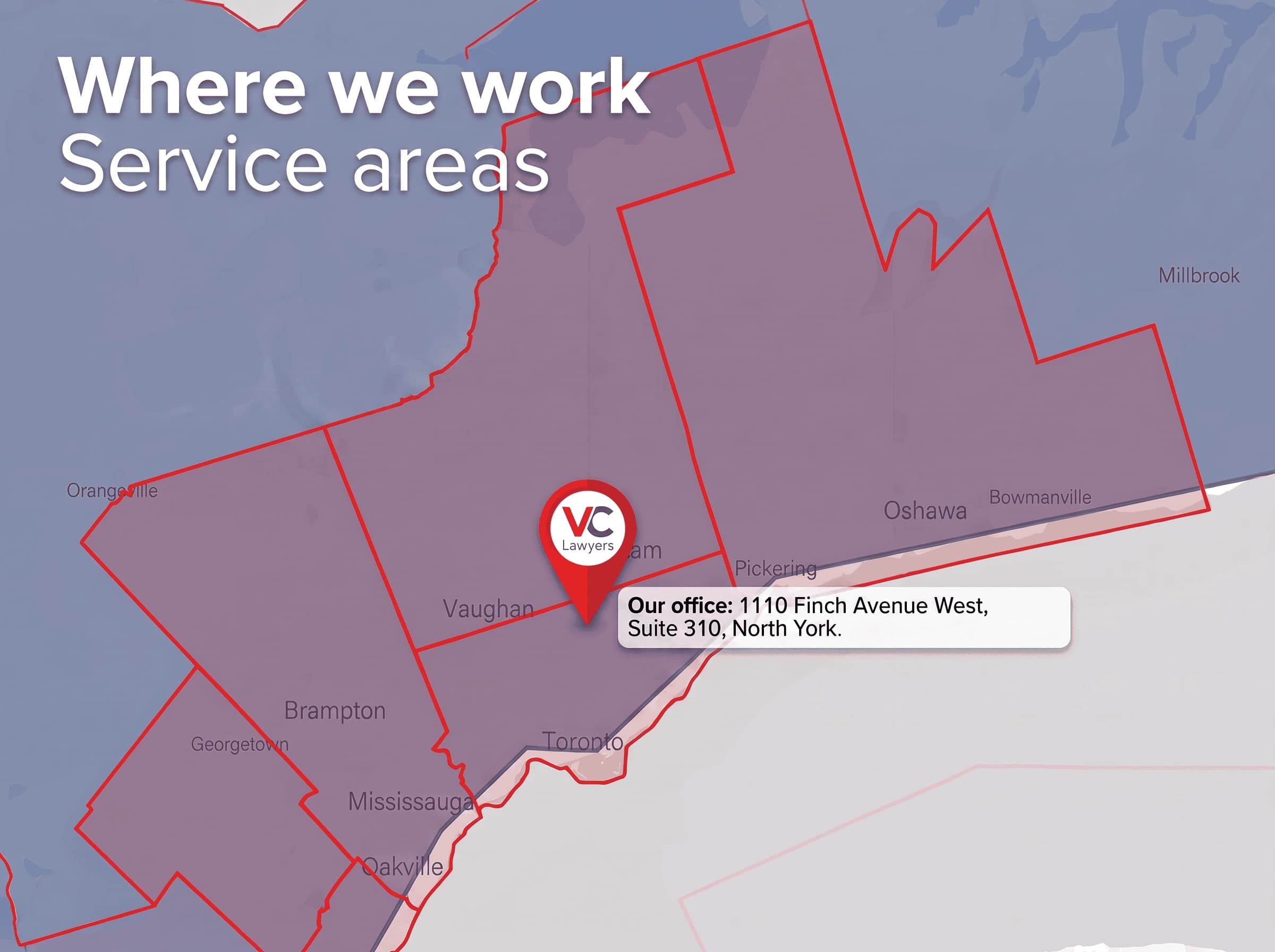
Where we work
Service areas
VC Lawyers serves clients throughout the Greater Toronto Area, including Toronto, North York, Scarborough, Etobicoke, Mississauga, Brampton, Oakville, Burlington, Vaughan, Richmond Hill, Pickering, Ajax, Whitby, Oshawa, Newmarket, and Aurora. We also represent clients across Ontario through video consultations and home/hospital visits when needed.
Languages spoken at the firm include English, Korean (한국어), Hebrew, Mandarin, and others depending on lawyer assignment.
Our office is located at 1110 Finch Avenue West, Suite 310, in North York, with parking and TTC access (Finch West subway and bus connections).
Also serving North York