VC·Lawyers®
North York disability and insurance claim lawyer, VC Lawyers

North York

North York Disability & Insurance Claim Lawyers

Toronto Lawyers Association
Ontario Trial Lawyers Association (OTLA)
The Canadian Bar Association
Love Toronto
Consulate General of the Republic of Korea in Toronto
Korean Legal Clinic
Ontario Bar Association
Toronto Lawyers Association
Ontario Trial Lawyers Association (OTLA)
The Canadian Bar Association
Love Toronto
Consulate General of the Republic of Korea in Toronto
Korean Legal Clinic
Ontario Bar Association
Toronto Lawyers Association
Ontario Trial Lawyers Association (OTLA)
The Canadian Bar Association
Love Toronto
Consulate General of the Republic of Korea in Toronto
Korean Legal Clinic
Ontario Bar Association

Trusted by accident victims and businesses across Ontario

Overview

Disability and insurance claims in North York

Has an insurance company said no in North York? Our experienced disability and insurance claim lawyers in North York fight denials on every kind of policy. We take on long-term and short-term disability turned down when you applied or cut off at the two-year mark, CPP disability refused and then appealed, and critical illness policies that argue with your diagnosis. We also take on life insurance and accidental death and dismemberment (AD&D) claims fought against grieving families, mortgage and creditor insurance that disappears the moment you use it, and travel insurance denials that leave families holding a foreign hospital bill. And we take on accident benefits disputes at the Licence Appeal Tribunal, the Ontario tribunal that decides accident benefit disputes after a motor vehicle accident, whether you were driving, a passenger, on foot, or on a bike. We also handle the property and title claims our broader insurance practice covers.

Our team has recovered over $30M+ for clients across North York, Ontario and the GTA, much of it from insurance companies. This is, at its core, what this firm does: the policy read properly, the denial answered with evidence, and the insurer held to the contract it sold. One practice, one opponent, one promise. A denial is the insurer's position, not your outcome.

North York Disability & Insurance Claim Lawyers, VC Lawyers

One opponent, every policy

Start with the structural truths that hold across every policy type, because they run through this entire practice. First: the denial letter is an opening move. Insurers deny legitimate claims routinely. They cite insufficient medical documentation, policy definitions read against you, pre-existing-condition theories, surveillance interpretations, and the "you can work" conclusion your own doctor disputes. The denial's stated reason is not a verdict. It is the issue list your claim must answer, and that is exactly how we answer it: targeted evidence aimed at the actual reason, not volume aimed at nothing in particular.

Second: the internal appeal is a clock that doesn't stop. Insurers invite appeals, sometimes several rounds. Many claimants discover too late that the limitation period for suing generally runs two years from the denial, and internal appeals do not pause it. The appeal process can consume the very window in which your lawsuit had to be filed. We use internal appeals strategically where they serve, and we file suits where they don't, but the clock gets protected from day one, always.

Third: the lawsuit is the leverage. Suing the insurer claims back everything the denial took: the benefits you were never paid, your benefits restarted going forward (or a lump sum instead of them), interest, and bad-faith damages where the insurer's handling was not just wrong but wrongful. Facing that risk changes insurer behaviour like nothing else. Most claims end in a negotiated settlement, either a lump sum or benefits restarted, and we advise on which one fits your facts, because insurers settle properly when the file was built to be proven.

Fourth: the translation problem decides disability claims. Doctors write diagnoses; policies pay on function, and that gap is where most denials live. "Insufficient medical evidence" almost always means "the wrong kind." Closing the gap with properly framed medical evidence, functional documentation, and treating-physician reports aimed at the policy's actual test is the craft this practice runs daily.

And fifth: the definitions decide the case. "Total disability" is measured against your own occupation for the first two years. Then comes the "any occupation" change of definition, when the insurer switches the test from whether you can do your own job to whether you can do any job. That is the point at which insurers cut off benefits in huge numbers. On top of that sit the elimination periods (the waiting time before benefits begin), the exclusions, and the offsets (other income, such as CPP, that the insurer subtracts from your payment), all buried in policy language written to be unreadable. The Supreme Court has held that these words carry a reasonable-person standard: you are totally disabled when a reasonable person would say you should not be doing the work, even if you could physically force yourself through it. We read all of it the way courts do: wording that is unclear counts against the insurer who wrote it, and what a clause actually does matters more than what it is called.

This page is the hub of our disability and insurance practice, and each type of claim has its own page behind it. Long-term disability (LTD) is the biggest part of the work, covering denials, terminations, and the two-year mark. Short-term disability (STD) comes first, and a denial there blocks the LTD claim behind it. CPP disability is the federal claim, where the Villani doctrine (the Federal Court of Appeal's rule that disability must be assessed in your real-world circumstances, not in the abstract) applies and appeals move one step at a time. Critical illness claims turn on the gap between your diagnosis and the policy's definition of it.

Non-earner benefits and the Statutory Accident Benefits Schedule (SABS) system form the motor-vehicle side, reshaped on July 1, 2026. Medical, rehabilitation and attendant care stayed mandatory on every auto policy, while income replacement, non-earner, caregiver, housekeeping and home maintenance, and death and funeral became optional purchases under narrowed eligibility. Since that date, auto insurance pays first on medical claims, ahead of your own extended health or employer plan. The insurance claims hub carries life, AD&D, travel, mortgage, and property files. Each carries its own playbook; this page carries what they share, and the coordination.

Real lives rarely present one policy at a time. The disabled worker holds an LTD denial and a CPP application and workplace benefits and, where an accident started it, SABS and tort claims (lawsuits against the at-fault party) too. Run separately, those claims offset, interact, and damage each other. Run together under one roof, they stack to full value, which is precisely how we run them.

With a written contingency fee agreement under which no legal fee is payable unless the claim succeeds, a free consultation, 8+ languages, and home and hospital visits across the GTA, VC Lawyers exists for the moment the insurer says no. Bring us the denial letter, and we will read the policy against it.

Get in touch

Looking for legal help? Speak directly with a lawyer

Tell us what happened and a lawyer will personally review your case. Personal injury consultations are free and there are no fees unless we win. For all other practice areas, a consultation fee applies.

  • $30M+ recovered for injury clients
  • Available 24/7, including weekends
  • Service in English, Korean, and 6+ more languages

Prefer to call? (416) 661-4529

A VC Lawyers lawyer in consultation with a client at the North York office

Background

Disability & insurance claims in North York: what you need to know

Denied claims in North York follow the way this part of the city works: the warehouse worker whose back ended the Keele-corridor shifts, denied at the any-occupation change; the Yonge-corridor professional whose depression the insurer's assessor doubted; the personal support worker (PSW) whose CPP application was refused.

They also include the family holding a life insurance denial built on a misrepresentation theory, the travellers home from a foreign hospital with a denial citing a condition they didn't know they had, and the accident victim fighting the Minor Injury Guideline (MIG) box while the LTD insurer offsets the SABS. Different letters, one practice.

The policy map, and where the dedicated practices take over

Long-term disability is the flagship. It covers application denials, the documentation fights, and the two-year change-of-definition terminations, where insurers move from "your occupation" to "any occupation" and cut benefits en masse. It also covers the surveillance cases and the lawsuits that recover arrears, reinstatement, and bad-faith damages, all carried in depth by our LTD practice.

Short-term disability is the gateway whose denial blocks the LTD behind it. We fight it fast, because the amounts are immediate and the precedent matters. CPP disability is the federal track: the severe-and-prolonged test read through the real-world lens the courts require, the reconsideration and tribunal ladders climbed on their own deadlines, and the LTD offset interactions managed. Critical illness brings the definition-gap fights: the heart attack that "doesn't meet the policy definition" of heart attack, the survival periods, the threats of rescission (retroactively cancelling the policy as if it never existed).

Accident benefits and non-earner benefits are the motor-vehicle claims: MIG escapes, catastrophic designations, and the LAT's per-denial clocks. Since July 1, 2026, medical, rehabilitation and attendant care are the three every auto policy still carries, and the auto insurer pays their medical claims first, ahead of your own extended health plan. Income replacement, non-earner, caregiver, housekeeping and the other optional benefits depend on the coverage the policy actually bought.

Life, AD&D, mortgage, travel, and property make up the insurance claims hub: contested beneficiary and misrepresentation fights, accidental-death definitions, the travel exclusions read after the hospital bill, and the property and title claims our broader practice carries.

Not sure where you stand? One conversation will tell you.

A VC Lawyers lawyer meeting a client at the North York office

The denial taxonomy, and the answers

"Insufficient medical evidence." This is the translation problem: diagnoses delivered where function was required. We answer with treating reports written to the policy's test and functional documentation adjudicators can actually use. "Not totally disabled under the policy." This is the definition fight. The words are read with their legal content: the reasonable-person standard, substance over labels, ambiguity against the drafter. "Pre-existing condition." The look-back clause gets stretched. We answer with the medical timeline, the stability evidence, and the clause's actual wording.

"Our assessor says you can work." A paper review or one-hour examination is set against your treating team. We answer with evidence quality and, where needed, the courtroom. "Surveillance shows..." The good hour is filmed against the documented condition. We answer with consistency, context, and the diary that out-testifies the footage. "You failed to..." These procedural denials cite late forms, missed examinations, and "non-compliance with treatment." We answer with the facts, the policy's actual requirements, and the duty of good faith that binds the insurer's conduct too.

The settlement question, honestly

Most successful claims end in negotiation, and the structure matters as much as the number. Reinstatement puts you back on claim: benefits monthly, the relationship continuing, with its security and its surveillance. The lump sum buys finality: no future fights, the future benefits discounted, and the release total, priced properly or not at all.

The tax treatments differ. Extended health and other benefits must survive the settlement's wording, and the offsets (CPP-D especially) change the numbers. We model both structures on every file, and nothing signs under an insurer's deadline, because those deadlines are a negotiating tactic, and the claim's value does not expire at the end of the week.

By the numbers

Disability & insurance claim facts every North York policyholder should know

What holds true across every policy.

  • Denials are positions, not verdicts

    Insurers deny legitimate claims routinely, using documentation theories, definition readings, pre-existing clauses, and surveillance. The stated reason is your claim's issue list. It gets answered with targeted evidence, not accepted as an ending.
  • Internal appeals don't stop the clock

    The right to sue generally runs two years from the denial, and the insurer's own appeal process can quietly consume it. Appeals get used strategically; the limitation gets protected from day one.
  • The lawsuit claims everything

    Past benefits, reinstatement or its lump-sum equivalent, and interest, plus bad-faith damages where the handling itself was wrongful. That is the exposure that makes insurers settle properly.
  • The translation problem is the real fight

    Doctors write diagnoses; policies pay on function. "Insufficient medical evidence" almost always means the wrong kind, and it is fixable with reports aimed at the policy's actual test.
  • The definitions were written by the insurer

    "Own occupation" governs for two years, then comes the any-occupation change where terminations cluster. Add elimination periods, exclusions, and offsets. All of it is read against the drafter, as courts read it.
  • The two-year mark is a business model

    Benefit terminations concentrate at the change of definition. That makes them predictable, contestable, and the single busiest moment in disability law.
  • Policies stack and interact

    LTD, STD, CPP-D, workplace benefits, SABS, and tort claims offset and coordinate. Run separately, they undercut each other. Run together, they stack to full value.
  • Settlement is a choice with structure

    Lump sum versus reinstatement, tax treatment, future-benefit valuation, and the release's reach all get analyzed properly before anything signs, and never under deadline pressure.
Boardroom at VC Lawyers, 1110 Finch Avenue West, North York

The letter that changes the month

The denial letter arrived. Three things to know first.

It came today: the envelope, the regret-to-inform, the paragraph of reasons that reads like it was written about someone healthier than you. The household budget just broke. Hear the three things every denied claimant deserves to be told immediately. The denial is a position, not a verdict. The reasons are answerable, because they're a list of what your evidence must show, and evidence is buildable.

And the meter is running: two years from that letter, with the insurer's own appeal process counting against it. The review is free, the fee comes only from recovery, and the answer starts with one phone call to Finch and Keele, in whichever of our 8+ languages you'd rather fight this in.

The deadlines here are shorter than most people expect.

Step by step

What to do when the insurer says no

  1. 01

    Date the denial letter and calendar two years

    The limitation likely runs from it, and internal appeals won't pause it.
  2. 02

    Get the complete policy, not the booklet

    Get the master policy with definitions, exclusions, and offsets. You're entitled to it, and it's the contract that governs.
  3. 03

    Don't appeal reflexively

    The internal appeal is the insurer's process, on the insurer's clock. Get advice on whether it serves before it consumes.
  4. 04

    Keep treating, consistently

    Gaps read as recovery, and the medical record carries the claim whatever route it takes.
  5. 05

    Ask your doctors for function, not just diagnosis

    What you can't lift, sustain, and concentrate through, in writing. We'll frame the requests.
  6. 06

    Answer the stated reason, and only it

    The denial's basis is the issue list. Evidence aimed anywhere else is volume, not progress.
  7. 07

    Mind the parallel claims

    The CPP application (its own deadlines), the STD gateway, the SABS file, and the employment front, each with clocks, all interacting.
  8. 08

    Live consistently with your claim

    Surveillance is standard in contested files, and consistency is its complete answer.
  9. 09

    Sign nothing under deadline pressure

    Not the "final offer," not the release, not the updated authorization that's broader than it should be.
  10. 10

    Bring the letter to a North York disability and insurance claim lawyer this week

    The review is free, the reason is answerable, and the clock is the only thing that can't be argued with.

Our process

How our North York disability & insurance claim lawyers handle your case

  1. 01

    Free denial review, the map in one meeting

    We read the denial letter against what the stated reason actually requires. We obtain and read the complete policy, covering definitions, elimination periods, exclusions, offsets, and the clauses the brochure never mentioned. We confirm and calendar the limitation position, and we identify the parallel claims: the CPP application to make, the short-term disability gateway to reopen, the SABS file running alongside. Then comes the honest assessment: what the claim is worth, what answers it, and which route, whether appeal, demand, or suit, serves your facts.
  2. 02

    The evidence built to the test

    We solve the translation problem deliberately. Treating physicians are engaged with the policy's actual definition in front of them. Functional evidence is assembled, meaning what you can lift, sit, focus, and sustain, documented the way adjudicators read. Specialist reports are added where the condition demands them, especially the chronic pain, psychiatric, and neurological claims insurers doubt loudest. Surveillance is answered in advance by consistency. And the insurer's examinations are attended prepared, because their assessors' reports are positions our evidence must out-prove, and does.
  3. 03

    The claim pressed, by appeal, demand, or action

    We file internal appeals where they genuinely serve, with the clock protected regardless. We build the litigation demand on the full claim: arrears, reinstatement, interest, and the bad-faith exposure where the file earned it. Where insurers won't move, we issue the lawsuit and prepare it like the trial it may become, because that preparation produces the settlements these cases mostly end in. The resolution is structured properly: lump sum versus reinstatement analyzed on your facts, releases read before they bind, and extended health and other surviving benefits protected in the paper.
  4. 04

    The whole picture secured

    We complete the parallel tracks. CPP-D is pursued, and its interaction with LTD offsets is managed. The SABS and tort files are coordinated where an accident underlies it all, and the employment front is guarded where termination shadows the disability. The file closes on the income stream, the arrears, and the future actually secured. Whatever is recovered is paid to you, and our fee is the percentage taken from it under the written contingency fee agreement, so no legal fee is payable unless the claim succeeds. The percentage and the disbursements we fund, meaning the medical and vocational evidence, are explained to you before you sign anything.

Important

Insurance clocks run from each denial, generally 2 years to sue, with some policies and claim types shorter. The internal appeal process does not pause them, while arrears accrue, evidence ages, and the insurer's file builds toward its own conclusions. Whatever the policy and whatever the letter says, the order is fixed: review first, appeal second, and the clock protected before anything else. Contact a disability and insurance claim lawyer in North York this week.

Every situation is different. Yours deserves a specific answer.

Know their playbook

Insurer tactics across every policy and how we answer them

  • The documentation treadmill

    Forms, updated forms, and "one more report": delay dressed as diligence while arrears and exhaustion accumulate. We answer with complete submissions, deadlines imposed back, and the bad-faith record the treadmill itself builds.
  • The friendly appeal invitation

    "You may appeal within 60 days" is the process that feels like progress while the two-year clock runs. We answer with strategy: appeals used where they serve, suits filed where they don't, and the clock protected regardless.
  • The paper-review verdict

    Your decade of treatment gets outweighed by a file review that never met you. We answer with treating-team evidence built to the policy's test, and the courtroom, where positions get weighed by someone neutral.
  • The change-of-definition cull

    Benefits are terminated at the two-year mark as "any occupation" arrives: a calendar event disguised as a medical one. We answer with the vocational and functional evidence the new test actually requires, and the litigation that reinstates.
  • The surveillance reel

    The grocery trip gets filmed; the condition's bad days are unfilmable. We answer with consistency, context, and treating records that out-testify a highlight reel.
  • The deadline-priced offer

    The lump sum "open until month's end," discounted for your fatigue. We answer with the full valuation of arrears, future benefits, interest, and bad faith, and the standing rule: a claim's value does not expire at month's end.

In the news

The denial economy and the courts that keep pricing it

The disability and insurance story runs on a stable tension. On one side sit insurers' claims-handling practices: the documentation demands, the paper reviews, and the change-of-definition terminations. On the other sits a body of law that keeps answering, through the Supreme Court's reasonable-person reading of disability definitions, the bad-faith jurisprudence attaching real damages to wrongful handling, and the steady stream of judgments reinstating benefits insurers cut.

The regulatory layer watches alongside, with conduct oversight from the Financial Services Regulatory Authority of Ontario (FSRAO) and the LAT's accident-benefits docket. Meanwhile, the practical landscape every claimant inhabits stays constant: the two-year clocks, the appeals that don't pause them, and the gap between what policies promise and what unrepresented claimants collect.

For North York's policyholders, the takeaway is this page's thesis. Outcomes split two ways: denials accepted quietly, or claims built properly and paid. The variable between them is almost never the medicine; it's the file.

Rather ask someone who handles these matters every week?

Why VC Lawyers

Why hire a disability & insurance claim lawyer in North York at VC Lawyers

  • Fighting insurers is the firm's identity

    Disability, life, critical illness, travel, accident benefits, property, and title. One opponent across every practice, which means the playbook is never new to us.
  • The denial answered at its reason

    Targeted evidence aimed at the stated basis. That is the method that wins appeals, demands, and lawsuits alike, and the opposite of the volume-and-hope approach that loses them.
  • The clock protected from day one

    Limitation periods are calendared at the first meeting, and internal appeals are used strategically rather than fatally. That is the discipline that keeps claims alive.
  • Contingency fee basis

    No upfront legal fees and a free consultation. You only pay if we recover. No win, no fee.
  • The whole picture under one roof

    LTD, CPP-D, STD, SABS, tort, and the employment front, coordinated so offsets are managed and nothing signed in one file surrenders another.
  • Bad faith pursued where it's earned

    We examine the handling itself, including the delays, the cherry-picked medical reviews, and the surveillance, because wrongful conduct carries damages beyond the benefits.
  • Multilingual service

    English, Korean (한국어), Hebrew, Mandarin, and more, because policies are hard enough to fight in your first language.

Choosing wisely

How to choose the right disability & insurance claim lawyer in North York

Before hiring any firm, ask these questions. Is fighting insurers their actual identity, across every policy type, or a sideline? Will they answer the denial at its stated reason with targeted evidence? Is the limitation clock protected from the first meeting, with appeals used strategically, never fatally?

Then go deeper. Can they run the whole picture, meaning LTD, CPP-D, SABS, and employment, as one coordinated strategy? Will they model lump sum versus reinstatement honestly, and refuse deadline-priced offers? And do they pursue bad faith where the handling earned it?

At VC Lawyers, the answer to each is yes, from an office in the heart of North York, on a written contingency fee with the percentage and the disbursements explained before you sign, in your language.

Still weighing what to do next? That is what a first conversation is for.

Testimonials

What our North York clients say

4.8★★★★★·140 on Google
After my car accident, I went through an incredibly challenging time. Thanks to Lawyer Jun Lee and his exceptional team, I received tremendous support and strength.

Jay Kim

Personal Injury Client

When my mother suffered a serious head injury, I was devastated. After meeting Lawyer Jae Hyon Cho, my family was able to receive substantial compensation.

Minkyung Park

Personal Injury Client

Avi Vaturi was professional, responsive, and thorough. When the transaction became complex, his calm communication and practical solutions navigated us to a smooth close.

Jordan Glaser

Real Estate Co-Counsel

Mr. Avi Vaturi did a fantastic job. The whole process was seamless — timely, detailed, and professional from start to finish.

Howard Huang

Real Estate Client

He helped me with both my car accident case and the buying and selling of my home. Everything was handled professionally and efficiently.

Yoon Jung

Personal Injury & Real Estate Client

Jae Cho was great to deal with and very attentive to my case. His associate Sunny was also very helpful. I would highly recommend.

Jordan Ungerman

Personal Injury Client

Their professionalism, attention to detail, and commitment to clients truly stand out. Whether handling urgent matters or guiding me through complex issues, the team delivered.

Charles Hong

Long-time Client

It has been my pleasure to work with Jae Cho and his team. Knowledgeable, clear in their explanations, and the process was smooth and stress-free.

Joanne Jeong

Real Estate Client

Vaturi & Cho LLP is an outstanding law firm. They explain even complex matters clearly, and their dedication to achieving the best outcomes is truly impressive.

Jong Ko

Client

The team was not only knowledgeable but also very kind and attentive throughout the entire process. Highly recommended.

Tobi

Client

After my car accident, I went through an incredibly challenging time. Thanks to Lawyer Jun Lee and his exceptional team, I received tremendous support and strength.

Jay Kim

Personal Injury Client

When my mother suffered a serious head injury, I was devastated. After meeting Lawyer Jae Hyon Cho, my family was able to receive substantial compensation.

Minkyung Park

Personal Injury Client

Avi Vaturi was professional, responsive, and thorough. When the transaction became complex, his calm communication and practical solutions navigated us to a smooth close.

Jordan Glaser

Real Estate Co-Counsel

Mr. Avi Vaturi did a fantastic job. The whole process was seamless — timely, detailed, and professional from start to finish.

Howard Huang

Real Estate Client

He helped me with both my car accident case and the buying and selling of my home. Everything was handled professionally and efficiently.

Yoon Jung

Personal Injury & Real Estate Client

Jae Cho was great to deal with and very attentive to my case. His associate Sunny was also very helpful. I would highly recommend.

Jordan Ungerman

Personal Injury Client

Their professionalism, attention to detail, and commitment to clients truly stand out. Whether handling urgent matters or guiding me through complex issues, the team delivered.

Charles Hong

Long-time Client

It has been my pleasure to work with Jae Cho and his team. Knowledgeable, clear in their explanations, and the process was smooth and stress-free.

Joanne Jeong

Real Estate Client

Vaturi & Cho LLP is an outstanding law firm. They explain even complex matters clearly, and their dedication to achieving the best outcomes is truly impressive.

Jong Ko

Client

The team was not only knowledgeable but also very kind and attentive throughout the entire process. Highly recommended.

Tobi

Client

After my car accident, I went through an incredibly challenging time. Thanks to Lawyer Jun Lee and his exceptional team, I received tremendous support and strength.

Jay Kim

Personal Injury Client

When my mother suffered a serious head injury, I was devastated. After meeting Lawyer Jae Hyon Cho, my family was able to receive substantial compensation.

Minkyung Park

Personal Injury Client

Avi Vaturi was professional, responsive, and thorough. When the transaction became complex, his calm communication and practical solutions navigated us to a smooth close.

Jordan Glaser

Real Estate Co-Counsel

Mr. Avi Vaturi did a fantastic job. The whole process was seamless — timely, detailed, and professional from start to finish.

Howard Huang

Real Estate Client

He helped me with both my car accident case and the buying and selling of my home. Everything was handled professionally and efficiently.

Yoon Jung

Personal Injury & Real Estate Client

Jae Cho was great to deal with and very attentive to my case. His associate Sunny was also very helpful. I would highly recommend.

Jordan Ungerman

Personal Injury Client

Their professionalism, attention to detail, and commitment to clients truly stand out. Whether handling urgent matters or guiding me through complex issues, the team delivered.

Charles Hong

Long-time Client

It has been my pleasure to work with Jae Cho and his team. Knowledgeable, clear in their explanations, and the process was smooth and stress-free.

Joanne Jeong

Real Estate Client

Vaturi & Cho LLP is an outstanding law firm. They explain even complex matters clearly, and their dedication to achieving the best outcomes is truly impressive.

Jong Ko

Client

The team was not only knowledgeable but also very kind and attentive throughout the entire process. Highly recommended.

Tobi

Client

After my car accident, I went through an incredibly challenging time. Thanks to Lawyer Jun Lee and his exceptional team, I received tremendous support and strength.

Jay Kim

Personal Injury Client

When my mother suffered a serious head injury, I was devastated. After meeting Lawyer Jae Hyon Cho, my family was able to receive substantial compensation.

Minkyung Park

Personal Injury Client

Avi Vaturi was professional, responsive, and thorough. When the transaction became complex, his calm communication and practical solutions navigated us to a smooth close.

Jordan Glaser

Real Estate Co-Counsel

Mr. Avi Vaturi did a fantastic job. The whole process was seamless — timely, detailed, and professional from start to finish.

Howard Huang

Real Estate Client

He helped me with both my car accident case and the buying and selling of my home. Everything was handled professionally and efficiently.

Yoon Jung

Personal Injury & Real Estate Client

Jae Cho was great to deal with and very attentive to my case. His associate Sunny was also very helpful. I would highly recommend.

Jordan Ungerman

Personal Injury Client

Their professionalism, attention to detail, and commitment to clients truly stand out. Whether handling urgent matters or guiding me through complex issues, the team delivered.

Charles Hong

Long-time Client

It has been my pleasure to work with Jae Cho and his team. Knowledgeable, clear in their explanations, and the process was smooth and stress-free.

Joanne Jeong

Real Estate Client

Vaturi & Cho LLP is an outstanding law firm. They explain even complex matters clearly, and their dedication to achieving the best outcomes is truly impressive.

Jong Ko

Client

The team was not only knowledgeable but also very kind and attentive throughout the entire process. Highly recommended.

Tobi

Client

Our team

Meet your North York legal team

Our lawyers bring decades of combined experience against every major insurer, with disability, life, critical illness, travel, and accident claims fought through appeals, demands, and litigation. Every client at VC Lawyers works with a dedicated North York disability and insurance claim lawyer who answers the denial at its reason and protects the clock from day one.

Who handles your file

The people on your matter

  • Avi Vaturi, Partner

    Senior litigation counsel leading disability and bad-faith litigation against institutional insurers.
  • Jae Hyon Cho, Co-Managing Partner

    Experienced counsel guiding North York's claimants, including the Korean-speaking community, through denials, appeals, and settlements.
  • Jun Ki Lee, Associate

    Dedicated associate handling evidence development, CPP-D appeals, LAT disputes, and litigation across North York and the GTA.
  • Allan Weiss, Associate

    Experienced lawyer providing strategic guidance on coverage disputes, settlement structures, and appeals.

Not sure where you stand? One conversation will tell you.

Key metrics

In the numbers

Recovered, much of it from insurers
$30M+
Cases handled
4,000+
Years combined experience
70+
No fee, contingency basis
No Win
VC Lawyers Toronto legal team, Vaturi & Cho LLP

Talk to us

Bring the denial letter. The review is free, and the clock is already running.

Whatever the policy, whether disability, life, critical illness, travel, or accident, bring the denial (or the termination, or the silence) and the policy if you have it. We'll tell you what the denial actually means, what evidence answers it, and what your claim is worth across every head. We'll also tell you what the limitation clock says, before any internal appeal eats another month.

There are no fees unless we win. Office, video, home, or hospital, your choice.

Book Free Consultation

Frequently asked questions

We answered all

  • My claim was denied. Is that the end of it?
    No. A denial is the insurer's position and the legal beginning, not the end. Ontario law lets you challenge it through internal appeals and, decisively, through a lawsuit that can recover past benefits, reinstatement or its lump-sum value, interest, and, where the handling was wrongful, bad-faith damages. Insurers deny legitimate claims routinely. The claimants who recover treat the letter as an issue list and answer it. Bring it in; the review is free.
  • Should I do the insurer's internal appeal first?
    Only carefully, and never automatically. Internal appeals are the insurer's own process: sometimes useful for a clean, genuinely fixable documentation gap, often a treadmill. Critically, they do not pause the two-year limitation period that generally runs from the denial. Claimants have appealed politely through their entire lawsuit window. We assess whether an appeal serves your facts, and either way the clock gets calendared and protected first.
  • What can I actually win if I sue the insurance company?
    You can win the full claim: all past unpaid benefits with interest, ongoing benefits reinstated or negotiated as a lump-sum present value, and the costs consequences Ontario litigation carries. Where the insurer's conduct itself was wrongful, meaning unreasonable delays, cherry-picked medical reviews, and a denial maintained against its own file, bad-faith damages come on top. Most cases settle before trial, in lump sums or reinstatement, because insurers pay properly when the file was built to be proven.
  • The insurer says there's "insufficient medical evidence" but I see my doctors constantly. What's going on?
    It usually means your evidence is the wrong kind, not that you lack evidence. This is the translation problem, the most common denial in disability law: your doctors write diagnoses and treatment, while the policy pays on function, meaning what you can lift, sit through, concentrate on, and sustain. The fix is craft, not volume: treating physicians engaged with the policy's actual test, functional evidence documented the way adjudicators read, and specialist support where conditions like chronic pain and mental health get doubted loudest. We run that translation on every file.
  • My LTD benefits were cut off right at the two-year mark. Coincidence?
    Almost certainly not. This is the change of definition: most policies pay the first two years if you can't do your own occupation, then switch to whether you can do any occupation reasonably suited to you. Terminations cluster at that calendar line because the insurer hopes the new test goes unanswered. It is answerable with vocational evidence, functional capacity, and the real-world reading courts give "any occupation." The two-year cut-off is the single most commonly reversed termination in our practice.
  • What's the difference between taking a lump sum and getting back on claim?
    The difference is structure, with real consequences. Reinstatement restores the monthly benefit and the ongoing relationship: security plus continued scrutiny. The lump sum buys finality, with every future benefit discounted to present value, the release total, and no future fights, priced properly or badly. Tax treatment, CPP-D offsets, the survival of extended health benefits, and your prognosis all move the analysis. We model both on every file, and nothing signs under the insurer's "month-end" deadline. Value doesn't expire; leverage does, and it's theirs that's expiring.
  • Do these rules apply to my life insurance, critical illness, travel, or mortgage insurance denial too?
    Yes, the same principles hold across every policy type: the denial as position, the complete policy as the governing contract, ambiguity read against the drafter, the two-year clocks, and the bad-faith duty on handling. The specifics differ, with misrepresentation and contestability (the window in which an insurer can investigate and potentially void the policy) fights in life claims, definition gaps in critical illness, and exclusion archaeology in travel files. Our insurance claims practice carries each in depth. One firm, one opponent, every policy.
  • I have an LTD denial, a CPP application, and a car accident file all at once. How do these fit together?
    They fit together carefully, and best under one roof. The policies offset and interact: CPP-D reduces most LTD payments, SABS and LTD coordinate, and tort claims account for both. Since July 1, 2026, auto insurance pays before your own extended health or employer plan on medical claims, and the coordination starts from what the auto side actually carries: medical, rehabilitation and attendant care on every policy, with income replacement, non-earner and the other optional benefits either bought or not. Statements in one file appear in the others, and settlements signed carelessly in one can surrender value in the rest. Run separately, the claims undercut each other; run together, which is exactly our model, they stack to full value. Bring everything to the first meeting.
  • The insurer wants me examined by their doctor. Do I have to go, and how do I handle it?
    Usually yes, you have to go: the policy typically requires attendance, and refusal hands them a procedural denial. So the answer is preparation, not avoidance. Know what the examination is for, present consistently and honestly, and take notes after. Their assessor's report is a position your treating evidence must out-prove. We prepare clients for every insurer examination, and we litigate the paper-review and one-hour-opinion files that contradict years of treatment.
  • Is there surveillance on me? What should I do about it?
    In contested files, assume yes: vehicle surveillance, social media review, or the grocery-store reel. Answer it the only way that works: live consistently with your claim. Disability is rarely paralysis; good days exist and policies know it. The danger is the gap between the filmed hour and the claimed condition. Close it with honest, consistent presentation and the symptom diary that gives every clip its context. Surveillance budgets are wasted on consistent claimants; be one.
  • What deadlines am I actually facing?
    You face a stack of them. Generally you have two years from each denial to sue, with some policies and claim types shorter, and we check yours. Add CPP-D's own reconsideration and tribunal windows, the LAT's two-years-per-denial on accident benefits, and employment-law clocks where termination shadows the disability. The practical deadlines run too: arrears accruing, evidence aging, and household finances compressing. Every one is manageable this week and some are fatal next year; the free review calendars all of them.
  • How much does a disability and insurance claim lawyer cost in North York?
    Nothing upfront, and nothing unless we recover. VC Lawyers works on a contingency fee basis, with no fees unless we win, across the entire practice, and we fund the medical evidence, vocational experts, and litigation throughout. The free consultation happens at our office, by video, or at your home. The insurer has lawyers on salary, and a contingency arrangement is what puts counsel on the other side of the table without a retainer you do not have.

North York disability & insurance claim lawyers
The policy promised. The letter refused. The law decides, and it starts free.

Insurance denials are engineered for the unrepresented: the appeal that eats the clock, the definitions written to be unreadable, the assessor who never met you, and the offer priced for your worst month. They are also reversed, daily, for everyone else. The approach is the same across every policy: the reason answered, the clock protected, the file built to be proven. That's the practice. It's funded entirely on recovery, and it begins with the letter you're holding. The first consultation is free, and you pay no legal fees unless we win your case.

Toronto Office

Vaturi & Cho LLP

1110 Finch Ave W #310
North York, ON M3J 2T2
info@vclawyers.ca
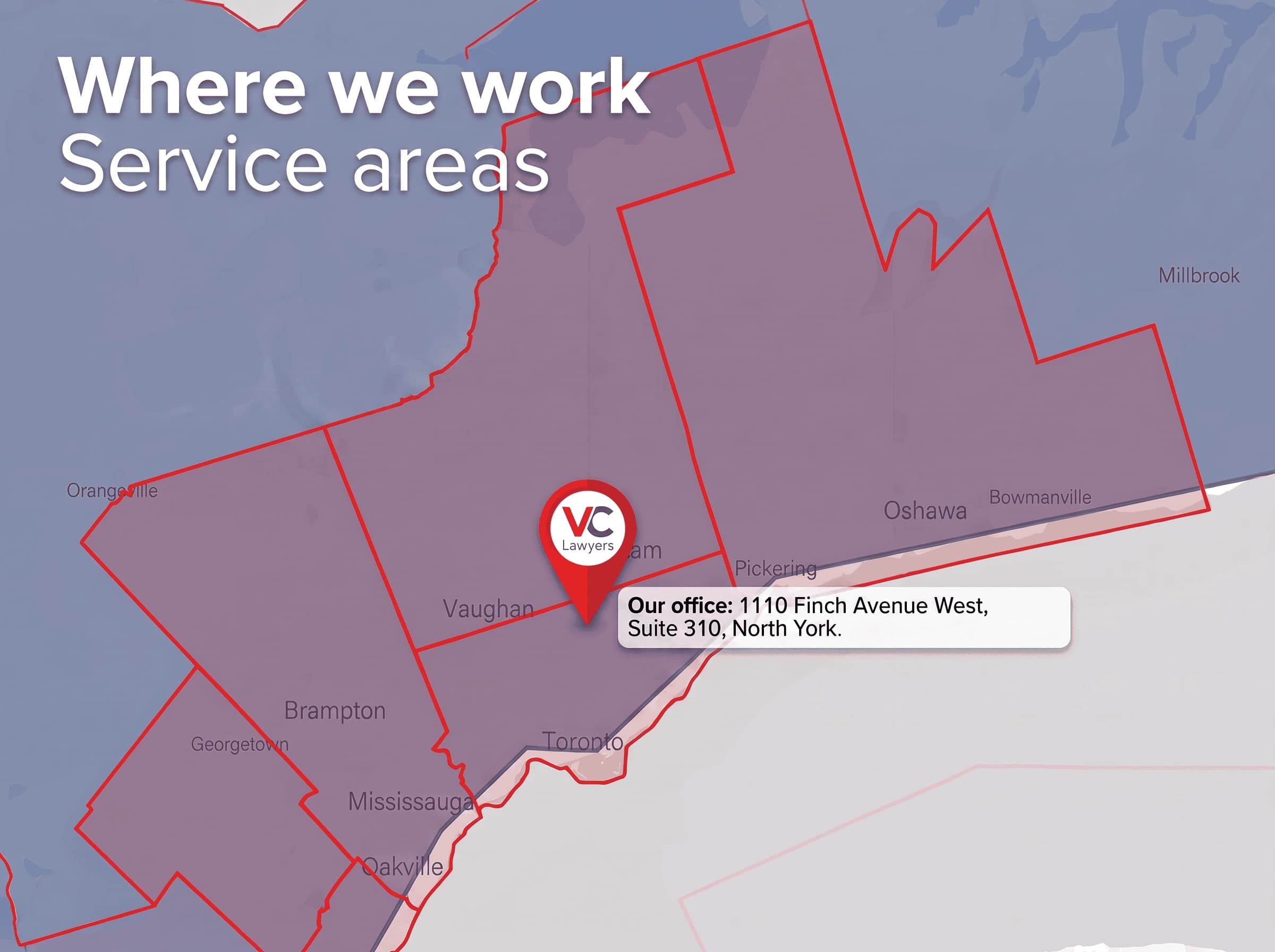
VC Lawyers service area map, Toronto and the Greater Toronto Area, with our North York office marked

Service areas

North York disability & insurance claim lawyers serving every neighbourhood

From our office at Finch Ave W and Keele, we represent denied claimants across all of North York, including Willowdale, Don Mills, Downsview, York Mills, Bathurst Manor, Lansing, Newtonbrook, Bayview Village, Flemingdon Park, Jane and Finch, Yorkdale and Glen Park, Clanton Park, Parkwoods, and Victoria Village. We also serve neighbouring communities in Vaughan, Thornhill, Richmond Hill, Markham, Scarborough, Etobicoke, and Downtown Toronto.

Whatever the policy and whoever the insurer, whether the LTD cut off at two years, the CPP refusal, the life claim contested, or the travel bill stranded, our North York disability and insurance claim lawyers answer the denial at its reason. We offer office, video, home, and hospital meetings, and parking and TTC access (Finch West Station) at our office.

Our office is at 1110 Finch Ave W #310, near Finch and Keele, with parking on site. By transit, take the Finch West LRT or the bus network connecting from Finch West Station on Line 1. If your injuries or circumstances make travel difficult, we come to you at home or in hospital, anywhere in North York.

Related practice areas

Continue exploring