
Workplace & Specialty
Toronto Sexual Assault Civil Lawyercivil claims on the survivor’s terms



Trusted by survivors of sexual violence across Ontario
Available 24/7
Crisis Resources Available 24/7
If you are in immediate danger, call 911. Nothing listed below requires you to have made any decision about the police, a lawyer, or a civil claim. These services are there whether or not you ever take a legal step.
Assaulted Women's Helpline (Ontario, 24/7)
1-866-863-0511 / TTY 1-866-863-7868Toronto Rape Crisis Centre / Multicultural Women Against Rape
416-597-8808Talk4Healing (Indigenous women, all languages, 24/7)
1-855-554-HEAL (4325)Victim Support Line (Ontario)
1-888-579-2888Kids Help Phone (under 20)
1-800-668-6868 / Text “CONNECT” to 686868Hope for Wellness Helpline (Indigenous, 24/7)
1-855-242-3310
Hospital-Based Sexual Assault/Domestic Violence Treatment Centres in the GTA
These hospital-based Sexual Assault/Domestic Violence (SADV) centres provide medical care, forensic examination, counselling, and follow-up support. You do not need to involve the police to be seen at one, and you do not need to make any legal commitment.
Women's College Hospital
416-323-6040Sunnybrook Health Sciences Centre
416-480-4055SickKids (under 18)
416-813-6275Scarborough Health Network
416-495-2555Trillium Health Partners (Mississauga)
905-848-7100 ext 2024
You do not need to make a legal decision today. This page is here when you are ready. A consultation with our firm does not replace any of the services above, and we encourage survivors to keep crisis-line and therapeutic support in place alongside any legal proceeding. The legal process can be demanding, and that support helps you stay well through it.
Overview
Reading This Page on Your Own Terms
This page is for survivors of sexual assault who are considering civil legal options. We have written it carefully. The language is informational rather than graphic, and the page is laid out so you can take whatever time you need.
You can read all of it, some of it, or none of it. You can come back another day. You can have a friend, family member, support worker, or therapist read it with you. You can stop at any point. You do not need to make a legal decision today, this week, or this month. Under Ontario law there is no time limit for civil sexual assault claims, so the legal door stays open no matter how long you take.
If you decide at any point that you want to speak with a lawyer, the first conversation is free and entirely confidential. You can call, email, or use video conferencing. You can have a support person with you. You can take breaks. You can decide afterward whether you want to do anything more, or simply walk away with information.
What this page covers:
- 01
The difference between criminal and civil cases
The legal system offers two separate paths, and pursuing one does not require pursuing the other. A criminal case is brought by the state. The Crown attorney decides whether to lay charges and how to run the prosecution. You are a witness rather than a party. The standard of proof is beyond a reasonable doubt, and the remedy is punishment of the perpetrator rather than compensation for you.
A civil case is brought by you. You are the plaintiff. You and your lawyer control the strategy and the timing. The standard of proof is the balance of probabilities, and the remedy is money for the harm done. Because the civil standard is substantially lower, a civil case can succeed even where a criminal case failed or was never started, including against someone who was never charged at all.
Many survivors choose civil action for the control it returns to them. You decide when to file, what to seek, when to negotiate, when to settle, and when to walk away. The compensation also pays for concrete things that punishment does not address: therapy, medical care, and the education or career years you lost. Where an institution was negligent, settlements can include policy reform and training commitments that protect other people.
- 02
Ontario's removal of time limits for sexual assault civil claims (Bill 132, 2016)
Before 2016, sexual assault civil claims in Ontario were generally caught by a two-year limitation period under the Limitations Act, 2002. Survivors who came forward later often had to fight a procedural battle before anyone looked at the merits of what happened to them. That deadline measured recovery on someone else's clock. Survivors commonly take years, and often decades, before they are ready to come forward.
On March 9, 2016, Ontario's Sexual Violence and Harassment Action Plan Act, commonly called Bill 132, received Royal Assent. It added section 16(1)(h) to the Limitations Act, 2002. There is now no limitation period for a proceeding based on a sexual assault, and the change applies retroactively, no matter when the assault happened. Section 16(1.3) extends that to claims against third parties such as schools, churches, employers, and other organizations, covering negligence, breach of fiduciary duty, and vicarious liability.
The removal also reaches other misconduct of a sexual nature where the survivor was a minor at the time, or where there was a relationship of authority, dependency, or trust. It reaches physical assault where the survivor was a minor, or where there was an intimate or dependent relationship. If a lawyer told you in 2010 that it was too late, that advice no longer applies. What has not changed is evidence. Witnesses move, memories change, and documents are lost, so an early conversation helps identify what can still be gathered.
- 03
Who can be sued (perpetrator, institutions, employers, organizations)
The most direct defendant is the person who committed the assault. The claim against them is the tort of battery, and they can be sued whether or not they were ever charged or convicted. Many individual perpetrators, though, have limited assets, and a judgment against someone with no assets is hard to collect.
Institutions are often where meaningful compensation comes from, because they carry insurance and resources. Employers can be vicariously liable for assaults committed by employees, under the Supreme Court of Canada's framework in Bazley v Curry (1999) and Jacobi v Griffiths (1999). That is especially so where the job created the opportunity for the assault, where prior complaints or warning signs were ignored, or where the role placed the employee in a position of trust or authority over vulnerable people.
Institutions of many kinds have faced civil liability in Canada: schools and school boards, religious organizations, sports clubs and governing bodies, residential and care facilities, healthcare providers, childcare and youth programs, and, in limited circumstances, property owners whose security failures contributed to the assault. Identifying every viable defendant, and the insurance available behind each one, is what turns a claim into a case that can actually pay for what you need.
- 04
What compensation can be sought and how it's used
General damages for pain and suffering are capped by the Supreme Court of Canada's trilogy, currently around $469,000 to $470,000 in 2026 dollars. Awards in the $100,000 to $300,000 range are common in serious sexual assault cases, and awards approaching the ceiling are reserved for the most severe. Sexual assault almost always supports aggravated damages as well, which address the manner in which the wrong was committed. Punitive damages are available where the conduct was particularly reprehensible, as the Supreme Court confirmed in Whiten v Pilot Insurance Co. (2002).
The rest of a claim is built on what the harm actually costs you. Lifetime trauma-focused therapy and mental health treatment can total hundreds of thousands of dollars in severe cases. A claim also covers past and future income loss, lost educational years, reduced earning capacity, and vocational rehabilitation. It covers medical expenses and lost housekeeping capacity, along with out-of-pocket costs such as travel to treatment, security measures, and relocation. Family members can claim separately under the Family Law Act for loss of guidance, care, and companionship.
Total recovery depends on the severity and duration of the assault, the harm to you, which defendants exist and what they can pay, and the strength of the evidence. As a rough guide, modest cases run $50,000 to $200,000. Moderate cases run $200,000 to $1,000,000. Serious cases run $1,000,000 to $3,000,000 and above. Catastrophic cases or class actions run $3,000,000 to $10,000,000 and above per claimant. These are general ranges only, and a consultation gives you a more specific assessment.
- 05
How the legal process works
It begins with a free, confidential consultation, typically 30 to 60 minutes. You can have it in person, by video, or by phone, and you can bring a support person. You do not need to recount everything in detail and you do not need to bring documents. If you decide to proceed, the retainer sets out the contingency arrangement. The investigation then begins: identifying potential defendants, gathering institutional and employment records, tracing prior complaints, finding witnesses, and, with your consent, coordinating with your treating professionals.
A formal demand letter to the defendants often opens settlement discussions, and many cases resolve there, usually three to nine months in. If a case does not resolve at that stage, we file a Statement of Claim in the Ontario Superior Court of Justice using your initials or a pseudonym. Documentary discovery and examinations for discovery follow. At your examination you can take breaks, and a support person can be present. Your lawyer is there to object to inappropriate questions, and it all happens in a private setting rather than a courtroom.
Mediation is mandatory in Toronto and many Ontario regions, and most sexual assault cases settle at or after it. You do not need to be in the same room as the defendant, because mediation can run with the parties in separate rooms. In rough terms, investigation and the demand letter take two to six months. Discovery and examinations take twelve to eighteen months. Mediation lands around eighteen to twenty-four months from intake. Trial, in the small share of cases that reach one, comes at twenty-four to thirty-six months.
- 06
Privacy and confidentiality protections
The first consultation, and everything after it, is protected by solicitor-client privilege. Nothing said in it can be disclosed without your permission, even if you decide not to proceed with us.
In court, Ontario allows sexual assault survivors to bring proceedings using initials or a pseudonym, commonly Jane Doe or John Doe. Public court records and published decisions then carry initials rather than your name. Hearings are described the same way, and a search for your name will not turn up the lawsuit. The protection is not automatic. Your lawyer requests it at the start of the case, and courts generally grant it in sexual assault matters. Courts can also seal sensitive material such as medical and therapy records, and can order a publication ban that binds newspapers, websites, and social media accounts. Breaking that ban is contempt of court.
Most cases settle rather than go to trial, and settlement agreements normally carry strict confidentiality. Neither side can disclose that a settlement exists or what it says. The defendant cannot publicize the outcome, and any public statement requires mutual agreement. The choice between a private case and a public one belongs to you, and you can change your mind as the case moves. What you tell friends, family, a therapist, or an employer is also entirely your decision.
- 07
Resources beyond the legal system
The legal system is one path, and it should never be the only support a survivor has. The crisis lines at the top of this page are available now, several of them 24 hours a day, and the hospital-based SADV centres provide medical care, forensic examination, counselling, and follow-up without requiring police involvement or any legal commitment.
Longer-term support exists across the GTA. The Toronto Rape Crisis Centre / Multicultural Women Against Rape offers specialized counselling, advocacy, and accompaniment. The Barbra Schlifer Commemorative Clinic offers legal, counselling, and interpretation services. METRAC works on education and advocacy. The Toronto Counselling Centre for Survivors provides free counselling for adult survivors. The Gatehouse supports adults who experienced childhood sexual abuse, and Boost Child & Youth Advocacy Centre works with children and adolescents.
Other resources serve specific communities. Indigenous survivors can turn to the Native Women's Resource Centre of Toronto, Anduhyaun, and Talk4Healing. LGBTQ2S+ survivors can turn to The 519 and LGBT YouthLine. Newcomers can turn to OCASI and the Riverdale Immigrant Women's Centre. Men and non-binary survivors can turn to BridgeNorth, 1in6 Canada, and MaleSurvivor.org. Ending Violence Association of Canada keeps a national directory at endingviolencecanada.org. Keeping this support in place alongside a legal proceeding matters, because the process can be demanding.
What this page does not include:
- 01
Graphic descriptions of assault
Nothing here describes an assault. The page is written to be usable information rather than something you have to brace for, so it sticks to the law, the process, and the choices in front of you.
The same applies to the first conversation with a lawyer. It does not require recounting the assault in detail. We need only enough to assess the legal possibilities, and later meetings move at your pace, with breaks, pauses, and stops available at any point.
- 02
Pressure to take any action
You can read all of this, some of it, or none of it, and come back tomorrow or in five years. Because Ontario has no limitation period for civil sexual assault claims, waiting until you are ready costs you nothing in law.
Every important decision in a case, including whether there is a case at all, stays with you. We advise, and you decide.
- 03
Legal advice about your specific situation (only a consultation can provide that)
Everything on this page is general. Only a conversation can surface the facts that answer the real questions: what a claim is realistically worth, who can be sued, whether an institution shares responsibility, and what evidence still exists after many years.
You can bring a support person to that first conversation, you can take it by phone or video instead of in person, and you can end it having taken nothing away but information.
VC Lawyers represents survivors of sexual assault in civil proceedings only. We do not represent persons accused of sexual assault, so we never face the conflicts that arise when a firm tries to do both. Our entire role is advocacy for survivors. Cases are handled on contingency, meaning no fee unless we recover compensation for you, and the percentage is set in writing at the start of the engagement. The first 30-minute consultation is free, confidential, and carries no obligation.
The way we work follows from that. Privacy protections are pursued by default rather than on request, so anonymous filing, sealed records, and settlement confidentiality are the starting point unless you choose a public case. We map every potential defendant and the insurance behind each one, because the total available recovery often substantially exceeds what any single defendant's resources would provide. Some cases need expert evidence from forensic psychiatrists, trauma experts, vocational consultants, and economists. The firm advances those costs and recovers them from the eventual settlement.
(416) 661-4529, when you are ready.
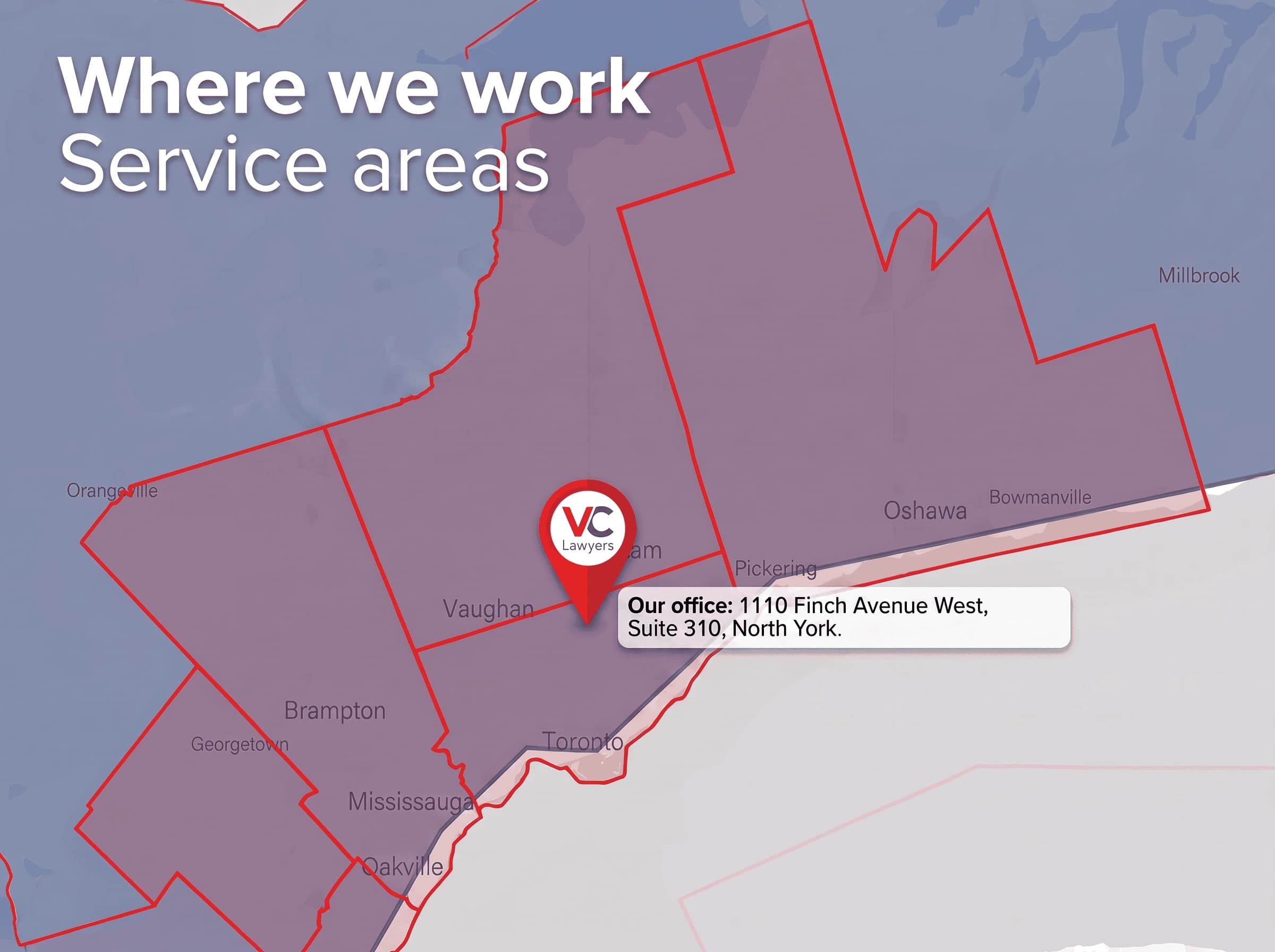
Where we work
Service areas
VC Lawyers serves clients throughout the Greater Toronto Area, including Toronto, North York, Scarborough, Etobicoke, Mississauga, Brampton, Oakville, Burlington, Vaughan, Richmond Hill, Pickering, Ajax, Whitby, Oshawa, Newmarket, and Aurora. We also represent clients across Ontario through video consultations and home/hospital visits when needed.
Languages spoken at the firm include English, Korean (한국어), Hebrew, Mandarin, and others depending on lawyer assignment.
Our office is located at 1110 Finch Avenue West, Suite 310, in North York, with parking and TTC access (Finch West subway and bus connections).
Frequently Asked Questions: Sexual Assault Civil Claims
We answered all
The assault happened decades ago. Is it really not too late?
Correct. Under Ontario law, there has been no limitation period for civil claims based on sexual assault since March 9, 2016. Bill 132, the Sexual Violence and Harassment Action Plan Act, added section 16(1)(h) to the Limitations Act, 2002, and the change applies retroactively regardless of when the assault occurred. Adult survivors of childhood abuse, survivors of historical workplace harassment, and survivors of decades-old institutional abuse can all still bring a claim. Section 16(1.3) extends the same rule to claims against institutions, so a claim against a school, church, employer, or other organization connected to the assault is also free of any limitation period. The practical challenges of older cases are different from the legal ones. Evidence can fade with time, witnesses move or die, and documents are lost. But Ontario courts are experienced with historical sexual assault cases and have developed approaches to evaluating evidence in these contexts. Strong cases are often built decades after the events, with the help of trauma-informed expert witnesses and whatever corroborating evidence survives. That evidence can include medical records, diaries kept at the time, statements made to family members or therapists back then, and patterns of similar conduct by the perpetrator. If you have been told in the past that “it's too late,” that advice is no longer accurate. A free consultation can assess what your specific case looks like under current law and what evidence is still available to build it.I never reported to the police. Does that affect my civil case?
Generally no. The absence of a police report does not bar a civil case. Many survivors do not report to police, for all kinds of reasons: fear, distrust of the criminal justice system, worries about confidentiality, the perpetrator's relationship to family or community, immigration status, or a calculated decision that criminal proceedings would not produce a satisfying outcome. None of these reasons affects the survivor's right to bring a civil claim. In fact, many civil cases proceed without any criminal involvement. The civil case stands on its own evidence and its own standard of proof. That said, where a police report exists or where a criminal proceeding occurred (whether successful or not), the records can sometimes provide useful evidence. A consultation can address how a criminal case, or the absence of one, affects your specific situation.I'm not sure exactly what happened or whether what happened was “really” assault. Can I still pursue a case?
The legal definition of sexual assault under Canadian civil law is broad. It includes any non-consensual sexual contact, ranging from unwanted touching through to rape, and the criminal definition is similarly broad. Several common situations may qualify as sexual assault even when the survivor is not sure. One is touching during what was meant to be a medical or therapeutic procedure. Another is sexual contact while the survivor was incapacitated by alcohol, drugs, or sleep. Coerced or pressured sexual contact qualifies, including by an intimate partner, and so does sexual contact after consent was withdrawn. So does sexual contact with a person who had charge of the survivor, such as a teacher, coach, or supervisor, and sexual contact obtained through threats, manipulation, or abuse of authority. Childhood sexual contact qualifies too, regardless of how it was framed at the time. You do not need to label what happened to you in a particular way to seek legal advice. The conversation with a lawyer can clarify whether the events as you describe them constitute legally actionable conduct. Many survivors have absorbed messages that minimize what happened, from the perpetrator, from the people around them, or from the wider culture. A trauma-informed lawyer will not pressure you to label your experience in a particular way. They will simply tell you whether the legal framework applies to the events you describe.Can I make a claim without my family knowing?
In most cases, yes. Ontario offers several privacy protections: anonymous court filings, sealed records, publication bans, and confidentiality in settlement. Together they typically allow survivors to pursue civil cases without their families learning about the case. There are a few practical considerations. Mail and calls from your lawyer need to reach you somewhere private. Settlement funds may need to be paid out in a way that keeps the case private. Settlement amounts can also surface in your tax filings. All of these issues can be managed. Many of our cases involve survivors whose families never learn about the proceedings. If you are worried about one particular person finding out, the consultation can address how to manage that.The perpetrator has no money. Is the case worth pursuing?
This depends on whether other defendants are available. If the only viable defendant is an individual perpetrator without significant assets, civil action may not produce meaningful compensation. You can still obtain the judgment, which establishes legal accountability, but collecting on it against a defendant with no assets is often unsuccessful. However, many sexual assault cases involve institutional defendants with insurance coverage and resources. It might be an employer who failed to supervise the perpetrator. It might be a school, church, sports organization, or other institution that bore responsibility. It might be a property owner whose security failures enabled the assault, or a parent organization or franchisor with deeper resources. Identifying these institutional defendants is often the key to building a meaningful case. A consultation can map the defendants available in your situation and the insurance coverage behind each of them. For cases where no viable institutional defendant exists, the Criminal Injuries Compensation Board (CICB) provides another path. CICB compensation is more limited than civil damages, but does not depend on the perpetrator's resources.What is the Criminal Injuries Compensation Board (CICB) and should I apply?
The Criminal Injuries Compensation Board is an Ontario government body that provides compensation to victims of certain crimes, including sexual offences. The CICB is a separate path from civil litigation, and it works differently. It is a government program rather than a court, and its process is less formal than litigation. Compensation amounts are generally smaller than civil damages. A police report typically helps but is not always required. A criminal conviction is not required either, and no limitation period has applied since 2016. The CICB may make sense when the perpetrator has no resources and no viable institutional defendant exists. It can also make sense when you want something faster and simpler than civil litigation, or when the financial need is for specific limited expenses such as therapy costs rather than comprehensive damages. Civil litigation typically produces better results when viable institutional defendants exist with insurance coverage, when the harm is severe and substantial compensation is needed, or when you want a more comprehensive resolution. The two paths are not mutually exclusive. Some survivors pursue both, and a consultation can address which approach, or which combination, makes sense for your situation.Will I have to face the perpetrator in court?
Probably not, but the level of contact depends on what stage the case reaches and what protections apply. Most cases settle before trial, and in those cases you do not appear in court at all. Mediation and settlement discussions can be conducted with the parties in separate rooms. In cases that reach examinations for discovery, you and the defendant will both be examined, but typically on different days. You are not examined together. In the rare cases that go to trial, you may need to testify with the defendant present in the courtroom. Even then, several protections apply. A screen or one-way glass can block your view of the defendant. You can testify by closed-circuit video from a separate room. A support person can be with you, cross-examination can be limited, and a publication ban can cover the case. Most survivors find that the process is much less directly confrontational than they had feared. A civil case runs through counsel, so you communicate through your lawyer rather than directly with the defendant.How much does it cost? I don't have money to pay a lawyer.
VC Lawyers handles sexual assault civil cases on contingency, meaning no fee unless we recover compensation for you. The contingency percentage is set in writing at the start of the engagement, typically ranging from 25% to 33% of the recovery, depending on the complexity and the stage at which the matter resolves. Disbursements (court filing fees, expert reports, examination transcripts, mediation fees) are advanced by the firm and recovered from the eventual settlement. You do not pay disbursements out of pocket during the case. The first 30-minute consultation is free. There is no charge for an initial conversation, and no obligation to retain us afterwards. If your case does not produce a recovery, whether through dismissal, a resolution at zero, or any other reason, you owe nothing. The financial risk is on the firm, not on you. This contingency structure exists because survivors should never be shut out of justice by a lack of money. The firm believes in the cases it takes on, and puts its own resources behind that belief.I'm a man / non-binary / trans. Does the law apply to me?
Yes. Sexual assault civil law in Ontario protects all survivors regardless of gender identity, sex, or sexual orientation. The legal framework applies equally, including the Limitations Act provisions, the tort of battery, and the institutional liability principles. Male, non-binary, and trans survivors face additional barriers in coming forward, including different forms of stigma, few support resources built for them, and cultural pressure in some communities. Those obstacles contribute to under-reporting in these populations. But the legal door is equally open. VC Lawyers represents survivors of all genders and sexual orientations. We work with culturally competent therapists and with support organizations that serve diverse communities. The consultation environment is designed to be respectful and trauma-informed for all survivors.I'm an immigrant or refugee. I'm worried about my status. Can I still pursue a case?
Yes. Civil proceedings in Ontario are entirely separate from immigration matters. Initiating a civil case does not affect your immigration status, and your immigration status is generally not relevant to your civil claim. In fact, specific protections may apply to immigrant survivors. Trafficking, abuse within a sponsorship relationship, and exploitation of a survivor's immigration vulnerability have all produced civil claims. Federal immigration policy includes provisions for survivors of family violence, and in some cases civil documentation may support immigration applications rather than threatening them. Cultural and language considerations are real, though. Survivors from diverse cultural backgrounds may face specific barriers, including community pressure, fear of family disclosure, religious considerations, and concerns about sponsoring family members. It matters to work with a lawyer who can engage with all of that. VC Lawyers handles cases in English, Korean (한국어), and several other languages depending on lawyer assignment. For Korean-Canadian survivors, the Korean-language version of this page carries equivalent information, and Korean-speaking counsel handles the file from intake through resolution. We work with translators and bilingual staff for Mandarin, Cantonese, Hindi, Punjabi, Tagalog, Spanish, Portuguese, Arabic, Farsi, and other languages. If you have concerns about immigration implications, raise them in the consultation, where a lawyer with experience in cross-cultural files can address them directly.
Why people choose VC Lawyers
The right firm handles everything so you can focus on recovery
Choosing the right personal injury law firm after an accident in Toronto can mean the difference between a lowball settlement and the full compensation you deserve.
No Fees Unless We Win
Personal injury cases run on a contingency basis. You pay nothing upfront.
Free Personal Injury Consultation
Speak with an injury lawyer today at zero cost. Other practice areas are quoted before we start.
24/7 Emergency Hotline
We’re available around the clock when you need us most.
Home & Hospital Visits
Too injured to come to us? We’ll come to you.
Multilingual Legal Team
Services in 8 languages so nothing gets lost in translation.
Boutique Firm, Big Results
You’re never just a case number. Get direct access to your lawyer.
Get in touch
Looking for legal help? Speak directly with a lawyer
Tell us what happened and a lawyer will personally review your case. Personal injury consultations are free and there are no fees unless we win. For all other practice areas, a consultation fee applies.
- $30M+ recovered for injury clients
- Available 24/7, including weekends
- Service in English, Korean, and 6+ more languages
Prefer to call? (416) 661-4529
When you are ready
When You Are Ready
You may be reading this today and not be ready to act. You may come back to it in five years, when you are. Either way, the door stays open. Ontario law has removed the time limits that previously excluded so many survivors. The legal options exist whenever you choose to consider them.
The first conversation is free, confidential, and creates no obligation. You can bring a support person. You can take breaks. You can stop at any point. You do not need to commit to anything until you decide you are ready.
Free consultation · Trauma-informed practice · No fee unless we recover · Anonymous filing protections · Korean and other languages
Korean language: 한국어 상담이 가능합니다. Korean-speaking lawyers handle the file from intake through resolution.
Related practice areas
Continue exploring
Sexual Assault Claim Lawyer in North York
The same practice, served from our office in North York.
Toronto Birth Injury Lawyer
Catastrophic injury claims involving children.
Toronto Work Injury Lawyer
Tort claims when WSIB does not apply.
WSIB Lawyers in Ontario
Workplace insurance benefits and appeals.
Toronto Medical Malpractice Lawyer
Medical negligence claims beyond the obstetrics setting.
Toronto Traumatic Brain Injury Lawyer
Traumatic brain injury claims, including HIE.
Toronto Wrongful Death Lawyer
For survivors of fatal cases.
Ontario SABS Accident Benefits Lawyer
Statutory accident benefits where motor vehicle coverage applies.