
Maurice Vaturi
Senior Counsel

Premises Liability




Trusted by injured Ontarians across premises liability
Overview
A summer barbecue at a friend's cottage. Twelve adults are on the wraparound deck, wine glasses in hand, watching the sunset over the lake. Without warning, the deck shudders. There is a cracking sound. About a third of the deck's surface separates from the cottage and pitches downward. Three people fall directly to the rocky ground six feet below. A fourth falls into the deck's collapse and is pinned by a beam. The remaining guests scramble to safety. The hosts call 911. By the time paramedics arrive, three people have serious injuries: a fractured pelvis, a traumatic brain injury, and multiple broken ribs. The fourth needs surgery for an internal hemorrhage caused by the impact.
A condominium balcony in downtown Toronto. The owner is having coffee on the balcony, leaning casually against the railing as she has done thousands of times. The railing is original to the building and has never been inspected. Hidden corrosion has eaten into the points where it connects to the balcony slab. The railing gives way. She falls eight storeys. She does not survive. The investigation that follows reveals that the building's reserve fund had identified balcony railing remediation as required maintenance years earlier. The work had been deferred repeatedly because of the cost.
A Toronto townhouse with a wooden second-floor deck. A young family hosts a small birthday party for their toddler. Eight or nine adults stand on the deck. The deck looks fine. Hidden under the surface, water damage has weakened the ledger board, the beam that fastens the deck to the house. The deck pulls away from the house. Adults and children fall together onto the patio below. Children break bones. Adults suffer concussions. One adult suffers a serious back injury. And a community of friends and family spends the next year processing what happened.
These scenarios are not rare. In the United States alone, collapsing decks and balconies have injured more than 6,500 people since 2003, roughly 550 every year, and have caused about 30 deaths over the same period, according to U.S. Consumer Product Safety Commission data. Canada tracks no national equivalent, but the same construction methods and the same failure modes apply here. The actual numbers may be higher, because many less serious injuries never get tracked. And these are only the dramatic collapse incidents. Far more numerous are the everyday failures: the slip and fall accidents, the railing failures that produce fall-from-height injuries, the children who slip through inadequate guards, and the elderly residents who fall from balconies that were properly designed but improperly maintained.
What unites these accidents is that they are almost entirely preventable. Properly designed and constructed balconies and decks, properly inspected and maintained, do not fail. When they do fail, someone has been negligent: a property owner who deferred maintenance, a contractor who cut corners on construction, a condominium corporation that ignored warning signs, a manufacturer who supplied inadequate materials, or an architect who missed safety requirements. Ontario law provides a comprehensive framework for holding negligent parties accountable when their failures injure people who were rightfully on the property.
VC Lawyers represents Toronto-area and Ontario-wide clients in balcony and deck accident cases. The first 30-minute consultation is free, all balcony and deck cases are handled on contingency (no fee unless we recover), and we work in English, Korean, and several other languages. For accident victims who cannot easily travel, we conduct video and home/hospital consultations. If your situation requires immediate attention, call (416) 661-4529 at any point while you are reading this page.

Talk to us
The first 30-minute consultation is free and confidential. We will tell you within that conversation what your realistic options are, and what to do next.
No fee unless we recover. Home and hospital visits available across the GTA.
Property-type considerations
The Occupiers' Liability Act applies the same duty of reasonable care to every property in Ontario. What changes from one property type to the next is who else can be named alongside the occupier, what records exist to show the failure was foreseeable, and how much insurance sits behind the claim.
A condominium case turns on the declaration and on the reserve fund study. An apartment case brings in the landlord and the property management company. A private home deck usually brings in the original builder and the manufacturers of the materials. A commercial patio carries far larger policies. When several people are hurt at once, those claimants can also share the cost of proving what went wrong. The sections below set out how each of these works.
The Greater Toronto Area has one of the highest concentrations of high-rise condominiums in North America. With this concentration comes a significant population of aging condominium balconies. Many were constructed in the 1960s through 1980s and are now at the end of their original design life.
Start with the reserve fund study. Ontario condominiums are required to commission one every three years. These studies identify major maintenance and replacement needs and project the funding required. Balcony remediation appears in many older condo reserve fund studies as a substantial line item, often costing millions of dollars for comprehensive balcony slab and railing replacement on a single tower.
When condominium corporations defer balcony remediation after a reserve fund study identified the need for it, they create substantial liability exposure. If the balcony then fails, the case against the corporation is a particularly strong one.
The next question is what the balcony counts as. Whether it is part of the unit, a common element, or an exclusive use common element depends on the building's declaration. The Condominium Act and the declaration determine maintenance responsibilities. For most Ontario condominiums, the structural elements of balconies are common elements (corporation responsibility) while the unit owner has limited responsibility for the surface and minor finishes.
Buyers face a disclosure question of their own. Condominium buyers receive a Status Certificate identifying current and planned major repairs. Sometimes the certificate identifies balcony remediation and the unit is sold anyway, with no follow-through on the work. Future buyers may then have claims against the seller, the corporation, and others. So may guests injured in a later failure.
In a rental building the tenant uses the balcony but does not control its structure. The landlord is responsible for structural and major maintenance, and the tenant is responsible for the daily condition of the unit and the hazards inside it. Most rental balcony cases are decided on that split.
For rental apartment buildings, the framework is similar, but the landlord-tenant dynamic adds complexity:
The landlord owes occupier duties to tenants and tenants' guests. Under the Act, an occupier is anyone with physical possession of the premises, or anyone with responsibility for and control over their condition. A landlord has both. A visitor who never signed the lease is owed the same reasonable care as the tenant who did.
In practice that duty covers several things. The balcony must be built to the code in force at the time. Its structural elements, connections and fasteners must be inspected. Defects that turn up must be repaired promptly. Railings and fasteners must be replaced at the end of their useful life. Access must be restricted where a structure is known to be dangerous. A landlord who did none of that cannot escape liability by saying nobody complained.
Property management companies share responsibility for inspection and maintenance. The company that runs the building day to day is a defendant in its own right, not simply the owner's agent. Companies engaged to inspect, maintain or repair balconies have professional duties, and a failure to identify or properly address an obvious defect produces contractor liability.
Naming both the owner and the manager matters because each carries its own insurance. Identifying every viable defendant is part of building a comprehensive case, and the total available compensation often exceeds what any single defendant's coverage provides.
A tenant who reports a defect that the landlord then fails to address bears less responsibility than a tenant who concealed the defect or contributed to the deterioration. Responsibility follows conduct, and a tenant who asked for the repair and was ignored is not the author of the failure.
This is why the paper trail matters. Maintenance requests, messages to the superintendent and prior complaint records are the documents that establish actual notice. They show the landlord knew about the danger and did not act. That is what turns an ordinary negligence claim into a strong one.
The Residential Tenancies Act, 2006 and the Occupiers' Liability Act work together to define responsibilities in rental contexts.
The practical question at the start of a rental balcony case is who the occupiers actually were. In a managed apartment building that can be the owner, the property management company and the tenant at the same time, each with a different duty and a different insurer behind it.
Private homes produce most deck cases, and those decks fail in a small number of recognizable ways. The ledger board connection that ties the deck to the house lets go. Rot spreads under the surface boards where nobody can see it. A railing that was never tall enough or strong enough gives way behind someone leaning on it.
For accidents at private residences (homeowner-built decks, professionally built decks, decks on rental properties), the framework typically involves:
The homeowner or property owner is the primary occupier and the first defendant. The duty is reasonable care in all the circumstances, not a guarantee that nothing will ever happen. It covers regular inspection of the structural elements, especially connections, fasteners and load-bearing components. It covers prompt repair of whatever the inspection finds, and replacement of railings, deck boards and fasteners at the end of their useful life. It covers preventative maintenance such as waterproofing, sealing and staining. And it covers warning about or restricting access to a structure that cannot be fixed right away.
Where none of that was done on a structure decades old, the case is straightforward. The age of the deck is evidence that the danger should have been known. So is visible rot, rust, sagging or looseness, and so is any earlier complaint.
The original deck builder, where the work was professional, answers for how the deck was put together. Ledger board connection failure is by far the most common cause of catastrophic deck collapses. It is almost always a construction question: nails used where bolts were required, too few fasteners, a ledger fixed only to siding or sheathing instead of bolted through the building structure, or missing flashing that let water into the connection.
Modern building codes are specific about this point, requiring structural connectors, lag bolts of a stated diameter and spacing, and flashing to prevent water intrusion. Decks built to current code are far less likely to fail there. Older decks, and decks built without proper inspection, are at substantially elevated risk. The building permits and the construction contracts are what establish which category a particular deck belongs to.
Subsequent maintenance contractors answer for inspection or repair failures. A company paid to assess a structure has professional duties, and failing to identify or properly address an obvious defect produces liability of its own.
This matters most with rot, which is often invisible from the surface. A deck that appears solid can have substantially compromised structural elements hidden by its own boards, and finding them takes probing with a screwdriver, removing boards, or moisture-detection inspection. Rot collects in predictable places: at ledger board connections, at post bases, under the decking where runoff sits on the joists, around bolts and screws that pass through wood, at guard rail bases and at stair connections.
Material manufacturers answer in product liability where the failure began with the materials rather than the workmanship. That category covers several things: substandard lumber, defective fasteners, joist hangers and structural connectors that were not galvanized to an appropriate standard, failed waterproofing membranes, and inadequate flashing.
Metal corrodes, and Toronto's freeze-thaw cycles and de-icing salt exposure accelerate it. The usual starting places are ferrous fasteners not rated for outdoor use, and railing connection points where moisture concentrates. Warranty documentation from the manufacturer is obtained early, and wood, concrete or metal samples normally go to a laboratory as part of the engineering investigation.
For accidents involving guests of the homeowner, the homeowner's insurance policy typically provides the liability coverage. The injured guest claims against the homeowner, but in practice the claim is answered by the homeowner's insurer. That affects the personal relationship far less than it might first seem. Most homeowner's policies provide $1,000,000 or more in liability coverage, and some provide $2,000,000.
That is the figure to hold in mind when weighing whether a claim is worth making. Serious falls produce a predictable set of injuries: fractures of the legs, ankles and feet from the impact, wrists and arms broken in the fall, pelvic and spinal compression fractures, and head injury severe enough to change a life. The cost of that care does not disappear because nobody sued. It is paid by the injured person, by the provincial health system, or by the insurer whose policy exists for exactly this.
Restaurants with patios, hotels with balconies, bars and clubs with elevated outdoor seating, event venues and similar properties all carry heightened occupier duties. The use is commercial, and groups of people gather on those structures regularly.
The compensation available is typically substantial because:
Commercial properties carry larger liability insurance policies. A restaurant, hotel, bar or event venue insures for the number of people it invites onto the property, so the coverage behind a commercial patio is well above the $1,000,000 to $2,000,000 a homeowner's policy typically provides.
That matters most when the injuries are severe. Falls from height produce multiple fractures, traumatic brain injury, spinal cord injury, internal injuries from blunt trauma, and crush injuries where victims are pinned by collapsing structure. Lifetime care in those cases frequently runs into the millions, and the defendant's coverage limit is one of the main leverage points in any settlement discussion.
Commercial decks and patios fail with a crowd on them, so one failure usually produces several claims resting on the same engineering analysis of the same structure. Those claimants can share the evidence and the litigation costs.
That is worth real money. Engineering experts, document discovery and other case-building costs on a serious balcony or deck file can run $25,000 to $100,000 or more over the life of the case. Multi-person falls also compound the injuries themselves, because people fall on top of each other, structural elements come down on people from above, and several victims share the same initial medical resources.
Egregious conduct by commercial operators may support punitive damages. These sit on top of compensation and exist to punish conduct that merits punishment: knowingly defective construction, deliberately deferred maintenance, or a failure to act on a safety hazard that had already been identified.
The Supreme Court of Canada confirmed in Whiten v Pilot Insurance Co. in 2002 that Canadian courts will award substantial punitive damages where a defendant's conduct deserves more than a compensation order. A patio kept open after the operator was told it was unsafe is exactly the situation this claim is built for.
Class action litigation may be available when multiple victims are similarly affected by a single failure.
The Berkeley balcony collapse of 2015 shows the scale one failure can reach. Six people died and seven were seriously injured when an apartment balcony collapsed during a 21st birthday party. The investigation found that wood rot had compromised the cantilevered structural beams and that the load of roughly 13 people exceeded what the weakened structure could support. Without the rot the balcony might have held. Without the load the rot might not have produced a collapse. The combination was catastrophic.
Cottages concentrate the risk. Many of these decks were constructed by owners decades ago. They sit through a full winter of freeze and thaw with nobody on them, then take the heaviest use of the year over a handful of summer weekends.
For accidents at cottages, vacation rentals, and short-term rental properties (Airbnb, VRBO), the framework involves:
The property owner is the occupier and the primary defendant, and in practice the claim is answered by the owner's insurer rather than the owner personally. Dedicated cottage liability policies for second properties are common in Ontario, and they exist for exactly this situation.
The duty is the same one that applies at any other home. Inspect the structure, particularly the connections, fasteners and load-bearing components. Repair what the inspection finds. Replace railings and fasteners at the end of their useful life. Keep people off anything known to be unsafe until it has been fixed.
Where the property was booked through Airbnb, VRBO or a similar short-term rental platform, the platform itself may be part of the claim in some circumstances.
Working out who belongs on the claim is strategic work done at the start of a case, not later. The total available compensation often substantially exceeds what any single defendant's coverage provides, and the two-year limitation period runs from the accident regardless of how long the investigation takes.
The cottage rental management company can carry responsibility of its own where it handles the bookings, the upkeep, or both. Companies engaged to inspect, maintain or repair decks have professional duties, and failing to identify or properly address an obvious defect produces contractor liability separate from the owner's.
That is a second insurer to claim against and a second set of maintenance and inspection records to obtain. Those records, together with any earlier complaints about the deck, are frequently what shows the failure was foreseeable.
Much of that owner-built construction went up without permits and without professional trades. Failures of these structures are common during peak summer use, and the claims face specific challenges because the construction history is often informal.
Load is the other half of the picture. Most decks are designed for roughly 40 to 50 pounds per square foot, and a cottage gathering loads a deck in ways ordinary use never does. A crowd stands in one spot rather than spreading out. A hot tub goes in without anyone checking capacity. Heavy planters and furniture add weight of their own, and over the winter snow accumulates because nobody clears it.
The absence of a permit does not help the owner. Work that was never permitted was never subjected to code review and never inspected, and that typically makes the case against the owner stronger rather than weaker.
In May 2026 a woman fell to her death from a balcony on a Carnival cruise ship. That case shows the cross-border and maritime law dimensions some balcony claims involve. Cruise ship accidents are usually governed by maritime law rather than land-based premises liability, and the liability framework is significantly different. Vessels in U.S. waters fall under federal jurisdiction, international waters raise complex jurisdictional questions, and the passenger ticket itself often contains an arbitration clause.
For Ontarians injured on cruise ships, the legal framework typically requires coordination between Ontario personal injury counsel and U.S. maritime counsel. Limitation periods are much shorter. One year is common in cruise passenger contracts. Procedural requirements are stricter, and the available compensation may be substantially limited by the terms of the passenger ticket.
Toronto-specific considerations
Toronto has one of North America's largest concentrations of aging condominium buildings. Many of the city's most prominent towers were built in the 1960s, 1970s and 1980s. Their balcony slabs and railings, along with other building elements, are now reaching the end of their original design lives.
For Ontario residents in older condominiums, balcony failures are an unfortunate reality. The reserve fund study process is meant to identify these issues early. What gets in the way is financial pressure on the board. A special assessment to fund remediation is unpopular with owners, so the maintenance is deferred instead. That deferral is what creates the liability exposure.
For serious balcony and deck accident victims, Toronto's trauma care network is exceptional. St. Michael's Hospital is the regional trauma centre. Sunnybrook Health Sciences Centre provides comprehensive trauma services. University Health Network (Toronto General, Toronto Western), Mount Sinai Hospital, and SickKids all handle severe accident cases.
For balcony and deck legal claims, documentation from these institutions provides a strong evidentiary foundation.
The medical case is built well beyond the emergency records, though. As the file progresses we develop treating physician reports, specialist consultations, functional capacity evaluations, rehabilitation input, life care planning for future care, and vocational evidence on lost earning capacity. Mental health assessment belongs in that list as well, because post-traumatic stress is common after a structural failure.
Toronto's diversity is reflected in our practice. We handle balcony and deck accident cases in English, Korean, and several other languages. Korean-speaking clients work with Korean-speaking lawyers who handle the file from intake through resolution.
We also work with translators and bilingual staff for Mandarin, Cantonese, Hebrew, Hindi, Punjabi, Tagalog, Spanish, Portuguese, and other languages.
Our approach
Our practice is built on principles that apply consistently across every balcony and deck accident file. These are the operational rules that determine how we handle your case from intake through resolution.
The first conversation sets the tone for everything after it. We will tell you what we believe your case is worth, what timeline to expect, and whether litigation is warranted. We will not tell you what you want to hear. Balcony and deck cases vary enormously based on the specific failure mode, available defendants, severity of injuries, and other factors. We tell you directly which category your case falls into.
Balcony and deck cases often involve several potentially liable parties: the property owner, the contractor, the manufacturer, the condominium corporation, property management, architects, engineers and building inspectors. Identifying every viable defendant at the start of a case is what makes sure no source of compensation is missed.
We approach each case by mapping all potential defendants and the insurance coverage available from each. The total available recovery often exceeds what any single defendant's coverage provides.
Balcony and deck cases require engineering analysis of the failure. We work routinely with structural engineers experienced in failure analysis. The engineering report identifies the specific cause of the failure, the contributing factors, and the parties whose conduct contributed.
This technical foundation is essential for both settlement leverage and trial preparation. Insurers for property owners and contractors take a case seriously when qualified engineering analysis stands behind it.
These cases often involve several streams of compensation at once: the primary tort claim against multiple defendants, long-term disability claims where the injured person was working, Family Law Act claims by family members, and product liability claims against material manufacturers. Running them as one coordinated strategy produces stronger outcomes than handling them separately.
All balcony and deck cases are handled on contingency. There is no fee unless we recover. The contingency percentage is set in writing at the start of the engagement. Disbursements are advanced by the firm and recovered from settlement.
When you retain VC Lawyers, you are working with a lawyer, not a paralegal handling everything while a senior partner's name appears on the letterhead. You have direct contact with the lawyer handling your file. That lawyer is responsible from intake through resolution.
Balcony and deck cases frequently arise from accidents at properties owned by friends, family members, or close acquaintances. We approach these cases with awareness of the personal dynamics involved. That means explaining how the insurance process protects the personal relationship, communicating with sensitivity, and coordinating settlements that allow ongoing relationships where possible.
Key metrics
Senior Counsel

Partner

Co-Managing Partner

Lawyer

Lawyer

Immigration Consultant
RCIC R529664 · RQIC 11726
FAQs
Where we work
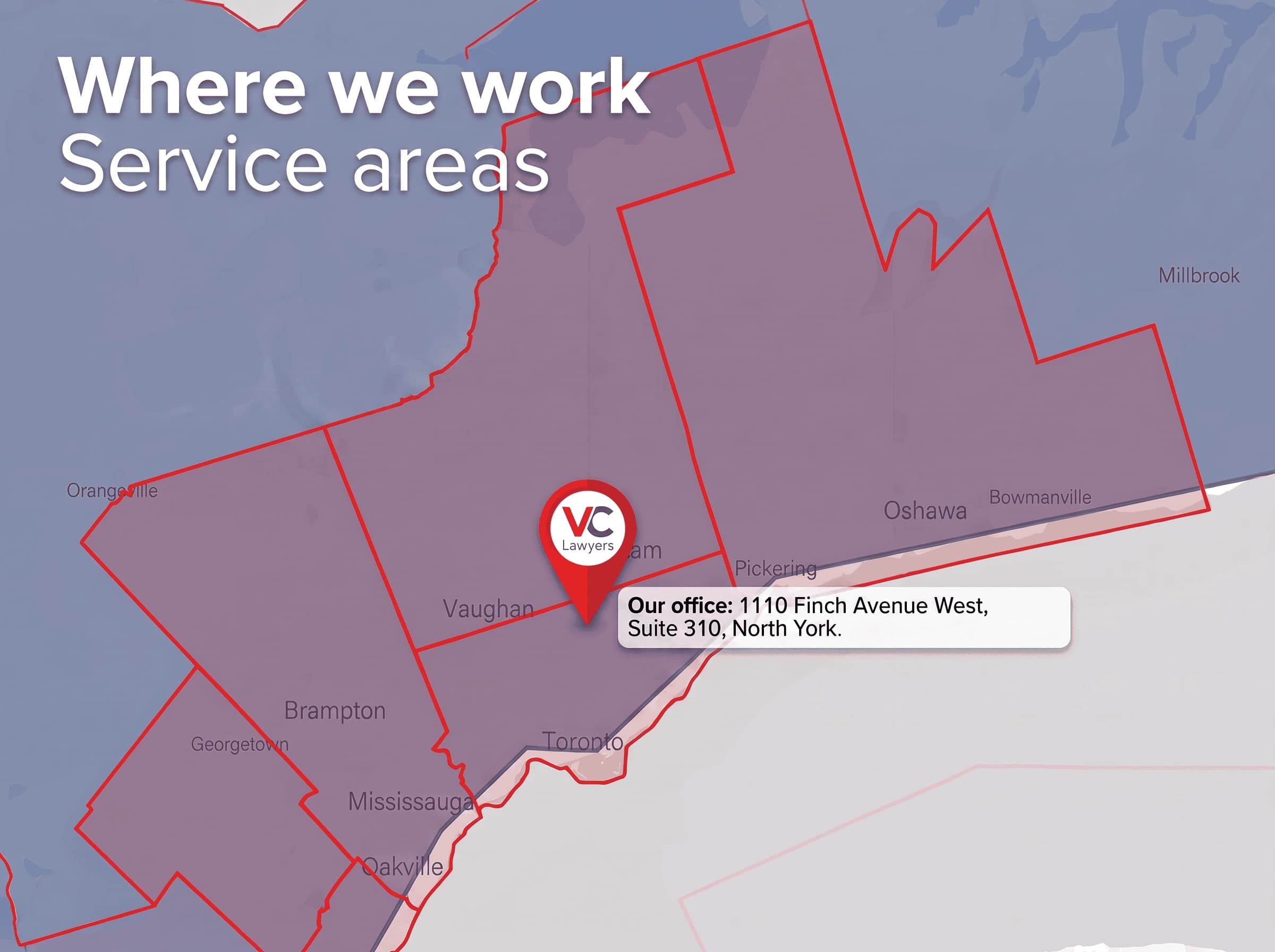
VC Lawyers serves clients throughout the Greater Toronto Area, including Toronto, North York, Scarborough, Etobicoke, Mississauga, Brampton, Oakville, Burlington, Vaughan, Richmond Hill, Pickering, Ajax, Whitby, Oshawa, Newmarket, and Aurora. We also represent clients across Ontario through video consultations and home/hospital visits when needed.
Languages spoken at the firm include English, Korean (한국어), Hebrew, Mandarin, and others depending on lawyer assignment.
Our office is located at 1110 Finch Avenue West, Suite 310, in North York, with parking and TTC access (Finch West subway and bus connections). The location is convenient for clients across the GTA, particularly those in North York, Vaughan, Richmond Hill, and the Finch West / Keele corridor. For balcony and deck accident victims who cannot easily travel to the office, we conduct video consultations and home/hospital visits.
Why people choose VC Lawyers
Choosing the right personal injury law firm after an accident in Toronto can mean the difference between a lowball settlement and the full compensation you deserve.
Personal injury cases run on a contingency basis. You pay nothing upfront.
Speak with an injury lawyer today at zero cost. Other practice areas are quoted before we start.
We’re available around the clock when you need us most.
Too injured to come to us? We’ll come to you.
Services in 8 languages so nothing gets lost in translation.
You’re never just a case number. Get direct access to your lawyer.
Get in touch
Tell us what happened and a lawyer will personally review your case. Personal injury consultations are free and there are no fees unless we win. For all other practice areas, a consultation fee applies.
Prefer to call? (416) 661-4529
Take the next step
Related practice areas
The same practice, served from our office in North York.
For related premises liability cases.
Pool, spa, and waterfront premises liability claims.
Premises liability for animal attacks on the property.
Defective material and component manufacturer claims.
The broader Ontario premises liability framework.
Traumatic brain injury claims after a fall from height.
Multiple fracture cases common in balcony and deck falls.
Statutory accident benefits where motor vehicle coverage applies.