
Maurice Vaturi
Senior Counsel

Employment Law




Trusted by employees and employers across Ontario
Overview
Most legal disputes happen between strangers. Employment disputes happen between people who used to share something: a workplace, a routine, sometimes years of weekly meetings, lunches, project deadlines, after-work drinks. When the relationship breaks down, the fallout is rarely just legal. It is financial. It is emotional. It affects mortgages, retirement plans, professional reputations, and family stability on both sides of the table.
That dual reality is exactly why VC Lawyers built our employment practice the way we did. We act for both employers and employees, but never in the same dispute, and we approach each side with full understanding of what the other is thinking. An employer who has just received a wrongful dismissal claim wants to know two things: how exposed are we, and how do we close this without reputational damage? An employee who has just been terminated wants to know two things: am I being treated fairly, and do I have to accept the package on the table? Both questions deserve serious answers grounded in current Ontario law, not boilerplate disclaimers.
This page is the central hub for everything we do in Toronto employment law. Below you will find an overview of the legal framework, the rights and obligations on both sides, the most common disputes we see in 2026, and links to our two dedicated pages, one for employers and one for employees, where each side can find guidance specific to their position.
Choose your side
We act for both, but never in the same dispute. Click into the page that matches your position to see specific guidance, fee structures, and procedural strategy.
HR compliance, termination strategy, and litigation defence. Fixed-fee compliance audits, contract drafting, and litigation representation.
Wrongful dismissal, severance negotiation, and workplace rights. Flat-fee severance reviews, hourly billing for negotiation and litigation.
Legal framework
Employment in Ontario is governed by a layered system of statutes, regulations, common law principles, and human rights protections. No single document tells the whole story. Understanding which layer applies to your situation is the first step in evaluating any claim or defence.
The Employment Standards Act (ESA) sets the statutory floor: minimum wage, hours of work, overtime, vacation, public holidays, leaves of absence, termination notice, and severance pay. Ontario's general minimum wage is $17.60 per hour, and rises to $17.95 on October 1, 2026. For terminations, the ESA provides termination pay (1 week per year, capped at 8 weeks) and severance pay (1 week per year of service, capped at 26 weeks, available where the employee has 5+ years of service AND the employer has either a $2.5M+ payroll or terminated 50+ employees within 6 months due to permanent closure). A long-tenured employee at a large employer can therefore receive up to 34 weeks of ESA-mandated payments. For most employees, however, the ESA is just the starting point.
Common law reasonable notice is where employment disputes are usually won or lost. Beyond the ESA floor, non-unionized employees in Ontario are entitled to court-developed reasonable notice, calculated using the Bardal factors (length of service, age, character of employment, availability of similar employment). There is no fixed formula. Ontario courts have developed a soft ceiling of approximately 24 months for the most senior, longest-serving employees. The general rule of thumb often cited is “approximately one month of notice per year of service,” but this is a starting point only.
Termination clauses are heavily litigated. Many employers attempt to limit common law notice through termination clauses in employment contracts. Whether such clauses are enforceable has become one of the most heavily litigated questions in Ontario employment law. In Waksdale v Swegon North America Inc. (2020 ONCA 391), the court ruled that a “for cause” provision that violates the ESA makes the entire termination clause unenforceable, and the employee falls back on full common law notice. That holds even when the employee is being terminated without cause. This decision invalidated a huge number of contracts overnight. For employers, termination clauses must be reviewed by an employment lawyer at the time of hire, every time. For employees, a contract that appears to limit your entitlement may not actually do so. A careful legal review can sometimes recover years of additional compensation.
The Ontario Human Rights Code prohibits discrimination in employment on 16 protected grounds. Discrimination claims are heard by the Human Rights Tribunal of Ontario (HRTO), with no filing fees, no costs awarded against losing parties, and a streamlined process. Awards can include compensation for lost wages, compensation for injury to dignity, feelings, and self-respect (typically $10,000 to $50,000, sometimes more), and orders for reinstatement or policy changes.
Protected Grounds
Layered on top of the ESA and common law, the Ontario Human Rights Code prohibits discrimination in employment on the grounds below. Sixteen of them apply in employment; receipt of public assistance is a housing ground and is listed here only to head off the confusion.
Other critical statutes
A complete understanding of Ontario employment law also requires familiarity with the other statutes that govern workplaces, particularly OHSA, WSIA, and the Canada Labour Code for federally regulated industries.

Just received a severance offer?
Initial severance offers are almost always based on ESA minimums. Those minimums are the legal floor, not your full entitlement. The deadline pressure is itself a tactic. Employers know that employees who feel rushed sign quickly.
Most severance offers can be reviewed and negotiated within one to two weeks.
Common disputes
Across our practice, the same patterns repeat. Below are the disputes we see most frequently. Detailed treatment of each is available on the Employer and Employee sub-pages.
The most common employment claim. An employee terminated without cause (or terminated with cause where the employer cannot prove just cause) sues for damages equal to the common law reasonable notice period. The employer's defence usually rests on either (a) a valid termination clause limiting notice to ESA minimums, or (b) just cause for summary dismissal.
The financial stakes are substantial. A 50-year-old marketing manager with 12 years of service earning $120,000 annually could be entitled to 14 to 18 months of notice. That is between $140,000 and $180,000, plus benefits continuation, plus prorated bonus.
A trickier claim. The employee was not formally terminated, but the employer made unilateral changes so significant that the employee was effectively forced to resign. Common triggers include: a unilateral reduction in pay or benefits; a demotion or significant reduction in responsibilities; a forced relocation to a distant office; a toxic workplace where the employer fails to address harassment; a fundamental change in reporting structure or job duties.
The legal test, refined in Potter v New Brunswick Legal Aid Services Commission (2015 SCC 10), asks whether a reasonable person in the employee's position would conclude that the employer's conduct showed an intention to no longer be bound by the contract. If proven, the employee is treated as having been dismissed without cause. That means they receive full common law notice damages.
When an employee receives a severance offer, they are usually asked to sign a release giving up all future legal claims. Once signed, the employee cannot come back later asking for more.
Employers typically offer ESA minimums plus a small “goodwill” amount, hoping the employee will sign quickly. A careful legal review often reveals that the offer is 3-5 times below what the employee could reasonably claim under common law. Negotiation, conducted properly, frequently doubles or triples the original offer without ever needing to file a lawsuit.
Bill 168 (now part of OHSA) requires every Ontario employer to have a workplace harassment policy, conduct investigations of complaints, and protect complainants from reprisal. Despite this, harassment cases continue to dominate our practice. The ones we see most involve bullying by managers; sexual harassment (including post-#MeToo cases now coming forward years later); racial or religious discrimination, especially against employees with non-Western names or accents; disability-related mistreatment (including failure to accommodate).
Employees can pursue harassment claims through HRTO, civil court, or both. Employers facing these claims must respond carefully. Botched investigations create independent liability.
Employers have a duty to accommodate employees with disabilities to the point of “undue hardship,” which is a high legal threshold. This includes physical disabilities, mental health conditions (depression, anxiety, PTSD), addiction (substance use disorders are protected disabilities under Ontario human rights law), and chronic illnesses.
A separate but related practice area involves long-term disability (LTD) claim denials by insurance companies. When an LTD insurer denies coverage, the employee is left without income, often unable to return to work, and facing complex insurance contract disputes. These claims involve different law than employment terminations but are frequently handled by the same legal teams.
A growing practice area. When a complaint is made about harassment, bullying, theft, fraud, or policy violations, the employer must investigate. A bad investigation can do enormous damage. For the complainant it means re-traumatization, valid complaints dismissed, and retaliation. For the respondent it means false findings that destroy careers. For the employer it means civil liability, HRTO claims, and reputational damage.
Investigations require neutrality, proper procedure, and legal training. Many employers retain external workplace investigators (often employment lawyers) for serious complaints.
Before disputes arise, the contract sets the rules. We draft and review: employment agreements (ensuring termination clauses are enforceable post-Waksdale); independent contractor agreements (and the related question of whether someone is really an independent contractor, which the Wiebe Door test answers); non-competition clauses (now banned for most non-executives under the Working for Workers Act, 2021); non-solicitation clauses (still enforceable if narrowly drafted); confidentiality and non-disclosure agreements; bonus and commission plans (a frequent litigation flashpoint when employees are terminated mid-cycle).
Unionized employees in Ontario are governed by the Labour Relations Act, 1995 and resolve disputes through grievance procedures and labour arbitration, not civil court. Federally regulated employees follow the Canada Labour Code, which provides “unjust dismissal” protection unique to federal workers. We handle both.
When 50 or more employees are terminated within a four-week window at a single establishment (now including remote workers' homes, post-2023 amendments), the ESA imposes additional notice requirements: 8, 12, or 16 weeks depending on the size of the termination. Mass terminations also trigger heightened scrutiny under HRTO if any selection criteria correlate with protected grounds.
The rarest and most heavily litigated termination type. “Just cause,” also called “summary dismissal,” allows an employer to terminate without notice and without severance. The legal threshold is extremely high: courts describe just cause as the “capital punishment” of employment law.
Conduct that has been found to support just cause includes serious theft, fraud, willful misconduct, sustained insubordination, and fundamental breach of trust. Conduct that has been found not to support just cause includes most performance issues, single instances of poor judgment, minor policy violations, and personality conflicts. For employers, attempting just cause termination without strong evidence is risky. Courts often find the cause unjust and award aggravated or punitive damages on top of regular notice damages. For employees alleging wrongful termination “with cause,” recovery often includes not just lost wages but additional compensation for the manner of dismissal.
Why both sides need different counsel
The legal industry sometimes treats employment law as if there are two separate practices. The reality is more nuanced. Both sides of every dispute operate under the same legal framework. An employer who understands what an employee is entitled to under common law makes better termination decisions and avoids expensive surprises. An employee who understands what an employer can legitimately demand makes more realistic settlement decisions and avoids prolonged, fruitless litigation.
VC Lawyers acts for both, but never in the same matter. Our internal protocols ensure that an employer file does not share information with an employee file. Conflicts are screened at intake, whether actual or perceived. Within a single firm, this dual-perspective approach has practical benefits: we know what employer counsel will argue because we are employer counsel in other files; we know what employee counsel will demand because we are employee counsel in other files; we negotiate from a position of realism rather than ideology; we resolve cases faster because both sides recognize our credibility on both sides of the table.
Our principles
There is no single right way to handle an employment dispute. Different cases call for different strategies. That said, our practice is built around principles that apply across nearly every file.
Key metrics
The first consultation
Whether you are an employer or an employee, the first consultation follows the same general structure. Consultations are confidential. Solicitor-client privilege protects what you share from the moment the consultation begins, even if you do not retain us.
Fees
Our employment practice offers a 30-minute initial consultation to all prospective clients. This is not a sales call. It is a working session in which a licensed lawyer reviews your situation, identifies the legal issues, and provides a candid assessment of your options.
For employees, a severance package review on its own is a flat fee, typically $500 to $1,500. Negotiation and litigation work is billed hourly. We quote the arrangement in writing before any work begins. Disbursements (court fees, mediator fees, expert reports) are billed separately from fees.
For employers, files are typically handled on hourly billing for litigation work, fixed fees for transactional work (contract drafting, policy review, compliance audits), and monthly retainers for ongoing HR advisory work. We provide written cost estimates before any work begins.
Our team
Employment law rewards strategic clarity, procedural depth, and the ability to negotiate from realism rather than ideology. Our team brings all three to every engagement, for employers and employees alike, and always in different files.
Senior Counsel

Partner

Co-Managing Partner

Lawyer

Lawyer

Immigration Consultant
RCIC R529664 · RQIC 11726
Frequently Asked Questions
Why people choose VC Lawyers
From property and business deals to family and estate matters, the right law firm gives you clear advice, transparent fees, and a lawyer who is genuinely in your corner.
We explain your fee arrangement before we start. No surprises.
One firm for your property, business, family, and estate matters.
Services in 8 languages so nothing gets lost in translation.
You’re never just a file number. Reach your lawyer directly.
Members in good standing with the Law Society of Ontario.
Senior counsel on every matter we handle.
Get in touch
Tell us what happened and a lawyer will personally review your case. Personal injury consultations are free and there are no fees unless we win. For all other practice areas, a consultation fee applies.
Prefer to call? (416) 661-4529
Take the next step
Related practice areas
Employment counsel for North York workers and employers.
For business-side employment matters that intersect with M&A, restructuring, or shareholder disputes.
For breach of contract claims and other commercial disputes that overlap with employment.
WSIB and workplace injury claims under the personal injury framework.
Business succession and family-business employment planning.
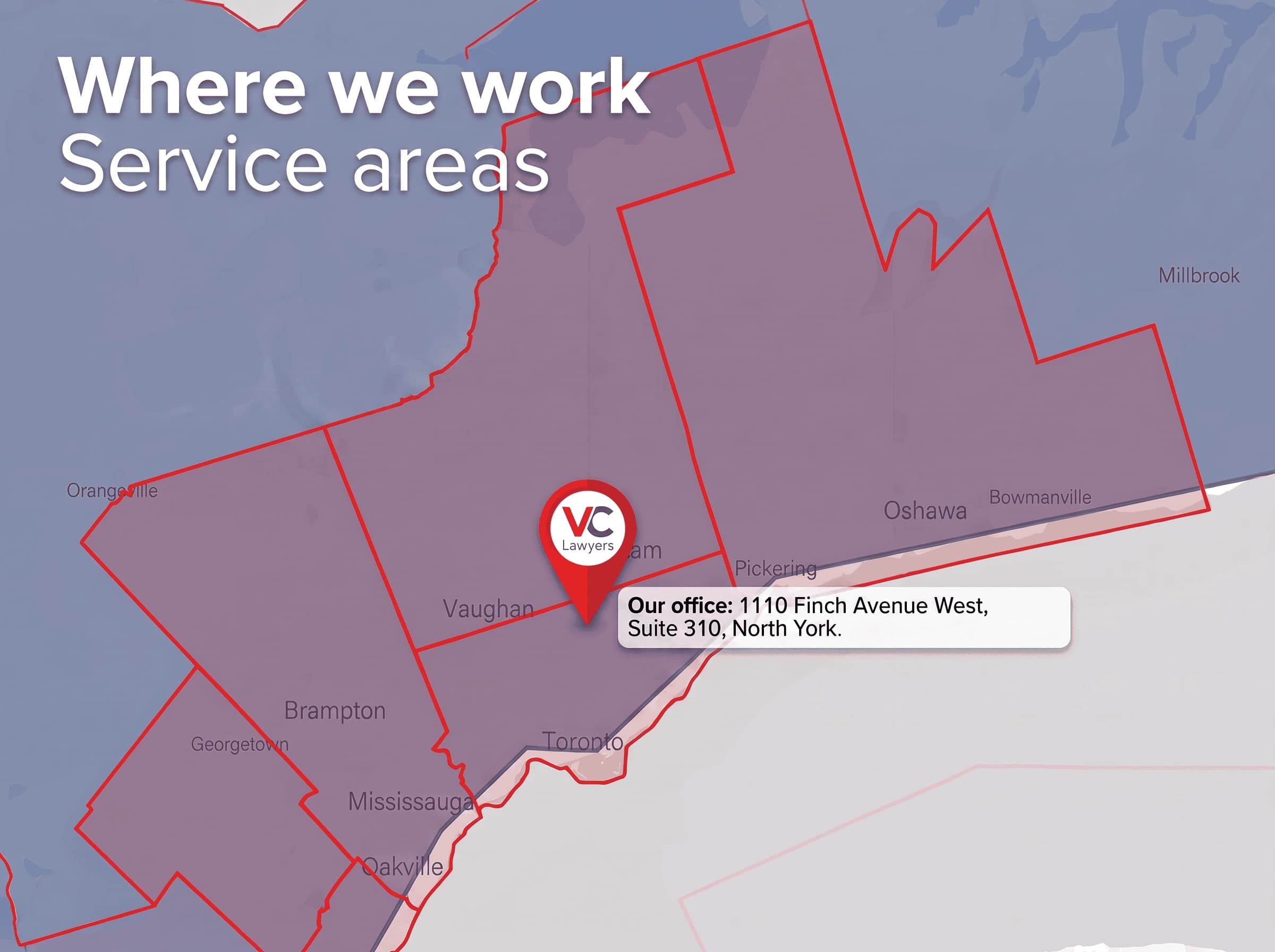
Where we work
VC Lawyers serves clients throughout the Greater Toronto Area, including Toronto, North York, Scarborough, Etobicoke, Mississauga, Brampton, Oakville, Burlington, Vaughan, Richmond Hill, Pickering, Ajax, Whitby, Oshawa, Newmarket, and Aurora. We also represent clients across Ontario through video consultations and home/hospital visits when needed.
Languages spoken at the firm include English, Korean (한국어), Hebrew, Mandarin, and others depending on lawyer assignment.
Our office is located at 1110 Finch Avenue West, Suite 310, in North York, with parking and TTC access (Finch West subway and bus connections).