
Catastrophic Injuries
Toronto Broken Bone & Fracture Lawyerfor car accidents, slip and falls, and workplace injuries




Trusted by accident victims and businesses across Ontario
Overview
The bone that breaks once changes the body forever
The X-ray on the screen at the Toronto General emergency department shows a clean break across the tibia. The orthopedic surgeon explains the surgery: pins, plates, six weeks non-weight-bearing, then graduated rehabilitation. The patient nods, exhausted, still wearing the clothes from the accident scene. The surgery happens. The recovery begins. And then, somewhere around month four or five, the patient starts to realize something they were not warned about: the body that emerges from a serious fracture is not the same body that went in.
The bone has healed. The doctors confirm it. Imaging shows the union is solid. But the leg is weaker than it used to be. The ankle that was once flexible now stiffens up after sitting too long. There is a deep ache in cold weather that was never there before. The fear of falling is completely irrational and deeply embedded, and it shows up on every walk over an icy sidewalk, on every set of stairs, in every moment of physical risk. The sport that filled the twenty years before the accident is over. The career that required physical capacity is in question. The savings that should have funded retirement instead funded six months of physical therapy that OHIP did not cover.
This is the reality of a serious fracture in Ontario. The medical system saves the bone. The legal system, if engaged properly, addresses everything else.
Every year, tens of thousands of Ontarians suffer fractures from preventable causes: car accidents, slip and falls, workplace incidents, defective products, sports injuries caused by negligent operators, dog attacks, and other circumstances where someone else's negligence produced the injury. The medical care comes through OHIP, walk-in clinics, and hospitals. But OHIP does not cover lost income. OHIP does not cover the prescription pain medications that are not on the provincial drug formulary. OHIP does not cover the home modifications, the missed work, the increased childcare expenses, the long-term physical therapy, the orthopedic specialists, or the pain and suffering that the injury produced. For those losses the legal system provides a different framework, and most fracture victims navigate it poorly without representation.
This page is a comprehensive guide to fracture and broken bone law in Ontario. It explains the medical and legal classifications of fractures, the compensation streams available, what cases typically settle for, and how to navigate the insurance and litigation process. It is written for fracture victims and their families. These are the people whose lives are temporarily or permanently changed by an injury that was someone else's fault.
VC Lawyers represents Toronto-area fracture clients in personal injury claims arising from motor vehicle accidents, slip and falls, workplace incidents, and other causes. The first 30-minute consultation is free. All fracture cases are handled on contingency, which means no fee unless we recover. We work in English, Korean, and several other languages. If your situation is urgent, stop reading and call (416) 661-4529.
Medical classifications
What a fracture actually is medically and legally
A fracture, in medical terminology, is any break or crack in a bone. The medical classifications matter because they affect the treatment, the recovery and ultimately the legal compensation.
By completeness
Completeness describes how far the break runs through the bone. A complete fracture separates it into two or more pieces. An incomplete fracture cracks the bone without separating it. A hairline crack may not show up on the first X-ray at all.
The distinction is not academic. The medical classification drives the treatment, the length of the recovery, and ultimately the legal compensation the claim can support.
- Complete fracture : the bone breaks all the way through and separates into two or more pieces.
- Incomplete fracture : the bone cracks but does not separate completely.
- Hairline fracture : a thin crack in the bone, often difficult to see on an initial X-ray.
- Stress fracture : a small crack from repetitive force or overuse.
By skin involvement
Skin involvement separates two kinds of break. In a closed fracture the bone breaks but does not pierce the skin. In an open or compound fracture the bone comes through it.
An open fracture leaves a wound and significantly increases the risk of infection, so the treatment and the recovery look different from the first hour. Because the compensation analysis follows the recovery rather than the X-ray alone, two people who break the same bone can end up with very different claims.
- Closed fracture (simple fracture) : the bone breaks but does not pierce the skin.
- Open fracture (compound fracture) : the bone protrudes through the skin, creating an open wound and significantly increasing infection risk.
By pattern
The pattern of a break records the force that produced it. A spiral fracture usually comes from a rotational force. A comminuted fracture means the bone shattered into three or more pieces. A compression fracture means the bone collapsed on itself, which is common in vertebral fractures.
Pattern also says something about who was injured. Greenstick fractures are mostly seen in children, whose bones are flexible enough to bend rather than break all the way through. A pathologic fracture is a break in a bone already weakened by disease such as cancer or osteoporosis.
- Transverse fracture : a straight horizontal break across the bone.
- Oblique fracture : an angled or diagonal break.
- Spiral fracture : a twisting break, often from a rotational force.
- Comminuted fracture : the bone shatters into three or more pieces.
- Greenstick fracture : a partial fracture, mostly seen in children, where the bone is flexible enough to bend rather than break all the way through.
- Avulsion fracture : a small fragment of bone pulled away by a tendon or ligament.
- Compression fracture : the bone collapses on itself, which is common in vertebral fractures.
- Pathologic fracture : a break in a bone weakened by disease such as cancer or osteoporosis.
By location and alignment
Alignment describes where the pieces ended up. A displaced fracture leaves the fragments out of line with each other. A non-displaced fracture breaks the bone but leaves the fragments aligned.
Location matters most when the break reaches a joint. Articular and intra-articular fractures involve the joint surface itself. Complex articular fractures are among the injuries most likely to leave permanent consequences, such as ongoing functional limitation and accelerated joint degeneration.
- Displaced fracture : the bone fragments are out of alignment.
- Non-displaced fracture : the bone breaks but the fragments remain aligned.
- Articular fracture : the break extends into a joint surface.
- Intra-articular fracture : the fracture line crosses a joint.
- Segmental fracture : the bone breaks in two or more places, creating a “floating” segment.
Common fracture sites we represent
The specific bone matters legally, because different fractures produce different functional consequences. A wrist fracture in a right-handed software engineer and the same fracture in a right-handed neurosurgeon mean very different things for earning capacity.
Age and circumstance work the same way. A femoral fracture in a 25-year-old marathon runner and the same fracture in a 75-year-old retiree produce different lifestyle impacts. The compensation analysis has to reflect the specific person and their specific life, not just the name of the bone.
- Skull fractures (often associated with traumatic brain injury)
- Facial fractures (orbital, nasal, jaw, mandible)
- Cervical spine fractures (neck)
- Thoracic spine fractures (mid-back)
- Lumbar spine fractures (lower back)
- Rib fractures, often complicated by pneumothorax (a collapsed lung) or hemothorax (blood in the chest cavity)
- Sternum fractures
- Clavicle (collar bone) fractures
- Scapula fractures
- Humerus (upper arm) fractures
- Radius and ulna (forearm) fractures
- Wrist fractures (Colles fracture, Smith fracture, scaphoid fracture)
- Hand and finger fractures
- Pelvic fractures, which are often serious and may involve internal injuries
- Hip fractures (femoral neck, intertrochanteric)
- Femur (thigh bone) fractures. The femur is the strongest bone in the body, so breaking it takes significant force
- Patella (kneecap) fractures
- Tibia and fibula (lower leg) fractures
- Ankle fractures
- Foot fractures (calcaneal/heel, metatarsal, talus)
Legal severity
The legal severity of a fracture
From the legal compensation perspective, fractures are categorized by severity and consequence rather than purely by anatomy. Four practical categories drive the value of most fracture cases. The ranges below are illustrative, drawn from Ontario case law and our own files, and they are not guarantees.
Minor fractures
Simple, well-healed fractures with no permanent functional consequences. The wrist that heals cleanly with full restoration of movement and strength. The toe that breaks and heals.
These produce smaller compensation claims, focused on medical costs, lost income during recovery, and pain and suffering during the recovery period. General damages in this band typically run $10,000 to $40,000. Once lost income and out-of-pocket expenses are added, a total settlement usually falls somewhere between $25,000 and $100,000, depending mostly on your occupation and how long the recovery took.
One caution applies if the fracture came from a car accident. Ontario applies a deductible of more than $40,000 to general damages in motor vehicle cases. The deductible is reduced or eliminated only where the award passes a higher threshold. On an award of this size it can consume most of the general damages, so the net recovery is often well below the headline number.
Moderate fractures
Fractures with some permanent consequences: reduced range of motion, intermittent pain, weather sensitivity, an increased risk of arthritis, and cosmetic changes from surgical scars. These produce larger compensation claims because the functional impact extends beyond the recovery period.
The damages reach further as a result. General damages typically run $40,000 to $120,000. The file also carries more substantial claims for lost income and lost earning capacity, for future medical and care costs, and for the loss of housekeeping and homemaking capacity.
Total settlements in this band typically run $75,000 to $400,000. The two factors that move that number most are the permanent functional impact and how much earning capacity the fracture took.
Severe fractures
Fractures with significant permanent consequences: chronic pain, ongoing functional limitation, an inability to return to certain types of work, a need for ongoing medical care, and accelerated joint degeneration. Femur fractures, severe pelvic fractures, vertebral fractures with neurological involvement, and complex articular fractures often fall into this category.
General damages here typically start near $120,000 and can exceed $300,000. They are usually not the largest part of the claim. Substantial future income loss belongs in the file alongside them. So does the future cost of care, which covers possible further surgeries, joint replacement and ongoing pain management. The housekeeping and homemaking claims sit there too.
So do Family Law Act damages. Spouses, children, parents, siblings and certain other family members can recover their own damages for loss of guidance, care and companionship. In serious fracture cases spouses typically recover $20,000 to $75,000, dependent children $15,000 to $50,000 each, and parents and siblings $5,000 to $25,000 each.
Total settlements in this band typically run $300,000 to $1,500,000 and beyond, depending on age, occupation and the extent of the permanent disability. Take a 25-year-old construction worker with a comminuted femur fracture that ends his career. Then take a 75-year-old retiree with the same fracture. The same X-ray produces very different numbers.
Catastrophic fractures
Fractures that produce permanent disability. This band covers fractures associated with brain injury, spinal cord injury or another catastrophic outcome. It covers multiple fractures producing combined impairment exceeding 55% of the whole person. It covers fractures requiring amputation and fractures that fundamentally change the person's life.
These engage the catastrophic impairment framework under the Statutory Accident Benefits Schedule (SABS). That designation is the single largest swing in the file. Medical and rehabilitation benefits rise from $65,000 over five years on a non-catastrophic claim to as much as $1,000,000 for a catastrophic one.
General damages approach the ceiling the Supreme Court of Canada set in Andrews v Grand & Toy Alberta Ltd in 1978. That ceiling was $100,000 then and is roughly $470,000 in 2026 dollars once indexed for inflation. Future cost of care alone often runs $1,000,000 to $5,000,000 for younger claimants with permanent disability. Family Law Act damages are available to several family members at once.
Total settlements for catastrophic outcomes typically start around $1,500,000 and can exceed $5,000,000. The category a fracture lands in is the single biggest driver of its value. The same medical injury can produce very different legal outcomes, depending on the person's circumstances and how the case is built.
The OHIP gap
What OHIP covers, and what it leaves you to pay for
Ontario's public health system saves the bone. It does not cover everything else. Knowing where that gap falls is the foundation of any fracture compensation strategy.
What OHIP covers
The Ontario Health Insurance Plan provides excellent acute medical care for fractures. Emergency department visits, imaging, surgery, hospitalization and follow-up specialist appointments are all covered. For most Ontarians the immediate medical care after a break comes at no out-of-pocket cost.
That is the part of the problem the public system solves well. The bone gets fixed and the acute care is paid for. What OHIP does not do is replace what the fracture took from the rest of your life.
- Emergency department care
- Hospital admission and stay
- Surgical interventions (open reduction internal fixation, joint replacement, etc.)
- X-rays, CT scans, MRIs ordered by physicians
- Specialist consultations (orthopedic surgeon, physiatrist)
- Physiotherapy in hospital settings or with prescribed coverage
- Medications during hospital stays
- Follow-up appointments
What OHIP does NOT cover, and why legal claims matter
OHIP coverage is far from comprehensive once the full impact of a serious fracture is counted. This is one of the most misunderstood points among fracture victims. Most people only learn it months in, once the receipts have already piled up.
For the losses below, the only recovery available is through legal claims against the responsible parties. That usually means a tort claim, SABS benefits after a motor vehicle accident, or WSIB for a workplace injury.
This is why a 25-year-old construction worker who fractures a femur at work faces very different financial consequences from the same worker who fractures a femur falling off a ladder at home. The injury is identical. The compensation framework is not.
- Lost income during recovery : the wages missed during weeks or months off work
- Loss of future earning capacity, where the fracture permanently affects what work you can do
- Out-of-hospital physiotherapy beyond limited covered amounts
- Prescription medications taken at home, unless you are over 65 or qualify for the Ontario Drug Benefit program
- Pain medications that are not on the provincial drug formulary
- Assistive devices such as crutches, walkers and wheelchairs, unless covered under a specific program
- Home modifications such as ramps, grab bars and modified bathrooms
- Transportation costs for medical appointments, especially if you cannot drive
- Increased childcare or eldercare costs during recovery
- Mental health treatment beyond limited OHIP-covered services
- Long-term care needs such as home care and attendant care
- Pain and suffering : the non-economic damages for the experience of injury and recovery
- Future medical costs such as ongoing treatment, eventual hardware removal surgery and joint replacement years later
- Loss of housekeeping and homemaking capacity during recovery and beyond
- Family impact : the toll on spouses, children and parents
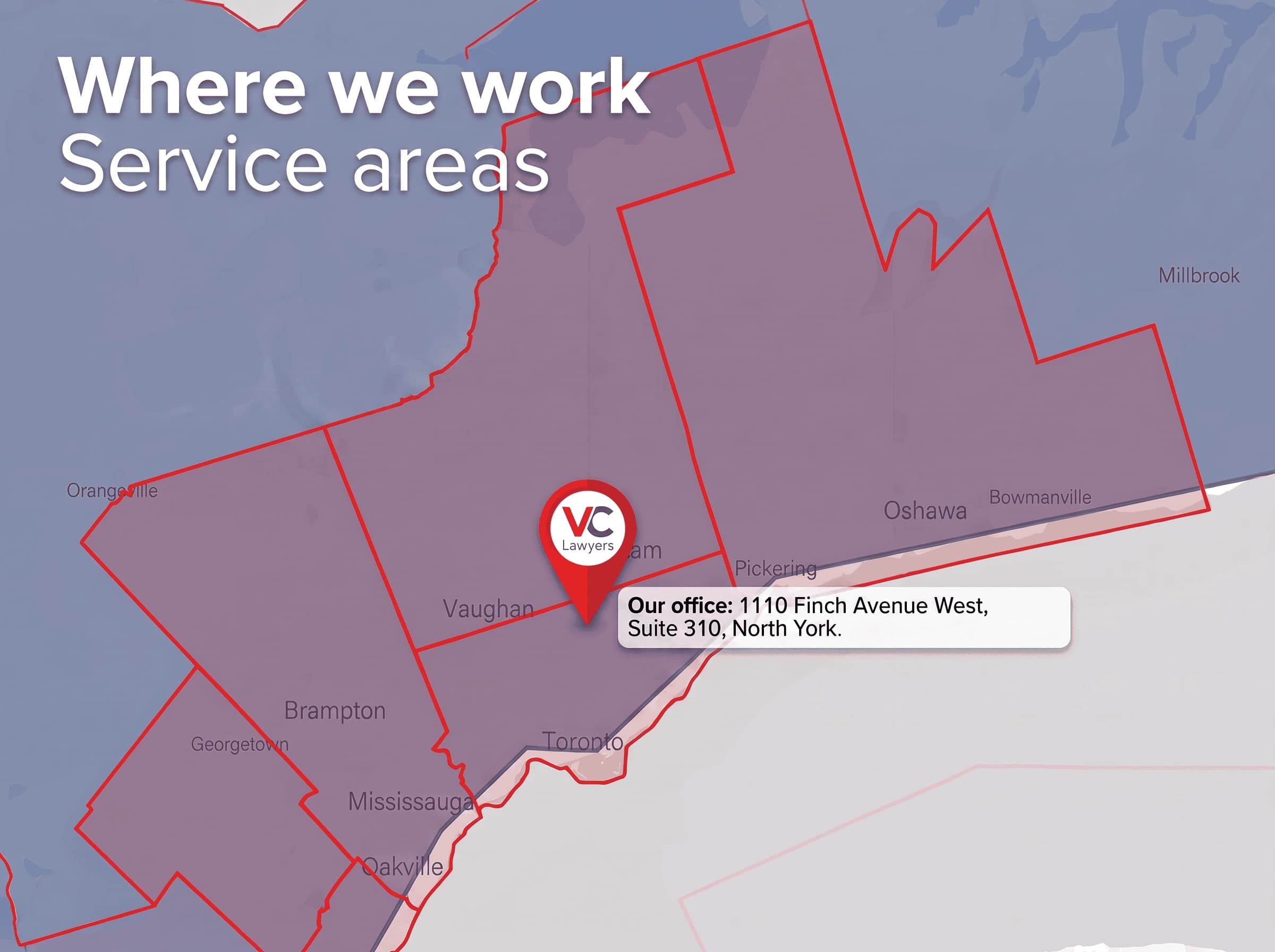
Where we work
Service areas
VC Lawyers serves clients throughout the Greater Toronto Area, including Toronto, North York, Scarborough, Etobicoke, Mississauga, Brampton, Oakville, Burlington, Vaughan, Richmond Hill, Pickering, Ajax, Whitby, Oshawa, Newmarket, and Aurora. We also represent clients across Ontario through video consultations and home/hospital visits when needed.
Languages spoken at the firm include English, Korean (한국어), Hebrew, Mandarin, and others depending on lawyer assignment.
Our office is located at 1110 Finch Avenue West, Suite 310, in North York, with parking and TTC access (Finch West subway and bus connections).
Frequently Asked Questions: Fracture Injury Claims
We answered all
What's the difference between a “broken bone” and a “fracture”?
There is no medical difference. “Broken bone” and “fracture” are interchangeable terms. Both refer to any break in a bone, from a hairline crack to a complete shatter. The medical profession typically uses “fracture” because it includes all forms of bone injury. In legal documents, “fracture” is the more precise term and is preferred. One point causes constant confusion. Many people believe a “fracture” is less serious than a “break,” and that is simply incorrect. Both words describe the same injury. The seriousness depends on the type of fracture (simple vs comminuted, displaced vs non-displaced, location, etc.), not on which word is used to describe it.How long do I have to file a claim for my fracture?
Multiple limitation periods apply. A tort lawsuit against the at-fault party generally has to be started within 2 years of the date of the accident, under the Limitations Act, 2002. A municipal claim over a sidewalk or a road needs written notice within 10 days, under s. 44(10) of the Municipal Act, 2001. For claims against Toronto the equivalent provision is s. 42(6) of the City of Toronto Act, 2006. That notice is separate from the lawsuit, and the lawsuit carries its own limitation period. A SABS application is typically submitted within 30 days of the accident, and late applications are accepted in some circumstances. A WSIB claim is reported to your employer immediately, and the formal claim is filed within 6 months. A dispute of a SABS denial generally has to be brought within 2 years of the date of denial. The 2-year tort limitation is the most consequential deadline. The 10-day municipal notice requirement is also critical for slip and fall cases on city sidewalks. Failure to give written notice within 10 days can defeat the claim, unless there is a reasonable excuse for the delay and the municipality is not prejudiced by it.Can I make a claim if I was partially responsible for my injury?
Yes. Ontario follows the comparative negligence principle under the Negligence Act. Even if you were partially at fault, you can still recover damages, and the recovery is reduced by your percentage of fault. For example, if you were found 25% at fault and your damages were $200,000, you would recover $150,000 (75% of $200,000). Even at 50% fault, you would recover 50% of damages. Courts have found partial fault in cases like these: a slip and fall claimant wearing inappropriate footwear, a pedestrian jaywalking when struck, a worker who failed to use available safety equipment, and a cyclist riding without a helmet. In the helmet cases the fault sometimes attaches to the head injury specifically. Insurance companies often try to maximize your percentage of fault in order to minimize what they pay. An experienced lawyer argues for the lowest defensible percentage and makes sure the recovery reflects the true allocation of responsibility. Even where contributory negligence is significant, the partial recovery is often substantial. Do not assume your own role in the accident eliminates your claim. Get legal advice before you write it off.The insurance company offered me a settlement. Should I take it?
Almost never on the timeline they propose. Initial settlement offers from insurance companies are almost always significantly below what a properly assembled claim is worth. The timing is the point. At that stage you do not yet know the full scope of recoverable damages. Out-of-pocket expenses, lost income, and pain and suffering have not been fully calculated. Future medical costs and earning capacity losses have not been quantified. The claim has not been built on solid medical and expert evidence. The deductible and other Ontario-specific factors may not have been properly addressed. A settlement signed at this stage typically includes a release giving up all future legal claims. Once signed, you cannot come back later asking for more. That holds even if you discover months down the road that the injury is worse than you thought, or that the ongoing treatment is more extensive. Do not sign anything before consulting a personal injury lawyer. If you have already signed a release and have concerns, raise them with a lawyer anyway. There are limited circumstances in which a release can be set aside, including lack of consideration, misrepresentation and duress, but the analysis is fact-specific. The 30-minute consultation is free, and it may dramatically increase your eventual recovery.What does it cost to hire a personal injury lawyer?
Personal injury cases are typically handled on contingency, meaning no fee unless we recover compensation for you. The contingency percentage is set in writing at the start, typically ranging from 25% to 33% depending on the complexity and the stage at which the matter resolves. Disbursements (court filing fees, expert reports, medical records requests, examination transcripts, and mediation fees) are typically advanced by the firm and recovered from the eventual settlement. The first 30-minute consultation is free with no obligation. For a serious fracture case that proceeds toward litigation, total disbursements can be substantial. They are carried by the firm and reimbursed only when the matter resolves, so you are not paying for expert reports out of pocket while the case runs. The contingency structure aligns the lawyer's incentives with yours: we get paid based on what you recover, so the harder we work to maximize your recovery, the better the outcome for both sides.My fracture happened at work. Can I sue my employer?
Generally no, but third-party claims may still be available. Under Ontario's Workplace Safety and Insurance Act, workers covered by WSIB are generally precluded from suing their employer or co-workers for workplace injuries. WSIB benefits replace the right to sue. Third-party tort claims are the exception. Equipment manufacturers can face a product liability claim. So can contractors on multi-employer construction sites. So can a driver who is not your employer and who caused a vehicle-related workplace accident. So can a property owner, where the workplace sits on someone else's property and the owner's negligence contributed. Whether third-party claims are available is fact-specific. WSIB claims themselves benefit from legal advice, particularly for permanent impairment determinations, ongoing benefit disputes, and appeals to the Workplace Safety and Insurance Appeals Tribunal (WSIAT).Do I have to go to court if I make a claim?
Probably not. The vast majority of fracture cases settle before trial. Industry statistics suggest that fewer than 5% of personal injury claims actually go to trial. Most resolve through negotiation between counsel, mandatory or voluntary mediation, pre-trial conferences, or pre-trial settlement. The threat of trial, combined with the cost and uncertainty of trial preparation, provides settlement leverage. A typical timeline runs like this. Initial review and the demand letter take 1 to 3 months. Negotiation follows, and many cases settle at that stage. A Statement of Claim is filed 6 to 12 months from intake. Discovery and examinations run from 12 to 24 months. Mediation comes next, and most cases settle there. Trial happens only if every earlier attempt at resolution fails. If your case does need to go to trial, that would typically happen 2 to 4 years after the accident.What if my fracture has caused chronic pain?
Chronic pain following fractures is a significant additional claim element. Even after the bone has fully healed, ongoing pain is recognized in Ontario law as a compensable injury, whether it comes from soft tissue damage, nerve injury, complex regional pain syndrome (CRPS), or another cause. The Supreme Court of Canada in Nova Scotia (WCB) v Martin (2003 SCC 54) confirmed that chronic pain disability is real and disabling. In a fracture case with a chronic pain component, a few steps matter more than the rest. Document the pain consistently, through a pain diary and your treating physician's notes. Get a specialist evaluation from pain medicine, an orthopedic surgeon, or a neurologist. Consider CRPS specifically if the pain is disproportionate to the original injury. Assess the functional impact of the pain on work, activities, and quality of life. And address the mental health side of it.What evidence should I be gathering for my fracture claim?
Start collecting evidence immediately. Begin with the medical file. Collect the emergency department records and the hospital records covering admission, surgery and discharge. Collect every imaging study, including X-rays, CT scans and MRIs. Collect the specialist consultations, the treatment notes from physiotherapy and occupational therapy, and the prescriptions and medication records. Ask for your pre-accident medical records too, because they establish the baseline. The financial evidence is the next layer: pre-accident pay stubs and T4s, records of time off work, receipts for every out-of-pocket expense, invoices for treatments not covered by OHIP, and records of cancelled events, vacations and activities. Liability evidence starts with the police accident report. Photograph the scene, the conditions and the vehicles. Photograph your injuries, casts, surgical scars and mobility aids. Collect witness names and contact information, maintenance and inspection records, and weather records if a slip and fall happened on ice. Ask for surveillance footage from nearby cameras early, because most of it is overwritten within days. The last layer is personal evidence: a pain diary or recovery journal, photographs of activities you can no longer do, and statements from family members about your changed condition.How do I choose the right fracture lawyer in Toronto?
Several factors matter. Start with depth of experience and look for lawyers whose practice is concentrated in personal injury work. Ask about their track record with fracture cases specifically, including past similar cases, the outcomes, and how they were handled. Ask whether the firm has the resources to carry the case, which often means $20,000 to $100,000 or more in disbursements over the course of the litigation. Ask about trial experience. Most cases settle, but they settle well only when the lawyer is credibly prepared to go to trial. Then weigh three more things: communication and accessibility over the 2 to 4 years a case can run, cultural and linguistic capacity, and contingency fee transparency backed by a clear written agreement. The first consultation is the time to evaluate all of this. Compare two or three firms before deciding.
Why people choose VC Lawyers
The right firm handles everything so you can focus on recovery
Choosing the right personal injury law firm after an accident in Toronto can mean the difference between a lowball settlement and the full compensation you deserve.
No Fees Unless We Win
Personal injury cases run on a contingency basis. You pay nothing upfront.
Free Personal Injury Consultation
Speak with an injury lawyer today at zero cost. Other practice areas are quoted before we start.
24/7 Emergency Hotline
We’re available around the clock when you need us most.
Home & Hospital Visits
Too injured to come to us? We’ll come to you.
Multilingual Legal Team
Services in 8 languages so nothing gets lost in translation.
Boutique Firm, Big Results
You’re never just a case number. Get direct access to your lawyer.
Get in touch
Looking for legal help? Speak directly with a lawyer
Tell us what happened and a lawyer will personally review your case. Personal injury consultations are free and there are no fees unless we win. For all other practice areas, a consultation fee applies.
- $30M+ recovered for injury clients
- Available 24/7, including weekends
- Service in English, Korean, and 6+ more languages
Prefer to call? (416) 661-4529
Take the next step
A serious fracture changes the math of your year.
Related practice areas
Continue exploring
Broken Bone & Fracture Lawyer in North York
The same practice, served from our office in North York.
Personal Injury Lawyer Toronto
For the broader personal injury framework.
Toronto Car Accident Lawyer
For motor vehicle accident fractures.
Toronto Slip & Fall Lawyer
For slip and fall fractures.
WSIB Lawyers in Ontario
For workplace fracture WSIB and third-party claims.
Toronto Chronic Pain Lawyer
For fractures producing chronic pain.
Toronto Amputation Lawyer
For fractures requiring amputation.
Catastrophic Injury Lawyer Toronto
For fractures that meet the catastrophic impairment threshold.
Toronto Non-Earner Benefits Lawyer
For SABS NEB claims after motor vehicle fractures.