VC·Lawyers®
Toronto work-related injury lawyer — VC Lawyers

Workplace & Specialty

Toronto Work-Related Injury Lawyertort claims and WSIB-election strategy

Toronto Lawyers Association
Ontario Trial Lawyers Association (OTLA)
The Canadian Bar Association
Love Toronto
Consulate General of the Republic of Korea in Toronto
Korean Legal Clinic
Ontario Bar Association
Toronto Lawyers Association
Ontario Trial Lawyers Association (OTLA)
The Canadian Bar Association
Love Toronto
Consulate General of the Republic of Korea in Toronto
Korean Legal Clinic
Ontario Bar Association
Toronto Lawyers Association
Ontario Trial Lawyers Association (OTLA)
The Canadian Bar Association
Love Toronto
Consulate General of the Republic of Korea in Toronto
Korean Legal Clinic
Ontario Bar Association

Trusted by injured workers across Ontario

Overview

When Work Becomes the Reason You Can't Work

A delivery driver in Mississauga is rear-ended by an impaired driver while making a route stop. He's hospitalized for two weeks, then home with a back injury that won't heal. His employer files the WSIB Form 7 immediately. Within days, WSIB sends him paperwork — including a form he's never heard of called an “Election Form.” His brother-in-law tells him to sign it and get the WSIB benefits started. The injured driver doesn't know that the form will permanently extinguish his right to sue the impaired driver — a tort claim that, properly pursued, could be worth ten times what WSIB will pay over his lifetime. He has three months to figure this out, but he doesn't know that either.

A construction worker on a Toronto high-rise project is struck by debris falling from above. The debris came from work being done by a different company on the same site — a subcontractor he's never met, doing work for a contractor he doesn't directly work for. He has a fractured pelvis, a concussion, and a torn rotator cuff. His own employer is reasonable and supportive. WSIB benefits begin within weeks. But over the months that follow, as the medical bills mount and his career future becomes uncertain, he learns that he probably could have sued the subcontractor whose negligent work caused the falling debris — except that by accepting WSIB benefits without legal advice, he transferred that right to WSIB itself.

A long-tenured employee at a Toronto company develops chronic pain after years of repetitive strain and a workplace that ignored her ergonomic complaints. She files a WSIB claim. WSIB denies it, finding insufficient evidence that the condition is “predominantly work-related.” She has 30 days to appeal — and then a longer, harder process through the WSIAT — to challenge the denial. She doesn't know which forms to file, which medical evidence to gather, what the legal standards actually require, or how long the process will take. Without representation, she loses the appeal and is left without coverage for a condition her workplace caused.

These scenarios reflect the daily reality of work-related injury law in Ontario. The system is more complex than most workers realize, the deadlines are tighter than most workers expect, and the decisions made in the first weeks after an injury often determine whether the injured worker receives meaningful compensation — or has those rights taken away by procedural defaults.

VC Lawyers represents injured workers throughout Ontario in third-party tort claims arising from workplace injuries, WSIB appeals, and the navigation between these systems. The first 30-minute consultation is free, all qualifying cases are handled on contingency (no fee unless we recover), and we work in English, Korean, and several other languages. Call (416) 661-4529 at any point in this article if you need urgent advice — particularly if you're approaching the 3-month election deadline or the 6-month WSIB claim deadline.
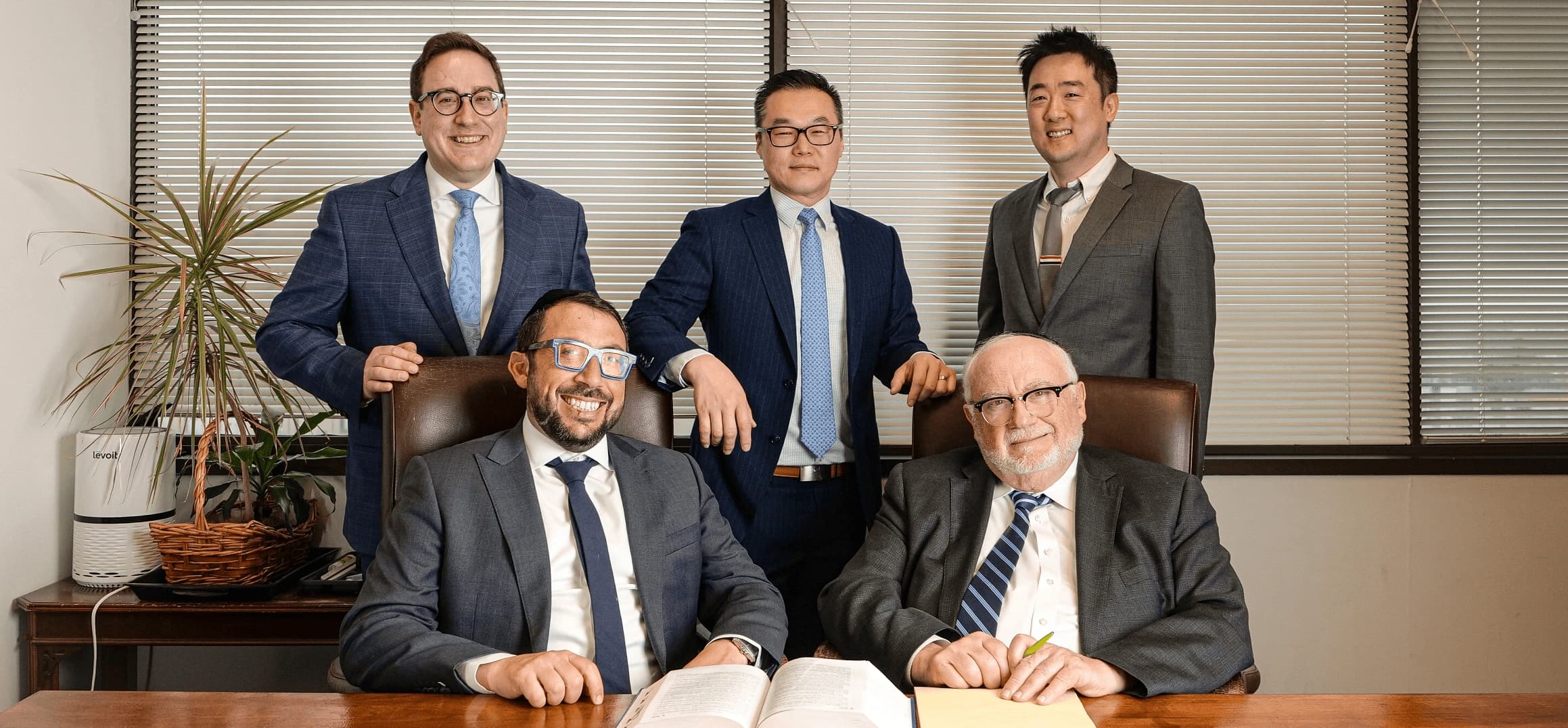
VC Lawyers Toronto personal injury team — Vaturi & Cho LLP lawyers

Talk to us

Every work-related injury case deserves a careful look

The first 30-minute consultation is free and confidential. We will tell you within that conversation what your realistic options are — and what to do next.

No fee unless we recover. Home and hospital visits available across the GTA.

Book Free Consultation

Compensation comparison

What Compensation Looks Like — WSIB vs. Tort

Understanding the different financial outcomes of the WSIB and tort paths helps explain why the election decision matters so much.

  1. Moderately serious injury

    WSIB: $50,000-$150,000. Tort: $100,000-$300,000+.
  2. Severe injury / permanent disability

    WSIB: $1,000,000-$3,000,000+. Tort: $2,000,000-$10,000,000+.

For minor injuries, WSIB and tort recovery are roughly comparable, and WSIB's faster timeline favors most workers.

For moderate injuries, tort recovery typically exceeds WSIB by 2-3x.

For serious and catastrophic injuries, tort recovery typically exceeds WSIB by 3-5x or more.

The election decision in concurrent entitlement cases is therefore most consequential for the most seriously injured workers — and these are precisely the workers most likely to receive Election Forms quickly without time to seek legal advice.

Our approach

How VC Lawyers Approaches Work-Related Injury Cases

Our work in this practice area is built on principles specific to workplace injuries:

  1. 01

    Early Strategic Analysis

    The first weeks after a workplace injury determine the trajectory of the case. We provide early consultations specifically because the 3-month election deadline can foreclose options that would otherwise be available. Don't wait until deadlines are approaching to seek advice.

  2. 02

    Both WSIB and Tort Capabilities

    We handle both WSIB appeals and third-party tort claims. This dual capability matters because the strategic decisions in one system affect the other. Coordinating the strategies — including the election decision — produces better outcomes than handling them separately.

  3. 03

    Multiple Defendant Identification

    For tort claims, identifying all potential defendants is essential. Construction injury cases in particular often involve multiple potentially liable parties — owners, contractors, subcontractors, manufacturers, designers. Comprehensive defendant identification often increases total recovery substantially.

  4. 04

    Medical Evidence Development

    Both WSIB claims and tort claims live or die on medical evidence. We work with treating physicians, specialists, occupational medicine experts, and functional capacity evaluators to develop the medical record needed for each forum.

  5. 05

    Cost Transparency and Contingency Fee Structure

    Tort claims handled on contingency — no fee unless we recover. WSIB appeals often handled on contingency or modified fee arrangements. All fee structures set in writing at engagement, with no hidden charges.

  6. 06

    Direct Lawyer Access

    When you retain VC Lawyers, you work directly with the lawyer handling your file. No paralegals or junior associates managing serious cases while a partner's name appears on the letterhead.

  7. 07

    Cultural Sensitivity and Multilingual Service

    Toronto's diversity is reflected in our practice. We handle files in English, Korean, and several other languages.

  8. 08

    We Represent Workers Only

    VC Lawyers represents injured workers in WSIB claims, appeals, and tort matters. We do not represent employers in WSIB defence work, and we do not defend tort claims brought by injured workers. Our entire role is advocacy for the injured.

Key metrics

In the numbers

Recovered for accident victims
$30M+

Recovered for accident victims

Section 30 election deadline
3 mo

Section 30 election deadline

Years combined experience
70+

Years combined experience

Hotline availability
24/7

Hotline availability

Kate Min Kwon — Immigration Consultant at VC Lawyers Toronto

Kate Min Kwon

Immigration Consultant

RCIC R529664 · RQIC 11726

FAQs
Frequently Asked Questions

  • I was injured at work. Should I file a WSIB claim or talk to a lawyer first?
    In most cases, you can do both. The standard practical advice for most injured workers: immediately, report the injury to your employer (mandatory under both WSIA and most employment policies), get medical attention, the employer files Form 7, and WSIB receives the file. Within days to weeks, file your worker's claim form (Form 6) and consent — this starts your WSIB benefits. Then consult a personal injury lawyer; most consultations are free. The lawyer assesses whether third-party claims are available alongside or instead of WSIB benefits. The risk of waiting too long before consulting a lawyer is the 3-month election deadline. If a third-party claim might be available, the election decision must be made within 3 months. Specific situations requiring urgent legal consultation: motor vehicle accidents while working; construction site injuries on multi-employer sites; injuries caused by defective equipment; slip-and-fall injuries on properties not owned by your employer; injuries caused by clearly negligent third parties; severe injuries with permanent consequences. For these situations, consult a lawyer before signing any Election Form.
  • Can I sue my employer for my workplace injury?
    Generally no, with limited exceptions. The WSIB system shields most Ontario employers from lawsuits for workplace injuries. The “historic compromise” gives you guaranteed benefits in exchange for the right to sue. Exceptions where you CAN sue your employer: your employer is not WSIB-covered (banks, dental offices, some travel agencies, certain professional offices); your employer is not properly registered with WSIB despite being required to (very limited situations); the injury occurred outside the course of employment (rare cases); the injury was caused by conduct so egregious it falls outside the WSIB shield (extremely rare). For the vast majority of Ontario workers, suing the employer for a workplace injury is not legally available. What you can do instead: WSIB benefits for the work-related injury; third-party claims against negligent parties other than your employer; OHSA reports for safety violations (regulatory, not compensation); workplace harassment complaints under the Occupational Health and Safety Act; constructive dismissal claims if the workplace conditions are intolerable (employment law, not WSIB).
  • The Election Form arrived. I have to choose between WSIB and a lawsuit. How do I decide?
    This is the highest-stakes decision in workplace injury law, and it should not be made without legal advice. Factors favouring WSIB election: minor injury with quick recovery expected; limited or no clear third-party fault; third-party defendant has minimal insurance or assets; immediate income need (can't wait for tort recovery); need for ongoing healthcare benefits WSIB provides; career uncertainty making vocational support valuable. Factors favouring tort claim election: serious injury with significant pain and suffering; strong evidence of clear third-party fault; adequate insurance coverage available from defendant(s); multiple potential defendants increasing total recovery; permanent injury affecting future earning capacity; family members with significant Family Law Act damages; catastrophic injury where tort damages substantially exceed WSIB caps. A qualified personal injury lawyer will analyze your specific situation against these factors. The free 30-minute consultation can identify the realistic recovery in each scenario. Critical: the 3-month election deadline does not pause for legal consultation. If you receive an Election Form, contact a lawyer immediately rather than waiting for the deadline to approach.
  • What if I already signed the Election Form for WSIB and now I think I should have sued?
    The election is generally final. Once you've elected WSIB, you've transferred your right to sue to WSIB. Limited circumstances where the election may be challenged: WSIB provided inaccurate information that affected your decision; you were unable to understand what you were signing (language barriers, cognitive issues, severe trauma); the form was signed under coercion or duress; new information has emerged that materially changes the analysis. These challenges are difficult but not impossible. WSIB has internal procedures, and WSIAT has jurisdiction in some cases. If you've signed an Election Form and now have concerns: don't assume nothing can be done; consult a personal injury lawyer immediately; don't sign any further forms or release without legal review; preserve all communications with WSIB and your employer. The earlier you raise the issue, the more options remain.
  • I'm an independent contractor. How does WSIB apply to me?
    Independent contractors, sole proprietors, and partners are generally not covered by WSIB unless they specifically purchase optional coverage. Implications: you don't receive WSIB benefits for workplace injuries; you retain full tort rights — including against the company you're working for; your full income loss, pain and suffering, and other tort damages are recoverable. Practical advice: if you're injured working as an independent contractor, all your tort options are open. The party that hired you can be sued for negligence. The premises owner can be sued for occupier's liability. Manufacturer can be sued for product defects. The classification challenge: whether you're truly an “independent contractor” or actually a “worker” is sometimes contested. The CRA, ESDC, and WSIB use different tests. Misclassification (calling a worker an “independent contractor” to avoid WSIB and other obligations) is increasingly common. For genuinely misclassified workers, both tort claims and WSIB claims may be available. If you're an independent contractor with a workplace injury, legal advice clarifies your options.
  • WSIB denied my claim. What now?
    Denials happen, including for many legitimate claims. The appeals process exists and is meaningful. Steps after denial: Step 1 — read the decision carefully; identify the specific reasons for denial. Step 2 — gather any new evidence that addresses those reasons (medical records, witness statements, employer documentation, expert opinions). Step 3 — file a reconsideration request with the original WSIB adjudicator; informal and free; many denials resolve here. Step 4 — if reconsideration fails, file an ARO appeal (Appeals Resolution Officer); this is a formal WSIB internal appeal; deadline 6 months from original decision. Step 5 — if ARO appeal fails, file a WSIAT appeal (Workplace Safety and Insurance Appeals Tribunal); independent tribunal, formal hearing; deadline 6 months from ARO decision. Step 6 — if WSIAT decision is unfavourable, judicial review in Divisional Court is possible (narrow grounds). Common appeal-success scenarios: new medical evidence proving causation; employer documentation establishing course of employment; expert reports addressing pre-existing condition issues; detailed factual record building. Workers benefit substantially from legal representation at the ARO and WSIAT stages.
  • I have severe chronic pain from work but WSIB says it's “not predominantly work-related.” Can I challenge this?
    Yes, this is one of the most contested issues in WSIB practice and is appealable. The legal framework: WSIB doesn't require workplace cause to be the only cause; the legal test is whether work was a “significant contributing factor”; pre-existing conditions can complicate the analysis but don't bar the claim; the “thin skull” rule means employers take workers as they find them. Common appeal scenarios: repetitive strain injuries denied as “degenerative”; chronic back pain denied as “pre-existing”; mental stress denied as not “substantial enough”; chronic pain syndrome denied as “not objectively medically supported.” What strengthens the appeal: specialist medical reports addressing causation specifically; functional capacity evaluations documenting the impact; job-specific analysis showing the work demands; comparative analysis showing what the worker could do before vs. now; expert reports from physicians specializing in occupational medicine. The Supreme Court of Canada in Nova Scotia (WCB) v Martin (2003 SCC 54) confirmed that chronic pain is a real disability that workers' compensation systems cannot exclude. Ontario courts have applied this principle.
  • What's the relationship between WSIB and other benefits like LTD or EI?
    Workers often have multiple coverage sources. The relationships are complex but important. WSIB and LTD (Long-Term Disability): most LTD policies have offset clauses reducing benefits by WSIB amounts; the total income replacement isn't doubled — it's coordinated; some LTD policies refuse to pay any LTD benefits while WSIB is paying; disputes over which insurer pays first are common. WSIB and EI (Employment Insurance): WSIB recipients generally cannot collect EI sickness benefits simultaneously; once WSIB benefits end, EI may become available. WSIB and CPP-D (Canada Pension Plan Disability): these are separate programs; some workers receive both; coordination rules apply; both have their own appeal processes. WSIB and private disability insurance: generally coordinates similarly to LTD; specific policy terms control. WSIB and tort recovery (when permitted): tort awards may be subject to WSIB subrogation; some heads of damage may be reduced; settlement negotiation typically addresses these issues. For workers with multiple coverage sources, comprehensive review by a personal injury lawyer ensures the available benefits are properly coordinated.
  • My employer is saying my injury isn't work-related. What should I do?
    This is a common dispute, particularly when the injury developed gradually (repetitive strain, chronic conditions), occurred during travel for work, occurred during work-from-home, occurred during work-related events (lunches, social functions), or has both work and non-work contributing factors. Critical steps: (1) Report anyway — even if your employer disputes the connection, file your Form 6 with WSIB. The 6-month deadline applies regardless of employer's position. (2) Document everything — save communications with employer, medical visit dates, witnesses to workplace incidents, ergonomic complaints made before injury, photos of workplace conditions. (3) Get medical documentation — treating physicians' reports addressing the work connection are critical; specialist consultations may be needed. (4) Don't accept employer's assessment — your employer is not the decision-maker on WSIB claims. WSIB is. Your employer's denial doesn't determine whether you receive benefits. (5) Get legal advice early — the earlier the legal analysis begins, the stronger the case becomes. The fact that your employer disputes the work connection often strengthens the case for legal representation rather than weakening it.
  • What does it cost to hire a workplace injury lawyer?
    Different practice areas within workplace injury law involve different fee structures. Third-party tort claims: handled on contingency — no fee unless we recover. Typically 25-33% of recovery, set in writing at engagement. Disbursements advanced by the firm and recovered from settlement. WSIB appeals (ARO and WSIAT): often handled on contingency but the structure varies. Some firms charge hourly; some use modified contingency arrangements. Discuss specific structure during consultation. Initial consultation: free, 30 minutes, no obligation. We'll explain available options and recommended path. For serious workplace injury cases involving both WSIB and tort issues, often the most cost-effective approach is a single firm handling both — coordinating the strategies, identifying when to elect, and pursuing all available recovery sources. The contingency fee structure means injured workers can access experienced legal representation without upfront cost.

Service areas

Service Areas

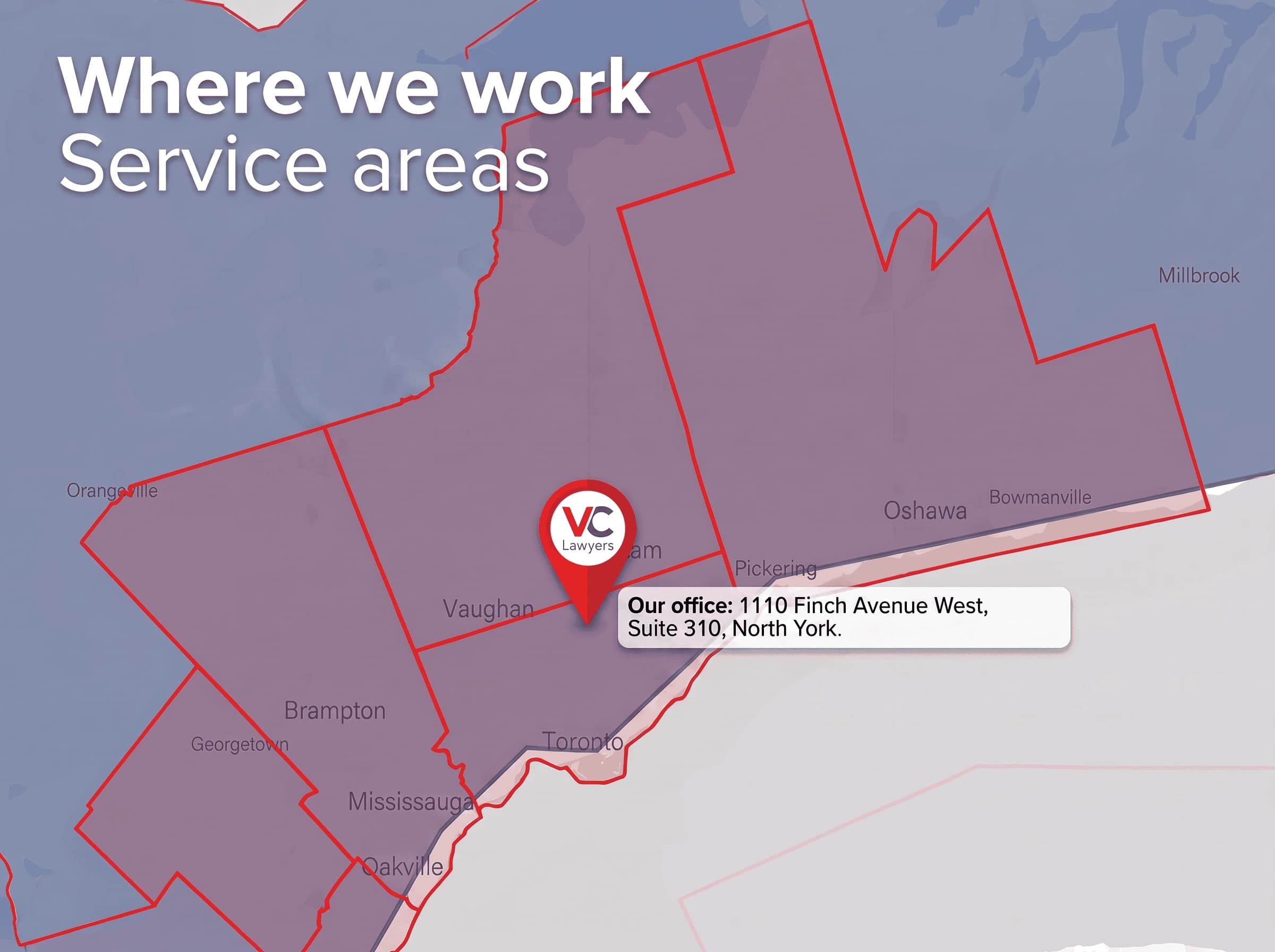
VC Lawyers serves workers throughout the Greater Toronto Area, including Toronto, North York, Scarborough, Etobicoke, Mississauga, Brampton, Oakville, Burlington, Vaughan, Richmond Hill, Pickering, Ajax, Whitby, Oshawa, Newmarket, and Aurora. We also represent workers across Ontario through video consultations and home/hospital visits when needed.

Languages spoken at the firm include English, Korean (한국어), Hebrew, Mandarin, and others depending on lawyer assignment.

Our office is located at 1110 Finch Avenue West, Suite 310, in North York, with parking and TTC access (Finch West subway and bus connections). The location is convenient for clients across the GTA, particularly those in North York, Vaughan, Richmond Hill, and the Finch West / Keele corridor.

VC Lawyers service area map — Toronto and Greater Toronto Area

Where we work

Service areas

VC Lawyers serves clients throughout the Greater Toronto Area, including Toronto, North York, Scarborough, Etobicoke, Mississauga, Brampton, Oakville, Burlington, Vaughan, Richmond Hill, Pickering, Ajax, Whitby, Oshawa, Newmarket, and Aurora. We also represent clients across Ontario through video consultations and home/hospital visits when needed.

Languages spoken at the firm include English, Korean (한국어), Hebrew, Mandarin, and others depending on lawyer assignment.

Our office is located at 1110 Finch Avenue West, Suite 310, in North York, with parking and TTC access (Finch West subway and bus connections).

Take the next step

Take the Next Step

Workplace injuries produce some of the most complex personal injury cases in Ontario law. The intersection of WSIB and tort systems, the deadline pressures, the election decision, the appeal processes — all require sophisticated legal navigation. The financial stakes are often substantial, particularly for severe injuries where the difference between WSIB-only recovery and combined recovery can be hundreds of thousands or millions of dollars.

The first conversation is free, the relationship is contingent (no fee unless we recover), and within 30 minutes you will have a clear understanding of your rights, your realistic options, and what to do next. We can come to your home or hospital for the consultation if travel is difficult.

Urgent: If you've received an Election Form or are approaching the 3-month deadline, call today.

Free consultation · Contingency fee · WSIB and tort claims · Korean and other languages
Korean language: 한국어 페이지 (/ko/personal-injury/work-related-injuries)

Toronto Office

Vaturi & Cho LLP

1110 Finch Ave W #310
North York, ON M3J 2T2
info@vclawyers.ca

Related practice areas

Continue exploring