
Catastrophic Injuries
Toronto Scarring & Disfigurement Lawyerfor permanent visible scars, burns, and disfigurement



Trusted by accident victims and businesses across Ontario
Overview
The mirror that stopped looking the same
Most people who suffer disfiguring injuries describe the same first moment. Days or weeks after the accident, after the bandages come off and the surgery is done, they stand in front of a bathroom mirror and see a face or body that is recognizably theirs but no longer fully theirs. The skin pulls differently. There is a line, a discoloration, a contour change, a missing piece. The reflection is the same person at one level and a stranger at another.
For the people who experience this, the legal system can feel almost insulting. The forms talk about “permanent serious disfigurement.” The insurance adjusters want to know whether the scar is a millimeter wider or thinner. The medical reports describe “well-healed” surgical sites with clinical detachment. None of it captures what the injury actually means. Every social interaction now starts with a calculation: whether to make eye contact, whether the other person is going to look and look away, whether to wear something that covers the scar or accept the visibility. Even a friend's wedding photographs raise the question of how they will look now compared with before.
The financial harm of disfigurement is real but almost beside the point compared to the human harm. A scar that runs from the corner of the mouth to the jawline does not just affect appearance. It changes how the person experiences every social moment for the rest of their life. A burn scar across the upper chest changes what a person can wear. Surgical scarring across the abdomen changes intimate relationships, and it changes swimming and beach days. It leaves decades of quiet, constant decisions about visibility. The keloid that develops on a child's face changes how that child grows up, how they dress, how they relate to peers, and how they ultimately date and marry and form a professional identity.
Ontario law recognizes disfigurement as a compensable injury, and not just incidentally. Under Ontario's motor vehicle insurance framework, “permanent serious disfigurement” is one of three specific threshold categories. Meeting one of them allows the injured person to recover non-economic damages despite the otherwise restrictive verbal threshold. The legal recognition is there. Translating it into compensation that reflects the full impact of the injury is the harder part. Insurers work to minimize disfigurement claims at every turn, from disputing whether the scar is permanent to arguing that cosmetic surgery will fix it.
This page is a comprehensive guide to scarring and disfigurement law in Ontario. It explains the legal framework, the compensation available, the patterns of insurance dispute, and what evidence actually wins these cases. It is written for the people who have been disfigured by someone else's negligence: the burn victims, the dog attack survivors, the car accident victims with facial trauma, the surgical-error patients, and everyone else whose appearance has been permanently altered by an injury they did not cause.
Disfigurement damages are not a single number. The general damages for the disfigurement itself sit alongside past and future income loss, out-of-pocket expenses, and Family Law Act claims belonging to a spouse, children and parents. The future cost of care belongs there too, covering reconstructive surgery, scar treatment and psychological counselling. Take a young professional with facial scarring who also lost work time and faces years of further reconstruction. The total recovery in a case like that runs well beyond the disfigurement figure on its own.
For motor vehicle disfigurement, two claims run in parallel: accident benefits with your own insurer and a tort claim against the at-fault driver. The verbal threshold and the statutory deductible both apply to the tort claim. In 2026 that deductible is $47,913.01 on general damages, and it falls away only where the award reaches $159,708.71. The figure written on a settlement and the figure that reaches you are not the same number, so how the case is built and how it is valued matter.
VC Lawyers represents Toronto-area clients in scarring and disfigurement claims arising from motor vehicle accidents, slip and falls, dog attacks, workplace incidents, defective products, and medical/cosmetic procedure errors. The first 30-minute consultation is free, and all disfigurement cases are handled on contingency (no fee unless we recover). We work in English, Korean, and several other languages. Call (416) 661-4529 at any point in this article if your situation requires immediate attention.
Medical spectrum
What “disfigurement” means medically and legally
In medical usage, disfigurement means any visible, permanent change from a person's normal physical appearance. It is a broad category, and the medical label on your injury matters less than the three things the law asks about it: whether the change is permanent, how visible it is, and what it does to your life.
Scars from injury
This is the most common form of disfigurement. Lacerations, surgical incisions, burns, and tissue damage all heal through scar formation. How visible the scar is, where it sits, and how the skin feels come down to four things: the injury itself, the healing process, the person's genetics, and the medical care received. Two people with the same wound can be left with very different scars.
That is why a disfigurement claim is valued on the scar you are left with rather than on the wound you started with. For legal purposes, a plastic surgeon's prognosis report is what settles the permanent state of the scar. It addresses the expected long-term appearance and the limits of what further treatment can achieve. For most significant scarring, complete restoration of the pre-injury appearance is not possible.
Burn injuries
Burns are graded by depth: first-degree (superficial), second-degree (partial-thickness), third-degree (full-thickness), and fourth-degree (involving deeper tissue). Each step up that scale produces a more severe and more disfiguring outcome. Hypertrophic scarring and contracture are common complications of severe burns, so the appearance keeps changing long after the wound itself has closed.
Burn cases involve complex medical evidence, multiple surgeries, long recovery periods, and often catastrophic disfigurement. Specialized burn treatment in Ontario runs primarily through the Ross Tilley Burn Centre at Sunnybrook Health Sciences Centre. It is Canada's largest burn unit and one of the leading burn centres in North America. Its documentation carries substantial weight in burn disfigurement cases. Keep a record of every treatment attempt and what it cost: surgery, laser treatment, topical medication, pressure garments. Those records support the damages claim and answer any argument that you failed to mitigate.
Keloid and hypertrophic scarring
Some people develop excessive scar tissue that extends beyond the original wound boundaries (keloids) or stays thickened within them (hypertrophic scars). These are more common in some populations than others and can be severely disfiguring.
Because this tissue keeps developing after the wound has healed, the appearance a year after the injury can be worse than the appearance on discharge from hospital. That matters, because the insurer's opening argument in most disfigurement claims is that the scar will fade with time. Expert evidence about how the scar is expected to change is often essential. For a keloid, that evidence frequently points in the opposite direction to what the insurer assumes.
Surgical scarring
Scars from surgery are themselves disfigurement, whether the surgery was needed because of the original injury or was cosmetic and elective. Emergency procedures after a collision leave scars of their own, and those scars belong to the same claim as the injury that made the surgery necessary.
Failed cosmetic procedures can produce devastating disfigurement claims. Ramotar v La Fontaine Jeunesse (2010) established cosmetic procedure error as a viable claim path. Consenting to the risks of a procedure does not eliminate liability for negligent treatment.
Pigmentation changes
Post-inflammatory hyperpigmentation (darkened skin) and hypopigmentation (lightened skin) following injury can be visually striking and emotionally distressing. These are particularly significant for individuals with darker skin tones, where pigmentation changes are often more visible.
Pigmentation change is one of the recognized consequences of cosmetic procedure errors such as laser hair removal burns. It is compensable in the same way scarring is. Because pigmentation can shift over months, the argument that the discoloration will simply resolve on its own is a predictable one. The answer to it is a report from a dermatologist or plastic surgeon on the expected long-term appearance.
Loss of body parts
Amputations are a form of disfigurement, though they are typically pursued under separate frameworks. Missing fingers, toes, and partial limb losses are addressed similarly to scarring claims.
These losses usually carry a functional claim as well as an aesthetic one, and the two compound each other. Dog attacks and workplace machinery are two common causes of crush injuries to the fingers. Where the loss limits movement or grip, the disfigurement claim runs alongside claims for loss of earning capacity, housekeeping, and the other heads of damages.
Facial fractures and contour changes
Healed facial fractures may leave permanent contour changes: depressed cheekbones, asymmetric jawlines, altered nasal structure, sunken orbital regions. There may be no open scar at all. The face is still not the face it was.
In motor vehicle cases these changes follow crush injuries and facial impact with the steering wheel, windshield, side window or dashboard. In falls, they follow impact with a hard surface. Because the change is one of shape rather than a mark on the skin, pre-accident photographs matter more here than almost anywhere else. They are what establish the difference between the face before and the face now.
Tooth loss and dental disfigurement
Lost or damaged teeth, while often correctable with dental work, are another form of disfigurement compensable under Ontario law. Falls in restaurants and stores are a frequent cause, as is facial impact in a collision.
Correctable does not mean cost free. The recommended dental work, its timing, and its realistic results belong in the future cost of care claim. The record of each treatment attempt and what it cost forms part of the evidence that supports the damages.
Hair loss
Traumatic alopecia is permanent hair loss caused by injury or burns. It is a form of disfigurement, and it is particularly significant for women and in certain cultural contexts.
Statistically, courts have awarded higher damages for scarring affecting women, although that pattern is evolving. Religious and cultural practices around hair and head covering can also change what visibility means for a particular claimant. That is part of why the seriousness analysis looks at social and psychological consequences rather than at the size of the affected area alone.
Loss of body function affecting appearance
Bell's palsy from nerve damage, drooping eyelid (ptosis), facial paralysis, and similar conditions affect appearance even without obvious scarring.
The legal definition is wide enough to cover them. Disfigurement means any permanent visible alteration of physical form that is reasonably regarded as marring the person's appearance. Nothing in that definition requires the change to be a scar. Narrative reports from your family physician and treating specialists, linking the original injury to the current condition, are what carry these claims.
The legal definition
Insurance Act s. 267.5, the three words that decide your case
Ontario law uses the term “disfigurement” without defining it exhaustively in the statute, so the analysis is left to the courts, case by case. The framework comes from the verbal threshold in s. 267.5(5) of the Insurance Act, which turns on three key terms. Each of the three is argued separately, and a motor vehicle claim can hinge on any one of them.
Permanent
In the context of disfigurement, the alteration of physical appearance must be expected to continue indefinitely. Scars and certain other forms of disfigurement are permanent by their nature. Some conditions may resolve over time and may not meet the permanence requirement.
This is where the insurer starts. The first line of attack in most disfigurement claims is that the scar will fade, that further treatment will improve the appearance, or that time will diminish the visibility. The conclusion the insurer draws from all three is the same: value the damages at the eventual healed state rather than at the state you are living in now.
The answer is a plastic surgeon's prognosis report addressing the expected long-term appearance and the limits of further treatment. For most significant scarring, complete restoration of the pre-injury appearance is impossible. The report puts that on the record rather than leaving it as your word against the adjuster's.
Serious
The disfigurement must rise above merely cosmetic concerns to a level that substantially interferes with the claimant's life. Courts and juries consistently award more for facial and visible scarring than for scars in covered areas. That is not because hidden scars hurt less. It is because visible scars produce ongoing social and psychological consequences that hidden scars do not. Location within the visible area counts as well. A scar on the cheek is more impactful than a scar near the hairline. A scar near the eye affects facial expression in a way a scar on the chin does not. Multiple scars together can produce greater damages than the sum of the individual scars, because what the law measures is the overall change to appearance.
The psychological consequences are compensable in their own right. Ramotar v La Fontaine Jeunesse confirmed that the depression, anxiety, social withdrawal and self-esteem damage that follow disfigurement are losses the law recognizes. The plaintiff in that case described becoming socially introverted and depressed, and she feared for her relationship. Her facial and neck scarring came from a laser hair removal procedure. The scars were relatively small, but the damages were substantial.
No single measurement decides seriousness. The analysis weighs these factors together.
- Visibility, meaning whether the disfigurement sits on the face or in an area normally covered
- Size and prominence
- Functional impact, such as scarring near a joint that impairs movement
- Psychological consequences
- Social and occupational consequences
- Permanence, since some disfigurement worsens over time and some improves
Disfigurement
Beyond mere scarring, the term encompasses any permanent visible alteration of physical form that is reasonably regarded as marring the person's appearance. Contour changes, pigmentation changes, traumatic hair loss and conditions such as facial paralysis all fall within that definition, even where there is no scar to point at.
For motor vehicle tort claims, permanent serious disfigurement is one of three pathways through the verbal threshold. The other two are death and permanent serious impairment of an important physical, mental or psychological function. Meeting one of them is what allows an injured person to recover non-economic damages at all.
Outside motor vehicle claims there is no equivalent threshold. Disfigurement from a slip and fall, a dog attack, a defective product or a negligent procedure is recoverable under ordinary tort principles regardless of severity. That is why the same scar can face a very different legal test depending on how it happened.
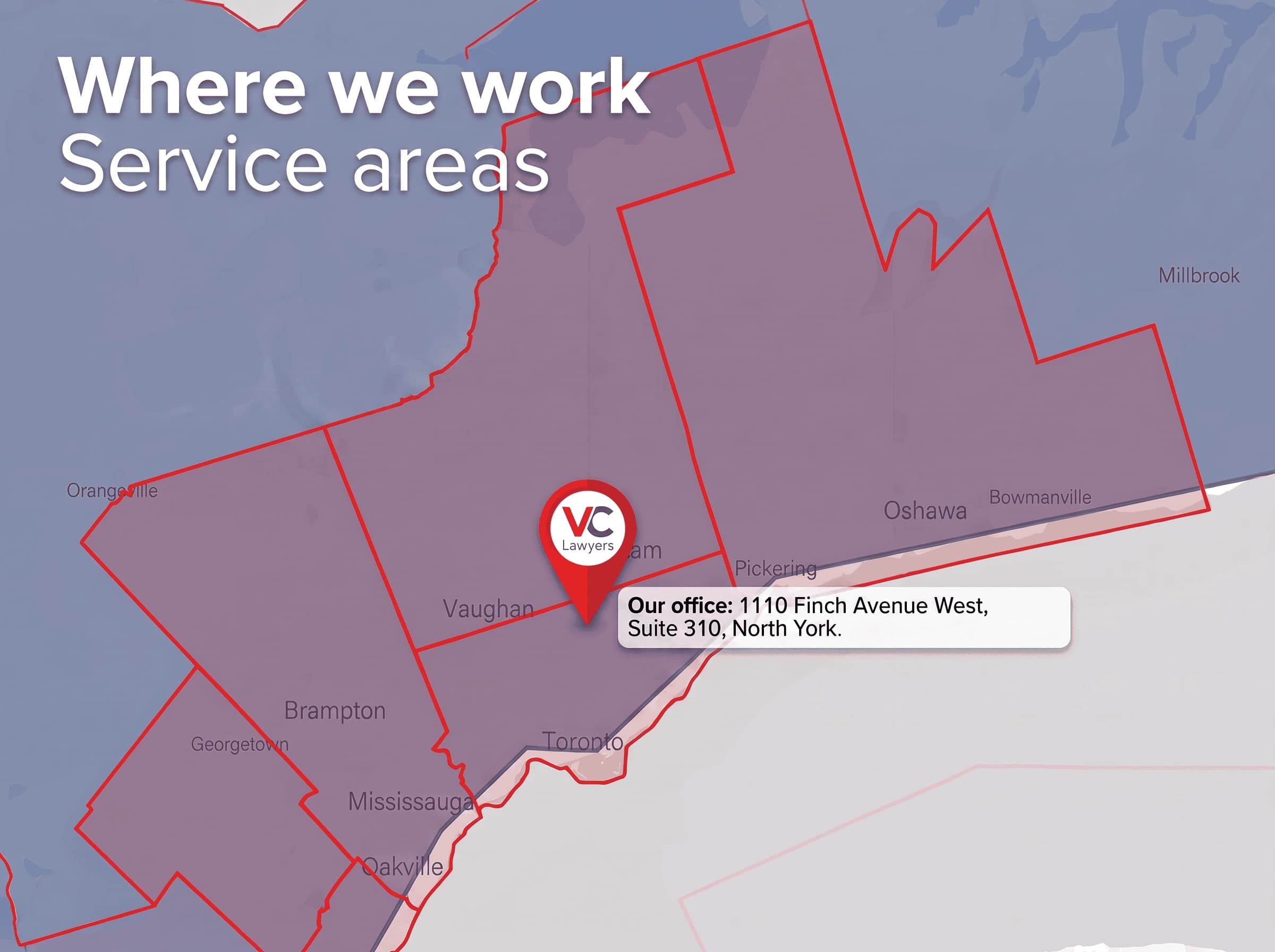
Where we work
Service areas
VC Lawyers serves clients throughout the Greater Toronto Area, including Toronto, North York, Scarborough, Etobicoke, Mississauga, Brampton, Oakville, Burlington, Vaughan, Richmond Hill, Pickering, Ajax, Whitby, Oshawa, Newmarket, and Aurora. We also represent clients across Ontario through video consultations and home/hospital visits when needed.
Languages spoken at the firm include English, Korean (한국어), Hebrew, Mandarin, and others depending on lawyer assignment.
Our office is located at 1110 Finch Avenue West, Suite 310, in North York, with parking and TTC access (Finch West subway and bus connections).
Frequently Asked Questions: Scarring and Disfigurement Claims
We answered all
How are scarring and disfigurement damages calculated in Ontario?
Disfigurement damages turn on several factors. Severity and visibility come first, because larger, more prominent scars in highly visible areas typically produce higher damages. Permanence is next, since a scar expected to remain produces higher damages than one expected to fade. Functional impact counts separately. Scarring that limits movement or the use of the affected area produces higher damages than purely aesthetic scarring. Psychological impact matters where depression, anxiety or social withdrawal is documented. Who the plaintiff is matters as well. Youth and an occupation that involves public interaction both raise the value. Underneath all of it sits causation, meaning proof that the accident caused the scarring. Typical ranges are $5,000 to $25,000 for minor scarring, $25,000 to $75,000 for moderate visible scarring, and $75,000 to $200,000+ for severe disfigurement. Catastrophic disfigurement runs up to the judge-made Andrews cap, roughly $465,000 to $470,000 in 2026 dollars. In Ellis v Fallios-Guthierrez (2012 ONSC 1670) the court awarded $55,000 in general damages for injuries that included scarring and disfigurement of the face. Individual awards vary widely on their own facts, but that case is a common benchmark for moderate facial scarring. These figures are general damages for the disfigurement itself. Recovery for medical costs, lost income, future care and the other heads of damages is additional. For motor vehicle accident cases, the 2026 statutory deductible of $47,913.01 reduces the net amount the claimant receives. It disappears only where the general damages award reaches $159,708.71.Does my injury need to be on my face to qualify for compensation?
No. Disfigurement injuries to any body location can produce compensation. Highly visible areas (face, neck, hands) produce the highest damages because of the daily social impact. Sometimes-visible areas (arms, legs, upper chest) produce significant damages, because what shows depends on the clothing and the activity. Covered areas (back, abdomen, thighs, lower torso) produce smaller but still real damages, because the scar is still seen in intimate settings, still seen during activity, and always seen by you. A scar on the chest or abdomen is visible to a partner. It becomes visible while swimming, playing sport, or changing in a locker room. You see it every day. For the verbal threshold in motor vehicle cases, permanent serious disfigurement covers disfigurement in any body location. Courts vary somewhat in how they read the word “serious.” Highly visible scarring clears the threshold more easily. Covered scarring takes more careful case-building to establish the impact.The accident was years ago and my scar has healed somewhat. Can I still make a claim?
Possibly, but limitation periods apply. Under the Limitations Act, 2002, tort claims generally must be filed within 2 years of the date of the accident, and the same general 2-year period applies to motor vehicle accidents. Some situations run on a different clock, including claims involving minors and claims where the injury was not initially apparent. If your accident was within 2 years, the claim should be pursued promptly. If it was longer than 2 years ago, the analysis is more complex. The discoverability rule may extend the limitation period in some circumstances, but generally the 2-year clock has run. The fact that the scar has healed “somewhat” does not eliminate the claim. Damages are based on the current and future state rather than on the immediate post-injury appearance. A scar that is less prominent than it once was does not end your claim. It affects the amount. If you are uncertain whether your case is still viable, a free consultation can clarify your options. Do not assume you are too late without asking.What if my disfigurement was caused by cosmetic surgery or laser treatment?
Cosmetic procedure injuries are an active area of personal injury law in Ontario. Cases like Ramotar v La Fontaine Jeunesse (2010) have established that cosmetic procedure errors can produce viable personal injury claims. The “consent to risks” associated with cosmetic procedures does not eliminate liability for negligent treatment. The consequences are all compensable: burns, scarring, post-inflammatory hyperpigmentation (darkened skin) and paradoxical adipose hyperplasia (fat that enlarges instead of shrinking after a fat-reduction treatment). The legal theories available include negligence, lack of informed consent, lack of qualifications, equipment defects, and breach of warranty. Common claims include laser hair removal burns, chemical peel burns, botched plastic surgery, failed dermal filler procedures, CoolSculpting complications, hair transplant complications, laser tattoo removal scarring, and microblading errors. These cases turn on expert evidence about the standard of care for the specific procedure and what went wrong. The defendants are often the practitioner and the clinic, and sometimes the manufacturer of the equipment.Will I have to take photographs of my scarring as evidence?
Yes. Photographs are the foundation of every disfigurement case. The documentation itself is not invasive, and it is usually done by you or a family member with an ordinary camera or a phone. The legal team can guide you on what to photograph and when. Five kinds of photograph are worth having. The first is the initial post-injury photo, often available from emergency department records. The second is the series of photos taken through the healing process. The third is the current state, showing the permanent scarring at various angles and in good lighting. The fourth is a set of photos in natural settings, taken while you are talking, smiling and moving. Those capture what a posed shot misses on facial scarring. The fifth is a pre-accident photo, which gives the comparison. For court or settlement purposes, professional photography is sometimes used, and your lawyer may arrange it when appropriate. The photos remain confidential and are used only for the purposes of your legal claim. They are not posted publicly or shared beyond the legal context. For some claimants, repeated photographic documentation is itself emotionally difficult, and the process should be structured in a way that respects that.How does scarring on a child differ legally from scarring on an adult?
A child's disfigurement case carries more weight than an adult's, for five reasons. The first is the span of the impact. A scar on a 5-year-old will be present for 70 to 80 years. On a 25-year-old, the same scar will be present for 50 to 60 years. The second is identity formation. Children develop self-concept during childhood and adolescence, so disfigurement in those years lands differently than it does on an already-formed adult identity. The third is school and social development, because children with disfigurement face elevated rates of bullying, school avoidance and academic disruption. The fourth is the uncertainty around career. A child's path is still undecided, and disfigurement may foreclose certain careers before the child ever chooses one. That is an earning capacity loss an adult plaintiff does not face. The fifth is procedural. Settlements involving minors require court approval under Rule 7.08 of the Rules of Civil Procedure. The motion material is served on the Office of the Children's Lawyer. The money itself is typically paid into a structured settlement or held in court. For parents, the strategic point is that a claim brought on behalf of a child has to reflect the lifetime impact rather than the immediate consequences. Settling early or cheaply for a childhood injury produces inadequate compensation for the adult life that follows. Family members, including parents and siblings, also have their own claims under the Family Law Act. Those claims cover the loss of guidance, care and companionship, and the emotional impact of the child's injury.What if I'm a model, actor, or work in a profession where appearance matters?
For plaintiffs whose income depends on appearance, disfigurement damages can be dramatically elevated. The calculation starts with general damages for the disfigurement itself, which are higher than for a plaintiff whose income does not depend on appearance. It then adds past income loss from contracts cancelled, jobs lost and opportunities foregone. Next comes future earning capacity loss, often the largest single component for an appearance-dependent career. Vocational rehabilitation and loss of competitive advantage are recoverable as well. A model whose career is shortened by ten years because of facial scarring loses substantial future income. A young actor whose available roles are limited by visible scarring loses opportunities across an entire career. Even a plaintiff who continues in the same field may face reduced competitive standing within it. These cases are built on expert evidence: industry experts, vocational consultants, and economists who project the future earning capacity loss.Can my family members make claims for my disfigurement injury?
Yes. Under Ontario's Family Law Act, certain family members can make claims for damages caused by the injury: spouses (married or common-law), children (including step-children and adopted children), parents, grandparents and grandchildren, and brothers and sisters. These claims compensate for the loss of guidance, care and companionship that the family member might reasonably have expected to receive from the injured person. The amounts vary with the closeness of the relationship and the extent of the impact. Disfigurement cases have their own pattern here. A spouse may claim for the impact on the relationship and the loss of companionship in social and intimate contexts. Parents of a disfigured child may claim for the emotional impact and the disruption to family life. Young children of a disfigured parent may claim for the impact on their relationship with that parent. Typical Family Law Act amounts run $20,000 to $60,000 for a spouse in moderate cases, and higher for severe disfigurement. Dependent children recover $15,000 to $40,000 each. A parent claiming for an adult child's injuries recovers $15,000 to $50,000, and an adult child claiming for a parent's injuries recovers $5,000 to $20,000. Family Law Act claims are usually combined with the primary tort claim and resolved together.What does it cost to hire a scarring and disfigurement lawyer?
All scarring and disfigurement cases at our firm are handled on contingency, meaning no fee unless we recover compensation for you. The contingency percentage is set in writing at the start, typically ranging from 25% to 33% depending on complexity and the stage at which the matter resolves. Disbursements are advanced by the firm and recovered from the eventual settlement. They include court filing fees, expert reports, photography costs, medical records requests and mediation fees. The first 30-minute consultation is free. A serious disfigurement case can need several expert reports: a plastic surgeon, a psychologist, a vocational consultant and an economist. In a case like that, total disbursements can run $15,000 to $50,000 over the course of the litigation. Those costs are carried by the firm while the case runs and are reimbursed only when the matter resolves, so the contingency structure keeps our incentives aligned with yours.How long does a disfigurement case typically take to resolve?
Disfigurement cases follow the usual personal injury litigation timeline. Initial review and the demand letter take 1 to 3 months from intake. Negotiation runs 3 to 9 months, and many cases settle there. If negotiation fails, the Statement of Claim is filed 6 to 12 months from intake. Pleadings, discovery and examinations take 12 to 24 months. Mediation comes 18 to 30 months from intake, and that is where most cases resolve. Trial, where it is necessary, follows 24 to 36 months from filing, sometimes longer. Most disfigurement cases settle before trial. The visual nature of the injury makes them compelling. Judges, juries and even adjusters can see what is being described, which limits the insurer's ability to dispute severity. For cases involving children, settlements require court approval, which can add several months. For most adult disfigurement cases, resolution within 18 to 30 months is typical, with the file settling at or before mediation.
Why people choose VC Lawyers
The right firm handles everything so you can focus on recovery
Choosing the right personal injury law firm after an accident in Toronto can mean the difference between a lowball settlement and the full compensation you deserve.
No Fees Unless We Win
Personal injury cases run on a contingency basis. You pay nothing upfront.
Free Personal Injury Consultation
Speak with an injury lawyer today at zero cost. Other practice areas are quoted before we start.
24/7 Emergency Hotline
We’re available around the clock when you need us most.
Home & Hospital Visits
Too injured to come to us? We’ll come to you.
Multilingual Legal Team
Services in 8 languages so nothing gets lost in translation.
Boutique Firm, Big Results
You’re never just a case number. Get direct access to your lawyer.
Get in touch
Looking for legal help? Speak directly with a lawyer
Tell us what happened and a lawyer will personally review your case. Personal injury consultations are free and there are no fees unless we win. For all other practice areas, a consultation fee applies.
- $30M+ recovered for injury clients
- Available 24/7, including weekends
- Service in English, Korean, and 6+ more languages
Prefer to call? (416) 661-4529
Take the next step
Disfigurement is an injury the law recognizes but rarely handles well without sophisticated advocacy.
Related practice areas
Continue exploring
Scarring & Disfigurement Lawyer in North York
The same practice, served from our office in North York.
Personal Injury Lawyer Toronto
For the broader personal injury framework.
Toronto Burn Injury Lawyer
For burn-specific compensation and severe burn injuries.
Toronto Dog Bite Lawyer
For dog attack disfigurement (strict liability).
Toronto Car Accident Lawyer
For motor vehicle accident disfigurement.
Toronto Slip & Fall Lawyer
For slip and fall disfigurement.
Toronto Broken Bone Lawyer
For fracture-related scarring and contour changes.
Toronto Chronic Pain Lawyer
For chronic pain associated with disfigurement.