
Disability Claims
Toronto Short-Term Disability LawyerDenied Benefits, Terminated Employees, and the STD-to-LTD Transition




Trusted by short-term disability claimants across Ontario
Overview
When You Can't Work and the Insurer Says No
Most Ontarians never look at their group benefits booklet until something goes wrong. They assume the disability coverage their employer provides is a safety net. If illness or injury keeps them from working, they expect the income to keep coming so they can cover the rent and the groceries while they recover. That assumption usually holds for the first few weeks. Then a denial letter arrives, or a case manager calls to say benefits will end on Friday, and the safety net turns out to be full of holes.
Short-term disability (STD) denials are some of the most disruptive financial events an Ontario worker can experience. Unlike long-term disability, where the dispute may unfold over months and the financial consequences accumulate gradually, an STD denial hits immediately. The employee is already dealing with a serious illness or injury: surgery recovery, a new cancer diagnosis, a mental health crisis, post-concussion symptoms, or an autoimmune flare. Then the call comes. Benefits have been refused, terminated, or “cut off pending further medical review.” Without the income replacement they were counting on, every other part of recovery gets harder.
This page is a comprehensive guide to short-term disability law in Ontario, written for the people who actually need it. That means employees facing denied STD claims, workers being pressured back to the job before they have recovered, employees terminated while on medical leave, and people approaching the transition from STD to long-term disability and worried about the gap. It covers the legal framework, the practical realities, the most common insurer tactics, and what your options are when things go wrong.
Short-term disability is a privately administered benefit, almost always provided through an employer's group insurance plan. It is not a government program. Ontario has no provincial short-term disability scheme, and the federal Employment Insurance (EI) sickness benefit runs on separate rules through Service Canada. The model itself is simple. When illness or injury stops you from working, the group insurer pays you a percentage of your regular income for a defined period. In some plans the employer pays the benefit directly.
Most Ontario plans share the same shape. Coverage typically runs 15 to 26 weeks, though some plans stop at 6 to 12 weeks and a few run longer. The benefit usually replaces 60% to 85% of regular income, and sometimes 100% for an initial period before it steps down. That percentage is normally calculated on pre-tax income. Almost every plan holds benefits back for a waiting or qualifying period of a few days to a week. You cover that gap with sick days, vacation time, or unpaid leave. To be eligible, you generally have to be actively employed when the disability begins and to have a minimum period of service, often three months. The disability test is usually the inability to perform the essential duties of your own occupation, and that test can become stricter as the STD period runs on.
The point that matters most is that STD is insurance, not an employment standards entitlement. There is no statutory right to short-term disability coverage in Ontario. If your employer does not offer it, you do not have it. If your employer does offer it, the contract terms control everything that follows: how disability is defined, what is excluded, how long you have to file, and when the payments stop. The insurer writes those terms and the employer adopts them.
STD is also easy to confuse with the benefits sitting next to it. Under Ontario's Employment Standards Act (ESA), sick leave gives up to 3 unpaid days per calendar year to every employee with at least two consecutive weeks of service. Since October 28, 2024, an employer cannot require a medical certificate for those days. Sick leave protects your job, not your income. EI sickness benefits replace up to 55% of insurable earnings to a maximum of $729 per week in 2026, and they run for up to 26 weeks. They cannot be paid at the same time as STD. ESA long-term illness leave has been in force since June 19, 2025. Employees with at least 13 consecutive weeks of service can take up to 27 unpaid weeks within a 52-week period. That leave too protects the job rather than the paycheque.
The rest of the landscape matters just as much. Long-term disability (LTD) normally begins where STD ends, pays 60% to 67% of income, and can run to age 65. Its disability test usually tightens after 24 months. If your inability to work comes from a workplace injury or occupational disease, WSIB is the correct system rather than STD. It generally pays better and carries additional protections. Critical illness insurance pays a lump sum on the diagnosis of a qualifying condition such as cancer, heart attack, or stroke, and it can be collected in addition to STD, LTD, and EI. Most workers facing a serious illness end up in some combination of these systems, and the coordination between them is rarely intuitive.
VC Lawyers represents employees across the Greater Toronto Area in short-term disability disputes. The first 30-minute consultation is free, most STD claims are handled on a contingency basis (no fee unless we recover compensation for you), and we work in English, Korean, and several other languages. If your situation is urgent, call (416) 661-4529 at any point while you are reading.
Frequently Asked Questions
Short-Term Disability Questions We Hear Most
How long do I have to file a lawsuit if my STD claim is denied?
Under the Limitations Act, 2002 (Ontario), the general rule is two years from the date of the formal denial letter to commence a lawsuit against the insurer. The clock runs from the denial, not from the day you decide to fight it. Internal insurer appeals do not pause it. Three situations can change that analysis. If the insurer never issues a clear formal denial and instead delays indefinitely, the discoverability rule may extend the deadline. If the policy contains a contractual limitation period shorter than two years, that clause may apply instead, although such clauses face legal scrutiny. And if the dispute concerns ongoing monthly benefits that were cut off mid-stream, a separate limitation period may apply to each missed payment. The strategic implication is simple: get a legal review early. Spend 18 months on internal appeals and you may reach a lawyer with only six months left on the clock. That produces rushed work and weak cases. The first 30-minute consultation is free, and a lawyer can flag limitation concerns immediately.What does it cost to hire a short-term disability lawyer?
Most STD disputes are handled on a contingency fee basis, which means no fee unless we recover compensation for you. The contingency percentage is set in writing at the start of the engagement and typically ranges from 25% to 33%. Where it lands depends on the complexity of the file and on the stage at which it resolves: negotiation, mediation, or trial. Disbursements cover court filing fees, expert reports, mediator fees, and examination transcripts. The firm typically advances them and is reimbursed out of the eventual settlement, so you are not funding the case out of pocket while you are off work. The first 30-minute consultation is free. For wrongful dismissal claims that overlap with an STD dispute, contingency arrangements are similar. We will tell you in that first consultation whether we believe the case is winnable and what a realistic recovery looks like.Can my employer fire me while I'm on short-term disability?
Technically yes, but the restrictions and the consequences are significant. Termination during STD is not automatically illegal, and several protections come into play at once. The employer must still pay ESA notice or pay in lieu, plus severance where it applies. Being off work does not waive that entitlement. For non-unionized employees, common law reasonable notice is calculated on the Bardal factors: length of service, age, character of employment, and availability of similar work. For long-tenured employees in mid-to-senior roles, that notice can reach 6 to 24 months of compensation. That is far more than the ESA minimums. Under the Ontario Human Rights Code, terminating someone for reasons connected to a disability is discrimination on a protected ground. The employer must accommodate to the point of undue hardship before it terminates, and accommodation includes considering modified duties and a gradual return-to-work plan. Section 74 of the ESA separately prohibits reprisal for exercising an ESA right, including taking a statutory leave. Honda Canada v Keays (2008 SCC 39) adds one more layer. Terminating an employee during a serious illness can breach the employer's duty of good faith in the manner of dismissal. The failure might be inadequate notice, no attempt at accommodation, or hostile communications. That breach supports aggravated damages on top of reasonable notice. The strongest cases combine a wrongful dismissal claim at common law with a human rights claim at the Human Rights Tribunal of Ontario. Damages there for injury to dignity, feelings, and self-respect typically run from $10,000 to $50,000, and they can go higher in egregious cases. Act quickly. The HRTO limitation period is one year, and the civil limitation period is two.My doctor says I can't work but the insurer disagrees. What can I do?
This is the most common STD dispute pattern. The decision was made by the insurer's case manager, who is a claims professional and not a physician. That person read the attending physician's statement and the clinical notes, then concluded that your documented limitations do not prevent you from working. In Ontario, courts generally give significant weight to a treating physician's opinion in disability cases. The leading case law is clear. An insurer's internal medical reviewer who has never examined the patient cannot lightly override a treating physician who has months or years of clinical history with you. Five responses tend to move a file. Strengthen the medical documentation by working with your physician to produce specific functional limitation reports rather than a general “unable to work” note. Obtain specialist confirmation. A specialist's opinion carries additional weight, and specialists tend to document more thoroughly than a family doctor working through a full appointment schedule. Consider obtaining your own independent medical assessment from a credentialed specialist to counter the insurer's position. Request the full report from the insurer's medical reviewer. Under the duty of disclosure, you are often entitled to see it. And consider legal action where the medical evidence is already strong and more paperwork will not change the insurer's mind.Does mental illness qualify for short-term disability?
Yes. Mental illness is a recognized disability under all Ontario STD policies. Anxiety, depression, bipolar disorder, PTSD, ADHD, OCD, eating disorders, schizophrenia, burnout, and other conditions can all qualify. Mental health conditions are now among the most common reasons for STD claims. They are also among the most heavily scrutinized, and insurers approach them with a skepticism they would not apply to a comparable physical injury. Insurers demand psychiatric assessment beyond the family doctor's notes. They question whether the symptoms are severe enough to prevent work, and argue that you should be able to cope in a different environment or a different role. They treat the absence of psychiatric medication, hospitalization, or specialist follow-up as evidence that the condition is mild. And they label the condition a matter of “subjective symptoms,” then delay or deny the claim for lack of “objective evidence.” These claims succeed when the documentation is built around functional impairment rather than diagnosis. Compare two letters. One says the patient is depressed and off work. The other comes from a psychiatrist. It explains that the patient is unable to maintain attention for sustained periods, cannot tolerate normal workplace pressures, has significant difficulty with interpersonal interactions, and meets the criteria for severe major depressive disorder. The second letter is far more persuasive.What if I can do some work but not my full job?
It depends on the policy wording. Three patterns appear in Ontario STD policies. A total disability requirement means you must be unable to perform any of the essential duties of your occupation, so partial ability defeats the claim outright. A substantial disability requirement is more common. It asks whether you can perform the essential duties, meaning the core functions of the job rather than every task. Under that wording you may still qualify while handling some peripheral tasks. Some progressive policies also include partial disability provisions, which pay a reduced benefit when you can work partially but not fully. That feature is less common in STD than in LTD. If you can do some tasks but not your core job duties, the question becomes whether your inability to perform the essential duties meets the threshold in your policy. That analysis turns on the exact policy language and on what your specific job actually requires. One point is worth stating plainly: gradually returning to work part-time does not mean you have recovered. Many policies and many treating physicians support gradual return-to-work plans, where you work reduced hours during recovery while STD benefits continue on a partial basis. That is often a better outcome than either staying on full STD or going back to full duties prematurely.Should I apply for EI sickness benefits if my STD was approved?
Most STD policies in Ontario require employees to apply for EI sickness benefits, and the EI amount is then offset against the STD benefit. The reasoning is that EI is a federal benefit you have already paid into through payroll deductions. The insurer wants you to draw on EI first. It then tops up the difference to your contracted STD amount. EI sickness benefits replace up to 55% of insurable earnings to a maximum of $729 per week in 2026, and they run for up to 26 weeks. To qualify you need a medical certificate and 600 hours of insurable employment in the qualifying period, and a one-week waiting period applies before the first payment. The practical implications are these. Your total income does not change. It is simply split between two sources. That waiting period means your first week of leave typically carries reduced or no income unless you have sick days or vacation to use. You must complete EI biweekly reports while receiving EI. EI is taxable, so it is worth confirming whether your insurer is offsetting the gross or the net amount. And if STD is later denied, an active EI claim gives you partial income while you appeal or litigate. Even where the policy does not require it, applying early is often strategic, because EI can bridge the gap when STD ends or is refused.The insurer wants me to attend an Independent Medical Examination. Do I have to go?
Most STD policies authorize the insurer to require Independent Medical Examinations (IMEs) at reasonable intervals, and refusing without good cause typically results in your benefits being terminated. IMEs are nonetheless a contested area. The examining doctor is paid by the insurer and is not your treating physician. IME reports are frequently used to override a treating physician's opinion. And the quality and neutrality of these assessments vary a great deal from one examiner to the next. You generally have the right to know who the examiner will be and what their specialty is. Attend the examination, because refusal usually means losing benefits. But attend prepared. Document the experience by noting how long it lasted, what questions were asked, and what physical or cognitive testing was actually conducted. Bring a support person if you need one, particularly for a mental health IME. Request a copy of the report. You are typically entitled to it, and it becomes critical evidence. If the report is then used to deny your claim, your treating physician or another specialist can respond to its specific findings. Repeated IME demands used as a delay tactic can amount to bad faith, so keep a record of the pattern.What's the difference between short-term disability and long-term disability?
Short-term disability usually covers 15 to 26 weeks and tests disability against your own occupation. It replaces 60% to 85% of regular income and begins after a short waiting period of 0 to 7 days. The funding is usually the employer's, whether the plan is self-insured or provided through an insurer. It is designed to hand you off to long-term disability (LTD) if the disability continues. LTD replaces 60% to 67% of income. It can run for months, or all the way to age 65, depending on the policy. It begins when STD ends, and it is usually administered by an insurer on employer-paid premiums. The critical difference is the test. For the first 24 months, LTD usually asks whether you can perform your own occupation, much as STD does. After 24 months it switches to any occupation, meaning any work for which you are or could become qualified by education, training, or experience. That is a far harder standard to meet, and many valid claims are cut off at exactly that 24-month mark. The handoff between the two policies is the other breaking point. The STD insurer says benefits end on Friday. The LTD insurer has not yet decided your application, wants more medical evidence, or denies outright under the stricter test. Months can pass with no income at all. If you are approaching that transition, get legal advice early.Can I work part-time while receiving STD benefits?
Most STD policies allow some form of partial return to work, but the rules vary significantly from policy to policy. Many policies actively support gradual return-to-work programs. You work reduced hours during recovery while STD benefits continue on a partial basis, and that arrangement is generally seen as positive for both employee and employer. Where you earn employment income while on STD, the insurer usually applies an earnings offset. It reduces the benefit by what you earn, or by a percentage of what you earn. The policy sets the exact calculation. Stricter policies impose a total disability requirement. Under those, doing any paid work at all can end the claim entirely. Some policies provide for a trial work period. You can attempt a return without benefits ending right away, and full benefits resume if the trial fails. Four things protect you in practice. Coordinate the plan with your physician so the return is medically supported. Get the plan in writing with both the employer and the insurer, so there is no later dispute about what was authorized. Track every dollar of earnings, because incorrect reporting is how overpayment claims start. And coordinate with EI if it is in play, since partial earnings affect EI sickness calculations differently than they affect STD. For Toronto residents on a modified return to work, three parties are involved at once: you, your employer, and the insurer. Disputes between them are common, so settle the arrangement in advance.
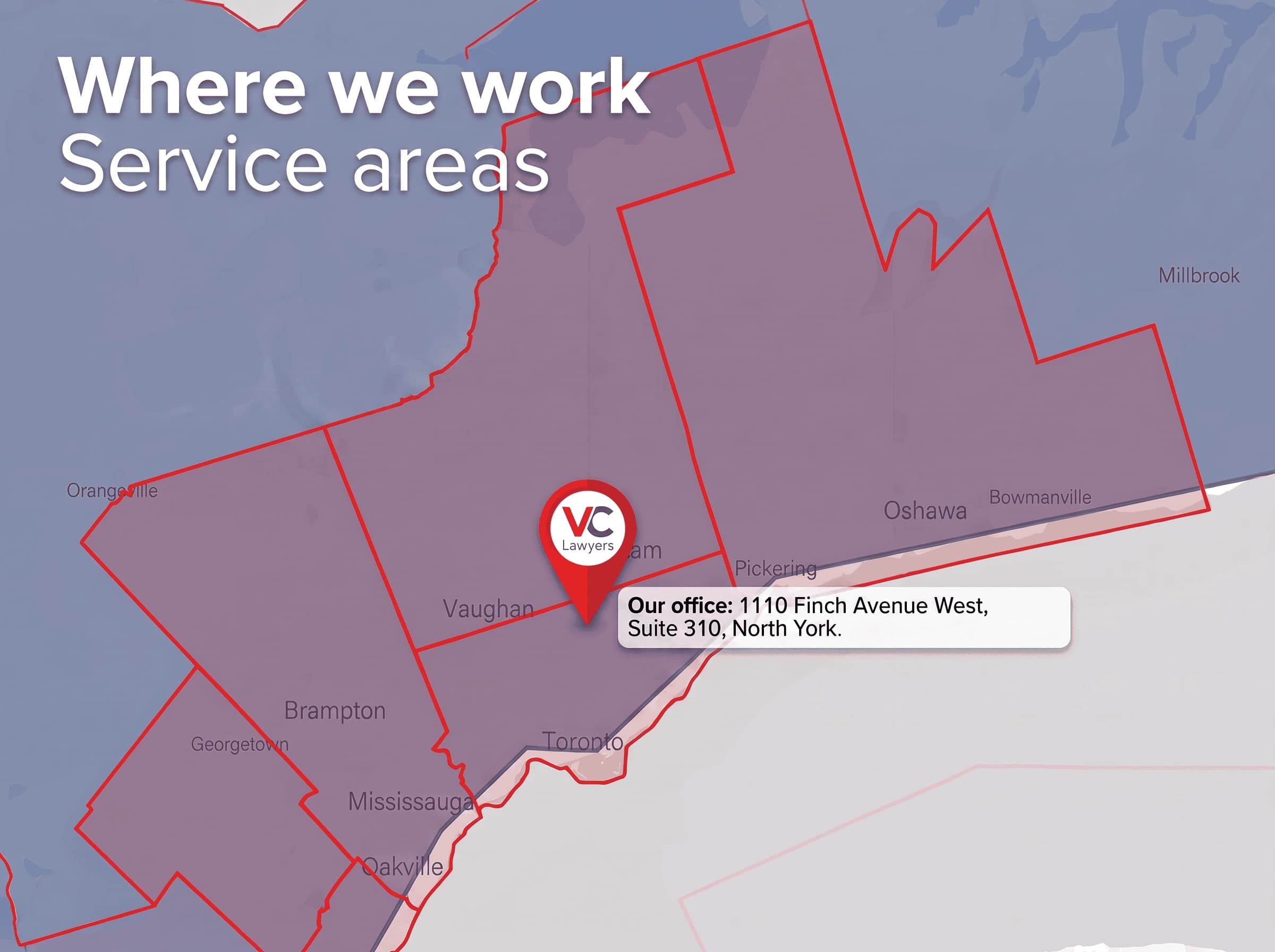
Where we work
Service areas
VC Lawyers serves clients throughout the Greater Toronto Area, including Toronto, North York, Scarborough, Etobicoke, Mississauga, Brampton, Oakville, Burlington, Vaughan, Richmond Hill, Pickering, Ajax, Whitby, Oshawa, Newmarket, and Aurora. We also represent clients across Ontario through video consultations and home/hospital visits when needed.
Languages spoken at the firm include English, Korean (한국어), Hebrew, Mandarin, and others depending on lawyer assignment.
Our office is located at 1110 Finch Avenue West, Suite 310, in North York, with parking and TTC access (Finch West subway and bus connections).
Why people choose VC Lawyers
The right firm handles everything so you can focus on recovery
Choosing the right personal injury law firm after an accident in Toronto can mean the difference between a lowball settlement and the full compensation you deserve.
No Fees Unless We Win
Personal injury cases run on a contingency basis. You pay nothing upfront.
Free Personal Injury Consultation
Speak with an injury lawyer today at zero cost. Other practice areas are quoted before we start.
24/7 Emergency Hotline
We’re available around the clock when you need us most.
Home & Hospital Visits
Too injured to come to us? We’ll come to you.
Multilingual Legal Team
Services in 8 languages so nothing gets lost in translation.
Boutique Firm, Big Results
You’re never just a case number. Get direct access to your lawyer.
Get in touch
Looking for legal help? Speak directly with a lawyer
Tell us what happened and a lawyer will personally review your case. Personal injury consultations are free and there are no fees unless we win. For all other practice areas, a consultation fee applies.
- $30M+ recovered for injury clients
- Available 24/7, including weekends
- Service in English, Korean, and 6+ more languages
Prefer to call? (416) 661-4529
Take the next step
Take the Next Step
Here is what makes the legal piece manageable. The first conversation is free, and the fee is contingent (no fee unless we recover for you). Within 30 minutes you will have a clear understanding of your rights, your realistic options, and what to do tomorrow morning.
Free consultation · Contingency fee available · Confidential · Korean and other languages.
Related practice areas
Continue exploring
Short-Term Disability Lawyer in North York
The same practice, served from our office in North York.
Toronto Long-Term Disability Lawyers
LTD claim disputes and the STD-to-LTD transition.
Toronto CPP Disability Lawyer
Federal disability benefits, denials, and Social Security Tribunal appeals.
Toronto Critical Illness Lawyer
Critical illness insurance claim denials and ESA leave rights.
Toronto Insurance Claim Lawyer
Bad-faith insurance handling and the broader denial framework.
Ontario SABS Accident Benefits Lawyer
Statutory accident benefits for every motor vehicle accident victim.
Toronto Non-Earner Benefits Lawyer
$185/week SABS benefits for retirees, students, and stay-at-home parents.
Toronto Traumatic Brain Injury Lawyer
Traumatic brain injury claims often paired with STD denials.
Toronto Soft-Tissue Injury Lawyer
Soft tissue claims that the insurer characterizes as “minor.”