
Wills & Estates
Toronto Estate Litigation Lawyer
Overview
If you are involved in an estate dispute, Will challenge, or probate matter in Toronto or anywhere across Ontario, our experienced estate litigation lawyer team is ready to fight for your inheritance rights. At VC Lawyers, our dedicated Toronto estate litigation lawyers represent executors and beneficiaries, estate trustees, family members, and dependants in every type of estate and trust dispute. Those disputes run from Will challenges and executor removal to passing of accounts, guardianship and capacity proceedings, and cross-border litigation involving assets spanning multiple jurisdictions.
Estate disputes spiral quickly. What begins as a family disagreement over a Will can evolve into a complex multi-party legal battle involving frozen accounts, contested powers of attorney, guardianship applications, and fiduciary duty claims. Our Toronto estate lawyers, acting for executors and for beneficiaries, bring the courtroom experience, the forensic financial analysis, and the strategic advocacy these disputes take, so your interests are protected and the true intentions of the deceased are honoured.
Key metrics
In the numbers
- Google reviews
- 150+
- Years combined experience
- 70+
- Languages spoken
- 8+
- Calls answered, every day
- 24/7
What Is Estate Litigation in Ontario?
Estate litigation encompasses every form of legal dispute arising from a deceased person’s estate, including challenges to the validity of a Will, disputes between executors and beneficiaries, fiduciary claims against trustees, dependant support applications, guardianship proceedings, and contested probate applications. Estate and trust disputes are among the most emotionally charged and legally complex proceedings in Ontario’s court system.
Most estate disputes in Toronto are heard in the Estates List of the Ontario Superior Court of Justice, a specialized court designed for complex inheritance and trust matters. Our estate litigation lawyer team has deep experience before this court and in every other venue where estate and trust disputes are resolved across Ontario.
The key legal framework governing estate litigation in Ontario includes:
- The Succession Law Reform Act, governing the distribution of estates and dependant support claims
- The Estates Act, governing probate applications and Certificates of Appointment of Estate Trustee
- The Substitute Decisions Act, 1992, governing powers of attorney, guardianship, and capacity proceedings
- The Trustee Act, governing the obligations and accountability of trustees and estate trustees
- Common law fiduciary duty, imposing personal liability on executors and trustees who breach their obligations to beneficiaries
Our estate litigation lawyers advise clients on every aspect of estate litigation, from initial strategy through mediation, trial, and enforcement of judgments at the Ontario Superior Court of Justice.
Will Challenges: Grounds to Contest a Will in Ontario
A Will challenge is a legal proceeding in which a party contests the validity of a Will filed for probate. Our estate litigation lawyer team handles every type of Will contest in Ontario, including:
Lack of testamentary capacity: A Will is only valid if the testator understood what they owned, who their natural heirs were, and the nature and effect of making a Will at the time it was signed. Where dementia, illness, or medication affected the deceased’s mental state at the critical time, our estate lawyers collaborate with geriatric psychiatrists to review medical records and establish that the deceased’s testamentary capacity was absent. A Will signed without capacity is invalid and should be set aside.
Undue influence: When a caregiver, family member, or “new friend” pressured or manipulated a vulnerable senior into changing their Will, the resulting document does not reflect the testator’s true wishes and can be challenged. Proving undue influence requires a careful investigation into the deceased’s relationships and circumstances. Our estate litigation lawyers subpoena medical records, financial records, and witness statements to build these cases.
Fraud and forgery: Where a Will was procured through deliberate misrepresentation or outright forgery, the document is void. Our estate litigation team works with forensic document examiners where necessary to establish that a Will is not authentic.
Improper execution: A Will must be signed by the testator in the presence of two witnesses who are both there at the same time, and a gift to a witness or a witness’s spouse is void even where the Will itself stands. Technical defects in the signing process can render a Will invalid, though since January 1, 2022 section 21.1 of the Succession Law Reform Act lets the Superior Court validate a Will that does not meet the formal requirements where it is satisfied the document sets out the deceased’s testamentary intentions.
Ambiguous language: Disputes over the meaning of specific clauses in a DIY Will frequently require court interpretation. Our estate litigators appear before the Ontario Superior Court of Justice to resolve these disputes efficiently.
Estate Trustee and Executor Accountability: Passing of Accounts
An executor or estate trustee has a fiduciary duty to administer the estate honestly, transparently, and in the best interests of all beneficiaries. An executor can breach this duty through negligence, self-dealing, or outright misappropriation of estate funds. When that happens, our estate litigation lawyers hold them personally accountable.
The Passing of Accounts is a formal court process in which an executor is required to produce a complete accounting of every transaction they have conducted on behalf of the estate. Our estate litigation team uses the passing of accounts process to uncover every dollar spent, every fee charged, and every decision made, including decisions that may constitute executor negligence or a breach of fiduciary duty.
Common executor and trustee failures our lawyers address:
- Failure to sell estate property at fair market value or engaging in self-dealing by purchasing estate assets
- Unauthorized payment of executor compensation beyond what the estate documents authorize
- Failure to distribute estate assets in a timely manner after all debts are settled
- Commingling estate funds with personal accounts
- Failure to properly account for security deposits, rental income, or investment proceeds held by the estate
Where an estate trustee or executor has wasted estate assets or caused loss through their conduct, they can be ordered to personally reimburse the estate. The legal concept is known as Devastavit. Our Toronto estate lawyers pursue these remedies aggressively on behalf of affected beneficiaries.
Dependant Support Claims in Ontario
Under Ontario’s Succession Law Reform Act, a spouse, child, parent, or sibling of the deceased may be entitled to support from the estate where they have been left with inadequate provision, or no provision at all. The claimant must be a dependant in the statutory sense, meaning the deceased was providing support, or was under a legal obligation to provide support, immediately before death. A dependant support claim is a powerful remedy that can override the terms of a Will entirely where the court finds the deceased failed to provide adequately.
Under section 61 of the Succession Law Reform Act, a dependant support application must be brought within six months of the grant of the Certificate of Appointment of Estate Trustee. Miss that date and you are not automatically out: the court may allow a late application, but only against the portion of the estate that is still undistributed when you apply. Since an estate trustee can distribute quickly, the practical answer is to move as soon as the Certificate is issued.
Our estate litigation team regularly handles dependant support claims for common-law spouses, adult children with disabilities, and other dependants who were excluded from or insufficiently provided for in a Will.
Powers of Attorney Disputes and Guardianship
Powers of attorney disputes and guardianship proceedings are a critical and growing area of estate and elder law practice. Our estate lawyers handle every type of dispute involving attorney for property and personal care, including:
Power of attorney validity disputes: challenges to the validity of a Power of Attorney for Property or Personal Care, allegations that an existing Power of Attorney is being misused, and accounting proceedings against an attorney who mismanaged the grantor’s assets.
Attorney misuse and fiduciary claims: where the person appointed as attorney under a Power of Attorney has acted in their own interests rather than the grantor’s, our estate lawyers pursue fiduciary claims and ask the court for restitution or for the attorney to be removed.
Guardianship and capacity proceedings: where a person is incapable of managing their own property or personal care and no valid Power of Attorney exists, a guardian can be appointed by the court under the Substitute Decisions Act, 1992. Our estate litigators act for applicants and for respondents in guardianship and capacity applications before the Ontario Superior Court of Justice, including matters in which the Office of the Public Guardian and Trustee is served or takes a position.
Property and personal care disputes involving vulnerable seniors are among the most urgent estate matters we handle. Ontario’s courts can move quickly when a vulnerable person’s property and personal care interests are at risk. So do we.
Elder Law and Capacity Issues
Our estate litigation lawyer team has extensive experience in elder law and the protection of seniors’ legal rights. We handle guardianship and capacity applications, elder financial abuse investigations, and disputes arising from the exploitation of vulnerable elderly individuals. Working alongside capacity assessors, geriatric psychiatrists, and the Office of the Public Guardian and Trustee where appropriate, we provide comprehensive legal services for families navigating the most difficult aspects of estate and elder law in Ontario.
Cross-Border and Multi-Jurisdictional Estate Litigation
Estate disputes spanning multiple jurisdictions, including estates with assets in other provinces or outside Canada, require careful legal advice and coordination with counsel elsewhere. Our cross-border litigation practice handles estate disputes involving assets in Ontario alongside assets located elsewhere, so every part of the deceased’s estate is properly administered and protected regardless of geography.
Multi-jurisdictional estate disputes involving real property, investment accounts, or business interests in multiple locations require careful analysis of Ontario’s and other jurisdictions’ conflict of laws rules. Our estate lawyers provide the strategic legal advice required to navigate these complex proceedings efficiently.
How Our Toronto Estate Litigation Lawyers Handle Your Case
Step 1: Book a Consultation
We review the Will, the timeline of events, and the current status of the estate. We identify every available legal remedy and advise on the most effective strategy for your specific dispute. Our fees, including the fee for the initial consultation, are set out in writing before any work begins. Contact the estate litigation team at VC Lawyers today.
Step 2: Investigation
We subpoena medical records, financial records, bank statements, and witness testimony. We work with forensic accountants to perform a complete passing of accounts review, uncovering every transaction conducted by the executor or trustee.
Step 3: Mediation
Under rule 75.1 of the Rules of Civil Procedure, mediation is mandatory in estate, trust and substitute decisions proceedings started in Toronto, Ottawa or Essex County. Our estate litigation lawyers use it as a strategic tool: an opportunity for early resolution where that serves the client, and preparation for litigation where it does not.
Step 4: Litigation
Where mediation does not resolve the dispute, our estate litigators bring the full force of their courtroom experience to trial in the Estates List of the Ontario Superior Court of Justice. We have handled high-value and high-complexity estate disputes at every level of Ontario’s court system.
Step 5: Enforcement and Distribution
We ensure every court judgment is fully enforced and that estate funds are securely transferred to the rightful heirs and beneficiaries following a successful outcome.
What Compensation and Remedies Can You Recover?
Our estate litigation lawyers pursue every available remedy for executors and beneficiaries in estate disputes:
- Full inheritance restoration, reverting the estate distribution to a previous valid Will or to the intestacy rules
- Dependant support awards, monthly or lump-sum payments from the estate for inadequately provided dependants
- Executor surcharge, making the trustee personally pay for losses they caused the estate
- Removal of the executor or trustee, appointing a neutral professional to manage the estate going forward
- Passing of accounts, a complete court-supervised accounting of all estate transactions
- Occupation rent, compelling an executor living in the estate property to pay rent to the beneficiaries
- Court approval for estate transactions and interim distributions where the dispute is ongoing
Why Choose VC Lawyers as Your Estate Litigation Lawyer in Toronto?
When estate disputes spiral into serious litigation, you need Toronto estate litigation lawyers with the courtroom experience, the forensic financial analysis, and the strategic depth to fight at the highest level.
Courtroom Experience
Our estate litigation lawyers have appeared before the Estates List of the Ontario Superior Court of Justice in some of the most complex and high-value contested estate cases in the GTA. We bring real courtroom experience to every file we handle, not just settlement experience.
Clear Fees, in Writing
We set out our fees in a written retainer at the start of your matter, so you always know what to expect and there are no surprises.
Forensic Financial Accountability
We work with specialized forensic accountants on passing of accounts reviews, going transaction by transaction through the estate ledger to find money that was moved, charged, or spent without authority.
Elder Law and Capacity Work
Our estate lawyers have run guardianship and capacity applications, power of attorney disputes, and files involving the exploitation of vulnerable seniors for years, and we know how much of the outcome turns on the medical record and on handling the family carefully.
Phone Line Answered 24/7
An estate emergency such as the sudden sale of an estate property or an unauthorized distribution of assets requires an immediate injunction. Call any time. The phone line is answered 24/7, and urgent matters can be seen evenings or weekends by arrangement.
Frequently Asked Questions: Estate Litigation Lawyer Toronto
How long does a Will challenge take in Ontario?
Estate litigation typically takes 12 to 24 months from commencement to resolution, depending on the complexity of the dispute. We can often obtain interim support orders or asset preservation injunctions quickly at the outset of litigation while the main dispute proceeds.
How much does an estate litigation lawyer cost?
We offer flexible billing arrangements. For probate applications and straightforward estate administration matters, we bill on an hourly basis. We set out our fees in a written retainer at the start of your matter, so you always know what to expect.
Can I sue the executor for mismanaging the estate?
Yes. Self-dealing, wasting assets, and failing to administer the estate in a timely manner are all breaches of an executor’s fiduciary duty. An executor who breaches that duty can be held personally liable for the resulting losses. Our estate litigation team pursues these claims aggressively through the passing of accounts process and direct court applications.
What is a dependant support claim?
A dependant support claim is a court application under Ontario’s Succession Law Reform Act seeking support from the estate for a spouse, child, parent or sibling whom the deceased was supporting, or was legally obliged to support, and who was inadequately provided for. The application must be brought within six months of the grant of the Certificate of Appointment. A late application can sometimes be allowed against undistributed assets, but that is discretionary, so contact our estate lawyers immediately to protect your rights.
Can I contest a Will if I am not a named beneficiary?
Yes. An heir-at-law is someone who would inherit under intestacy if the Will were invalid. They have legal standing to challenge a Will even if they are not named as a beneficiary in the document being challenged.
Contact Our Toronto Estate Litigation Lawyers Today for a Consultation
If you are involved in an estate dispute, Will challenge, probate matter, or trustee accountability issue anywhere in Toronto, Ottawa, or across Ontario, do not wait. Estate disputes spiral quickly. The longer you wait, the more difficult it becomes to preserve estate assets and protect your rights.
Our estate litigation lawyers offer a consultation with no obligation. Estate lawyers can help you understand your rights, identify every available remedy, and develop the most effective strategy for your specific dispute. Contact our Toronto estate litigation lawyers today. Our phone line is answered 24/7, and we serve clients throughout the Toronto area and across Ontario.
Types of Wills and Estate Cases We Handle in Toronto
Why people choose VC Lawyers
The right firm handles the details so you can move forward with confidence
From property and business deals to family and estate matters, the right law firm gives you clear advice, transparent fees, and a lawyer who is genuinely in your corner.
Clear, Upfront Fees
We explain your fee arrangement before we start. No surprises.
Full-Service Firm
One firm for your property, business, family, and estate matters.
Multilingual Legal Team
Services in 8 languages so nothing gets lost in translation.
Boutique Firm, Direct Access
You’re never just a file number. Reach your lawyer directly.
Trusted Ontario Counsel
Members in good standing with the Law Society of Ontario.
Decades of Combined Experience
Senior counsel on every matter we handle.
Get in touch
Looking for legal help? Speak directly with a lawyer
Tell us what happened and a lawyer will personally review your case. Personal injury consultations are free and there are no fees unless we win. For all other practice areas, a consultation fee applies.
- $30M+ recovered for injury clients
- Phone line answered 24/7
- Service in English, Korean, and 6+ more languages
Prefer to call? (416) 661-4529
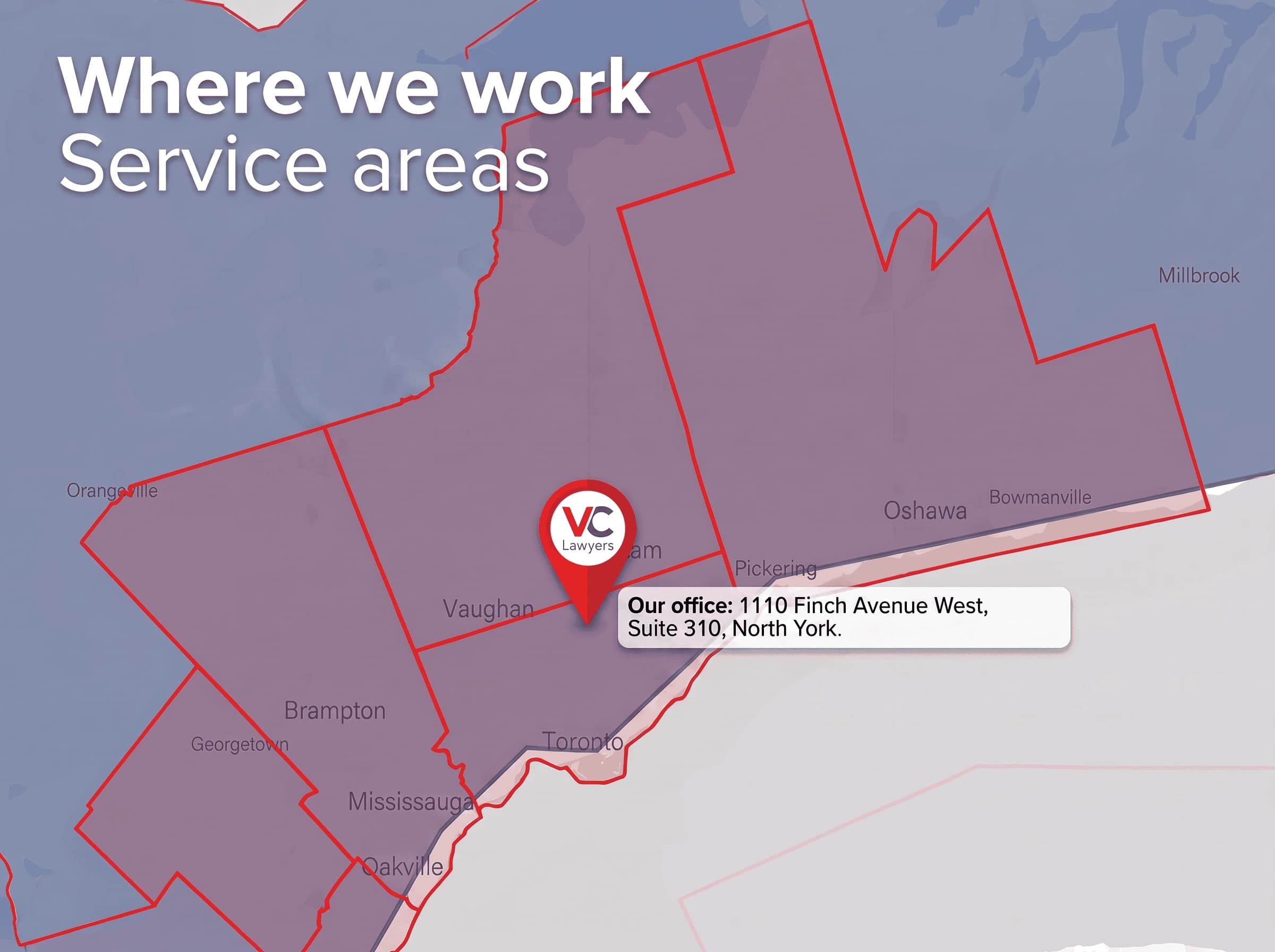
Where we work
Service areas
VC Lawyers serves clients throughout the Greater Toronto Area, including Toronto, North York, Scarborough, Etobicoke, Mississauga, Brampton, Oakville, Burlington, Vaughan, Richmond Hill, Pickering, Ajax, Whitby, Oshawa, Newmarket, and Aurora. We also represent clients across Ontario through video consultations when needed.
Languages spoken at the firm include English, Korean (한국어), Hebrew, Mandarin, and others depending on lawyer assignment.
Our office is located at 1110 Finch Avenue West, Suite 310, in North York, with parking and TTC access (Finch West subway and bus connections).
Also serving North York