
Wills & Estates
Toronto Estate Administration Lawyer
Overview
If you have been appointed as an executor or estate trustee, our experienced estate lawyers in Toronto are ready to guide you through every legal aspect of estate administration, from filing the initial probate application through the final distribution of assets to beneficiaries. At VC Lawyers, our dedicated estate administration lawyer team represents executors and trustees across Toronto and throughout Ontario, providing the legal, tax, and fiduciary counsel required to administer even the most complex estates with confidence.
Serving as an executor is a significant legal responsibility. Estate trustees carry personal liability for every decision they make, from paying debts and filing tax returns to managing real estate and communicating with beneficiaries. Our experienced estate administration lawyers provide every service required to fulfill your duties correctly, protect you from personal liability, and ensure the estate is administered efficiently and in full compliance with Ontario law.
Key metrics
In the numbers
- Google reviews
- 140+
- Years combined experience
- 70+
- Languages spoken
- 8+
- Calls answered, every day
- 24/7
What Is Estate Administration in Toronto?
Estate administration is the legal and administrative process of settling the affairs of a deceased person: collecting assets, paying final debts and taxes, and distributing the remaining estate to the rightful beneficiaries under the Will or, where there is no Will, according to Ontario’s intestacy rules under the Succession Law Reform Act.
In Toronto and across Ontario, most estate administrations require a Certificate of Appointment of Estate Trustee (commonly called probate) from the Ontario Superior Court of Justice. Without this court-issued document, financial institutions will refuse to release funds, the Land Registry Office will not permit the transfer of real estate, and investment brokers cannot act on the executor’s instructions. Our probate and estate administration lawyers manage the full application process on every executor’s behalf.
The key legal responsibilities of an estate trustee or executor in Ontario include:
- Locating and securing every estate asset, including physical property, bank accounts, investments, digital assets, and life insurance policies
- Notifying all creditors and settling valid debts owed by the estate
- Filing the deceased’s final T1 income tax return and the estate’s T3 trust return with the Canada Revenue Agency
- Obtaining a CRA Tax Clearance Certificate before making the final distribution
- Distributing the estate to beneficiaries in accordance with the Will or intestacy rules
- Maintaining transparent records of every transaction and providing a formal accounting to beneficiaries on request
Our estate administration lawyers provide every service required to guide executors and trustees through each of these obligations: managing paperwork, coordinating with financial institutions, handling real estate transactions, and providing strategic legal advice at every stage.
Probate and Estate Administration: The Certificate of Appointment Process
Probate is the court-supervised process that confirms the validity of a Will and grants the executor the formal legal authority to administer the estate. Our experienced estate lawyers manage every aspect of the probate application, including:
Preparing the Application for Certificate of Appointment: our estate administration team drafts the complete court application, calculates the Estate Administration Tax (EAT) payable to the Minister of Finance, and files all required supporting documentation with the Estates Office of the Ontario Superior Court of Justice.
Calculating and paying the Estate Administration Tax: the EAT is calculated at $15 per $1,000 of estate value above $50,000. Accurate valuation of the estate at the time of application is critical. Undervaluing the estate can result in penalties, while overvaluing increases the tax burden unnecessarily. Our estate administration lawyers work with accountants and appraisers to ensure every asset is correctly valued.
Navigating complex estate structures: estates involving private holding companies, multiple real estate properties, or assets spanning multiple jurisdictions require experienced counsel. Our Toronto estate administration team has managed complex multi-asset probate applications involving millions of dollars in assets and multiple beneficiaries across the GTA and beyond.
Locating and securing digital assets: no Ontario statute requires an executor to run a formal digital audit, and Ontario has not adopted the fiduciary access legislation now in force in Saskatchewan, Prince Edward Island and New Brunswick. The ordinary duty is enough: an estate trustee must identify, secure, value and account for every asset of the estate, and cryptocurrency wallets, monetized social media accounts and online financial balances are assets like any others. The difficulty is practical, because a platform will often decline to act on a Certificate of Appointment of Estate Trustee. Our estate administration lawyers help executors trace and value digital holdings, deal with platform terms of service, and document the search so the accounting stands up to scrutiny from beneficiaries and from the CRA.
Estate Trustees: Duties, Responsibilities, and Personal Liability
The role of estate trustee carries significant legal responsibility. Executors and trustees in Ontario have a fiduciary duty to all beneficiaries, which means they must act honestly, transparently, and in the best interests of the estate at all times. A breach of fiduciary duty can result in the executor being held personally liable for any losses caused to the estate.
Our estate lawyers advise every executor and trustee on their duties and responsibilities from the moment they are retained, so that every action taken is legally defensible and fully documented.
Common executor mistakes that create personal liability, and how we prevent them:
Distributing assets before paying the CRA: if an executor distributes estate funds to beneficiaries before all tax obligations are settled, the CRA can pursue the executor personally for the unpaid amounts. Our estate administration lawyers ensure that a Tax Clearance Certificate is obtained from the CRA before any final distribution is made.
Commingling estate funds: placing estate money into a personal bank account is a breach of fiduciary duty. Our estate lawyers advise every executor to open a dedicated estate bank account and maintain clear separation between personal and estate finances throughout the administration.
Failing to maintain accounts: beneficiaries have a legal right to a formal accounting of every estate transaction. Failing to keep and provide transparent records is the leading cause of estate litigation in Toronto. Our estate administration team maintains comprehensive records and manages the formal Passing of Accounts process where required.
Distributing too early or too late: rushing distribution before all debts are settled creates personal liability; delaying unnecessarily exposes the executor to a court application by beneficiaries. Our estate lawyers advise every trustee on the correct timing and sequence of every distribution.
Wills and Trusts: Estate Administration Involving Trust Structures
Many Ontario estates involve trusts established under the Will that continue to operate after the initial estate distribution. Common trust structures our estate administration lawyers manage include:
Spousal trusts: trusts established for the benefit of a surviving spouse that hold assets for their lifetime before distributing to the children or other beneficiaries of the testator. Managing a spousal trust requires ongoing accounting, tax filings, and investment oversight, all of which our estate and trust administration lawyers provide.
Henson Trusts: discretionary trusts for beneficiaries with disabilities that protect inheritances without disqualifying the beneficiary from government support programs. The interpretation and ongoing administration of a Henson Trust calls for careful, experienced estate law drafting and oversight.
Discretionary family trusts: trusts that allow the trustee to determine how and when distributions are made to a class of beneficiaries. These structures require careful documentation, annual accounting, and tax reporting under both the Trust and estate income tax regimes.
Our experienced estate lawyers advise trustees on every aspect of ongoing trust management, including annual reporting, investment decisions, and distribution planning. That advice ensures every trust structure serves its intended purpose for as long as it operates.
Common Duties in Estate Administration: A Step-by-Step Overview
Our estate administration lawyers provide comprehensive assistance with every duty required of an executor or estate trustee:
Securing the estate: immediately after death, the executor should secure all physical property, notify the deceased’s insurance company that any real property is now vacant, and take steps to preserve all estate assets from loss or theft. Our estate lawyers advise every executor on the specific steps required at this critical early stage.
Locating and inventorying all assets: an executor must identify and value every asset in the estate, including real estate, bank and investment accounts, business interests, personal property, and digital assets. Our estate administration team coordinates appraisals and valuations across every asset category.
Filing the Notice to Creditors: publishing the Notice to Creditors protects the executor from personal liability for unknown claims against the estate by setting a formal deadline for creditors to come forward. Our estate lawyers manage this publication on every file.
Managing real estate: many GTA estates involve real property that must be transferred, rented, or sold during the administration. Our integrated real estate law team manages the transmission of title, the marketing and sale of estate homes, and the discharge of estate mortgages. Every executor gets a seamless single-firm service.
Filing final tax returns: the executor must file the deceased’s final T1 return and the estate’s T3 trust return and obtain a CRA Tax Clearance Certificate before distributing the estate. Our estate lawyers coordinate with accountants to ensure every filing is accurate, complete, and submitted on time.
Communicating with beneficiaries: keeping all beneficiaries informed of the administration timeline, expected distributions, and the status of outstanding issues is both a legal obligation and a practical strategy for avoiding estate disputes. Our estate administration lawyers manage all beneficiary communication professionally and proactively.
Final accounting and distribution: once all debts are paid and the CRA clearance is obtained, we prepare the final accounting, secure formal releases from all beneficiaries, and facilitate the final distribution of the estate residue.
How Our Toronto Estate Administration Lawyers Handle Your File
Step 1: Book a Consultation
We review the Will, confirm your appointment as executor or estate trustee, and advise on your powers and the immediate steps required to secure the estate. We quote a fixed fee for the probate and administration work before we begin.
Step 2: Probate Application
We prepare and file the complete application for Certificate of Appointment, calculate and pay the Estate Administration Tax, and manage all court correspondence until the Certificate is issued, typically within 8 to 12 weeks of filing.
Step 3: Asset Management and Debt Settlement
We assist with the collection of all estate assets, coordination with financial institutions, the sale or transmission of real estate, the settlement of valid creditor claims, and the filing of all required tax returns.
Step 4: Final Accounting and Distribution
We prepare the final estate accounting, work with accountants to obtain the CRA Tax Clearance Certificate, secure formal releases from every beneficiary, and facilitate the final distribution. Our estate administration lawyers structure the closing of every file to fully protect the executor from any future claim by a beneficiary or creditor.
What Compensation Is an Executor Entitled To?
In Ontario, an estate trustee is generally entitled to fair and reasonable compensation. That is typically calculated as approximately 5% of the total value of the estate, unless the Will specifies otherwise or the court orders a different amount. This compensation is subject to the approval of all beneficiaries or, if disputed, by the court through a Passing of Accounts proceeding.
Our estate administration lawyers help every executor document and justify their compensation claim, so that the time spent, the complexity of the administration, and the skill and responsibility involved are all properly reflected in the compensation requested.
Why Choose VC Lawyers as Your Estate Administration Lawyer in Toronto?
When executors and beneficiaries across Toronto need experienced estate lawyers who provide comprehensive, practical estate administration services, VC Lawyers delivers.
Certificate of Appointment Experience
Our estate administration team has filed hundreds of probate applications across the Estates Office of the Ontario Superior Court of Justice, managing even the most complex multi-asset and multi-jurisdictional estates efficiently.
Integrated Real Estate Law
We have a dedicated real estate department that handles the transmission and sale of estate properties across the GTA, giving every executor access to seamless single-firm service.
Fixed-Rate Probate Packages
Our transparent, fixed-rate probate and estate administration packages give every executor certainty about legal costs before the administration begins. No hourly billing surprises.
Tax Clearance and CRA Coordination
We work with experienced estate accountants to manage every CRA filing, obtain the Tax Clearance Certificate, and ensure every executor is fully protected before the final distribution is made.
24/7 Strategic Support
If a beneficiary files a Notice of Objection or threatens estate litigation, our team is available around the clock to defend your actions as executor and protect the integrity of the administration.
Frequently Asked Questions: Estate Administration Lawyer Toronto
How long does probate take in Toronto?
The court typically takes 8 to 12 weeks to issue the Certificate of Appointment once the application is filed correctly. Complex estates involving disputed assets or unusual structures may take longer. Our estate administration team manages the entire process to minimize delays.
How much is the Estate Administration Tax in Ontario?
The EAT is $15 for every $1,000 of estate value above $50,000. There is no EAT on the first $50,000. Accurate valuation of the estate at the time of application is critical. Our estate lawyers work with accountants and appraisers to ensure the application is filed correctly.
Can I be sued personally as an executor?
Yes. If you distribute assets too early, ignore creditor claims, fail to file tax returns, or breach your fiduciary duty in any other way, beneficiaries and creditors can pursue you personally. Our estate administration lawyers provide the ongoing legal advice and oversight required to ensure your every action as trustee is defensible.
What is a Passing of Accounts?
A Passing of Accounts is a formal court-supervised accounting process in which the executor presents a complete record of every transaction conducted on behalf of the estate. Beneficiaries can review and challenge any items they dispute. Our estate lawyers manage this process on behalf of executors, ensuring the accounts are complete, accurate, and properly presented.
What if the deceased died without a Will?
Where no Will exists, the estate is administered according to Ontario’s intestacy laws under the Succession Law Reform Act. A family member must apply to the court to be appointed Estate Trustee Without a Will. Our estate administration lawyers manage these applications and advise on the specific distribution rules applicable to the estate.
Contact Our Toronto Estate Administration Lawyers Today for a Consultation
If you have been appointed as an executor or estate trustee anywhere in Toronto or across Ontario, you do not have to carry the legal weight alone. Our experienced estate administration lawyers provide every service required to administer the estate correctly, protect you from personal liability, and bring the administration to a successful conclusion.
Our estate lawyers offer a confidential consultation with no obligation. Contact our Toronto estate administration team today. We are available 24/7 and serve executors and beneficiaries across the GTA and throughout Ontario.
Types of Wills and Estate Cases We Handle in Toronto

Executor's duties
Administering the estate
An estate trustee's job has roughly 40 discrete tasks, and only some of them are obvious: Notice to Creditors publication, CRA clearance certificate, final tax return, distribution under the will or intestacy rules, passing of accounts.
We support executors through the full administration timeline, particularly when the estate includes business interests, multi-jurisdictional assets, or beneficiaries who may challenge the accounting at the passing-of-accounts hearing.
Why people choose VC Lawyers
The right firm handles the details so you can move forward with confidence
From property and business deals to family and estate matters, the right law firm gives you clear advice, transparent fees, and a lawyer who is genuinely in your corner.
Clear, Upfront Fees
We explain your fee arrangement before we start. No surprises.
Full-Service Firm
One firm for your property, business, family, and estate matters.
Multilingual Legal Team
Services in 8 languages so nothing gets lost in translation.
Boutique Firm, Direct Access
You’re never just a file number. Reach your lawyer directly.
Trusted Ontario Counsel
Members in good standing with the Law Society of Ontario.
Decades of Combined Experience
Senior counsel on every matter we handle.
Get in touch
Looking for legal help? Speak directly with a lawyer
Tell us what happened and a lawyer will personally review your case. Personal injury consultations are free and there are no fees unless we win. For all other practice areas, a consultation fee applies.
- $30M+ recovered for injury clients
- Available 24/7, including weekends
- Service in English, Korean, and 6+ more languages
Prefer to call? (416) 661-4529
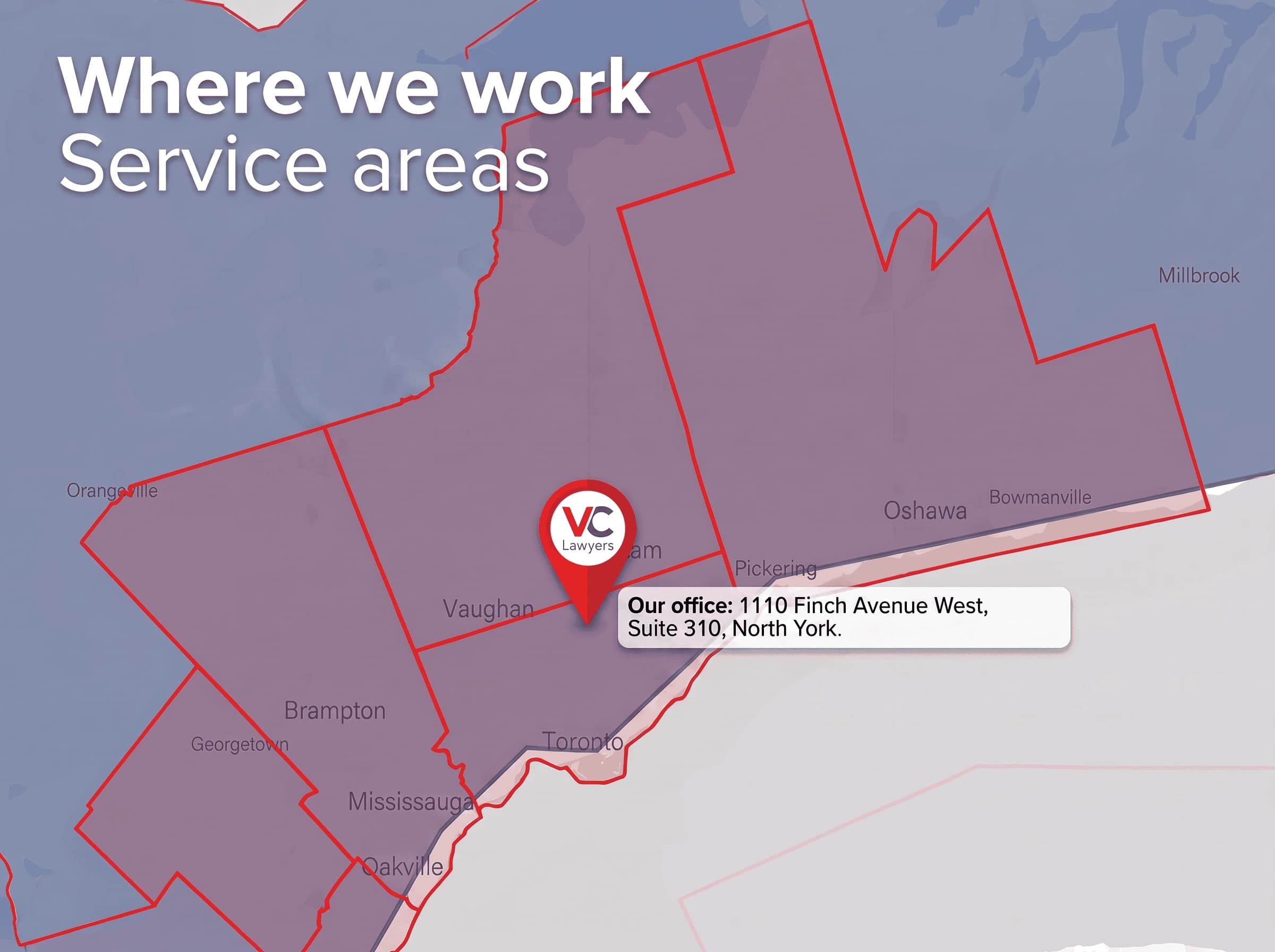
Where we work
Service areas
VC Lawyers serves clients throughout the Greater Toronto Area, including Toronto, North York, Scarborough, Etobicoke, Mississauga, Brampton, Oakville, Burlington, Vaughan, Richmond Hill, Pickering, Ajax, Whitby, Oshawa, Newmarket, and Aurora. We also represent clients across Ontario through video consultations and home/hospital visits when needed.
Languages spoken at the firm include English, Korean (한국어), Hebrew, Mandarin, and others depending on lawyer assignment.
Our office is located at 1110 Finch Avenue West, Suite 310, in North York, with parking and TTC access (Finch West subway and bus connections).
Also serving North York