
Maurice Vaturi
Senior Counsel

Vehicle Accidents


Trusted by accident victims and businesses across Ontario
Overview
A Toronto family is driving south through Ohio on the way to Florida for March break. A semi-trailer crosses the centre line on I-75 outside Cincinnati. The accident is severe. The family ends up in an American hospital, inside a U.S. legal system they do not understand. There are U.S. insurance companies to deal with, a U.S. police report, and American emergency physicians who are excellent but who have no reason to know that OHIP works differently from American health insurance.
By the time the family is medically stable enough to think about anything beyond survival, they are facing a legal landscape that has nothing in common with the one they would have faced if the accident had happened in Burlington or Hamilton.
A Mississauga snowbird flies to Tampa for the winter. While crossing a parking lot at a grocery store in Sarasota, she is struck by a driver backing out of a space. She has soft-tissue injuries that turn into chronic neck pain over the following months. She returns to Ontario, sees her family doctor, gets the referrals and starts the treatment. Then she discovers that the U.S. driver was carrying only the Florida minimum of $10,000 in liability coverage, and her own Ontario insurer is telling her that her American claim is “complicated.”
A Hamilton truck driver is delivering across the border into upstate New York when his rig is hit by an uninsured driver who fled the scene. He is hospitalized in Buffalo for three days, transferred back to Hamilton, and now faces a long recovery. Several systems are potentially relevant, and none of them are talking to each other: his employer's commercial insurance, his personal Ontario insurance, the OPP investigation, the New York State Police investigation, his health insurance, and possibly multiple workers' compensation systems.
These are cross-border accident cases, and they are among the most complex personal injury matters in Ontario practice. A single file can combine Canadian provincial insurance law (SABS), American state tort and insurance law, conflict-of-laws principles, multiple insurance policies, multiple legal systems, and multiple limitation periods running on different clocks. The American law varies dramatically from state to state. Done properly, these cases produce substantial recoveries. Done improperly, or by lawyers without cross-border experience, they regularly leave clients with a fraction of what they should have received.
This page is a comprehensive guide to cross-border accident law for Ontarians. It explains what happens when you are injured outside Ontario, what insurance and legal protections exist, what mistakes to avoid, and how to navigate the multi-jurisdictional process. Begin with the part that does not depend on anything you bought. Since 1 July 2026, medical, rehabilitation and attendant care benefits are mandatory on every Ontario auto policy. They travel with you across the border, and the auto insurer pays the medical and rehabilitation side ahead of any extended health or employer plan. Income replacement, non-earner, caregiver, housekeeping and home maintenance, lost educational expenses, expenses of visitors, damage to personal items, and death and funeral benefits are now optional purchases. They are payable only where the policy bought them, and only to the named insured, that person's spouse, dependants of either, and drivers listed on the policy. Everything else on a cross-border file follows from two questions: which policy responds, and which jurisdiction hears the claim. This page is written for Canadians who have been injured in the United States, whether on a vacation, a business trip, a snowbird winter or any other circumstance. It is also written for the families of those who have been seriously injured or killed in cross-border accidents.
VC Lawyers represents Toronto-area clients in cross-border accident claims, working with U.S. counsel through co-counsel arrangements as needed. The first 30-minute consultation is free, all cross-border cases are handled on contingency (no fee unless we recover), and we work in English, Korean, and several other languages. Call (416) 661-4529 at any point in this article if your situation requires immediate attention.
Talk to us
The first 30-minute consultation is free and confidential. We will tell you within that conversation what your realistic options are, and what to do next.
No fee unless we recover. Home and hospital visits available across the GTA.
Toronto context
Toronto residents cross into the United States through a handful of routes, and each one quietly decides which law will govern the claim. The Buffalo and Niagara Falls corridor is the most common crossing, so accidents on the Peace Bridge, the Lewiston-Queenston Bridge, the Rainbow Bridge and the surrounding roads come up constantly. Those crashes are New York files. New York gives you a 3-year limitation period and a no-fault system paying up to $50,000 in basic economic loss benefits. It also gates pain and suffering behind the serious injury threshold in Insurance Law section 5102(d). That threshold turns on categories such as fracture, significant disfigurement, permanent loss of use, or a medically determined injury that prevents your usual daily activities for 90 of the 180 days after the accident.
Detroit is the other heavy corridor. The Ambassador Bridge and the Detroit-Windsor Tunnel produce constant cross-border traffic, and Michigan's post-2019 no-fault reforms make those files harder than they look. Michigan drivers now choose their own PIP limit anywhere from $50,000 to unlimited, and a Canadian injured there is subject to whatever level the at-fault driver happened to select. Catastrophic injuries may reach the Michigan Catastrophic Claims Association, which covers costs above an individual policy's PIP limit. The Michigan limitation period is generally 3 years. A tort claim for pain and suffering has to clear one of three thresholds: serious impairment of body function, permanent serious disfigurement, or death. Sault Ste. Marie is far less trafficked but produces a steady stream of the same Michigan questions.
Air travel is its own category. Toronto residents who fly to a U.S. destination and rent a vehicle there end up with three things interacting at once: the rental company's coverage, their own Ontario policy, and the law of a state they have never driven in. What does not change is the Ontario side. Your own policy responds for accident benefits wherever in North America the accident happened, and the dispute over those benefits is heard in Ontario rather than in the state where you were hurt.
Toronto-area snowbirds travel to a short list of destinations. Florida is by far the largest. Arizona comes next, drawing people mostly to the Phoenix and Tucson areas, and then southern California. Texas draws a steady number to the Rio Grande Valley. Hawaii tends to draw the Toronto retirees who keep a longer-term presence there. The Carolinas draw people mostly to the coast, in both North and South Carolina.
Each destination changes the arithmetic of a claim, and Florida is the hardest place to be hurt. Florida drivers are required to carry only $10,000 in Personal Injury Protection and $10,000 in property damage liability, and Florida is one of the few states that does not require bodily injury liability insurance at all. Estimates put the share of uninsured Florida drivers at 20 to 25 percent, and many of the insured ones carry nothing beyond the minimum, so the at-fault driver's policy is routinely a fraction of the actual loss. Florida also applies a verbal threshold before pain and suffering can be claimed at all. Your injury has to fit one of four categories: significant and permanent injury, significant and permanent loss of an important bodily function, permanent injury within a reasonable degree of medical probability, or significant and permanent scarring or disfigurement. Florida's limitation period for negligence was cut to 2 years in the 2023 reforms, so the window is shorter than most Canadians assume.
The western destinations behave differently again. Arizona and California are fault states with no mandatory no-fault benefits, and both apply pure comparative negligence, meaning a share of the blame reduces the award rather than ending the claim. Arizona minimums are $25,000 per person and $50,000 per accident. California minimums were recently raised to $30,000 per person and $60,000 per accident, plus $15,000 in property damage. California also has the MICRA cap, which limits damages in medical malpractice, and that matters if the injury is compounded by the treatment that follows. Texas has no PIP requirement and uses a modified comparative negligence rule, so a plaintiff found more than 50 percent at fault recovers nothing. Nevada is a fault state with the same 50 percent bar, and its minimums match Arizona's at $25,000 per person and $50,000 per accident. In Arizona, California, Texas and Nevada the limitation period is 2 years.
Two things hold wherever you winter. Your Ontario policy still responds for accident benefits, and the underinsured motorist coverage on that policy is usually what closes the gap between a $10,000 U.S. policy and the real cost of the injury. For a state not listed here, assume nothing by analogy. Each state has its own rules, and reasoning from a state that looks similar is how limitation periods get missed.
Cross-border accidents reach every part of Toronto's diverse population. Korean-Canadian, Chinese-Canadian, South Asian, and other communities frequently travel to the U.S. for tourism, family visits, business, and snowbird residence. When one of those trips ends in an accident, language and culture add a second layer of difficulty on top of the legal one.
Language carries more weight in a cross-border file than in a domestic one. The client is dealing with two sets of insurers, two sets of medical records and two sets of deadlines at the same time. The U.S. records often need a formal authorization before anyone can obtain them. A misunderstanding on either side of the border costs evidence.
VC Lawyers handles cross-border accident cases in English, Korean, and several other languages depending on lawyer assignment. We work with translators and bilingual staff for Mandarin, Cantonese, Hebrew, Hindi, Punjabi, Tagalog, Spanish, Portuguese, and other languages. For cross-border cases involving non-English-speaking clients, the U.S. co-counsel often arranges for U.S.-side translation as well.
Our approach
Our practice is built on principles that apply consistently across every cross-border accident file. These are the operational rules that determine how we handle your case from intake through resolution.
The first conversation sets the direction of everything that follows. We will tell you what we believe your case is worth in both jurisdictions, what timeline to expect, and what the strategic considerations are, rather than what you would prefer to hear. Cross-border cases vary enormously. The U.S. state involved, the at-fault driver's insurance, your own Ontario coverage, the severity of the injuries and many other factors all move the number. We tell you directly where yours falls.
Part of that first assessment is arithmetic on deadlines, because the clocks are the one thing nobody can fix afterwards. State limitation periods vary dramatically, and a Canadian who assumes the Ontario two-year period applies can find out too late that the state clock ran shorter. Before any strategy is settled, we confirm the limitation period in the state where the accident happened, along with the separate Ontario clocks on the accident benefits dispute and the underinsured motorist claim.
Cross-border cases require coordinating two legal systems. We treat your case as a single integrated file, even though parts may be handled by Ontario counsel and parts by U.S. state co-counsel. The medical evidence, lifestyle documentation, and damages analysis support both claims. The settlement strategy in each jurisdiction reflects awareness of the other.
The division of labour follows the law rather than convenience. Your Ontario policy answers for accident benefits wherever in North America the accident happened, and a dispute about those benefits is heard in Ontario before the Licence Appeal Tribunal, not in a U.S. court. The tort claim against the at-fault driver goes where the crash happened, filed in that state's court under that state's law. That law sets the limitation period, the damages caps, the comparative negligence rule, and the threshold you have to clear before pain and suffering can be claimed at all. A case that is straightforward in one state can be difficult or unviable in the next, which is why the choice of state counsel and the timing of the lawsuit are strategic decisions rather than paperwork.
We maintain working relationships with experienced personal injury counsel in the major snowbird destination states (Florida, Arizona, California, Texas and Nevada) and in other states where Canadians are commonly injured. When a co-counsel arrangement is needed, we make the introductions and coordinate the work. The arrangement is common and well established. You pay a single contingency percentage, split between the two firms based on the work each performed, so you get Ontario and U.S. expertise on one file without paying for it twice.
The Ontario SABS claim is often undervalued by lawyers who focus primarily on the U.S. tort claim. We treat it as a substantial component of the overall recovery, building it methodically alongside the U.S. proceedings. Since 1 July 2026 that work starts with reading the policy. Only medical, rehabilitation and attendant care are mandatory on an Ontario policy. Every other benefit, including income replacement, is payable only where it was bought, and only to the named insured, that person's spouse, dependants of either, and drivers listed on the policy. The medical evidence developed for the benefits claim supports the tort claim and vice versa.
In practice that means the OCF-1 goes to your Ontario insurer as soon as you are medically stable, not after the U.S. claim resolves. The application is meant to be submitted within 30 days of the accident. This is the deadline Canadians injured in the United States miss most often, because every waking hour in the first weeks goes to the American hospital and the American insurer. A late application can still be accepted with a reasonable explanation, but the delay costs you treatment funding you were entitled to the whole time.
The mandatory side is worth real money, and it does not depend on anything the at-fault driver did. Medical, rehabilitation and attendant care benefits come to $65,000 combined on a non-catastrophic claim and up to $1,000,000 combined where the injuries meet the catastrophic definition. Set that against a Florida PIP policy capped at $10,000, or New York no-fault at $50,000, and it is usually the most generous coverage in the file. Disputes about it are decided in Ontario under Ontario law, before the Licence Appeal Tribunal.
Where the U.S. driver is underinsured, the OPCF 44 underinsured motorist coverage is often the largest single component of the recovery. OPCF 44 is the Family Protection Coverage endorsement. Without it, the uninsured automobile coverage on a standard Ontario policy tops out at $200,000. The endorsement raises that ceiling to your third-party liability limit, which is $1 million for most Ontario drivers and $2 million for some. OPCF 44R extends the same protection to family members travelling with you. When the driver who hit you in Florida was carrying $10,000, that difference is the whole case.
Protecting it is a matter of sequence. You claim against the U.S. driver's insurance to the limits of their coverage, settle the U.S. tort claim, then claim the shortfall against your own Ontario underinsured motorist coverage. Before you settle anything in the United States, your Ontario insurer has to be given written notice of the proposed settlement and the proposed release, with 30 days to respond. That notice gives the insurer a choice. It can consent to the settlement, which leaves your underinsured claim intact, or it can match the proposed amount and take over the claim against the at-fault U.S. driver itself. The requirement comes from Ontario case law including Beausoleil v Canadian General Insurance Co. and Kovacevic v ING Insurance. It is the step lawyers without cross-border experience most often skip.
Kovacevic is why we are strict about it. The plaintiffs were injured by a tractor trailer in Florida, where the U.S. policy limit was $1,000,000. They settled the Florida action for $300,000, signed a full and final release, and then tried to claim the difference from their Ontario insurer under their OPCF 44R coverage. The Ontario court ruled against them: an insured cannot intentionally settle for less than the tortfeasor's available policy limits and then sue their own Ontario auto insurer for the underinsurance. They lost the gap between the $300,000 they took and the far larger amount that had been available. We coordinate the timing of the U.S. settlement and the Ontario notice so that trap never opens on a client of ours.
Cross-border cases require evaluating damages under both jurisdictions. The U.S. tort damages are calculated under state law, which is often more generous than Ontario for non-economic damages. The Ontario accident benefits are calculated under provincial law. The total recovery reflects both sources, properly coordinated. Neither number tells you much on its own.
The component most often left out is the future. Plenty of cross-border cases settle for an amount that covers the U.S. hospital bills and the wages already lost, but nothing for the care the client will need for years after coming home. The client returns to Ontario, keeps needing treatment, and discovers the settlement was never built for it. Before we settle, we complete a full future care plan with Canadian experts: rehabilitation specialists, life care planners and economists. It is priced at the cost of care in Canada, because Canada is where the client will actually live and be treated. A settlement that skips that step is one the client ends up funding themselves.
All cross-border cases are handled on contingency, with no fee unless we recover. The contingency percentage is set in writing at the start of the engagement, with clear language about how the fee is divided between Ontario and U.S. counsel, so that you are paying one percentage rather than two.
Disbursements are explained the same way, before the work starts. Court filing fees, expert reports, medical records requests, examination transcripts and mediation fees are advanced by the firm and recovered from the eventual settlement. Cross-border files carry heavier disbursements than Ontario-only files, because the evidence has to be developed in two jurisdictions, foreign expert reports are frequently required, and records have to be obtained from U.S. providers and converted. You should know that going in, and it should be in writing rather than in a conversation you half remember.
When you retain VC Lawyers as your Ontario counsel in a cross-border case, you have direct contact with the lawyer handling your file. The U.S. co-counsel relationship adds a second lawyer to the team but does not reduce your access to the Ontario lawyer.
It also does not turn you into the messenger between the two. Coordinating with U.S. counsel is our work, not yours, and it should never be something you are doing from a hospital bed. Many cross-border clients are badly injured or out of the country when the file opens. We run consultations by video where travel is not realistic, including for clients who are still in a U.S. hospital, and we visit clients at home where that is easier.
Toronto's diversity is reflected in our practice. We handle cross-border cases in English, Korean, and several other languages depending on lawyer assignment. For Korean-speaking clients, the Korean-language version of this page provides equivalent information, and Korean-speaking lawyers handle the Ontario side of the file from intake through resolution.
Beyond those, we work with translators and bilingual staff for Mandarin, Cantonese, Hebrew, Hindi, Punjabi, Tagalog, Spanish, Portuguese and other languages. Where a client does not speak English, the U.S. co-counsel generally arranges translation on their side as well, so the same file does not end up understood in one country and guessed at in the other.
Our team
Cross-border accident cases benefit from lawyers with specific cross-border experience and strong working relationships with U.S. counsel.
Senior Counsel

Partner
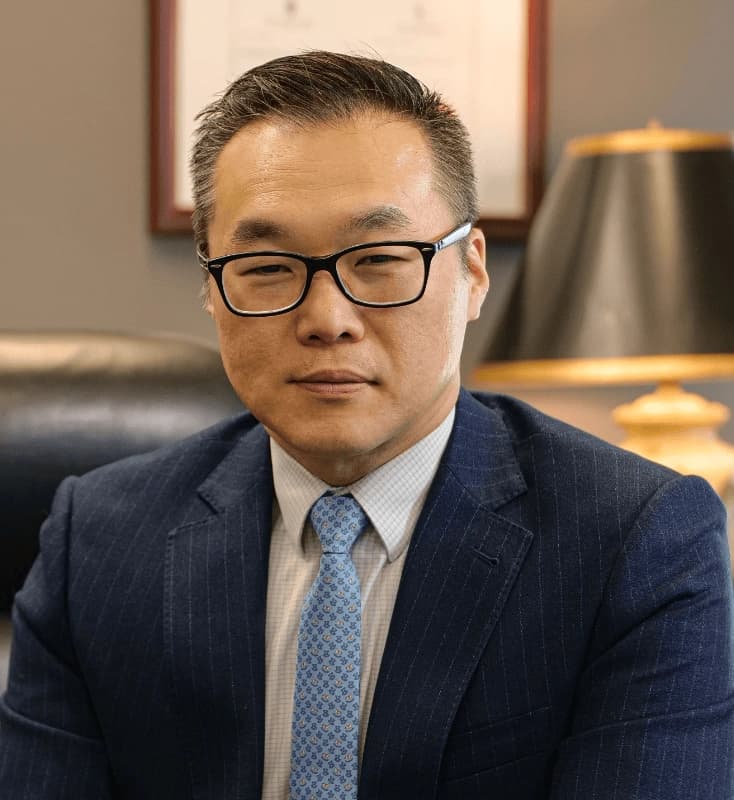
Co-Managing Partner
Lawyer
Lawyer

Immigration Consultant
RCIC R529664 · RQIC 11726
Frequently Asked Questions
Where we work
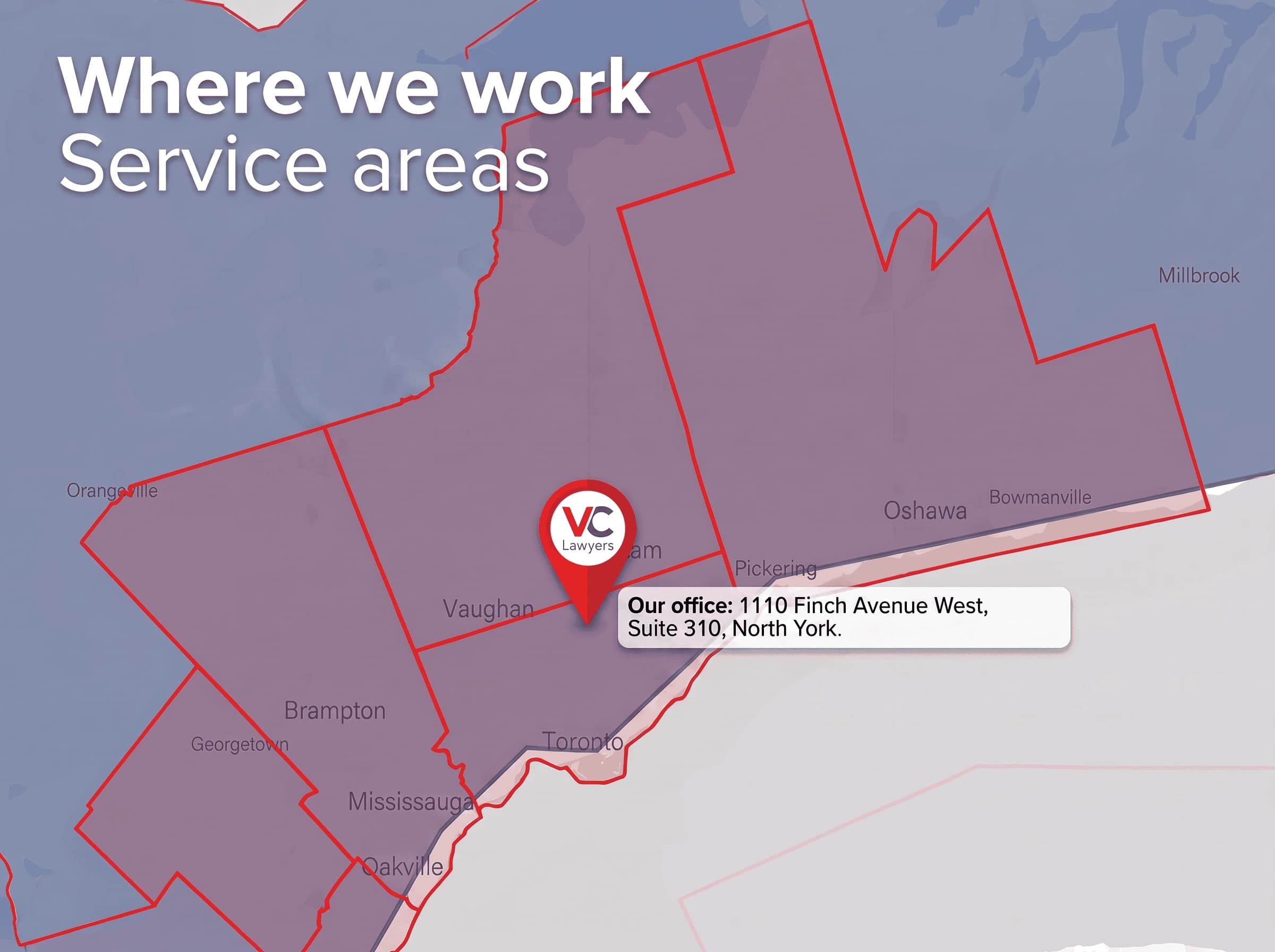
VC Lawyers serves clients throughout the Greater Toronto Area, including Toronto, North York, Scarborough, Etobicoke, Mississauga, Brampton, Oakville, Burlington, Vaughan, Richmond Hill, Pickering, Ajax, Whitby, Oshawa, Newmarket, and Aurora. We also represent clients across Ontario through video consultations, including clients who are still in U.S. hospitals or recovering away from home.
Languages spoken at the firm include English, Korean (한국어), Hebrew, Mandarin, and others depending on lawyer assignment.
Our office is located at 1110 Finch Avenue West, Suite 310, in North York, with parking and TTC access (Finch West subway and bus connections). For cross-border accident clients who cannot easily travel to the office, we conduct video consultations and home visits.
Why people choose VC Lawyers
Choosing the right personal injury law firm after an accident in Toronto can mean the difference between a lowball settlement and the full compensation you deserve.
Personal injury cases run on a contingency basis. You pay nothing upfront.
Speak with an injury lawyer today at zero cost. Other practice areas are quoted before we start.
We’re available around the clock when you need us most.
Too injured to come to us? We’ll come to you.
Services in 8 languages so nothing gets lost in translation.
You’re never just a case number. Get direct access to your lawyer.
Get in touch
Tell us what happened and a lawyer will personally review your case. Personal injury consultations are free and there are no fees unless we win. For all other practice areas, a consultation fee applies.
Prefer to call? (416) 661-4529
Take the next step
Related practice areas
The same practice, served from our office in North York.
For the broader personal injury framework.
For in-Ontario motor vehicle accidents.
For NEB claims when not employed at the time of the accident.
For serious cross-border injuries that meet the catastrophic threshold.
For cross-border fatal accidents.