
Family Law
Toronto Child Custody Lawyer
Overview
If you need an experienced child custody lawyer in Toronto or anywhere across Ontario, our dedicated team of Toronto child custody lawyers is ready to protect your parental rights and your children’s best interests. At VC Lawyers, our family law group represents parents in every type of child custody and access matter across Ontario, from joint custody and sole custody arrangements to contested custody disputes, parenting plans, child support enforcement, and relocation proceedings. We are custody lawyers in Ontario who focus every aspect of our family law practice on the children and the families we serve.
Navigating child custody in Ontario requires experienced legal representation from lawyers who understand the full complexity of Ontario’s custody laws, Ontario child custody court proceedings, and the best interests of the child framework that governs every custody decision in this province. Our Ontario child custody lawyers have the experience, resources, and dedication to guide every client through every stage of the child custody process, from initial consultation through final custody order.
Key metrics
In the numbers
- Google reviews
- 140+
- Years combined experience
- 70+
- Languages spoken
- 8+
- Calls answered, every day
- 24/7
Child Custody and Access in Ontario: What the Law Requires
Child custody and access in Ontario is governed by the Children’s Law Reform Act and the federal Divorce Act. Ontario’s custody laws have moved away from the older “custody and access” terminology toward “decision-making responsibility” and “parenting time.” That framework better reflects how Ontario courts analyze custody arrangements and parenting decisions in every custody case today.
Decision-making responsibility refers to the legal authority to make major decisions about a child’s health, education, religion, and activities. This is the substance of what Ontario’s custody laws previously called “custody.” It is the issue most frequently contested in custody disputes across Ontario.
Parenting time refers to the actual schedule during which a child is in the care of each parent. Parenting time and decision-making responsibility are determined independently in Ontario family law. A parent can have equal parenting time without shared decision-making authority, or vice versa, depending on the circumstances of each custody case.
The best interests of the child standard is the governing principle of every child custody decision in Ontario. Every custody arrangement, every custody order, and every custody agreement reached in Ontario must be based on what serves the child’s best interests, not the preferences of either parent. Ontario’s custody laws, the Children’s Law Reform Act, and the Divorce Act all direct courts and parents to keep the child’s best interests at the centre of every decision. Our child custody lawyer team builds every custody strategy around this standard.
Types of Custody in Ontario: Understanding Every Custody Arrangement
Our Ontario child custody lawyers advise clients on every type of custody arrangement available under Ontario law. The type of custody arrangement most appropriate for a family depends on the circumstances of the relationship, the history of parenting, and above all on what serves the child’s best interests.
Joint custody: a joint custody arrangement means both parents share decision-making responsibility for major decisions affecting the child’s health, education, religion, and activities. Joint custody is the most common custody arrangement in Ontario family law proceedings because it preserves both parents’ active involvement in the child’s life. Our child custody lawyer team negotiates joint custody arrangements that define how each parent exercises their decision-making authority in practice, minimizing future conflict while protecting parental rights.
Sole custody: a sole custody arrangement gives one parent exclusive legal authority to make major decisions for the child without requiring the other parent’s agreement. Sole custody arrangements are appropriate in Ontario court proceedings involving high-conflict custody disputes, safety concerns, parental alienation, or circumstances where one parent has been consistently absent from the child’s life. Our experienced child custody lawyers present the evidence required to obtain a sole custody order when the child’s best interests require it.
Shared custody: a custody arrangement where the child spends at least 40% of their parenting time with each parent. Shared custody in Ontario affects child support calculations under the Federal Child Support Guidelines. Our family law group ensures child support is accurately calculated in every shared custody arrangement.
Split custody: a less common custody arrangement in which multiple children are divided between parents, each parent having primary care of one or more children. Split custody requires individual analysis of each child’s best interests and a separate child support calculation for each custody arrangement. Our Ontario child custody lawyers advise carefully on split custody situations to ensure every child’s welfare is protected.
Physical custody: a plain-language term rather than an Ontario statutory one, describing the day-to-day caregiving schedule as distinct from decision-making responsibility. In an Ontario order or agreement it appears as parenting time. Our child custody lawyers ensure every parenting plan addresses both the residential schedule and the decision-making framework with precision and enforceability.
Legal custody: another plain-language term, describing the authority to make major decisions for a child, which Ontario legislation now calls decision-making responsibility. Our experienced child custody lawyers advise on how that authority interacts with the parenting time schedule in every custody arrangement.
Best Interests of the Child: The Standard for Every Custody Decision in Ontario
The “best interests of the child” is the cornerstone of Ontario child custody law. Every custody decision made by Ontario courts must be based on the child’s best interests, and so must every custody arrangement reached by parents. Understanding how Ontario courts apply this standard is fundamental to every custody case.
The Children’s Law Reform Act and the Divorce Act direct courts to consider a comprehensive range of factors when determining what serves the child’s best interests in a custody arrangement, including:
- The child’s physical, emotional, and psychological wellbeing
- The quality of each parent’s relationship with the child and the child’s relationship with other important people in their life
- Each parent’s ability and willingness to provide a safe, stable, and nurturing custody arrangement
- The child’s expressed views and preferences, given weight appropriate to their age, maturity, and the circumstances of the custody case
- The history of caregiving and each parent’s level of involvement in the child’s daily life
- Any history of family violence or safety concerns affecting the child or any family member
- Each parent’s ability to support the child’s relationship with the other parent, an increasingly important factor in Ontario family law proceedings
- The importance of maintaining stability and continuity in the child’s life, including school, community, and social connections
Our child custody lawyer team builds every parenting plan, every custody agreement, and every custody litigation strategy around these factors. We present the Ontario court with a compelling picture of how our client’s proposed custody arrangement serves the child’s best interests most effectively.
Child Custody Law: The Legal Framework in Ontario
Understanding child custody law in Ontario is essential for every parent involved in a custody dispute or negotiating a custody arrangement. Our Ontario child custody lawyers advise clients on every aspect of the legal framework governing custody and access in Ontario:
The Children’s Law Reform Act: Ontario’s primary statute governing child custody and access for parents who were never married or who are separated. The Children’s Law Reform Act establishes the best interests of the child as the governing standard and defines the rights and obligations of parents and children in every custody arrangement.
The Divorce Act: the federal statute governing child custody and access for married spouses going through a divorce in Ontario. Under the Divorce Act, the terminology of “custody” has been formally replaced with “parenting time” and “decision-making responsibility,” and the best interests of the child is explicitly the only factor courts may consider in a custody decision.
Ontario family law and the Family Law Act: the Family Law Act governs spousal support, property division, and domestic contracts in Ontario family law proceedings. While the Family Law Act does not directly govern custody arrangements, it is frequently relevant in combined proceedings where custody and property issues are resolved simultaneously.
Ontario court proceedings for custody: parenting cases in Ontario are heard either in the Superior Court of Justice or in the Ontario Court of Justice, and the choice matters. The Superior Court can hear every family matter, and it alone can grant a divorce or deal with family property and the matrimonial home. The Ontario Court of Justice hears decision-making responsibility, parenting time, contact, support, and child protection, but not divorce and not property. In 25 Ontario communities the two are merged into the Family Court branch of the Superior Court, the Unified Family Court, which hears everything in one place. Toronto is not one of them, so a Toronto parent often has a genuine choice of court, and an application about parenting must be started where the child lives.
Child Custody Disputes: Protecting Parental Rights and Children’s Best Interests
Custody disputes arise when parents cannot agree on a custody arrangement, parenting time schedule, decision-making authority, or the terms of a parenting plan. Our experienced child custody lawyers represent parents in every type of custody dispute, from negotiated settlements through full Ontario court litigation.
Contested custody cases: where a custody dispute cannot be resolved through negotiation or mediation, our experienced child custody lawyers represent clients before the Ontario court with the full force of our family law litigation practice. We present compelling evidence, examine witnesses, and make the legal arguments required to obtain the custody order that best serves the child’s best interests.
High-conflict custody disputes: custody disputes involving allegations of parental alienation, family violence, substance abuse, or mental health concerns call for experienced counsel and careful management of social work reports, voice of the child reports, and psychological assessments. Our custody lawyers help clients navigate these complex family law proceedings strategically and sensitively.
Parental relocation: moving a child within or outside Ontario without the other parent’s consent or a court order is a significant family law issue with serious legal consequences. Ontario courts apply a high legal threshold to relocation applications, balancing the relocating parent’s reasons against the impact on the child’s relationship with the other parent. Our child custody lawyer team advises on and advocates for both those seeking to relocate and those opposing relocation.
Variation of custody orders: where circumstances have materially changed since a custody order was made, our child custody lawyers advise on the legal threshold for a variation application and represent clients seeking to modify their custody arrangement, parenting time, decision-making responsibility, or child support.
Emergency custody orders: where a child is at immediate risk of harm or being removed from Ontario without consent, our legal team is available 24/7 to obtain urgent ex parte orders protecting the child.
Child Support in Ontario: Calculating and Enforcing Every Child’s Rights
Child support is the right of the child and is mandatory in every custody arrangement in Ontario. Both parents have a legal obligation to financially support their children. That obligation exists independently of any custody dispute or parenting time disagreement.
Child Support Guidelines: child support in Ontario is calculated under the Federal Child Support Guidelines based on the payor parent’s gross income and the number of children. Our family law group ensures child support accurately reflects the payor’s actual income, including income from a corporation, investment income, and imputed income where a parent is voluntarily underemployed.
Section 7 special and extraordinary expenses: in addition to table child support, both parents share Section 7 expenses including childcare, dental and medical costs, post-secondary education, and extracurricular activities. Our child custody lawyers ensure Section 7 contributions are properly addressed in every custody agreement and custody order.
Retroactive child support: where a parent has failed to pay support for a prior period, our child custody lawyers pursue retroactive child support claims for the support owed to the child.
Family Responsibility Office enforcement: child support orders are enforced by the Family Responsibility Office. Our family law firm assists clients in registering orders and dealing with enforcement issues where a payor is failing to comply.
Why Choose VC Lawyers as Your Child Custody Lawyer in Ontario?
When parents across the Greater Toronto Area and across Ontario need experienced child custody lawyers who combine compassionate client service with determined advocacy, VC Lawyers is ready to act.
Family Law Group Focused on Child Welfare
Our family law group works only on family law files, bringing the full depth of our Ontario family law experience to every custody case, parenting plan, and child support matter we handle. We bring the same care and preparation to a negotiated parenting schedule as we do to a contested hearing.
Experienced Ontario Child Custody Lawyers
Our experienced child custody lawyers have handled custody disputes across every level of Ontario’s family court system, from straightforward parenting plan negotiations to complex contested custody battles involving parental alienation, relocation, and high-value child support disputes. Our lawyers are familiar with every Ontario court venue and every judicial approach to custody and access across the GTA.
Protect Your Parental Rights
Protecting parental rights while keeping the child’s best interests first is the balance our child custody lawyers strike in every custody case. We advocate aggressively for our clients’ parenting rights while always maintaining the child-focused approach that Ontario courts expect and require.
24/7 Emergency Support
Family emergencies do not follow business hours. Our legal team is available around the clock to obtain urgent custody orders and protect children and parents in every emergency custody situation.
Multilingual Team
We serve clients in 8+ languages throughout Toronto, North York, and across Ontario. Language is never a barrier to accessing the family law support every parent deserves.
Frequently Asked Questions About Child Custody: Ontario Child Custody
At what age can a child choose which parent to live with in Ontario?
There is no fixed age at which a child can determine their own custody arrangement in Ontario. Courts give increasing weight to a child’s preferences as they approach ages 12 to 14, depending on maturity. A child’s preferences are one factor among many considered in determining what serves the child’s best interests. They are not automatically determinative. This is one of the most asked questions about child custody across Ontario, and our lawyers are familiar with how every Ontario court applies this principle.
How is child support calculated in a joint custody arrangement?
In a shared custody arrangement where each parent has the child at least 40% of the time, the set-off method applies under the Child Support Guidelines. Our family law group ensures every shared custody child support calculation is accurate and reflects the child’s actual financial needs.
What is the difference between joint custody and shared custody?
Joint custody refers to shared decision-making responsibility, which gives both parents legal authority to make major decisions for the child. Shared custody refers to parenting time, and it means the child spends at least 40% of their time with each parent. These are distinct concepts under Ontario child custody law and a custody arrangement can have one without the other.
Can I move my child out of Ontario without consent?
No. Moving a child outside Ontario without the other parent’s consent or a court order is a serious legal matter with significant consequences. Our child custody lawyers advise on relocation applications and represent clients in both supporting and opposing relocation proceedings.
How do I protect my parental rights during a custody dispute?
The most effective way to protect your parental rights during a custody dispute is to engage an experienced child custody lawyer in Toronto as early as possible, maintain consistent and documented involvement in your child’s life, avoid actions that could be characterized as parental alienation, and comply with all existing parenting orders and agreements while the dispute is resolved. Our experienced child custody lawyers advise on every step of this process.
Contact Our Ontario Child Custody Lawyers Today for a Consultation
Whether you are navigating a custody dispute, seeking to modify an existing custody arrangement, or facing an emergency custody situation, our experienced Ontario child custody lawyers are ready to help. Our family law group serves clients across Toronto and across Ontario, from initial consultation through final custody order.
Contact our Toronto child custody lawyers today for a consultation. We are available 24/7 and provide the compassionate, evidence-driven legal representation that every child custody matter in Ontario demands.
Types of Family Law Cases We Handle in Toronto

Children first
Parenting plans and decision-making
Ontario family courts no longer use the words "custody" and "access." The 2021 Divorce Act amendments replaced them with "parenting time" and "decision-making responsibility." The change is more than vocabulary. The new framework asks each parenting plan to start from the child's best interests, then work backward to the schedule.
We help parents draft parenting plans that hold up under section 16 of the Divorce Act, navigate move-away applications, and respond to police-assisted enforcement when the other parent stops complying.
Why people choose VC Lawyers
The right firm handles the details so you can move forward with confidence
From property and business deals to family and estate matters, the right law firm gives you clear advice, transparent fees, and a lawyer who is genuinely in your corner.
Clear, Upfront Fees
We explain your fee arrangement before we start. No surprises.
Full-Service Firm
One firm for your property, business, family, and estate matters.
Multilingual Legal Team
Services in 8 languages so nothing gets lost in translation.
Boutique Firm, Direct Access
You’re never just a file number. Reach your lawyer directly.
Trusted Ontario Counsel
Members in good standing with the Law Society of Ontario.
Decades of Combined Experience
Senior counsel on every matter we handle.
Get in touch
Looking for legal help? Speak directly with a lawyer
Tell us what happened and a lawyer will personally review your case. Personal injury consultations are free and there are no fees unless we win. For all other practice areas, a consultation fee applies.
- $30M+ recovered for injury clients
- Available 24/7, including weekends
- Service in English, Korean, and 6+ more languages
Prefer to call? (416) 661-4529
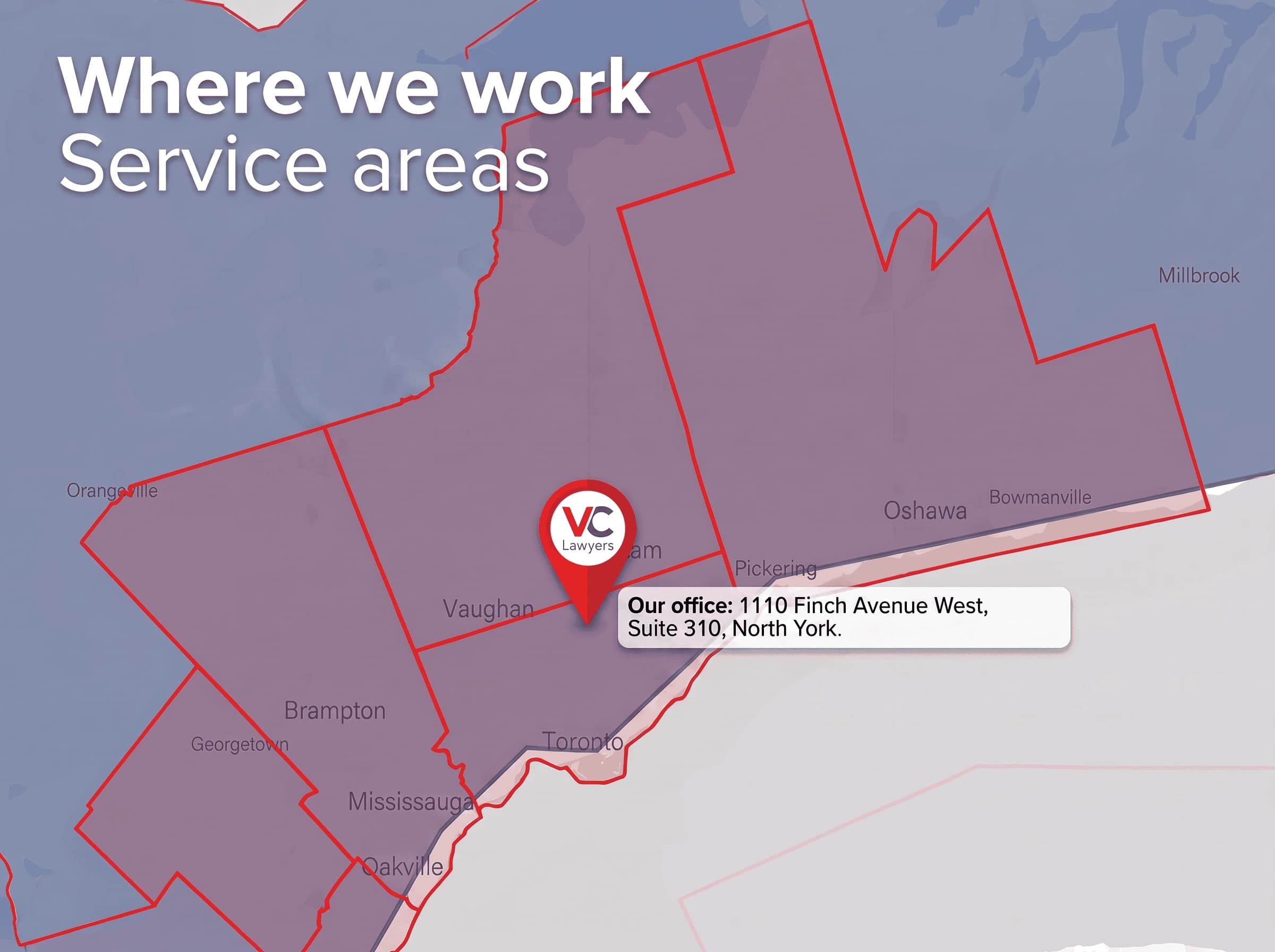
Where we work
Service areas
VC Lawyers serves clients throughout the Greater Toronto Area, including Toronto, North York, Scarborough, Etobicoke, Mississauga, Brampton, Oakville, Burlington, Vaughan, Richmond Hill, Pickering, Ajax, Whitby, Oshawa, Newmarket, and Aurora. We also represent clients across Ontario through video consultations and home/hospital visits when needed.
Languages spoken at the firm include English, Korean (한국어), Hebrew, Mandarin, and others depending on lawyer assignment.
Our office is located at 1110 Finch Avenue West, Suite 310, in North York, with parking and TTC access (Finch West subway and bus connections).
Also serving North York