
Corporate Law
Toronto Contract Dispute Lawyer
Overview
If you are involved in a contract dispute or facing a breach of contract in Toronto, Mississauga, or anywhere across Ontario, our experienced contract dispute lawyer team is ready to fight for your rights. At VC Lawyers, our dedicated contract lawyer team represents businesses and individuals in every type of contractual dispute, from commercial agreement breaches and partnership conflicts to construction contract disputes, supply chain failures, and employment contract violations. We are available 24/7.
Contract disputes can paralyze business operations, damage relationships, and cause significant financial losses. When a contractual obligation is not fulfilled, whether through non-payment, non-performance, misrepresentation, or anticipatory breach, our experienced civil litigation lawyers act quickly to protect your interests, preserve your evidence, and pursue every available legal remedy. From urgent injunctions to full Commercial List litigation, our contract dispute lawyer team has the resources, the experience, and the courtroom presence your matter calls for.
Key metrics
In the numbers
- Google reviews
- 140+
- Years combined experience
- 70+
- Languages spoken
- 8+
- Calls answered, every day
- 24/7
What Is a Contract Dispute in Ontario?
A contract dispute arises when one or more parties to an agreement disagree about whether a contractual duty has been fulfilled, whether the terms and conditions of the contract have been breached, or what remedy is available following a breach. In Ontario, contract law is governed by both common law principles and specific statutes, including the Consumer Protection Act, the Sale of Goods Act, the Commercial Tenancies Act, and the Construction Act. Each of those statutes imposes specific rights and obligations on contracting parties.
A material breach of a contractual obligation is one that goes to the heart of the agreement and defeats the purpose for which the contract was made. A breach at that level gives the non-breaching party the right to seek damages, rescission, specific performance, or other available remedies. Our contract dispute lawyer team analyzes every agreement and every set of circumstances to identify the strongest legal theory for your specific dispute.
Types of contract disputes our contract lawyers regularly handle:
- Breach of commercial supply agreements and service contracts
- Construction contract disputes under Ontario’s Construction Act, including holdback releases, proper invoices, and interim adjudication proceedings
- Partnership and shareholder agreement disputes, including disputes over profit sharing, authority, buy-sell provisions, and shotgun clauses
- Commercial lease conflicts, including disputes over CAM charges, exclusive use provisions, and alleged illegal lockouts
- Employment contract violations, including breach of non-compete and non-solicitation covenants
- Real estate contract disputes, including misrepresentation, failed conditions, and rescission claims
- Technology and software agreement disputes
Understanding the types of contract disputes applicable to your specific situation is the first step toward an effective legal strategy. Our Toronto contract lawyer team provides practical advice on the strength of every claim and the remedies most likely to deliver a favourable outcome for your business.
Breach of Contract: Legal Remedies Available in Ontario
When a breach of a contractual obligation occurs, Ontario law provides several categories of remedies depending on the nature and severity of the breach. Our contract dispute lawyer team advises every client on which remedies are available and pursues them aggressively through negotiation, mediation, arbitration, or litigation.
Damages are the most common remedy for a breach of contract. Our litigation lawyers pursue:
- Expectation damages, which place you in the financial position you would have been in had the contract been fully performed
- Reliance damages, which reimburse you for expenses wasted in anticipation of the contract being performed
- Consequential damages, which compensate you for foreseeable losses caused by the breach that go beyond the direct value of the contract itself, including lost profits and lost business opportunities
Specific performance: a court order requiring the breaching party to fulfill their contractual obligation. This equitable remedy is available in specific circumstances, particularly where the subject matter of the contract is unique, such as real estate or proprietary business assets. Our contract dispute litigation team regularly seeks specific performance as an alternative or supplement to damages in high-value commercial disputes.
Rescission: cancelling the agreement entirely and restoring both parties to their original positions. Rescission is an important remedy where a contract was induced by misrepresentation or where a fundamental breach has made the agreement commercially worthless. Our contract lawyers have successfully pursued rescission claims in commercial real estate, supply agreements, and franchise disputes.
Injunction: an urgent court order preventing a party from taking an action that would cause irreparable harm during the dispute. Our civil litigation team regularly obtains injunctions to freeze assets, prevent the dissipation of proceeds, and stop a breaching party from continuing conduct that damages our client’s interests while the litigation proceeds.
Remedies for a breach in the construction context are particularly complex. Our construction and contract lawyers advise on holdback rights, lien claims, and interim adjudication under the Construction Act as faster alternatives to a full court proceeding.
Material Breach vs. Minor Breach: Understanding the Distinction
Not every failure to perform under a contract constitutes a material breach that entitles the innocent party to terminate the agreement or claim significant damages. Understanding the distinction is critical to every contract dispute litigation strategy.
A material breach: sometimes called a significant contractual duty failure. It occurs when the breach goes to the root of the agreement and deprives the innocent party of substantially the entire benefit of the contract. A material breach entitles the innocent party to treat the contract as terminated and sue for full expectation damages.
A minor breach: a technical or partial failure that does not defeat the purpose of the agreement. It entitles the innocent party to claim damages for their actual loss, but it does not justify terminating the agreement or stopping their own performance.
Our contract lawyer team analyzes every set of facts carefully to determine whether a breach rises to the level of a material breach, because characterizing the breach incorrectly can itself create liability. Businesses and individuals that stop performance in response to a minor breach can find themselves in breach of the contract, exposing them to a counter-claim.
Construction Contract Disputes and the 2026 Amendments to the Construction Act
Construction contract disputes in Ontario run on their own statutory framework. The Construction Act, R.S.O. 1990, c. C.30 sets separate rules for prompt payment, holdback, lien rights, and interim adjudication, and a substantial package of amendments came into force on January 1, 2026. Those amendments were enacted by the Building Ontario For You Act (Budget Measures), 2024 and refined by the Fighting Delays, Building Faster Act, 2025. Together they change how money moves on a project and how quickly a payment dispute can be brought to a decision.
Since January 1, 2026, annual release of holdback has been mandatory. It applies to all contracts, with no price threshold and no multi-year project qualifier, although in practice it only bites once a contract passes an anniversary with holdback accrued. Before that date annual release was optional and available only where the contract provided for it and the contract price was at least $10 million. An owner must now publish a notice of annual release of holdback in the prescribed form within 14 days after each anniversary of the contract, and must then pay the accrued holdback no earlier than 60 days and no later than 74 days after publication, provided no lien has been preserved against the project, flowing down to contractors and subcontractors. Lien expiry is no longer tied to annual holdback release. The Fighting Delays, Building Faster Act, 2025 decoupled the two, so lien rights continue to run from the ordinary triggers of substantial performance, completion, or last supply, and do not have to be re-asserted every year. Two transition rules matter. For contracts entered into before January 1, 2026, the first annual release is required only on the second anniversary of the contract date that falls after January 1, 2026, and that payment must include all holdback accrued before it. The former right to refuse accrued holdback by publishing a notice of non-payment has been repealed. Interim adjudication was widened at the same time, so a notice of adjudication may now be given up to 90 days after a contract or subcontract is completed, abandoned, or terminated unless the parties agree otherwise, where previously an adjudication could not be started once the contract was complete. A notice of termination must be published within 7 days of termination.
Our contract dispute lawyer team advises contractors, subcontractors, owners, and developers on how these rules apply to their projects, including proper invoice requirements under the prompt payment regime, the annual holdback release cycle and the notices it requires, preservation and perfection of lien rights, and the conduct of an adjudication. Our construction litigation lawyers have extensive experience navigating the statutory adjudication process to secure payment faster than traditional civil litigation.
Alternative Dispute Resolution: Mediation, Arbitration, and Adjudication
Many commercial contract disputes can be resolved more efficiently and cost-effectively through alternative dispute resolution (ADR) than through traditional court proceedings. Our contract dispute lawyer team is experienced in every form of ADR available in Ontario:
Mediation: a structured negotiation process facilitated by a neutral mediator in which the parties work toward a mutually acceptable resolution. Mediation is particularly effective in disputes where the parties have an ongoing business relationship that they wish to preserve. Our contract lawyers prepare every client thoroughly for mediation and negotiate aggressively to achieve the best possible settlement.
Arbitration: a private adjudication process in which an arbitrator hears evidence and makes a binding decision. Many commercial contracts include mandatory arbitration clauses. Our civil litigation lawyers have extensive experience representing clients before commercial arbitrators in Ontario, presenting the same quality of evidence and legal argument as in court proceedings.
Statutory adjudication: Part II.1 of the Construction Act lets a party refer a payment or valuation dispute to an adjudicator without waiting for a trial, and the adjudicator must ordinarily determine it within 30 days of receiving the referring party’s documents. The determination binds the parties on an interim basis only, until the dispute is finally resolved by a court, by arbitration, or by written agreement, and a certified copy can be filed with the Superior Court of Justice and enforced as an order of the court. Our construction contract dispute team uses adjudication to secure interim payments and resolve scope disputes quickly.
Dispute resolution strategy: our contract lawyers advise every client on the dispute resolution mechanism best suited to their specific contractual dispute, whether that is direct negotiation, mediation, arbitration, adjudication, or litigation on the Commercial List of the Ontario Superior Court of Justice.
What NOT to Do After a Contract Breach
Do not stop performance without legal advice. Withholding payment or stopping your own performance without proper legal justification can put you in breach and expose you to a counter-claim for damages. Always consult a contract dispute lawyer before taking any unilateral action in response to a perceived breach.
Do not delete electronic communications. Emails, Slack messages, text messages, and other digital communications are frequently the most critical evidence in commercial litigation cases. From the moment you suspect a dispute is developing, preserve everything, including drafts and internal communications.
Do not sign an amending agreement under pressure. If the breaching party pressures you to agree to new terms or sign an amendment after a breach has occurred, any signature could waive your right to sue for the original failure. Review every proposed amendment with our contract lawyer team before signing.
Do not miss limitation periods. Most contract disputes in Ontario are subject to a two year limitation period that runs from the day you discovered the claim, and the law presumes you knew on the day of the breach unless you prove otherwise. A notice of adjudication under the Construction Act must generally be given within 90 days after the contract is completed, abandoned, or terminated, and a construction lien must be preserved within 60 days. Many individual contracts impose even shorter notice periods, some as short as 7 to 14 days. Contact our contract dispute lawyers immediately to ensure your right to legal action is preserved.
How Our Toronto Contract Dispute Lawyers Handle Your Case
Step 1: Book a Consultation
We analyze the contract language, review the relevant correspondence, and assess the strength of your breach claim. We identify every available remedy and advise on the fastest and most cost-effective path to resolution. Our practical advice at this stage prevents many clients from making costly procedural mistakes.
Step 2: Demand and Negotiation
We issue a formal Notice of Default where required, preserve all evidence, and pursue direct negotiation or mediation to resolve the dispute without the cost of full litigation where possible. Many contract disputes are resolved at this stage with favourable outcomes for our clients.
Step 3: Litigation or Adjudication
Where negotiation fails, our litigation lawyers initiate proceedings, whether through the Commercial List of the Ontario Superior Court of Justice, statutory adjudication under the Construction Act, or private arbitration. We present compelling legal arguments, manage evidence disclosure, and pursue every available remedy including injunctions where required.
Step 4: Enforcement
We enforce every judgment or settlement obtained, including through asset seizure, garnishment, and contempt proceedings where the breaching party refuses to comply with a court order or arbitral award.
What Compensation Can You Recover in a Contract Dispute?
Our contract dispute lawyer team pursues every available head of recovery in commercial contract litigation:
- Expectation damages, which put you in the financial position you would have been in if the contract was performed
- Reliance damages, which reimburse wasted expenses incurred in anticipation of the agreement
- Restitution, which forces the breaching party to return any unjust enrichment they received at your expense
- Specific performance, which is a court order compelling completion of the contract
- Punitive damages, which courts may award beyond your actual loss in rare cases of high-handed or bad faith conduct
- Debt collection, which recovers unpaid invoices, holdbacks, and contractual amounts owing
- Legal costs, a portion of which may be recoverable in successful commercial litigation cases
Our contract lawyers calculate every head of damages available in your dispute, including consequential losses and lost profits, so your recovery reflects the true financial impact of the breach.
Why Choose VC Lawyers as Your Contract Dispute Lawyer in Toronto?
When businesses and individuals across Toronto, Mississauga, Brampton, and southwestern Ontario need a contract dispute lawyer with the commercial sophistication and courtroom experience their dispute demands, VC Lawyers is ready to act.
Commercial List Experience
Our civil litigation lawyers are experienced practitioners before the Toronto Superior Court of Justice Commercial List, one of Ontario’s most demanding commercial courts. That court has its own procedural rules and its own pace, and we know how to work within them.
Clear Fees, in Writing
We set out our fees in a written engagement at the start of your matter, so you always know what to expect and there are no surprises.
Experienced in Every Form of ADR
Our contract lawyers are experienced in mediation, arbitration, and statutory adjudication under the Construction Act, and advise every client on the fastest and most cost-effective path to resolution for their specific contractual dispute.
24/7 Availability
Commercial crises do not follow business hours. Our contract dispute team is available around the clock to litigate urgent injunctions, freeze assets, and respond to eleventh-hour developments in active contract litigation.
Serving Toronto, Mississauga, and Across Ontario
Our Toronto contract lawyer team represents clients across the GTA, including Toronto, Mississauga, Brampton, North York, and Etobicoke. We also act throughout Ontario and across Canada.
Frequently Asked Questions: Contract Dispute Lawyer Toronto
How long do I have to sue for breach of contract in Ontario?
For most contract claims in Ontario the basic limitation period under the Limitations Act, 2002 is two years, and it runs from the day the claim was discovered rather than automatically from the day of the breach. The Act presumes you knew of the claim on the day the act or omission took place unless you prove otherwise, and a 15 year ultimate limitation period also applies, so delay is rarely safe. Construction matters carry their own deadlines: a construction lien must be preserved within 60 days and perfected within 90 days after the last day it could have been preserved, and a notice of adjudication under the Construction Act must generally be given within 90 days after the contract is completed, abandoned, or terminated. Individual contracts may impose shorter notice periods, some as brief as 7 to 14 days. Contact our contract dispute lawyers immediately to protect your right to legal action.
What if the contract was verbal?
Verbal contracts are legally binding in Ontario for most commercial matters. Under Canadian law, our contract lawyers use Course of Conduct evidence, such as emails, invoices, and patterns of behaviour, to establish the terms of an oral agreement and prove the breach.
How much does a contract dispute lawyer cost?
We offer flexible billing structures, including hourly rates for advisory work. Contact us for a consultation to discuss your matter and the billing arrangement best suited to your dispute.
Can I claim for lost profits in a breach of contract case?
Yes. Where lost profits were a foreseeable consequence of the breach at the time the contract was entered into, courts will award damages, including compensation for lost business opportunities and disrupted operations. Our contract lawyers work with forensic accountants to calculate and document every element of consequential loss.
What is the difference between mediation and arbitration in a contract dispute?
Mediation is a facilitated negotiation where a neutral mediator helps the parties reach a voluntary settlement. The mediator does not impose a decision. Arbitration involves a neutral arbitrator who hears evidence and makes a binding decision, similar to a court judgment. Our contract dispute lawyer team advises on which process is most appropriate for your specific dispute.
Involved in a Contract Dispute? Contact Our Toronto Team Today for a Consultation
Whether you are a business owner whose contract has been breached, a contractor owed payment, or a party seeking to defend against an unjustified claim, our contract dispute lawyer team is ready to protect your interests and pursue the full remedies available to you.
Our contract lawyers offer a consultation with no obligation. We serve clients in Toronto, Mississauga, Brampton, and across Ontario. We are available 24/7 for urgent matters. Contact us today and let our experienced contract dispute litigation lawyers review your agreement, advise on your rights and obligations, and develop the most effective strategy for your situation.
Types of Corporate and Commercial Cases We Handle
Why people choose VC Lawyers
The right firm handles the details so you can move forward with confidence
From property and business deals to family and estate matters, the right law firm gives you clear advice, transparent fees, and a lawyer who is genuinely in your corner.
Clear, Upfront Fees
We explain your fee arrangement before we start. No surprises.
Full-Service Firm
One firm for your property, business, family, and estate matters.
Multilingual Legal Team
Services in 8 languages so nothing gets lost in translation.
Boutique Firm, Direct Access
You’re never just a file number. Reach your lawyer directly.
Trusted Ontario Counsel
Members in good standing with the Law Society of Ontario.
Decades of Combined Experience
Senior counsel on every matter we handle.
Get in touch
Looking for legal help? Speak directly with a lawyer
Tell us what happened and a lawyer will personally review your case. Personal injury consultations are free and there are no fees unless we win. For all other practice areas, a consultation fee applies.
- $30M+ recovered for injury clients
- Available 24/7, including weekends
- Service in English, Korean, and 6+ more languages
Prefer to call? (416) 661-4529
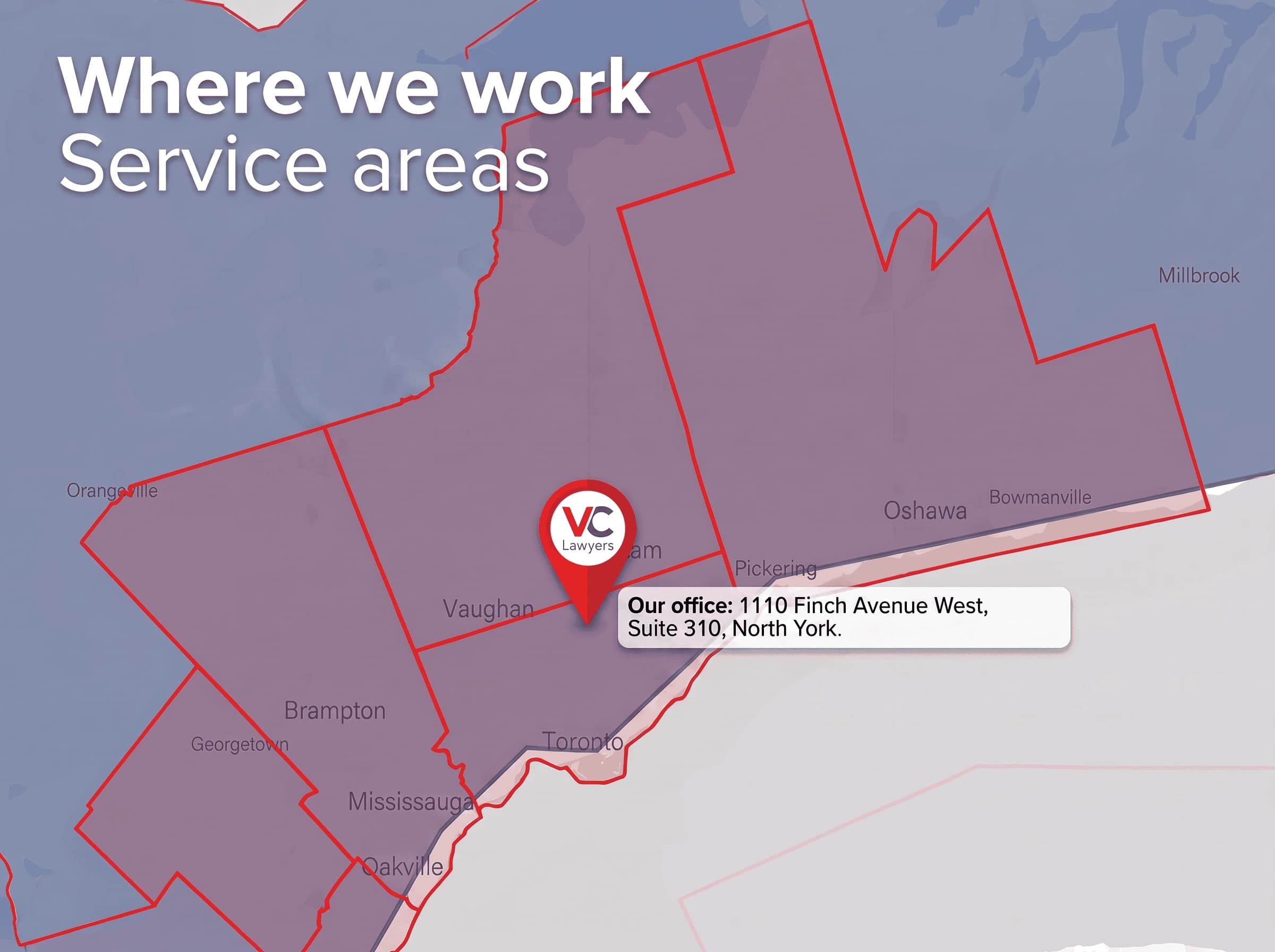
Where we work
Service areas
VC Lawyers serves clients throughout the Greater Toronto Area, including Toronto, North York, Scarborough, Etobicoke, Mississauga, Brampton, Oakville, Burlington, Vaughan, Richmond Hill, Pickering, Ajax, Whitby, Oshawa, Newmarket, and Aurora. We also represent clients across Ontario through video consultations and home/hospital visits when needed.
Languages spoken at the firm include English, Korean (한국어), Hebrew, Mandarin, and others depending on lawyer assignment.
Our office is located at 1110 Finch Avenue West, Suite 310, in North York, with parking and TTC access (Finch West subway and bus connections).
Also serving North York