
Maurice Vaturi
Senior Counsel

Employee-Side Practice




Trusted by employees across the GTA
For employees
If your employer has terminated you, asked you to sign a severance package, made unilateral changes to your role, or treated you in a way that may amount to harassment or discrimination, you have rights. The steps you take in the first weeks shape what your case is worth months or years later.
This page is written for the people on the receiving end of these decisions. We will not tell you that “every situation is unique” and end every paragraph with “consult a lawyer.” We will tell you what the law actually says, what your case is likely worth, what the most common mistakes are, and what to do tomorrow morning.
VC Lawyers represents employees across the GTA in wrongful dismissal, severance negotiation, harassment, accommodation, LTD denial, wage theft, and other employment claims. A severance package review on its own is a flat fee, typically $500 to $1,500, and negotiation and litigation work is billed hourly. Every fee arrangement is quoted in writing before work starts. The first 30-minute consultation is confidential and protected by solicitor-client privilege from the moment it begins. We work in English, Korean, and several other languages.
When to call
Some employment situations have hard procedural deadlines that affect what your case is worth. The framework below sorts the most common situations by urgency. Call us at the priority tier that matches your situation.
Call us as soon as possible if any of the following apply: you have just received a termination letter and a severance offer; you have been laid off and are not sure if it is permanent; you have received a release to sign with a deadline; you have been told to resign or be terminated; you have been escorted out of the building suddenly; you have been formally accused of misconduct and asked to respond.
These situations typically involve hard procedural deadlines that affect what your case is worth.
Get legal advice this month if any of these apply: your role has been restructured with reduced responsibilities, pay, or seniority; your hours, schedule, or location have been unilaterally changed; you have been demoted or moved to a new role you did not agree to; your bonus has been withheld or reduced unfairly; you have been told you must return to office work after working remotely; you are facing a workplace investigation.
These are constructive dismissal triggers. The timing of your response shapes the legal analysis.
Plan to consult a lawyer in the next one to three months if any apply: you have been harassed, bullied, or discriminated against and are considering leaving; your employer is refusing a reasonable accommodation (disability, family status, religion, etc.); you have been pressured to sign a new employment contract or restrictive covenant; you suspect your performance reviews are being manipulated to justify termination; you are negotiating an exit deal voluntarily and want to know what you should ask for.
Severance components
Most severance disputes focus on the salary component, but the full package includes much more. These additional components are often left off employer offers. Recovering them can substantially increase total compensation.
Termination clause errors
Many Ontario employment contracts contain termination clauses that fail under the Ontario Court of Appeal's decision in Waksdale v Swegon North America Inc. (2020 ONCA 391). When a clause fails, the employer's “ESA-only” offer becomes a starting point for negotiation, not a final answer. The most common drafting errors that invalidate termination clauses are below.

The package on your desk
Initial severance offers are almost always based on ESA minimums plus a small “goodwill” amount. A careful review often reveals the offer is 3-5 times below entitlement. Negotiation, conducted properly, frequently doubles or triples the original offer without ever needing to file a lawsuit.
Severance reviews are a flat fee, typically $500 to $1,500, far less than the additional recovery typically obtained.
Common employee claims
Most employee-side files fall into one of these ten categories. Each has its own legal framework, evidence requirements, and typical resolution path.
The classic claim. You were terminated without cause, but your employer offered you only ESA minimums (or close to it) and asked you to sign a release. You believe you are entitled to more.
What to look for: your length of service, age, role, and the difficulty of finding similar work suggest you should receive substantially more than the offer; your termination clause may be unenforceable; the deadline pressure feels artificial; the employer is unwilling to discuss the package.
Typical resolution: negotiated settlement, typically 2-5 times the original offer. Most cases settle within 2-6 months. Litigation is rare.
You were not formally fired, but the employer made unilateral changes that effectively forced you out. The legal test (from Potter v New Brunswick Legal Aid Services Commission, 2015 SCC 10): would a reasonable person conclude that the employer's conduct showed an intention to no longer be bound by the employment contract?
Common triggers: significant pay reduction (10%+ usually qualifies); demotion or substantial reduction in responsibilities; forced relocation to a distant office (the threshold varies by case); toxic workplace where employer fails to address harassment; fundamental change in reporting structure or job duties.
The big strategic question: should you resign and sue, or stay and try to make the situation work? The right answer depends on how severe the change is, how long you have been with the employer, your ability to find alternative employment, the strength of the constructive dismissal evidence, your financial situation, and whether there are other claims (harassment, discrimination). This is a decision that should not be made alone. Resigning prematurely can convert a winning constructive dismissal case into a losing voluntary resignation case. Staying too long can be interpreted as accepting the new terms.
You were given a severance package and you want to know if it is fair. This is the single most common reason employees retain us.
The review process: collect documents (termination letter, employment contract, severance offer, recent pay information, performance reviews); calculate ESA entitlement (termination pay, severance pay, benefits, accruals); calculate common law entitlement (Bardal analysis based on your specific circumstances); assess the termination clause (does it survive Waksdale?); identify other components (bonus, commission, equity); compare to the offer (gap analysis); strategy (counter-offer, negotiation approach, timeline).
Most reviews can be completed in 3-7 days. If the offer is fair, we tell you. If the offer is significantly below entitlement, we negotiate. That typically results in a settlement at 2-4 times the original offer.
You have been harassed at work, and the employer has either failed to address it or has made things worse. Multiple paths exist for relief: HRTO (Human Rights Tribunal of Ontario) for harassment based on a protected ground, where there are no filing fees, no costs against losing parties, and awards that include lost wages and compensation for injury to dignity, feelings, and self-respect (typically $10,000-$50,000+); civil court for the tort of harassment (a relatively new but increasingly recognized claim) or for other employment-related damages; OHSA / Ministry of Labour for failure of the employer to investigate or to maintain a harassment-free workplace; wrongful dismissal claim if you were terminated for raising a complaint (that is a “reprisal,” which is independently illegal); constructive dismissal claim if the harassment forced you to resign.
These claims often combine. A successful harassment case can include all of: HRTO compensation for human rights damages, civil court damages for the tort of harassment, and wrongful dismissal damages for the termination/forced resignation.
You have a disability, whether physical, mental, or chronic, and your employer is failing to accommodate. The duty to accommodate runs to “undue hardship,” which is a high legal threshold. Most accommodation requests should be granted.
Common accommodation issues: mental health conditions (depression, anxiety, PTSD), which are increasingly recognized; addiction (substance use disorders), which is protected as a disability; chronic illnesses (cancer, MS, Crohn's disease, fibromyalgia); mobility impairments; sensory impairments (visual, auditory); cognitive disabilities; pregnancy and pregnancy-related conditions.
What employers must do: engage in the “accommodation conversation” (collaborative process to find solutions); modify the job, hours, location, or other aspects to remove the barrier; provide leave where appropriate; maintain confidentiality of medical information; follow up regularly during the accommodation. What we can help with: documenting your accommodation request properly; responding to employer requests for medical information without overdisclosing; negotiating accommodation arrangements; HRTO complaints if accommodation is denied; wrongful dismissal claims if you are terminated during accommodation.
You have been off work due to a medical condition, and your insurance company has denied your LTD claim. This is a different legal issue from employment law, but it frequently affects employees in the same circumstances.
Common denial reasons: “not totally disabled” (the insurer's interpretation); “pre-existing condition”; “no objective medical evidence”; “failure to follow recommended treatment”; “not covered by policy”; “mental illness limitation expired.”
Most LTD denials can be challenged. The insurance company has a duty of good faith. Successful challenges often result in: reinstatement of benefits (sometimes retroactively); lump-sum settlements covering past and future benefits; bad-faith damages in extreme cases. LTD claims are typically handled on contingency. There is no fee unless we recover.
You are owed wages that have not been paid: unpaid overtime (very common, because many employees do not realize they are entitled to overtime); unpaid commissions or bonuses; vacation pay not paid out on termination; misclassification as exempt from overtime when actually entitled; unpaid statutory holiday pay; tips and gratuities improperly retained by the employer.
Recovery options: Ministry of Labour complaint (free, but capped at $10,000); civil court (uncapped recovery, appropriate for larger amounts); class action (for systemic wage theft affecting many employees).
You have been working as an “independent contractor” but your relationship looks more like employment. This misclassification is common in tech, consulting, the gig economy, and many small businesses. It can cost you years of unpaid vacation pay, statutory holiday pay, overtime pay, CPP and EI contributions, common law severance (if “terminated”), and benefits.
The legal test (Wiebe Door v Minister of National Revenue): control (who controls the work?); ownership of tools (who provides the tools and equipment?); chance of profit (does the worker have entrepreneurial opportunity?); risk of loss (does the worker bear financial risk?); integration (is the worker integrated into the business?). The “dependent contractor” doctrine (a halfway category) recognizes workers who are not full employees but are economically dependent on a single payer. Dependent contractors are entitled to the same common law reasonable notice on termination as employees.
If you have been working as an “independent contractor” for the same company for years, primarily or exclusively, you may have a substantial misclassification claim.
Your former employer is threatening to enforce a non-compete or non-solicitation clause. The good news for most Ontario employees: non-compete clauses are largely unenforceable as of October 2021. The Working for Workers Act, 2021 prohibits non-compete agreements except for executives (CEO, COO, CFO, CIO, CTO, etc.) and the sale of a business.
Non-competes signed before October 2021 may still be enforceable but face heavy scrutiny under traditional restraint of trade analysis (geographic scope, time period, scope of restricted activity). Non-solicitation clauses remain enforceable if narrowly drafted, but many are drafted overly broadly and would not survive a court challenge. If you are facing threats, get advice before assuming you must comply.
You reported illegal conduct, safety violations, fraud, or other wrongdoing. Now you are being punished for it. Multiple statutory protections may apply: Ontario Securities Act protections for reporting securities law violations; Public Servants Disclosure Protection Act for public sector workers; OHSA for raising health and safety concerns; common law (courts have increasingly recognized public policy protections for whistleblowers).
Whistleblower claims often combine with wrongful dismissal claims (you were terminated for whistleblowing) and harassment claims (you were treated badly for raising concerns).
Key metrics
Case phases
Most wrongful dismissal cases follow this six-phase pattern. Roughly 90% of cases settle before trial, most during Phase 3 negotiation or Phase 4 mediation.
Preparing for the consultation
The more documentation you bring, the more specific our analysis can be. That said, do not delay calling because you are missing some of these. Bring what you have, and we will help you gather the rest.
Information to have ready
Beyond documents, the more of the following information you can summarize for us at the first meeting, the more specific our analysis can be.
What not to worry about
Many employees delay calling because they think they need to be fully prepared. They do not. The list below is what you do not need to worry about before the first consultation.
Our team
Employee-side employment law rewards strategic clarity, negotiation experience, and the ability to read a severance package quickly and accurately. Our team brings all three to every engagement.
Senior Counsel

Partner

Co-Managing Partner

Lawyer

Lawyer

Immigration Consultant
RCIC R529664 · RQIC 11726
Frequently Asked Questions
Why people choose VC Lawyers
From property and business deals to family and estate matters, the right law firm gives you clear advice, transparent fees, and a lawyer who is genuinely in your corner.
We explain your fee arrangement before we start. No surprises.
One firm for your property, business, family, and estate matters.
Services in 8 languages so nothing gets lost in translation.
You’re never just a file number. Reach your lawyer directly.
Members in good standing with the Law Society of Ontario.
Senior counsel on every matter we handle.
Get in touch
Tell us what happened and a lawyer will personally review your case. Personal injury consultations are free and there are no fees unless we win. For all other practice areas, a consultation fee applies.
Prefer to call? (416) 661-4529
Take the next step
Related practice areas
The same practice, served from our office in North York.
Return to the central employment law page.
Employer-side practice for compliance, terminations, and litigation defence.
Disability claims and LTD disputes outside the employment framework.
Commercial disputes and tort claims outside employment.
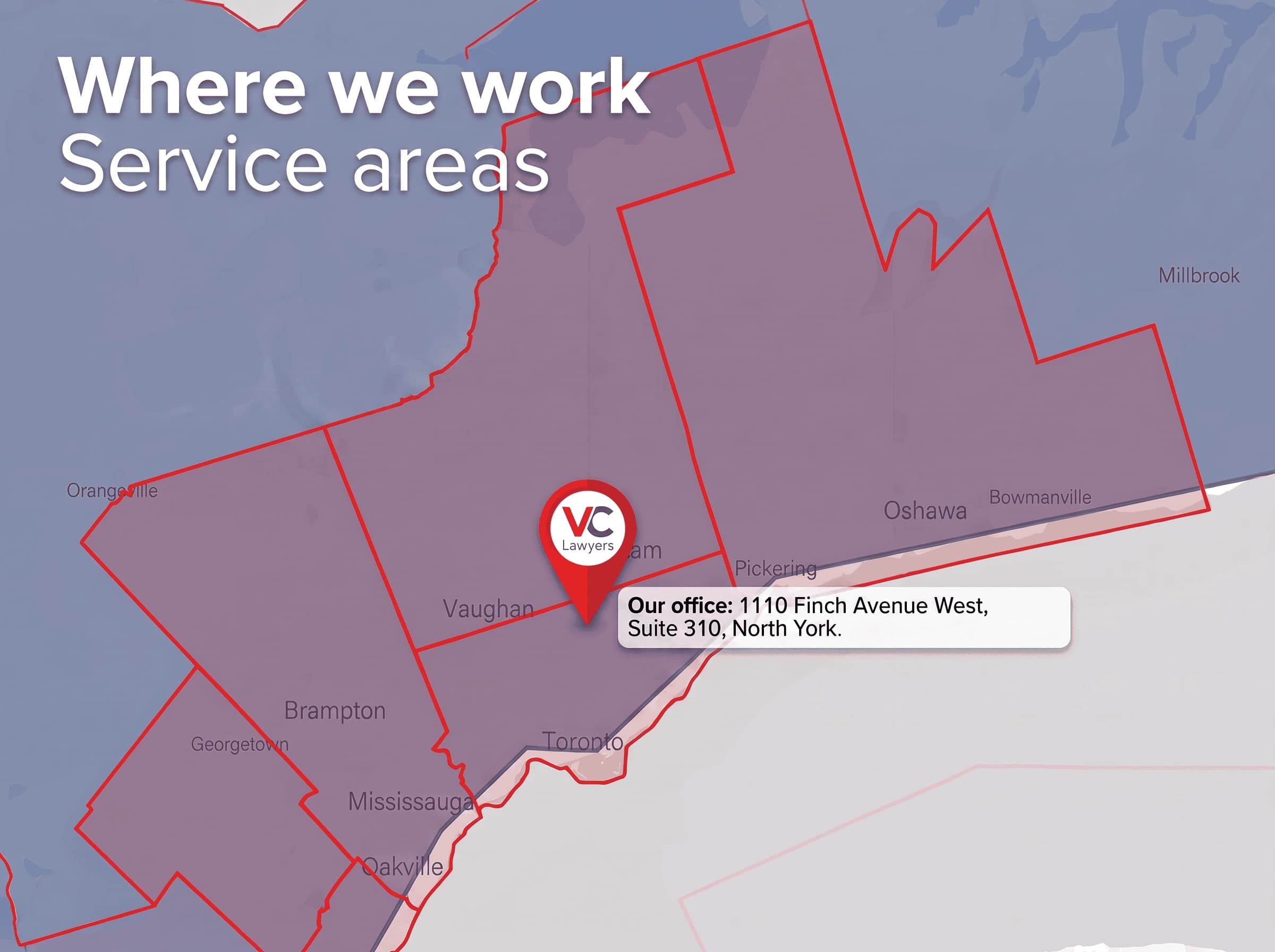
Where we work
VC Lawyers serves clients throughout the Greater Toronto Area, including Toronto, North York, Scarborough, Etobicoke, Mississauga, Brampton, Oakville, Burlington, Vaughan, Richmond Hill, Pickering, Ajax, Whitby, Oshawa, Newmarket, and Aurora. We also represent clients across Ontario through video consultations and home/hospital visits when needed.
Languages spoken at the firm include English, Korean (한국어), Hebrew, Mandarin, and others depending on lawyer assignment.
Our office is located at 1110 Finch Avenue West, Suite 310, in North York, with parking and TTC access (Finch West subway and bus connections).