
Catastrophic Injuries
Toronto Burn Injury Lawyerfor catastrophic burns, scarring, and lifetime compensation




Trusted by accident victims and businesses across Ontario
Overview
Burn injuries are among the most catastrophic personal injuries a person can suffer
At VC Lawyers, our dedicated team of Toronto burn injury lawyers represents victims of catastrophic burns, scarring, and electrical injuries across Toronto and throughout Ontario. The physical, psychological, and financial consequences of a serious burn extend far beyond the initial trauma. Recovery takes years of reconstructive surgery, skin graft procedures, trauma therapy, and specialized nursing care, and it can cost millions over a lifetime.
Survival is now the ordinary outcome even for injuries that would have been fatal thirty years ago. The Ross Tilley Burn Centre at Sunnybrook is the only adult burn centre in Ontario and the largest in Canada. It takes roughly 300 of the province's most serious burn patients every year, and the work it does is extraordinary: skin grafts, reconstructive surgery, precisely fitted pressure garments, pain management protocols. But surviving a serious burn is the beginning of a different story, not the end of one.
Pressure garments are worn 23 hours a day for years. Contractures form despite the best occupational therapy, tightening the healed skin until a joint no longer moves through its full range. Skin that grows back where skin was lost behaves nothing like the skin that was there before. It itches, it tightens, and it scars in patterns that keep changing for five years and never quite stop. Reconstructive surgeries continue at intervals stretching over a decade. Children stare, new acquaintances ask, and every introduction to a stranger involves a calculation about whether to mention the burn at all.
The financial dimensions match that reality. Acute care alone can run into six figures before any private expense begins. Specialized pressure garments cost roughly $500 to $1,500 each and are replaced every three to six months. Add custom prosthetics for digits or limbs lost to thermal or electrical injury, physical and occupational therapy that becomes part of weekly life, and psychological care for post-traumatic stress and body image. Then add the vocational consequences for someone whose career is no longer possible. Properly assembled, a future cost of care projection for a serious burn reaches into the millions.
Ontario law provides substantial compensation for that reality, but only when the claims are properly pursued. There is rarely only one claim to make. Burns from a motor vehicle accident engage the Statutory Accident Benefits Schedule (SABS). Workplace burns engage the Workplace Safety and Insurance Board (WSIB). Burns from defective products engage product liability law. Burns from a negligent property owner engage occupier's liability. Burns from criminal acts engage a further set of remedies. Each stream runs under its own rules, and most serious burn cases have several of them going at once. They have to be coordinated as a single file rather than handled one at a time.
Securing a catastrophic impairment designation, known as a CAT designation, is one of the most important steps in a burn injury claim. Where burns cover a significant percentage of the body or result in permanent serious disfigurement, our personal injury lawyers pursue one. It raises the combined medical, rehabilitation, and attendant care limit to $1,000,000, or $2,000,000 where the optional higher limit was purchased. Without it, the standard limit is $65,000.
We work on a contingency fee basis, so you pay nothing unless we win. The first consultation is free, and for serious burn injury cases we cover all expert and disbursement costs upfront, often $50,000 to $150,000 or more across a single case.
Burn depth classifications
The four degrees of burn injury severity
Burns are classified two ways: by depth, meaning how many layers of skin and tissue were destroyed, and by the percentage of total body surface area involved. Both matter to a legal claim, because together they determine the medical care you will need and the compensation you are entitled to.
First-degree burns (superficial)
First-degree burns affect only the outer layer of skin, the epidermis. Sunburn is the classic example. They cause redness and pain but typically heal within a week without scarring. On their own they rarely produce a significant legal claim. The exception is a widespread first-degree burn, such as one from a chemical exposure, which can occasionally support a claim.
Depth is only half of the assessment. The other half is total body surface area, or TBSA, calculated with the Rule of Nines: the head 9%, each arm 9%, the front torso 18%, the back torso 18%, each leg 18%, and the perineum 1%. Children are assessed instead on the more precise Lund-Browder chart, which adjusts for the different body proportions of a child at each age. Severity is always depth and TBSA read together, never one on its own.
Second-degree burns (partial thickness)
Second-degree burns extend into the dermis, the layer under the epidermis. They blister and hurt a great deal, and many require hospital treatment and leave permanent visible scarring. There are two subtypes. Superficial partial thickness heals with minimal scarring within 2 to 3 weeks. Deep partial thickness takes longer and often produces significant scarring.
That subdivision decides a great deal. A partial-thickness burn over 10% TBSA in an adult is treated as a major burn, and for a child or an older adult the threshold drops to 5%. A major burn belongs in a specialized burn centre rather than a general emergency department. A deep partial-thickness burn that leaves permanent visible scarring also supports damages for disfigurement even where function eventually returns. Ontario courts treat visible scarring as a real and continuing loss, not a cosmetic footnote.
Third-degree burns (full thickness)
Third-degree burns destroy both the epidermis and the dermis, and often reach into the subcutaneous tissue below. The burned skin looks leathery, white, brown, or charred. It is often relatively painless because the nerve endings have been destroyed, while the surrounding partial-thickness areas are frequently excruciating. These burns cannot heal on their own. They require skin grafting and leave permanent scarring.
Any third-degree burn over 5% TBSA is a major burn. So is any burn to the face, hands, feet, genitalia, perineum, or a major joint. So is any electrical or chemical burn, any burn with an inhalation injury, and any burn on a patient with significant pre-existing conditions. Major burns require admission to a specialized burn centre, which in Ontario means the Ross Tilley Burn Centre at Sunnybrook for adults and the Hospital for Sick Children for pediatric patients.
Third-degree burns also drive the catastrophic impairment analysis. Under the AMA Guides to the Evaluation of Permanent Impairment, 4th edition, a burn is rated on eight factors: total body surface area, depth, location (face, hands, feet, and joints carry higher values), functional impairment from contractures, cosmetic disfigurement, heat and cold intolerance, nerve damage, and psychological consequences. A patient with third-degree burns over 30% TBSA, hand involvement, and significant scarring will typically rate substantially above the 55% whole-person threshold that unlocks catastrophic benefits.
Fourth-degree burns
Fourth-degree burns extend beyond the skin into muscle, tendon, bone, or other deep structures. These are the most severe burn injuries, and they often require amputation or extensive reconstructive surgery. Survival is uncertain for severe fourth-degree burns covering a significant body area.
Where a fourth-degree burn costs a limb, or leaves contractures that make an arm permanently unusable, catastrophic impairment can be established under paragraph (d)(ii) of SABS section 3.1(1). That paragraph covers total and permanent loss of use of an arm even without a formal amputation. Where an associated electrical injury damaged the spinal cord, paragraph (b) may apply instead. Both are separate routes to catastrophic designation, and neither depends on reaching a 55% whole-person rating.
Types of burns
Mechanisms of burn injury
Burns are categorized by mechanism, meaning the source of the heat, energy, or chemical that caused the injury. Each type produces distinct medical and legal considerations.
Thermal burns
Thermal burns are caused by heat: flames, hot liquids (scalds), hot surfaces, and hot gases. They are the most common type. Data from the Ross Tilley Burn Centre indicates that approximately 56% of burn admissions are from fire and 21.5% from scalds.
The legal question in a thermal burn is almost always who controlled the source of the heat. A house fire may trace back to a landlord's defective wiring, inoperative smoke detectors, or blocked fire exits. A kitchen scald may trace back to equipment that malfunctioned. A vehicle fire may trace back to a ruptured fuel system or a damaged battery. Investigating the cause is critical. Fire investigators do that work, and they are often retired fire marshals or specialized engineers. Their finding on origin and cause establishes which legal pathway to compensation is actually open.
Electrical burns
Electrical burns result from current passing through the body. They are particularly insidious because the visible damage may be minimal while the internal damage is severe. Current entering at one point and exiting at another can damage muscles, nerves, and blood vessels along the entire path. Cardiac arrhythmia is a significant risk. Electrical injuries account for approximately 11.5% of burn admissions at Ross Tilley.
That gap between what is visible and what is damaged is why electrical injuries are so often under-assessed at the outset. It is also why the medical record has to trace the path of the current rather than simply describe the entry and exit wounds. In Ontario, recovery after an electrical injury runs largely through St. John's Rehab, the rehabilitation partner of the Ross Tilley Burn Centre. Where the electrical injury caused spinal cord damage, paragraph (b) of the catastrophic impairment test may apply on its own.
Chemical burns
Chemical burns result from exposure to acids, bases, or other corrosive substances. Industrial chemical burns are common in manufacturing, cleaning, and laboratory settings. The severity depends on the concentration of the chemical, the duration of exposure, and whether neutralization occurred quickly.
Because so many of these injuries happen at work, a chemical burn usually engages WSIB. It often supports a claim against a third party as well, such as the manufacturer of equipment that failed or a contractor controlling a multi-employer site. Concentration and exposure time decide severity. That makes three things worth preserving immediately: the substance involved, its labelling, and the maintenance records for whatever released it. A chemical burn also counts as a major burn regardless of how it looks on the first day.
Radiation burns
Radiation burns result from ionizing radiation, ultraviolet exposure, or therapeutic radiation. They are uncommon in personal injury practice, but they do occasionally arise.
When they do, they are assessed the same way as any other burn. Depth, total body surface area, location, and the resulting functional and cosmetic impairment drive both the treatment plan and the value of the claim. The mechanism affects who is liable. It does not change how the injury itself is measured.
Friction burns
Friction burns result from rapid skin contact with abrasive surfaces. The most common examples are road rash from motorcycle accidents and treadmill injuries, particularly in young children.
Road rash is a burn in the legal sense as much as the medical one. It is assessed on the same depth and surface area criteria, and it can leave the same permanent scarring. That matters, because a motorcycle collision engages both SABS and a tort claim against the at-fault driver. Treadmill injuries to young children are the other common presentation. Where a machine's design, manufacture, or warnings were inadequate, a product liability claim against the manufacturer may run alongside an occupier's liability claim against whoever controlled the premises.
Inhalation burns
Inhalation burns damage the airways through hot gas, smoke, or chemical inhalation. They often accompany external burns, and they can be life-threatening even when the external burn area is limited. Carbon monoxide poisoning, cyanide toxicity, and direct thermal damage to the airways all fall under this category.
An inhalation injury makes a burn a major burn on its own, whatever the external surface area involved. That alone is grounds for admission to a specialized burn centre. Because the damage is internal, it is also the injury most easily left out of the early record. Getting it documented properly from the start protects both the treatment and the claim built on top of it. The strength of the medical record sets the strength of everything that follows.
How burns happen
The most common causes of serious burn injuries
How a burn happened decides which compensation systems are open to you. Each cause below points to a different stream, and most serious burn injury cases have several of them running at once.
Motor vehicle accidents
A collision burns people in several ways: vehicle fires, fuel system ruptures, electrical fires from damaged batteries, contact with hot vehicle components after the crash, exposure to airbag chemical residues, and fuel tank ruptures in motorcycle or pedestrian accidents.
A burn from a crash engages SABS regardless of who caused the collision, and it is the one mechanism where catastrophic impairment designation is available. That designation raises the combined medical, rehabilitation, and attendant care limit to $1,000,000 for life. It also doubles attendant care to $6,000 a month, removes the five-year time limit, and adds housekeeping and caregiver benefits. Where another driver was at fault, a tort claim runs alongside the accident benefits file, and that is where general damages, future cost of care, and income loss are recovered.
Workplace accidents
Workplace burns come from industrial fires and explosions, contact with hot surfaces or equipment, electrical accidents, chemical exposure, and scalds from steam or boiling liquids in food service.
Workplace burns go to WSIB, which pays without any need to prove fault. The benefits are loss-of-earnings payments at roughly 85% of net pre-injury earnings, a non-economic loss award for permanent impairment, and lifetime medical and rehabilitation coverage. Vocational retraining is also available for workers who cannot go back to the job they had. A worker covered by WSIB generally cannot sue their employer or co-workers. A claim against a third party is often still open: the manufacturer of equipment that failed, a contractor on a multi-employer site, or a driver in a vehicle-related workplace accident. A Ministry of Labour investigation frequently produces evidence that a civil claim can use.
Residential fires
Burns at home come from house fires, cooking accidents, heating equipment failures, electrical wiring fires, and smoking-related fires. A civil liability claim may be available where a landlord was negligent, through defective wiring, inoperative smoke detectors, or blocked fire exits.
Causation drives everything in a fire case. The investigator's finding on origin and cause decides who the claim runs against. It may be a landlord whose smoke detectors, sprinklers, or exits were inadequate. It may be a property owner responsible for unsafe wiring or failing heating equipment. It may be the manufacturer of the appliance or product that started the fire, or another occupant whose fire spread through a multi-unit building. More than one of those can be true at once, so building inspection records, maintenance records, and fire department reports need to be secured early.
Defective products
Defective products burn people most often through lithium battery fires, in electronics, e-cigarettes, e-bikes, and hoverboards. Other sources are space heater malfunctions, kitchen appliance defects, hot water tank malfunctions, hair styling tools, gasoline cans without flame arrestors, and lighters with manufacturing defects.
A product liability claim requires expert engineering analysis establishing a design, manufacturing, or failure-to-warn defect, and proof that you were using the product in a foreseeable way. The most important thing you can do is keep the product. Do not return it to the retailer or send it back to the manufacturer. Hold on to the packaging, the instructions, and any warnings that came with it.
These cases are resource-intensive, but recoveries can be substantial. That is especially true where the manufacturer is a large corporate defendant, or where the same defect has injured more than one person, which raises the possibility of a class action.
Restaurant and cooking accidents
Commercial kitchens burn workers and customers alike, through hot oil spills, deep fryer accidents, steam from coffee equipment, scalding from coffee or hot water, and equipment malfunctions.
For a customer, this is occupier's liability under the Ontario Occupiers' Liability Act. The occupier is the owner, the tenant, or whoever else is in control of the premises. That person owes a duty to take reasonable care that visitors are reasonably safe. The claim turns on establishing the duty, the breach of it, and the causal link to the burn. Damages mirror any other tort claim: pain and suffering, future care, income loss. For a worker burned in the same kitchen, the identical incident goes to WSIB instead, with a possible third-party claim against whoever made the equipment.
Hot beverage spills
Coffee, tea, and other hot beverages cause significant burns when spilled, particularly on children. Drive-thru spills, restaurant accidents, and home accidents all produce these claims.
Where the person burned is a child, the procedure changes. The claim is brought through a litigation guardian, usually a parent, and any settlement requires court approval so a judge can confirm it is in the child's best interests. The two-year limitation period generally does not start to run until the child turns 18, but claims are normally pursued right away so that treatment and care are funded through childhood rather than years later.
Recreational accidents
Recreation produces its own burns: campfire injuries, gasoline explosions during yard work, fireworks, propane tank malfunctions, boat fires, and ATV gas tank ruptures.
These usually resolve into an occupier's liability claim, a product liability claim, or both, depending on whether the danger came from the property or from the equipment. If you were burned as a visitor on someone else's property, the occupier owed you a duty of reasonable care. If a propane tank, a fuel container, or a gas tank failed, the manufacturer may be liable, which makes preserving the item itself the first practical step.
Electrical contact accidents
These burns come from power line contact, electrical panel failures, ground fault interruption failures, defective extension cords, and household electrical incidents.
Power line contact is frequently a workplace event, which means WSIB plus a possible third-party claim against an equipment manufacturer or another contractor on the site. Whatever the setting, the visible wound routinely understates the injury. Current passing between an entry point and an exit point damages muscle, nerve, and blood vessel along the way, and it carries a real risk of cardiac arrhythmia. A cardiac assessment and a full workup of the current's path belong in the record from the beginning.
Criminal acts
Some burns are inflicted deliberately, through arson, intentional scalding, acid attacks, and other intentional burns. Criminal prosecution proceeds separately, but civil claims against the perpetrator and against any negligent property owner may also be available.
Where compensation comes from has changed. The Criminal Injuries Compensation Board used to pay burn victims regardless of whether the perpetrator was ever identified or had any money. It was wound down in 2019 and replaced by the Victim Quick Response Program Plus, which covers emergency expenses. Ongoing compensation for a criminal burn now flows primarily through a civil claim against the perpetrator where assets exist, and against any property owner whose negligence made the attack possible.

Talk to us
Every burn injury case deserves a careful look
The first 30-minute consultation is free and confidential. Whether you were injured, lost a loved one, or are caring for an injured family member, we will tell you within that conversation what your realistic options are, and what to do next.
No fee unless we recover. Home and hospital visits available across the GTA.
Frequently Asked Questions
We answered all
How serious does a burn need to be to qualify for catastrophic impairment under SABS?
There is no single “size” threshold. The qualifying analysis depends on the multiple factors that together produce a 55% whole-person impairment rating under the AMA Guides, 4th edition. Burns that generally meet this threshold include third-degree burns over substantial body surface area (typically 20%+ TBSA), burns with significant hand or facial involvement, burns producing major contractures or functional limitations, and burns with severe psychological consequences. Combinations of physical and psychological impairments qualify as well. Smaller burns can still qualify when combined with other injuries from the same accident, because the 55% rating considers the whole person rather than isolated injuries. A burn over 15% TBSA together with other significant injuries from a vehicle crash may collectively reach 55%. Burns are not given their own paragraph in section 3.1(1), so they qualify through other routes. Paragraph (h) covers a combination of impairments including a mental or behavioural disorder at Class 4 or Class 5. Paragraph (d)(ii) covers total and permanent loss of use of an arm from contractures or amputation. Paragraph (b) applies where an electrical injury damaged the spinal cord. Eligibility is determined through the OCF-19 application and the medical assessment behind it. The application is normally filed once the medical picture has stabilized, typically 6 to 12 months after a serious burn. An experienced burn injury lawyer coordinates that assessment and can usually predict the likely outcome from the medical evidence before it is filed.How much can I receive in compensation for my burn injury?
Total compensation depends on multiple factors. Where the burn is catastrophic, SABS benefits run up to $1,000,000 in combined medical, rehabilitation, and attendant care over a lifetime. That limit is $2,000,000 where the optional higher limit was purchased. Income Replacement Benefits of up to $400/week are payable on top, where that optional coverage was bought. Tort damages are available where another party was at fault, and they come in four main categories. General damages run up to approximately $470,000, the indexed Andrews ceiling. Future cost of care is often $1M to $5M+ for serious burns. Past and future income loss is often $500K to $2M+. Family Law Act damages run $50K to $500K combined for family members. Future cost of care is the largest of the four in most serious burn cases. It has to cover decades of reconstructive surgery, pressure garment replacement, scar management, pain management, attendant care beyond the SABS limits, home modifications, and psychological treatment. For a serious burn case with a young claimant and clear liability, total compensation can reach several million dollars when properly assembled and pursued. For older claimants, less serious burns, or cases with liability complications, the totals are lower but still typically in the high six figures or seven figures.Can I make a claim if my burn happened at work?
Workplace burns engage the WSIB (Workplace Safety and Insurance Board) system. WSIB provides loss-of-earnings benefits, non-economic loss compensation, medical and rehabilitation benefits, and vocational rehabilitation. Workers covered by WSIB generally cannot sue their employer or co-workers, but lawsuits against third parties may still be available: equipment manufacturers (product liability), contractors on multi-employer sites, drivers in vehicle-related workplace accidents, and property owners (occupier's liability where applicable). WSIB benefits are often more limited than tort damages, but they operate without any fault requirement and through simpler procedures. That is why the two systems have to be assessed together rather than one at a time. The interaction is complex, so an experienced lawyer works out whether WSIB is mandatory, what tort claims may be available against third parties, and how to structure the overall claim. The WSIB application itself also benefits from legal advice, particularly on permanent impairment determinations and disputes about benefit levels. Burn-related impairment ratings under WSIB's framework can produce substantial non-economic loss awards.My child was burned. How does the legal process work for minors?
Children's burn cases involve several special considerations. Specialized pediatric care: serious burns in children are typically treated at the Hospital for Sick Children in Toronto, which has dedicated pediatric burn services. The detailed clinical documentation from SickKids is valuable evidence in the claim. Pediatric assessment: total body surface area is measured with the Lund-Browder chart rather than the Rule of Nines used for adults, because it adjusts for the different body proportions of children at various ages. Lifetime impact: for a child the future stretches across decades, so the long-term projection sits at the centre of the case. A burn at age 7 produces consequences across 70 or more years of expected life. Vocational impact, psychological development, social development, and reproductive considerations all factor into the claim. Litigation procedures: lawsuits are conducted through a “litigation guardian,” typically a parent. Any settlement involving a minor also needs court approval through the infant settlement approval process, which confirms the settlement is in the child's best interests. Settlement structuring: money for a minor is typically held in trust or invested through Ontario's accountant of the Superior Court until the child turns 18, or longer depending on capacity. Structured settlements that pay out periodically are common in serious pediatric cases. Limitation period: the two-year period under the Limitations Act, 2002 generally does not begin to run for minors until they reach 18, so a 10-year-old has until age 20 to sue. Parents normally pursue the claim promptly anyway, so that proper care is funded during childhood.How long do I have to make a burn injury claim?
Multiple limitation periods may apply. For motor vehicle burns, a SABS application is due within 30 days of the accident. The OCF-19 catastrophic designation is filed when the medical situation stabilizes. A LAT application against a SABS denial is generally due 2 years from the date of the denial. A tort lawsuit is generally due 2 years from the date of the burn under the Limitations Act, 2002, and for minors that period generally begins at age 18. A WSIB claim should be reported to the employer immediately, with the formal claim filed within 6 months. Family Law Act claims are generally tied to the same 2-year period. For road and sidewalk non-repair claims against a municipality, written notice is due within 10 days. That deadline comes from s. 44(10) of the Municipal Act, 2001, or from s. 42(6) of the City of Toronto Act, 2006 where the claim is against Toronto. Late notice can still be excused where there is a reasonable excuse and the municipality is not prejudiced. The 2-year tort limitation is the most consequential deadline, because missing it generally extinguishes the right to sue altogether, no matter how strong the case would have been. The SABS deadlines are more forgiving in practice, since a late application can be accepted with a reasonable explanation, but the benefits themselves do not start flowing until the application is in. Earlier action is always better, and there is no version of a burn injury claim that improves by waiting.Will hiring a lawyer cost me anything up front?
No. Burn injury cases are handled on contingency, meaning no fee unless we recover compensation for you. The contingency percentage is set in writing at the start of the engagement, typically ranging from 25% to 33% depending on the complexity of the case and the stage at which it resolves. Disbursements (court filing fees, expert reports, examination transcripts, mediation fees) are advanced by the firm and recovered from the settlement at the end. For serious burn injury cases, disbursements alone can run $50,000 to $100,000 or more, because a properly built case needs life care planners, plastic surgeons, psychiatrists, vocational consultants, and economists. Those costs are carried by the firm during the litigation and reimbursed only when the case resolves, so there is no bill to you while the case runs. The first 30-minute consultation is free. In that conversation we will give you a candid assessment of your case and of the compensation you can realistically expect.What if a defective product caused my burn?
Product liability claims may be available against the manufacturer. The most common scenario is a lithium battery fire from an e-bike, a hoverboard, an e-cigarette, or other electronics. Others include defective space heaters and other heating appliances, hot water tank malfunctions, hair styling tool failures, kitchen appliance defects, and lighter or fuel container defects. A product liability case requires preserving the defective product, so do not return it to the retailer or the manufacturer. It also requires engineering analysis to establish the defect and documentation of how the product was used, along with the original packaging, instructions, and any warnings. The plaintiff has to show the product was being used in a foreseeable manner. These cases are resource-intensive, but settlement values are particularly significant when the manufacturer is a major corporate defendant, or when the defect has affected multiple consumers, which raises the possibility of a class action. If you suspect a product defect contributed to your burn, contact a lawyer immediately and preserve all related materials. Once the product goes back to the retailer, the evidence of the defect usually goes with it.Can my family members make their own claims for my burn injury?
Yes. Under Ontario's Family Law Act, certain family members can make claims for damages caused by the injury: spouses (married or common-law), children (including step-children and adopted children), parents, grandparents and grandchildren, and brothers and sisters. Family Law Act claims compensate for the loss of guidance, care and companionship that the claimant might reasonably have expected to receive from the injured person. In a burn case that loss is a real one, because years of caregiving and the changes a serious burn brings genuinely reshape family life. For serious burn cases the typical ranges are $50,000 to $200,000 for a spouse, $25,000 to $50,000 for each child, $25,000 to $100,000 for each parent, and $5,000 to $25,000 for each sibling. The figure for a child is adjusted depending on whether that child is an adult or still young. These claims are usually advanced together with the primary tort claim rather than separately. Caregivers may also be entitled to compensation for the value of the care they have personally provided, potentially calculated at market rates for attendant care services. Those caregivers are usually the same spouses and parents.What about my disfigurement and scarring?
Visible scarring is one of the most significant elements of burn injury damages. Ontario courts recognize that permanent disfigurement produces ongoing psychological and social consequences. It affects employment, dating, and social interactions. The stares, the intrusive questions, and the assumptions burn survivors face are all real losses. Disfigurement is compensated through general damages (the Andrews ceiling), through specific psychological damages, and through the future care component that funds scar management treatment. That treatment includes silicone sheets, laser therapy, steroid injections, and surgical scar revision. Photographic evidence matters more here than in almost any other kind of injury claim. Photographs of you before the accident, set beside the scarring documented as it progressed, are what let a judge or a jury see the difference. For severe disfigurement, especially of the face, the general damages component is typically substantial and often approaches the indexed Andrews ceiling.How do I choose the right burn injury lawyer in Toronto?
Several factors matter, and each of them is worth testing directly at the first consultation. Specialization in catastrophic injury: burn cases need a lawyer who handles catastrophic work routinely. Catastrophic designations, future care planning, and complex multi-stream tort claims are their own discipline, and a general personal injury practice does not cover it. Burn-specific medical fluency: the lawyer should understand TBSA assessment, the AMA Guides rating system as it applies to burns, the typical surgical trajectory, scar management, and the long-term consequences of burns. Familiarity with Ross Tilley Burn Centre treatment protocols and outcomes is valuable too. Resources to fund expert evidence: burn cases need life care planners, vocational consultants, economists, plastic surgeons, dermatologists, and psychiatrists. The firm has to be able to advance those costs, often $50,000 to $100,000 or more, across years of litigation. Trial experience: most burn cases settle, but they settle well only because the lawyer is credibly prepared to try them. Communication and accessibility: a burn file runs for years, so you need a lawyer you can actually reach, who returns calls and keeps you informed. Cultural and linguistic capacity: in a city as diverse as Toronto, being able to discuss your case in your first language produces better outcomes, because the case is ultimately the story of your life before and after the burn. Contingency fee transparency: a clear written agreement at the outset, in plain language. The first consultation is the time to evaluate all of this. Bring documents. Ask hard questions. Compare two or three firms before deciding.
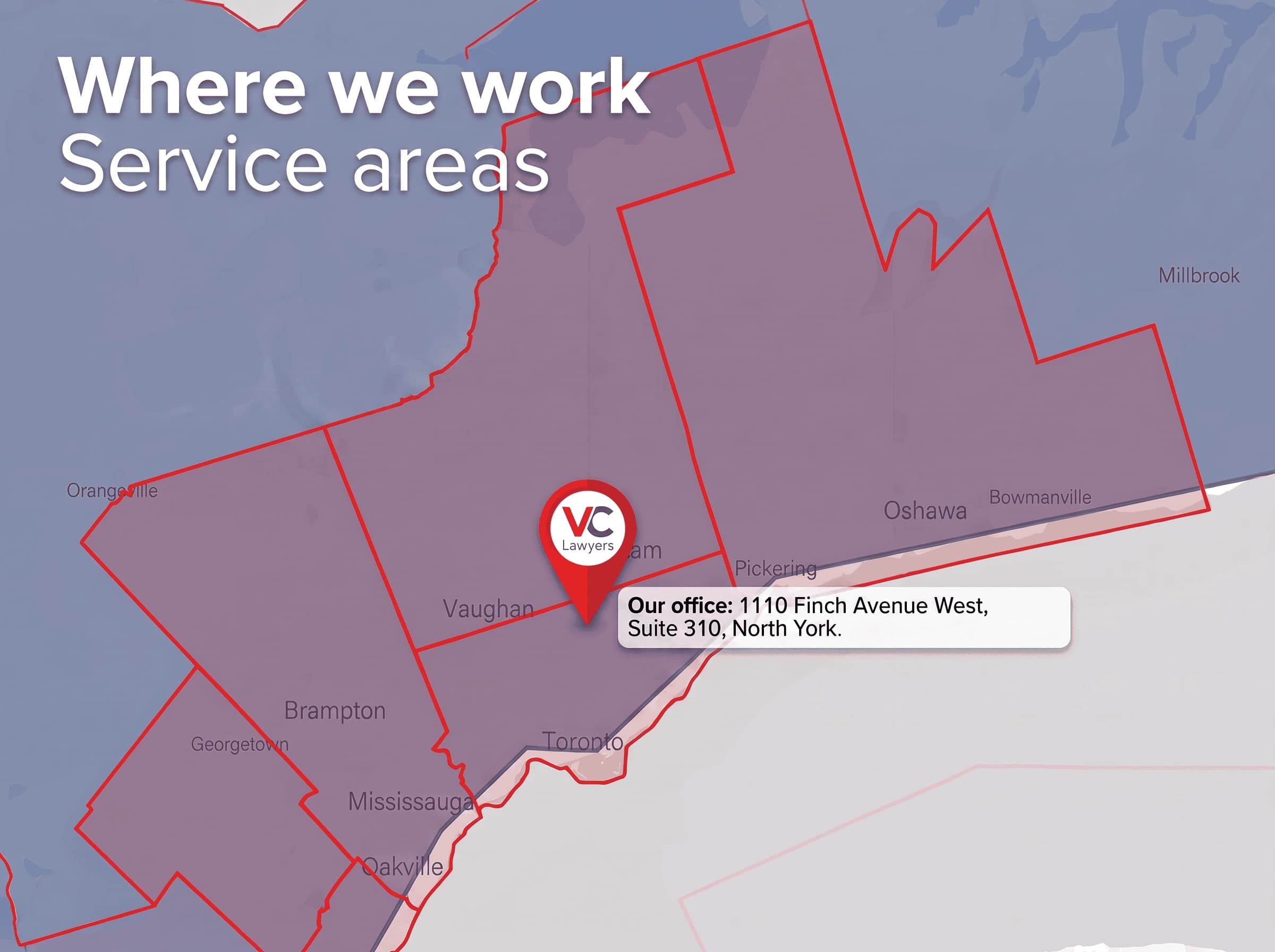
Where we work
Service areas
VC Lawyers serves clients throughout the Greater Toronto Area, including Toronto, North York, Scarborough, Etobicoke, Mississauga, Brampton, Oakville, Burlington, Vaughan, Richmond Hill, Pickering, Ajax, Whitby, Oshawa, Newmarket, and Aurora. We also represent clients across Ontario through video consultations and home/hospital visits when needed.
Languages spoken at the firm include English, Korean (한국어), Hebrew, Mandarin, and others depending on lawyer assignment.
Our office is located at 1110 Finch Avenue West, Suite 310, in North York, with parking and TTC access (Finch West subway and bus connections).
Why people choose VC Lawyers
The right firm handles everything so you can focus on recovery
Choosing the right personal injury law firm after an accident in Toronto can mean the difference between a lowball settlement and the full compensation you deserve.
No Fees Unless We Win
Personal injury cases run on a contingency basis. You pay nothing upfront.
Free Personal Injury Consultation
Speak with an injury lawyer today at zero cost. Other practice areas are quoted before we start.
24/7 Emergency Hotline
We’re available around the clock when you need us most.
Home & Hospital Visits
Too injured to come to us? We’ll come to you.
Multilingual Legal Team
Services in 8 languages so nothing gets lost in translation.
Boutique Firm, Big Results
You’re never just a case number. Get direct access to your lawyer.
Get in touch
Looking for legal help? Speak directly with a lawyer
Tell us what happened and a lawyer will personally review your case. Personal injury consultations are free and there are no fees unless we win. For all other practice areas, a consultation fee applies.
- $30M+ recovered for injury clients
- Available 24/7, including weekends
- Service in English, Korean, and 6+ more languages
Prefer to call? (416) 661-4529
Take the next step
A serious burn changes the math of every year going forward.
Related practice areas
Continue exploring
Burn Injury Lawyer in North York
The same practice, served from our office in North York.
Catastrophic Injury Lawyer Toronto
Return to the catastrophic injuries hub.
Toronto Scarring & Disfigurement Lawyer
Permanent visible scarring claims and the verbal threshold.
Toronto Amputation Lawyer
For severe burns leading to amputation.
Toronto Traumatic Brain Injury Lawyer
Co-occurring traumatic brain injuries.
Motor Vehicle Accident Lawyer Toronto
For motor vehicle accident burn claims.