
Corporate Law
Toronto Corporate Governance Lawyer
Overview
Our experienced corporate governance lawyer team advises boards, directors, officers, and management teams across Canada on every aspect of corporate governance, from board structure and compliance programs to shareholder rights, regulatory requirements, and governance best practices. At VC Lawyers, our dedicated corporate governance lawyers provide the practical, strategic legal counsel that Canadian corporations, private companies, and organizations need to govern effectively, manage risk, and comply with an increasingly complex regulatory environment.
Strong corporate governance is no longer optional. It is a legal, fiduciary, and commercial imperative. Boards of directors face growing scrutiny from shareholders, regulators, and the courts. Directors and officers carry personal liability for governance failures. Our corporate governance lawyer team helps every client build governance frameworks that protect the company, protect its leadership, and create long-term organizational value.
Key metrics
In the numbers
- Google reviews
- 140+
- Years combined experience
- 70+
- Languages spoken
- 8+
- Calls answered, every day
- 24/7
What Is Corporate Governance in Canada?
Corporate governance is the system of rules, practices, and processes by which a company is directed and controlled. It encompasses the relationships between the board of directors, management, shareholders, and other stakeholders. It also covers the legal and regulatory framework within which each of these groups operates.
In Canada, corporate governance obligations arise from multiple sources of legislation and regulation, including the Canada Business Corporations Act (CBCA), the Ontario Business Corporations Act (OBCA), provincial securities legislation, industry-specific regulatory requirements, and the common law duties of directors and officers. Our corporate governance lawyers advise on every layer of this framework, so every client understands both the legal requirements they must comply with and the best practices that go beyond the minimum standard.
Effective corporate governance requires more than legal compliance. It requires a clear policy framework, a well-structured board, defined director duties, robust internal controls, and a culture of accountability at every level of the organization. Our law firm provides the full spectrum of corporate governance legal counsel required to build and maintain this foundation.
Board of Directors: Structure, Duties, and Governance
The board of directors is the cornerstone of every corporation’s governance framework. Directors owe fiduciary duties to the company, including the duty of loyalty and the duty of care. They can also be held personally liable for governance failures. Our corporate governance lawyers advise boards across Canada on every aspect of board governance, including:
Board structure and composition: advising on the appropriate size, independence requirements, and committee structure for every type of company. Effective boards require a balance of skills, independent judgment, and clearly defined roles for each director. Our firm advises on board composition best practices and assists with director recruitment and orientation.
Director duties and liability: advising directors and officers on their legal duties under Canadian corporate legislation, the scope of their personal liability, and the governance processes required to fulfill their obligations. Understanding the duty of loyalty, the duty of care, and the business judgment rule is essential for every director sitting on a Canadian board.
Board committees: advising on the establishment and mandate of audit committees, compensation committees, governance committees, and special committees for specific transactions or governance issues. Each committee must have a clear charter, defined authority, and appropriate independence standards.
Board meeting process and minutes: ensuring that board meetings are conducted correctly, that proper notice is provided, that quorum requirements are met, and that minutes accurately record decisions taken and the deliberative process underlying them. Well-maintained board records are a director’s most important defence in any governance dispute.
D&O insurance: advising directors and officers on directors’ and officers’ liability insurance coverage and how to ensure their insurance policy provides adequate protection against governance claims.
Compliance Programs: Building a Regulatory Compliance Framework
Regulatory compliance is a growing challenge for Canadian organizations across every sector. Our corporate governance lawyers advise companies and organizations on the development and implementation of compliance programs that meet current regulatory requirements and protect against liability.
Designing compliance programs: our firm advises on the structure and content of corporate compliance programs, including policies for anti-corruption, privacy, workplace conduct, securities law compliance, and industry-specific regulatory requirements. Effective compliance programs require clear policy documentation, employee training, monitoring mechanisms, and a culture of accountability that starts at the board level.
Regulatory requirements and reporting: advising on the specific regulatory requirements applicable to your company’s sector, including securities reporting obligations, financial disclosure requirements, and industry-specific compliance obligations. Our corporate governance lawyers ensure every client understands the full scope of their regulatory obligations and the consequences of non-compliance.
Internal investigations: when compliance failures occur, prompt and thorough internal investigation is critical to managing legal and regulatory risk. Our corporate governance team advises management and boards on how to conduct internal investigations correctly, including evidence preservation, reporting obligations, and privilege considerations.
Risk management: advising on the governance structures and processes required to identify, assess, and manage enterprise risk. Effective risk management requires active board oversight, clear management accountability, and robust internal reporting processes. Our firm assists every client in building the risk management governance framework that regulators and shareholders expect.
Shareholder Rights and Governance Disputes
Shareholders play a fundamental role in corporate governance. They exercise rights to vote, receive information, and hold the board accountable. Our corporate governance lawyers advise both companies and shareholders on the full range of shareholder governance matters, including:
Shareholder agreements: drafting and reviewing shareholder agreements that govern the relationship between shareholders, define each party’s rights and obligations, and establish mechanisms for resolving governance disputes. A well-drafted shareholder agreement addresses share transfer restrictions, voting arrangements, information rights, dividend policy, and dispute resolution provisions. That reduces the likelihood of costly governance conflict.
Proxy season and annual meetings: advising boards on shareholder meeting requirements, proxy disclosure obligations, and the management of contested director elections or shareholder proposals. Proxy season governance advice includes the review of shareholder proposals, the drafting of management information circulars, and the development of board responses to activist shareholder campaigns.
Shareholder disputes and conflict: advising on the legal remedies available where a shareholder’s rights have been violated: oppression remedies under the CBCA or OBCA, derivative actions on behalf of the company, and court applications for compliance with governance obligations.
Minority shareholder protections: advising minority shareholders on their rights under Canadian corporate law and ensuring that corporate decision-making processes comply with the fairness and procedural requirements applicable to transactions affecting minority interests.
Corporate Governance for Private Companies and Organizations
Corporate governance best practices are not limited to public companies. Private corporations, not-for-profit organizations, and other entities across Canada benefit from strong governance frameworks. They also increasingly face regulatory expectations that were previously reserved for publicly traded companies.
Our corporate governance lawyers advise private equity-backed companies, family-owned businesses, professional corporations, and charitable organizations on the governance structures appropriate for their specific circumstances. That work covers board composition, conflict of interest policies, director compensation, and succession planning for management and ownership.
Private equity governance involves unique challenges: the management of portfolio company boards, the alignment of management incentives, and the governance requirements imposed by institutional investors. Our firm advises on every aspect of private equity governance in the Canadian market.
International corporate governance is a distinct part of this practice. For Canadian companies with cross-border operations or international shareholders, our corporate governance lawyers advise on the interaction between Canadian and international governance requirements. That means navigating the differences between Canadian corporate law and the governance standards of other jurisdictions where the company operates or is listed.
Trends in Canadian Corporate Governance
The corporate governance landscape in Canada is evolving rapidly. Our corporate governance lawyers monitor every significant governance trend affecting Canadian boards and management, including:
ESG (Environmental, Social, and Governance) obligations: directors increasingly face stakeholder and regulatory expectations regarding climate risk disclosure, diversity on boards, and supply chain responsibility. Our firm advises on how to integrate ESG considerations into governance frameworks and board oversight processes.
Cybersecurity governance: regulatory and stakeholder expectations regarding board oversight of cybersecurity risk have intensified significantly. Our corporate governance team advises on board-level cybersecurity governance, including policy frameworks, risk reporting, and incident response governance.
Executive compensation governance: the governance of executive compensation has become a significant area of shareholder scrutiny. It covers the design of compensation programs, the role of the compensation committee, and say-on-pay processes. Our firm advises on compensation governance best practices and compliance with applicable regulatory requirements.
Digital transformation and governance: the adoption of artificial intelligence, automation, and digital platforms creates new governance questions regarding oversight, accountability, and regulatory compliance. Our corporate governance lawyers advise on the governance implications of emerging technology at the board and management level.
How Our Corporate Governance Lawyers Help Your Organization
Our corporate governance lawyer team provides practical, strategic counsel tailored to the specific governance needs of every client:
Board advisory services: attending board and committee meetings as legal counsel, advising on governance matters as they arise, and providing ongoing legal guidance on evolving corporate governance requirements.
Policy drafting and review: drafting and reviewing governance policies including codes of conduct, conflict of interest policies, board charters, committee mandates, insider trading policies, and whistleblower programs.
Governance audits: reviewing existing governance frameworks against current best practices and regulatory standards, identifying gaps, and recommending practical improvements.
Transactions and special situations: advising boards on the governance requirements applicable to significant transactions, including mergers, acquisitions, related party transactions, and restructurings. Governance failures in transaction contexts are among the most common sources of director liability in Canadian corporate law.
Training and education: providing director orientation programs, board education sessions, and governance workshops for management teams, so every director understands their duty and responsibility from the moment they are appointed.
Why Choose VC Lawyers as Your Corporate Governance Lawyers?
When your organization needs experienced corporate governance lawyers who combine deep knowledge of Canadian corporate law with practical governance experience, VC Lawyers is a law firm that boards and management trust.
Canadian Corporate Law Experience
Our corporate governance lawyers have extensive experience advising Canadian corporations and organizations across every sector, from technology and financial services to manufacturing, real estate, and not-for-profit organizations.
Commercial and Litigation Integration
We provide both transactional governance advice and litigation counsel for governance disputes. Every client gets one law firm that can take a governance matter from advice through to courtroom resolution if required.
Practical and Strategic Counsel
Our corporate governance lawyers provide practical legal advice that integrates seamlessly into how boards and management actually operate, not abstract legal opinions that are difficult to implement. We advise on the standard that regulators and courts apply, and we help every client consistently meet it.
24/7 Availability
Governance crises such as activist shareholder campaigns, regulatory investigations, and board conflicts do not follow business hours. Our team is available around the clock to consult on urgent governance matters and provide immediate strategic guidance.
Frequently Asked Questions: Corporate Governance Lawyers
What is the difference between corporate governance and corporate law?
Corporate law is the legal framework: the statutes, regulations, and case law that govern how companies are formed, operated, and managed. Corporate governance is how companies actually implement and comply with that framework in practice, through board structures, policies, processes, and decision-making culture. Our corporate governance lawyers advise on both.
Do private companies need corporate governance advice?
Yes. Private corporations, family businesses, and not-for-profit organizations all benefit from strong governance frameworks. Increasingly, institutional lenders, private equity investors, and regulators expect governance practices from private companies that were previously associated only with public companies.
What are the personal liability risks for directors?
Directors can be held personally liable for breaches of fiduciary duty, failure to comply with corporate legislation, environmental violations, tax remittance failures, and a range of other obligations. D&O insurance provides important protection, but governance processes are the first line of defence. Our corporate governance lawyers advise every director on the practical steps required to manage their personal exposure.
When should a company consult a corporate governance lawyer?
Ideally, governance counsel should be engaged proactively, before governance failures occur. Our corporate governance lawyers advise on governance framework design, policy development, board structure, and compliance programs as a preventive measure. Governance issues sometimes arise first, including shareholder conflict, regulatory inquiry, or board dysfunction. When that happens, early legal involvement is critical to managing the matter effectively.
Contact Our Corporate Governance Lawyers Today for a Consultation
If your company, board, or organization needs experienced corporate governance lawyers in Canada, our team is ready to assist. We advise on every aspect of governance, from compliance programs and board structure to shareholder disputes and governance crisis management.
Contact our corporate governance lawyers today for a confidential consultation. Our firm is available 24/7 and serves clients across Toronto, Ontario, and throughout Canada.
Types of Corporate and Commercial Cases We Handle

Board duties
Director liability protection
Ontario directors operate under fiduciary and statutory duties that have grown more demanding over the past decade. The OBCA, ESG disclosure obligations, and oppression-remedy jurisprudence have all expanded what counts as a defensible board decision.
We advise boards through compliance audits, minute-book remediation, fiduciary-duty training, and the documentation patterns that hold up when a director's decision is later second-guessed by a regulator, an aggrieved shareholder, or a class-action plaintiff.
Why people choose VC Lawyers
The right firm handles the details so you can move forward with confidence
From property and business deals to family and estate matters, the right law firm gives you clear advice, transparent fees, and a lawyer who is genuinely in your corner.
Clear, Upfront Fees
We explain your fee arrangement before we start. No surprises.
Full-Service Firm
One firm for your property, business, family, and estate matters.
Multilingual Legal Team
Services in 8 languages so nothing gets lost in translation.
Boutique Firm, Direct Access
You’re never just a file number. Reach your lawyer directly.
Trusted Ontario Counsel
Members in good standing with the Law Society of Ontario.
Decades of Combined Experience
Senior counsel on every matter we handle.
Get in touch
Looking for legal help? Speak directly with a lawyer
Tell us what happened and a lawyer will personally review your case. Personal injury consultations are free and there are no fees unless we win. For all other practice areas, a consultation fee applies.
- $30M+ recovered for injury clients
- Available 24/7, including weekends
- Service in English, Korean, and 6+ more languages
Prefer to call? (416) 661-4529
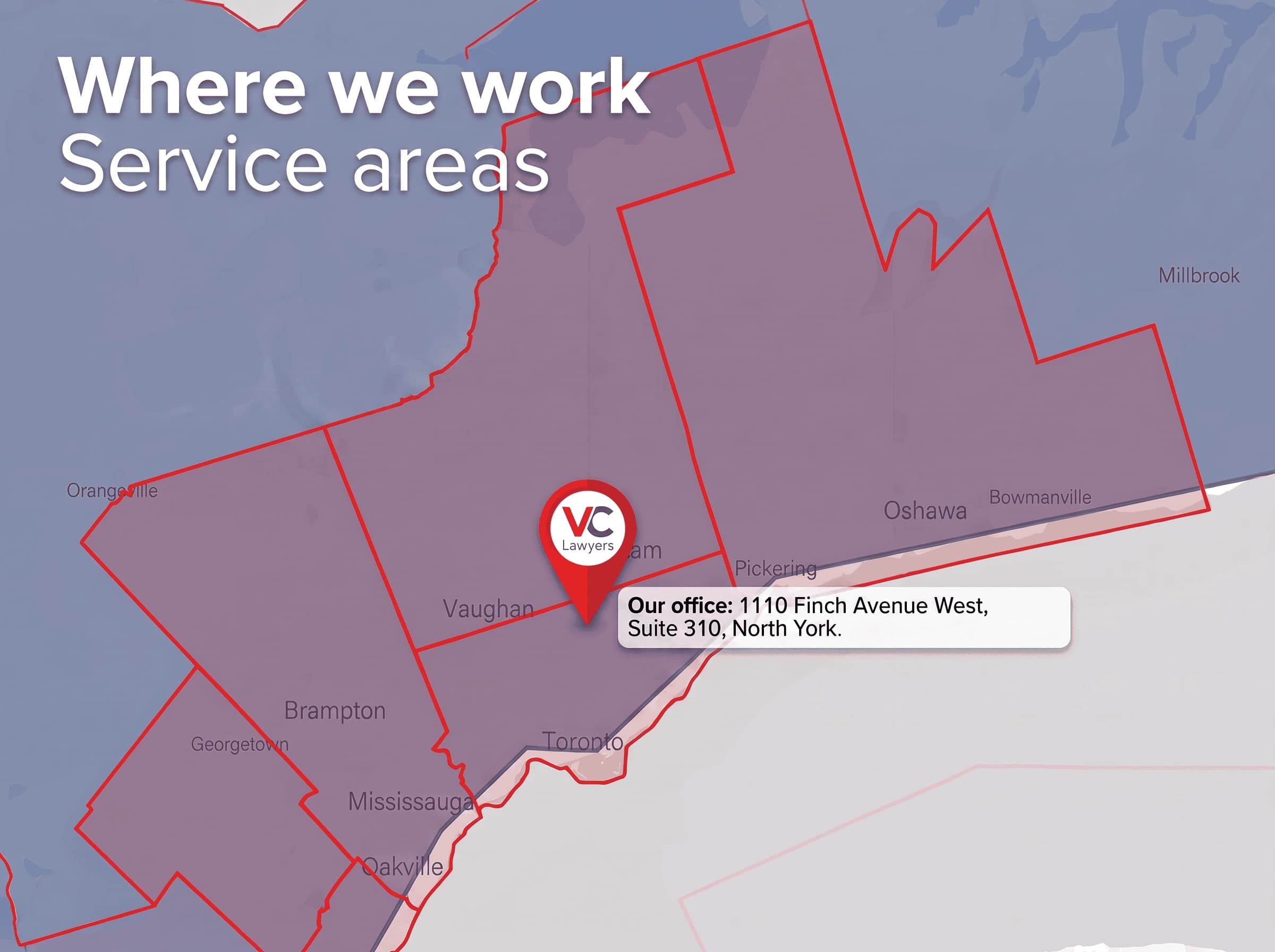
Where we work
Service areas
VC Lawyers serves clients throughout the Greater Toronto Area, including Toronto, North York, Scarborough, Etobicoke, Mississauga, Brampton, Oakville, Burlington, Vaughan, Richmond Hill, Pickering, Ajax, Whitby, Oshawa, Newmarket, and Aurora. We also represent clients across Ontario through video consultations and home/hospital visits when needed.
Languages spoken at the firm include English, Korean (한국어), Hebrew, Mandarin, and others depending on lawyer assignment.
Our office is located at 1110 Finch Avenue West, Suite 310, in North York, with parking and TTC access (Finch West subway and bus connections).
Also serving North York