
Corporate Law
Toronto Shareholder Agreement Lawyer
Overview
If you need a shareholder agreement drafted, are facing shareholder disputes, or require experienced legal counsel to protect your rights as a majority or minority shareholder, our Toronto shareholder agreement lawyer team is ready to help. At VC Lawyers, our dedicated shareholder agreement lawyers represent shareholders, directors, and corporations across Toronto and throughout Ontario in every aspect of corporate law. We draft comprehensive shareholder agreements and unanimous shareholder agreements, and we resolve complex shareholder disputes through litigation, arbitration, and mediation.
A shareholder agreement is the most important corporate document your company will ever sign. Without a properly drafted agreement in place, a corporation’s governance, share transfer rights, exit scenarios, and management authority are all determined by the default provisions of the Ontario Business Corporations Act. Those provisions rarely align with what business partners actually intended when they joined forces. Our shareholder agreement lawyers draft every agreement to reflect your specific business needs, protect every shareholder’s rights and protections, and provide the clear mechanisms required to resolve disputes before they become expensive litigation.
Key metrics
In the numbers
- Google reviews
- 140+
- Years combined experience
- 70+
- Languages spoken
- 8+
- Calls answered, every day
- 24/7
What Is a Shareholder Agreement in Ontario?
A shareholder agreement is a private contract between the shareholders of a corporation, often structured as a Unanimous Shareholder Agreement (USA). It governs the relationship between shareholders, defines each party’s rights and obligations, regulates how shares are transferred, establishes management and voting rights, and provides mechanisms for dispute resolution, exit scenarios, and the orderly succession of ownership.
In Ontario, a shareholder agreement overrides certain default provisions of the Ontario Business Corporations Act (OBCA) and the Ontario Not-for-Profit Corporations Act (ONCA), giving shareholders the ability to customize the governance of their corporation beyond what the statute provides. A shareholders’ agreement is the most powerful corporate governance tool available to business owners. The absence of one is one of the most common causes of costly shareholder disputes in Toronto businesses.
Why every corporation needs a shareholders’ agreement:
Without an agreement in place, every shareholder’s rights on exit, death, disability, or disagreement are determined by statute. The company’s governance, voting structure, and decision-making authority default to the OBCA’s generic provisions. These default provisions treat every share as equal, give majority shareholders unchecked authority, and provide no protection to minority shareholders against dilution, oppression, or forced exit scenarios.
A well-drafted shareholder agreement resolves all of these issues in advance. It establishes the mechanisms that govern how the corporation will be managed, how disputes will be resolved, and how every departure scenario will be handled in a fair and equitable manner.
Critical Provisions in a Shareholder Agreement
Our shareholder agreement lawyers draft every agreement with the full range of provisions required to govern the corporation’s shareholder relationships effectively. Key shareholder agreement provisions our lawyers regularly draft include:
Shotgun clause: a compulsory buy-sell mechanism that resolves irreconcilable deadlocks between shareholders. Under a shotgun provision, one shareholder names a price at which they are willing to either buy the other’s shares or sell their own. The other shareholder must then choose whether to buy or sell at that price. A properly tailored shotgun clause is one of the most effective dispute resolution mechanisms available to shareholders in closely held corporations. It can also be predatory if it is not carefully structured to account for each shareholder’s liquidity and ownership percentage.
Right of first refusal: a provision giving existing shareholders the right to purchase a selling shareholder’s shares before those shares can be transferred to a third party. The right of first refusal is a critical mechanism for preserving ownership concentration and preventing an unwanted party from acquiring an interest in the corporation.
Tag-along (piggyback) rights: provisions that protect minority shareholders by ensuring they can participate in any sale of shares by majority shareholders on the same terms. Tag-along rights prevent a situation where majority shareholders sell shares to a third party and leave minority shareholders locked into the corporation with a new, unknown partner.
Drag-along rights: provisions allowing majority shareholders to require minority shareholders to sell their shares in a transaction where the majority is selling the entire company. Drag-along rights are important for ensuring that a controlling group can complete a corporate sale transaction without minority shareholders blocking the deal.
Pre-emptive rights: provisions giving existing shareholders the right to purchase new shares before they are offered to outside investors, preventing unwanted dilution of existing shareholder positions. Pre-emptive rights are among the most important protections for minority shareholders in any corporation that anticipates issuing additional equity.
Vesting schedules: provisions that subject a shareholder’s equity to forfeiture if they depart the corporation before a specified date or milestone. Vesting schedules protect the corporation and remaining shareholders from “sweat equity” founders who leave before contributing their full value. That is a critical protection for Toronto tech startups and growth-stage businesses of all sizes.
Valuation mechanisms: defining in advance how the fair market value of shares will be determined in a buy-sell transaction. Without a clear valuation mechanism, every shareholder dispute involving a share purchase quickly becomes an expensive battle between competing appraisers. Our shareholder agreement lawyers work with forensic accountants to define the valuation formula in every agreement. That prevents appraisal disputes before they arise.
Death and disability provisions: governing what happens to a shareholder’s shares upon their death, disability, or bankruptcy. Without these provisions, a corporation could find itself with a deceased shareholder’s estate, a court-appointed guardian, or a trustee in bankruptcy as an involuntary partner in the business.
Non-compete and non-solicitation covenants: restricting a departing shareholder from competing with the corporation or soliciting its customers and employees for a defined period following their departure. These provisions are critical in every closely held corporation where shareholder knowledge and relationships are the company’s primary assets.
Governance and voting provisions: defining how directors are elected, what decisions require unanimous shareholder approval, and how management authority is allocated between shareholders and the board. These provisions govern how the corporation operates day-to-day and are particularly critical in 50/50 partnerships where board deadlock is a constant risk.
Shareholder Disputes: When Agreements Break Down
Even with a well-drafted shareholders’ agreement, shareholder disputes arise. Our shareholder dispute litigation lawyers represent shareholders, directors, and corporations in every type of corporate conflict. We provide aggressive legal counsel at every stage, from demand letter through summary judgment and full trial on the Commercial List of the Ontario Superior Court of Justice.
Common causes of shareholder disputes in Ontario:
Breach of the shareholder agreement: a shareholder’s failure to comply with their obligations under the agreement gives rise to a breach of contract claim and, in many cases, injunctive relief applications. Common failures include breach of a non-compete, unauthorized share transfer, and failure to obtain required shareholder approvals. Our shareholder dispute litigation lawyers act immediately when a breach occurs to protect our client’s rights and preserve the status quo.
Oppression remedy claims: the oppression remedy under the Ontario Business Corporations Act allows a shareholder, director, or officer to apply to the court where the corporation’s affairs have been conducted in a manner that is unfairly prejudicial to their interests. Oppression remedy claims typically arise where majority shareholders exclude minority shareholders from management, dilute minority interests through new share issuance, divert corporate opportunities, or refuse to distribute profits. Our corporate litigation lawyers have extensive experience in oppression remedy proceedings.
Director disputes: conflicts between directors over the management of the corporation frequently escalate into shareholder disputes requiring legal intervention. Those conflicts include disagreements about compensation, strategic direction, and the exercise of director authority. Our shareholder lawyers advise directors and shareholders on their respective rights and obligations and provide clear legal counsel on how to resolve deadlocks without destroying the corporation.
Forced buyouts and valuation disputes: when a shareholder triggers a buy-sell mechanism or oppression remedy, the valuation of the departing shareholder’s interest is frequently contested. Our shareholder dispute lawyers work with forensic accountants to establish and present fair market value evidence in every buyout dispute.
Minority shareholder protection: protecting minority shareholders from oppression, dilution, and squeeze-out transactions requires experienced legal counsel with deep knowledge of the OBCA’s minority shareholder protection provisions. Our shareholder lawyers protect minority shareholders’ rights aggressively in every dispute context, from informal negotiation through full commercial litigation.
Resolving Shareholder Disputes: Litigation, Mediation, and Arbitration
Our shareholder dispute lawyers provide the full range of dispute resolution services. We pursue the mechanism best suited to our clients’ specific needs in every dispute:
Litigation: where shareholder disputes require court intervention, our litigation lawyers pursue claims on the Commercial List of the Ontario Superior Court of Justice with the same level of preparation and advocacy we bring to every complex corporate matter. We regularly obtain summary judgment and injunctive relief in shareholder disputes requiring urgent court action.
Mediation: a structured negotiation facilitated by a neutral mediator is frequently the most efficient way to resolve shareholder disputes in closely held corporations where the parties have an ongoing relationship. Our shareholder agreement lawyers prepare every client thoroughly for mediation and negotiate aggressively to achieve the best possible resolution.
Arbitration: many shareholder agreements include mandatory arbitration clauses as the dispute resolution mechanism for share valuation and buy-sell disagreements. Our lawyers have extensive experience representing shareholders before commercial arbitrators. We present the same quality of evidence and legal argument as in court proceedings.
Drafting a Shareholder Agreement: Our Process
Our shareholder agreement lawyers follow a structured drafting process designed to produce an agreement that every shareholder understands, accepts, and will rely on for years:
Step 1: Stakeholder Discovery
We interview all shareholders to understand their long-term vision, risk tolerance, exit scenarios, and concerns. Understanding each shareholder’s perspective is the foundation of every well-drafted agreement. That perspective includes the difference in liquidity positions, the importance of control rights, and the desired departure provisions.
Step 2: Custom Drafting
We produce a fully customized shareholders’ agreement tailored to your industry, your corporation’s specific governance structure, and the register of individuals with significant control that the Business Corporations Act (Ontario) has required private corporations to keep since January 1, 2023. Every provision is drafted to reflect the parties’ actual intentions, not a template provision that may not address your specific business needs.
Step 3: Negotiation and Refinement
We facilitate the review and negotiation process to ensure all parties are satisfied with the agreement before it is signed. Our shareholder agreement lawyers serve as neutral technical counsel to resolve disagreements about specific provisions. That maintains the collaborative relationship between shareholders throughout the drafting process.
Step 4: Execution and Corporate Records Update
We oversee the secure signing of the agreement and ensure the corporation’s minute book, Ontario Business Registry filings, and articles are updated to reflect the new governance structure. All security holders are properly notified of the agreement’s existence and obligations.
Why Choose VC Lawyers as Your Shareholder Agreement Lawyer in Toronto?
When businesses in Toronto and across Ontario need shareholder agreement lawyers who combine technical corporate law experience with real-world commercial judgment, VC Lawyers can help.
Businesses of All Sizes
Our shareholder agreement lawyers serve businesses of all sizes, from two-person startups requiring their first shareholders’ agreement to multi-shareholder corporations requiring complex governance restructuring. We tailor every agreement to the specific business environment and corporate structure of every client.
Dispute Prevention and Dispute Resolution
Our lawyers are equally experienced in drafting agreements that prevent disputes and litigating disputes when they arise. That dual experience gives every client access to lawyers who understand both the transactional and the litigation dimensions of every shareholder agreement provision.
Clear Fees, in Writing
We set out our fees in a written engagement at the start of your matter, so you always know what to expect and there are no surprises.
24/7 Strategic Crisis Support
If a shareholder attempts an unauthorized share transfer, breaches a non-compete, or takes unauthorized action that threatens the corporation, our team is available around the clock to file for immediate injunctive relief and preserve our clients’ rights.
Frequently Asked Questions: Shareholder Agreement Lawyer Toronto
Do I need a shareholder agreement for a 50/50 partnership?
Yes. These are the most critical cases. A 50/50 corporation without a shareholders’ agreement is inherently deadlock-prone. Without a shotgun clause or another clear dispute resolution mechanism, a 50/50 deadlock can only be resolved by court-ordered liquidation. That outcome destroys value for everyone. Our shareholder agreement lawyers draft every 50/50 shareholders’ agreement with the mechanisms required to resolve disagreements efficiently and equitably.
Can I protect a minority shareholder’s interests in a closely held corporation?
Yes. A properly drafted shareholders’ agreement includes pre-emptive rights to prevent dilution, tag-along rights to ensure minority shareholders participate in sale transactions on equal terms, and information rights to ensure minority shareholders are kept informed of the corporation’s affairs. Our lawyers protect minority shareholders’ rights comprehensively in every agreement we draft.
What is an oppression remedy?
The oppression remedy under the OBCA allows a shareholder to apply to court where the corporation’s affairs are being conducted in a manner that is unfairly prejudicial to their interests. It is one of the most powerful remedies available to minority shareholders in Ontario corporate law and can result in court-ordered buyouts, damages, and changes to the corporation’s governance.
How much does a shareholder agreement lawyer cost?
We offer fixed-rate agreement packages for standard shareholder agreements and hourly advisory rates for complex corporate restructuring and governance matters. Contact us for a consultation and a transparent quote.
Can a shareholder agreement be amended?
Yes. A shareholders’ agreement can be amended at any time provided all parties sign an amending agreement. Our shareholder lawyers manage the amendment process. That includes the necessary updates to the corporation’s minute book and Ontario Business Registry filings.
Contact Our Toronto Shareholder Agreement Lawyers Today for a Consultation
Whether you need a shareholder agreement drafted, are involved in shareholder disputes, or require legal counsel to protect your rights in an oppression remedy or buyout proceeding, our experienced Toronto shareholder agreement lawyers are ready to help.
Our Toronto lawyers offer a consultation with no obligation. We serve businesses in Toronto and across Ontario, from Bay Street corporations to family businesses in Etobicoke, North York, and Scarborough. Contact us today and let our shareholder agreement lawyers protect your corporate rights and business interests.
Types of Corporate Law Cases We Handle in Toronto

Shareholder protection
Unanimous shareholder agreement
A Unanimous Shareholder Agreement is the single document that determines how a closely held corporation handles its hardest moments: a partner who wants to exit, a death, a divorce, a disagreement that won't resolve through negotiation.
We draft USAs with shotgun, tag-along, drag-along, pre-emptive rights, and right-of-first-refusal clauses tuned to each ownership structure. When disputes still happen, the same drafting decisions decide whether an oppression-remedy claim or a corporate divorce will be resolved at the boardroom table or in the Commercial List.
Why people choose VC Lawyers
The right firm handles the details so you can move forward with confidence
From property and business deals to family and estate matters, the right law firm gives you clear advice, transparent fees, and a lawyer who is genuinely in your corner.
Clear, Upfront Fees
We explain your fee arrangement before we start. No surprises.
Full-Service Firm
One firm for your property, business, family, and estate matters.
Multilingual Legal Team
Services in 8 languages so nothing gets lost in translation.
Boutique Firm, Direct Access
You’re never just a file number. Reach your lawyer directly.
Trusted Ontario Counsel
Members in good standing with the Law Society of Ontario.
Decades of Combined Experience
Senior counsel on every matter we handle.
Get in touch
Looking for legal help? Speak directly with a lawyer
Tell us what happened and a lawyer will personally review your case. Personal injury consultations are free and there are no fees unless we win. For all other practice areas, a consultation fee applies.
- $30M+ recovered for injury clients
- Available 24/7, including weekends
- Service in English, Korean, and 6+ more languages
Prefer to call? (416) 661-4529
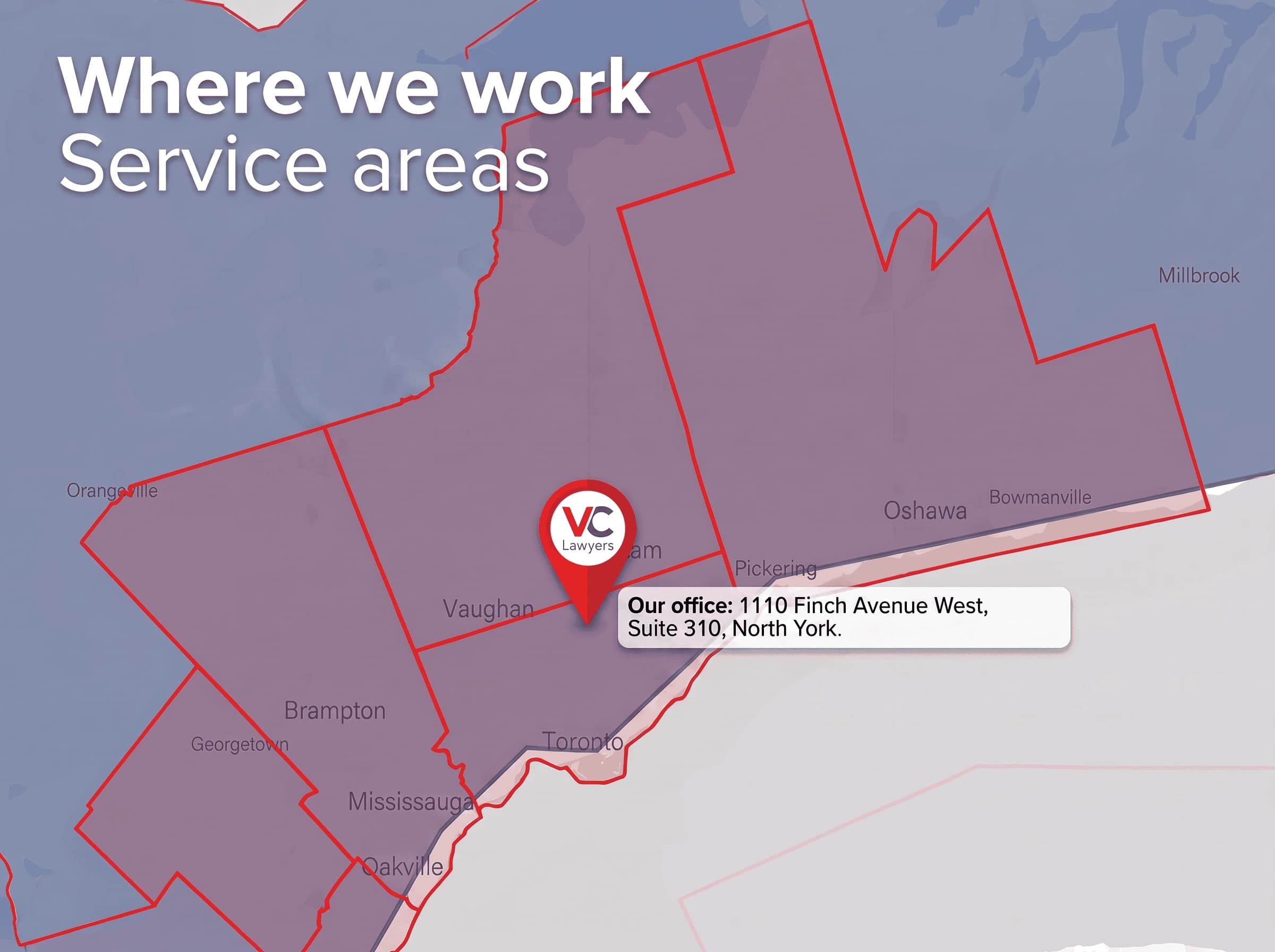
Where we work
Service areas
VC Lawyers serves clients throughout the Greater Toronto Area, including Toronto, North York, Scarborough, Etobicoke, Mississauga, Brampton, Oakville, Burlington, Vaughan, Richmond Hill, Pickering, Ajax, Whitby, Oshawa, Newmarket, and Aurora. We also represent clients across Ontario through video consultations and home/hospital visits when needed.
Languages spoken at the firm include English, Korean (한국어), Hebrew, Mandarin, and others depending on lawyer assignment.
Our office is located at 1110 Finch Avenue West, Suite 310, in North York, with parking and TTC access (Finch West subway and bus connections).
Also serving North York