
Vehicle Accidents
Toronto Distracted Driving Lawyerfor victims and drivers charged




Trusted by accident victims and businesses across Ontario
Overview
The two-second glance that changes everything
A young mother is driving her two children home from school on Yonge Street. The light turns green. She moves into the intersection. The Ford F-150 coming the other way is supposed to wait, but the driver is looking at his phone, scrolling through Instagram. He runs the red. The collision is severe. The mother's car is t-boned at speed. Both children are injured. She is hospitalized. The Ford driver walks away from the wreck. He is charged with distracted driving and careless driving, and ultimately with criminal dangerous driving. Months later, the families involved are facing the long aftermath: physical recovery, financial impact, insurance claims, and a legal system that handles these cases through both the criminal courts and the civil personal injury system.
This is distracted driving in Ontario. The term covers everything from the brief glance at a text message to the deliberate scrolling through social media at 80 kilometres per hour. The consequences span from a $615 ticket to a 10-year prison sentence under the Criminal Code. And on the other side of every distracted driving case are victims: the people in the other car, the pedestrian on the crosswalk, the cyclist in the bike lane. Their lives are altered by someone else's two-second glance at a screen.
Ontario's Highway Traffic Act and the Criminal Code of Canada now provide some of Canada's most aggressive distracted driving penalties. A first conviction under section 78.1(1) of the Highway Traffic Act produces a minimum $615 fine, three demerit points, and a three-day licence suspension. A second conviction within five years raises the suspension to seven days. A third conviction within five years suspends the licence for 30 days. For novice drivers (G1, G2, M1, M2), suspensions are even longer and a third conviction cancels the licence entirely, requiring the driver to restart the Graduated Licensing System.
Behind these administrative penalties is the much larger legal landscape of personal injury law. When a distracted driver causes an accident, whether through texting, other phone use, or any other distraction, the driver and their insurance company face civil liability for the resulting damages. If you were the one struck, two streams are open to you. The first is accident benefits under Ontario's Statutory Accident Benefits Schedule (SABS), which pay regardless of fault. Since 1 July 2026 three of those benefits are mandatory on every Ontario auto policy: medical, rehabilitation and attendant care. They are available to you whatever the driver who hit you carried. The auto insurer also pays the medical and rehabilitation side ahead of any extended health or employer plan. The rest are now optional purchases: income replacement, non-earner, caregiver, housekeeping and home maintenance, lost educational expenses, expenses of visitors, damage to personal items, and death and funeral benefits. Those are payable only where that coverage was purchased, and only to the named insured, that person's spouse, dependants of either, and drivers listed on the policy. If you were struck as a pedestrian or a cyclist and fall outside that class, you have the mandatory three and nothing more. The second stream is the tort claim against the distracted driver, which can produce substantial recovery for medical expenses, lost income, pain and suffering, and other losses.
This page covers both sides of distracted driving law in Ontario: the personal injury claim available to victims of distracted drivers, and the legal landscape facing drivers charged with distracted driving offences. The page is comprehensive because the two sides are connected. A conviction on the distracted driving charge provides powerful evidence in the civil personal injury claim, and the way the two tracks interact is part of how these cases play out in practice.
VC Lawyers represents Toronto-area clients in both contexts: as personal injury counsel for victims of distracted drivers, and (through criminal defence partnerships) for drivers facing serious distracted driving and related charges. The first 30-minute consultation is free, personal injury cases are handled on contingency (no fee unless we recover), and we work in English, Korean, and several other languages. Call (416) 661-4529 at any point while you are reading if your situation is urgent.
The statute
What counts as distracted driving in Ontario
Ontario's distracted-driving regime layers a specific Highway Traffic Act offence on top of the broader careless-driving and Criminal Code offences. Each category captures a different kind of conduct and triggers a different set of consequences.
The Statutory Framework
The primary statute is Section 78.1(1) of the Ontario Highway Traffic Act. It prohibits operating a motor vehicle on a highway while “holding or using a handheld wireless communication device or other prescribed device capable of receiving or transmitting telephone communications, electronic data, mail or text messages.” Three phrases in that sentence do most of the work.
“Holding or using.” The offence does not require active phone use. Simply holding the phone is enough, even at a red light, even with the car stopped. A driver who picks up a phone to check the time can be charged, and so can a driver who holds a phone while looking for a parking address. What the section prohibits is physical contact with the device while you are operating the vehicle on a highway.
“On a highway.” The offence applies to any highway under the Highway Traffic Act, which takes in virtually every public road in Ontario. It does not apply on private property such as parking lots and private driveways, but it applies on every public street, highway and roadway.
“Handheld wireless communication device.” Cell phones are the primary target, but the wording reaches further than that. Tablets, GPS units that are not built into the vehicle, electronic entertainment devices and similar handheld electronics are all caught by it.
What's Permitted: Hands-Free Use
Section 78.1(3) provides an exception: a person may use a device “in hands-free mode.” The Ministry of Transportation has clarified what counts. The list below is the practical version.
The line between permitted and prohibited use is sometimes contested. A permitted use can become an offence if the driver looks at the screen for an extended period, or appears to be reading rather than briefly activating a voice command. A phone sitting in a dashboard mount is lawful right up to the moment a finger goes to the screen.
Hands-free use also matters less than drivers assume. It does not eliminate distraction. It only changes the type, because cognitive distraction continues while the hands are on the wheel and the eyes are forward. A driver who was legally on a hands-free call can still be charged with careless driving under section 130 if their attention was impaired enough that they failed to drive with due care and attention. The same driver can still be found negligent in a civil claim. For someone who was injured, the civil question is not which statute was broken but whether the driver was negligent.
- Bluetooth headsets and earpieces are permitted
- Voice-activated dialing is permitted, but the phone must not be held
- Built-in vehicle systems are permitted : factory-installed Bluetooth, voice command and navigation
- Phone mounts (dashboard or windshield) are permitted, but only if the driver does not touch the phone while driving
- One-touch activation : touching the phone briefly to answer a call or activate a voice command is generally permitted, while ongoing manipulation is not
What's Prohibited
The Ministry of Transportation publishes an extensive list of activities that are prohibited while driving. The common thread is simple. If the activity requires you to hold the device, or to read what is on its screen, it is prohibited.
Two points catch drivers out. The offence is complete whether or not the vehicle is moving, so being stopped in traffic or waiting at a red light is no answer to the charge. And it is not only about phones: tablets, e-readers, portable gaming consoles and GPS units that are not built into the vehicle are all covered.
- Texting or reading text messages
- Dialing a phone (other than voice-activated)
- Holding a phone for any purpose
- Programming a GPS via touch screen
- Watching videos or movies
- Using a tablet or e-reader
- Using a portable gaming console
- Reading anything on the phone (emails, news, social media)
- Adjusting hands-free settings while driving
- Using hands-free features in a way that constitutes “using” the device (extensive screen viewing)
Other Distractions and Careless Driving
Activities that don't involve a handheld device may fall outside section 78.1, but they can still result in a careless driving charge under section 130 of the Highway Traffic Act. Careless driving is the broader offence. It can be charged whenever a driver's attention is impaired enough that they fail to drive with “due care and attention.”
Ontario auto insurers treat careless driving as a major conviction in the same category as distracted driving and stunt driving, so the insurance consequences set out further down this page apply to it as well.
For someone injured by one of these drivers, the label on the ticket matters less than it first appears. A civil claim turns on negligence rather than on which section was charged. A driver who was eating, grooming, reading, or turning around to deal with children in the back seat can be found liable even though no handheld device was ever in their hand.
- Eating or drinking while driving
- Personal grooming (applying makeup, shaving)
- Reading printed material
- Adjusting the radio or sound system extensively
- Tending to children or pets
- Talking with passengers in a way that takes attention from the road
- Smoking or vaping (in some circumstances)
- Looking at scenery, billboards, or roadside events
The Criminal Threshold: Dangerous Driving
When distracted driving causes serious injury or death, the Crown may pursue a criminal charge of dangerous operation of a conveyance under section 320.13 of the Criminal Code. The charge requires proof beyond a reasonable doubt that the driver operated the vehicle in a manner that, having regard to all the circumstances, was dangerous to the public.
Not every distracted driver crosses that line. Mere distraction may not meet the criminal threshold. Flagrant conduct is far more likely to cross it: extended phone use, watching video, or repeated reckless behaviour. Between the highway traffic offence and the criminal one sits a third charge, introduced by the 2018 amendments to Ontario's Highway Traffic Act: careless driving causing bodily harm or death. It carries significantly elevated penalties and still sits below the criminal threshold.
The stakes on the criminal side run well past the sentence itself. A criminal record affects employment, immigration status, travel to the United States and a great deal else. A driver facing these charges needs criminal defence counsel immediately. For the person who was injured, a conviction on the criminal or regulatory charge becomes powerful evidence in the civil claim under section 22.1 of the Ontario Evidence Act.
- Causing bodily harm : up to 10 years imprisonment
- Causing death : up to 14 years imprisonment
Penalties
The tiered penalty system
Fully Licensed Driver, First Conviction (within 5 years)
A first conviction is the cheapest version of this offence, but it still costs more than the ticket suggests. The $615 minimum already includes the victim surcharge and court costs. The three demerit points sit on the record for two years. The three-day suspension starts immediately, and there is a reinstatement fee to pay before you can drive again. Which tier you land in is decided by the five-year window. If your most recent prior conviction was more than five years ago, this offence is treated as a “first” conviction even though the older convictions remain on your record.
- Fine : minimum $615, maximum $1,000 (including victim surcharge and court costs)
- Demerit points : 3
- Licence suspension : 3 days
- Licence reinstatement fee
Fully Licensed Driver, Second Conviction (within 5 years)
A second conviction within five years doubles the ceiling on the fine to $2,000 and adds six demerit points on top of the three from the first conviction. The suspension more than doubles as well, from three days to seven, and the reinstatement fee applies again. The tier is set by your most recent prior conviction. A conviction that falls just inside the five-year mark is what moves you from the first level to this one.
- Fine : minimum $615, maximum $2,000
- Demerit points : 6 additional
- Licence suspension : 7 days
- Licence reinstatement fee
Fully Licensed Driver, Third or Subsequent Conviction (within 5 years)
A third or subsequent conviction within five years raises the fine ceiling to $3,000, adds another six demerit points, and takes the licence for 30 days rather than three or seven. The insurance side changes at this point too. Some traditional insurers stop renewing the policy altogether after repeat convictions, which leaves the driver to find coverage from a non-standard or high-risk insurer. In Ontario that can mean the Facility Association at substantially elevated rates.
- Fine : minimum $615, maximum $3,000
- Demerit points : 6 additional
- Licence suspension : 30 days
- Licence reinstatement fee
Novice Driver (G1, G2, M1, M2), First Conviction
The fine structure is the same as for fully licensed drivers, but the licence consequences are dramatically more severe. A novice driver loses the licence for 30 days on a first conviction. That is ten times the three-day suspension a fully licensed driver receives for exactly the same offence. No demerit points are recorded, because novice drivers are dealt with by suspension instead of by points.
- 30-day licence suspension
- No demerit points (since novice drivers are subject to suspension instead)
Novice Driver, Second Conviction
A second conviction takes the licence for 90 days. For a G1, G2, M1 or M2 driver, that is three months without driving, on top of the same minimum $615 fine that applies at every tier. It also leaves the driver one conviction away from losing the licence altogether.
- 90-day licence suspension
Novice Driver, Third Conviction
A third conviction cancels the licence outright and removes the driver from the Graduated Licensing System, which means starting the GLS program again from the beginning. For a young driver in the GLS the practical impact is severe: months without the ability to drive, and then the entire licensing process to work through a second time.
- Licence cancellation
- Removal from the Graduated Licensing System (GLS)
- Required to restart the GLS program from the beginning
Insurance Consequences
The fines and suspensions are the immediate consequences. The longer-term financial impact on insurance is usually the larger one. Ontario auto insurers classify distracted driving as a major conviction. It sits in the same group as speeding 50 km/h or more over the limit, careless driving, and stunt driving or racing. A major conviction typically affects the driver's rating for 3 years, even though the conviction itself stays on the licensing record permanently. Over that 3-year period the cumulative cost in increased premiums is often $5,000 to $10,000 or more, on top of the immediate fine and any legal fees. Many insurers also withdraw the discounts attached to preferred or claims-free status, which is a second increase layered on the first. A household feels the increase again when a spouse or an adult child is rated on the same policy.
- A 30% to 100% premium increase on a first major conviction, depending on the insurer and other factors
- Loss of “preferred customer” rates and discounts
- Required move to non-standard or high-risk insurers in some cases
Permanent Record
For most drivers the fine turns out to be the smallest part of what a conviction costs. The suspension is over in days, demerit points fall off after 2 years, and the insurance impact runs roughly 3 years. The conviction itself does not expire. It stays on the formal driving record permanently and remains available to be considered in:
- Future licensing decisions
- Commercial driving applications
- Some insurance applications
- Criminal proceedings if subsequent serious offences occur
- Employment screening for certain positions
The data
The statistics that drive the law
- How much more likely a texting driver is to crash than a fully attentive driver
- 23×
- Average time a driver's eyes are off the road while reading a text
- 4-5 sec
- Share of Ontario motor-vehicle collisions involving driver inattention (broadly defined)
- ~80%
- Minimum fine on a first Highway Traffic Act s.78.1(1) conviction
- $615

Talk to us
Every distracted driving case deserves a careful look
The first 30-minute consultation is free and confidential. We will tell you within that conversation what your realistic options are, and what to do next.
No fee unless we recover. Home and hospital visits available across the GTA.
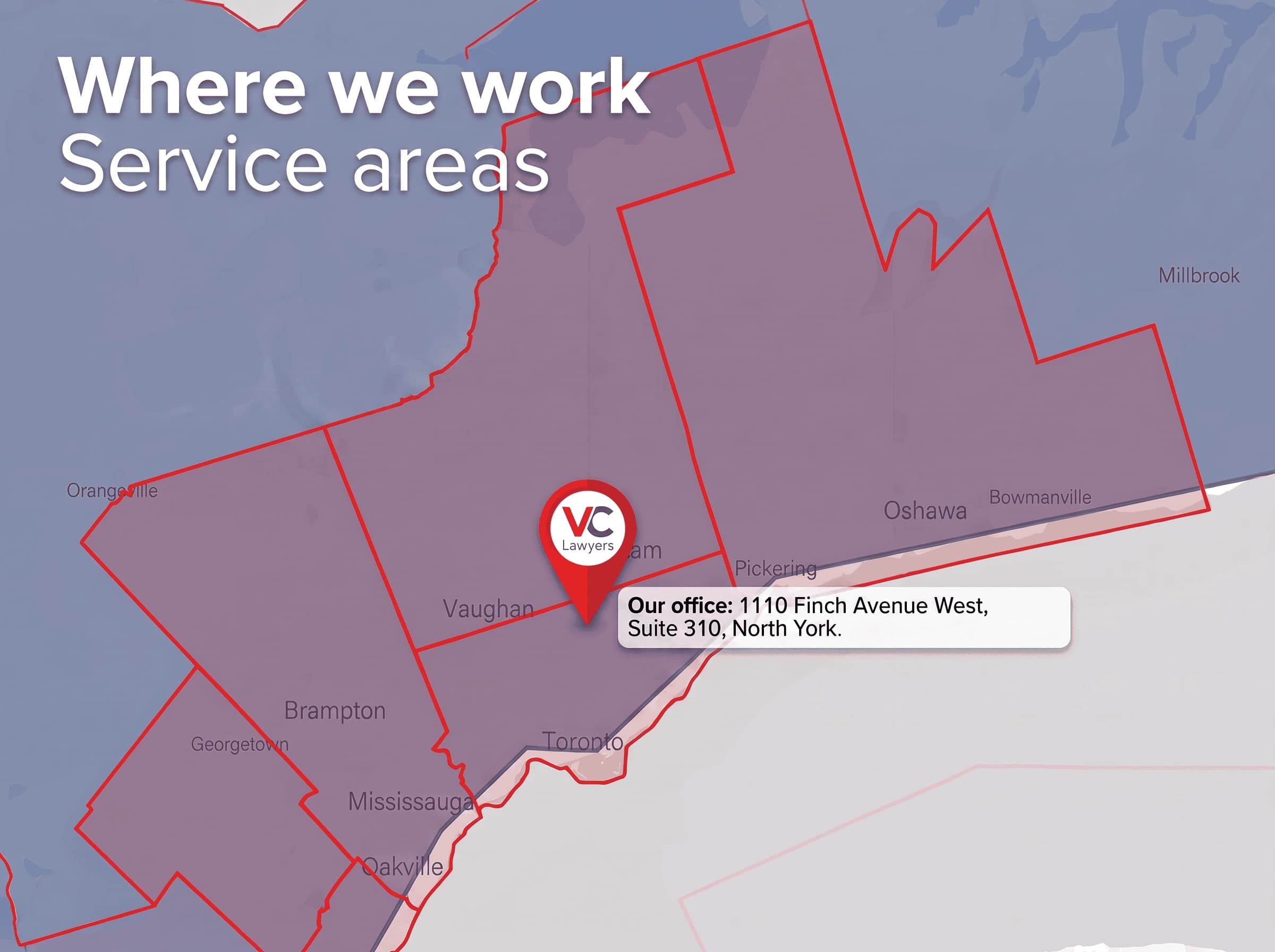
Where we work
Service areas
VC Lawyers serves clients throughout the Greater Toronto Area, including Toronto, North York, Scarborough, Etobicoke, Mississauga, Brampton, Oakville, Burlington, Vaughan, Richmond Hill, Pickering, Ajax, Whitby, Oshawa, Newmarket, and Aurora. We also represent clients across Ontario through video consultations and home/hospital visits when needed.
Languages spoken at the firm include English, Korean (한국어), Hebrew, Mandarin, and others depending on lawyer assignment.
Our office is located at 1110 Finch Avenue West, Suite 310, in North York, with parking and TTC access (Finch West subway and bus connections).
Frequently Asked Questions
We answered all
I was injured by a distracted driver who was texting. What can I claim?
You may have multiple claim categories. Start with the accident benefits that apply no matter what coverage was purchased. Medical, rehabilitation and attendant care are mandatory on every Ontario auto policy, so they are available to you whatever the driver who hit you carried. The limit is $65,000 combined over 5 years, or up to $1,000,000 combined where the impairment is catastrophic. Income replacement and non-earner benefits became optional purchases on 1 July 2026. Where those benefits were purchased on the responding policy, the standard option pays 70% of pre-accident gross income up to $400/week for income replacement. The non-earner benefit pays $185/week, after a 4-week wait and for up to 104 weeks. It also requires a complete inability to carry on a normal life, not simply that you were out of work. Those optional benefits reach only the named insured, that person's spouse, dependants of either, and drivers listed on the policy. So if a distracted driver struck you as a pedestrian or cyclist and you fall outside that class, you have the mandatory three and nothing more. Next comes the tort claim against the at-fault distracted driver and their insurer. It covers general damages for pain and suffering, which are subject to the verbal threshold and the 2026 statutory deductible of $47,913.01. It also covers past and future income loss, future cost of care, out-of-pocket expenses, Family Law Act damages for family members, and possibly aggravated or punitive damages. Other coverage may also apply: long-term disability (LTD) through your employer, critical illness insurance, and life insurance and AD&D in fatal cases. Note that your auto insurer now pays accident-related medical and rehabilitation costs ahead of an extended health or employer plan. What tends to make a distracted driving file strong is the liability evidence: cell phone records, witness statements, and any regulatory or criminal conviction. The first step is to document everything: the accident, your injuries, and any evidence of the other driver's distraction. The next step is getting legal advice. Most personal injury lawyers, including our firm, offer free 30-minute initial consultations and work on contingency.The distracted driver was charged but pleaded down to a lesser offence. Does this affect my civil case?
Generally no, but the analysis is fact-specific. In a civil personal injury case the burden of proof is “balance of probabilities,” which is a much lower standard than the criminal “beyond a reasonable doubt.” Even if the distracted driving charge was reduced or withdrawn in the criminal or regulatory proceedings, the civil case can still establish that the driver was negligent and was at fault for the accident. A conviction on the distracted driving charge provides powerful evidence in the civil case. Section 22.1 of the Ontario Evidence Act allows convictions to be admitted as evidence of the facts underlying them, which can make the negligence finding close to automatic. A withdrawal of charges does not affect the civil case directly, though it may complicate evidentiary issues. A plea to a lesser charge may still establish some admissions. And whatever becomes of the charge itself, the investigation behind it stays available to you. The civil case is built on its own evidence: police reports, witness statements, cell phone records, accident reconstruction analysis and medical records. It proceeds independently of the criminal track. A skilled personal injury lawyer establishes the distracted driving negligence through civil evidence, whatever the outcome of the criminal or regulatory case.How long do I have to file a claim against a distracted driver?
Several limitation periods apply. Accident benefits application: complete it and return it to the insurer promptly. The working rule is 30 days, though a late application can be accepted with a reasonable explanation. Tort lawsuit against the at-fault driver: generally 2 years from the date of the accident under the Limitations Act, 2002. Dispute over a denied accident benefit: generally 2 years, running from the insurer's written refusal rather than from the accident, so it can end well after 2 years from the crash. Family Law Act claims by family members: generally tied to the same 2-year period as the primary tort claim. Notice for municipal claims, where road conditions or municipal negligence contributed to the crash: 10 days written notice under the Municipal Act, 2001. That is by far the shortest clock on this list. The 2-year tort limitation is the most consequential deadline, and missing it generally extinguishes the right to sue. Earlier action is always better, because a claim needs proper preparation rather than a last-minute scramble. Filing the accident benefits application promptly remains best practice whatever optional benefits the policy turns out to include, because the mandatory medical, rehabilitation and attendant care benefits are there for you either way.The driver who hit me was using a hands-free Bluetooth device. Are they still at fault?
The legal answer depends on multiple factors. Hands-free use is not, by itself, distracted driving under section 78.1 of the Highway Traffic Act. On that section alone, the driver broke no prohibition. But they may still have been negligent. Negligence is a broader concept than statutory distracted driving. If the driver was so focused on the phone conversation (cognitive distraction) that they failed to react to an obvious hazard, they can be found negligent in the civil case. No Highway Traffic Act violation is needed for that finding. Cognitive distraction is real and well documented. Research has consistently shown that hands-free phone use does not eliminate distraction. It only changes the type. Drivers on hands-free calls have impaired reaction times, narrowed attention, and reduced situational awareness. Careless driving may still apply under section 130 if the driver's attention was sufficiently impaired that they failed to drive with due care and attention. For civil personal injury purposes, the question is not whether the driver violated a specific statute but whether they were negligent. Negligence is established by showing that a reasonable driver in similar circumstances would have done something different, which is a question about the driving rather than about the phone. If the hands-free conversation contributed to the accident, the driver may be liable even without a distracted driving conviction. The evidence that proves it is the evidence we would gather in any other case: phone records showing a call in progress at the moment of impact, witness accounts of how the vehicle was being driven, and expert accident reconstruction where the sequence is contested.Can I get the distracted driver's cell phone records?
Yes, through the legal discovery process, but that requires starting a lawsuit. In a personal injury lawsuit the steps are typically these. (1) A Statement of Claim is filed naming the at-fault driver as defendant. (2) Documentary discovery follows, where both sides exchange relevant documents and the plaintiff can request the defendant's cell phone records. (3) If the defendant does not provide the records voluntarily, a subpoena to the phone provider can compel production. That reaches call logs (incoming and outgoing calls with timestamps), text message logs (sent and received messages with timestamps) and data usage records. It sometimes reaches location data and message content as well, subject to privacy law limitations. (4) An expert then reads the records against the time of the accident to establish exactly what the driver was doing at the critical moment. This process typically takes months and requires the lawsuit to be filed. For pre-litigation purposes, voluntary production from the defendant or police investigation records may provide some information, but full cell phone records typically require formal legal proceedings. In serious injury cases the cell phone evidence is often decisive. It shows that the driver was texting, calling or actively using the phone at the moment of the accident, and that concrete record is far more persuasive than testimony alone.The distracted driver who hit me has minimum insurance ($200,000). My damages are much more. What can I do?
Several options exist. Start with your own underinsured motorist coverage. Your Ontario auto policy includes it. Without the OPCF 44 endorsement the standard limit is $200,000. With OPCF 44 the limit becomes your third-party liability limit, often $1 million or $2 million. Then there are the at-fault driver's personal assets. If the driver has substantial assets such as a home, a business or investments, these can sometimes be pursued in addition to insurance. In practice, recovering against personal assets is often impractical. Other insurance policies may also respond. The at-fault driver may have umbrella coverage, or employer-sponsored coverage if they were driving for work. Accident benefits sit outside all of this. Whatever happens with the tort claim, medical, rehabilitation and attendant care are mandatory on every Ontario policy. They are available to you regardless of the at-fault driver's liability limits. The limit is $65,000 combined over 5 years, or up to $1,000,000 combined where the impairment is catastrophic. Income replacement and non-earner benefits became optional purchases on 1 July 2026. Those depend on what coverage was purchased on the responding policy, and on whether you fall within the class it covers: the named insured, that person's spouse, dependants of either, and drivers listed on the policy. Total recovery in an underinsured driver case typically combines the at-fault driver's limits, your own underinsured motorist coverage (potentially $1 million or more with OPCF 44), the accident benefits actually available on the policy, LTD insurance through your employer, and other applicable coverage. Coordinating these multiple coverage streams is part of what experienced personal injury lawyers handle.What if I'm partially at fault for the accident?
Ontario follows the comparative negligence principle under the Negligence Act. Even if you were partially at fault, you can still recover damages. The recovery is reduced by your percentage of fault. For example, if your damages are $200,000 and you are found 25% at fault, you would recover $150,000 (75% of $200,000). If you were 50% at fault, you would recover 50% of damages. Even at higher percentages of fault, partial recovery is typically available. In distracted driving cases specifically, the at-fault driver's clear distraction often makes contributory negligence arguments harder. The defence cannot easily argue that the plaintiff's actions caused the accident when the driver it represents was looking at a phone. Contributory negligence can still apply in some cases. It comes up where the plaintiff was speeding, was also using a phone or otherwise distracted, failed to wear a seatbelt (which can affect injury severity and lead to “seatbelt deductions”), or contributed to the accident in some other way. The legal analysis is fact-specific, and even where contributory negligence is significant the partial recovery is often substantial. Don't assume your role in the accident eliminates your claim. Get legal advice before you decide that it does.I was hit by an Uber/Lyft driver who was distracted. Does this affect my claim?
Rideshare driver accidents in Ontario engage specific insurance frameworks. Uber, Lyft, and other rideshare companies typically maintain commercial liability insurance covering their drivers while engaged in rideshare activities. The coverage changes with the “period” the driver is in. In Period 1 the driver is online but has not accepted a ride request, and coverage is limited. In Period 2 the driver has accepted a ride and is travelling to pick up the passenger, and coverage is higher. In Period 3 the passenger is in the vehicle, and coverage is highest. Liability limits in Periods 2 and 3 typically run from $1 million to $2 million. Standard personal auto insurance often excludes rideshare activity, and the rideshare driver may have additional coverage under their personal policy through a specific rideshare endorsement. Accident benefits apply to rideshare passengers, to drivers struck by rideshare vehicles, and to pedestrians struck by rideshare vehicles, just as in any motor vehicle accident. Since 1 July 2026 that means the mandatory medical, rehabilitation and attendant care benefits in every case. Income replacement, non-earner and the other optional benefits turn on which policy responds, what coverage was purchased on it, and whether you are within the class it covers. For rideshare-related distracted driving accidents, the insurance coordination is more complex than in a typical accident because of the multiple coverage layers involved. The total available insurance is often substantial, particularly during an active rideshare trip, but accessing it requires understanding the specific coverage structure.The distracted driver fled the scene. Can I still make a claim?
Yes. Hit-and-run accidents are covered under specific provisions. Every Ontario auto policy includes mandatory uninsured automobile coverage of $200,000 minimum. It applies when the at-fault driver cannot be identified after a hit-and-run, or is identified but uninsured. For hit-and-run cases, you generally must report the accident to police promptly, obtain a police report, cooperate with any investigation, and notify your insurer of the claim. The uninsured motorist coverage caps liability at the policy limit ($200,000 standard, higher with optional coverage including OPCF 44). Your accident benefits flow regardless of whether the at-fault driver is identified. Medical, rehabilitation and attendant care are mandatory on whichever policy responds, so those reach you either way. Since 1 July 2026, income replacement, non-earner and the other optional benefits depend on what coverage that policy purchased and on whether you are within the class it covers. With no identified driver, the policy that responds is normally your own or a household policy, so working out exactly what it covers is one of the first things we do. If the hit-and-run driver is eventually identified through investigation, surveillance footage, witnesses or some other route, claims can be filed against them and their insurance. Immediate police reporting is essential, because many uninsured motorist coverages require prompt reporting to qualify. Failing to report to police within a reasonable time can void the coverage.What does it cost to hire a distracted driving personal injury lawyer?
Personal injury cases involving distracted driving are typically handled on contingency, meaning no fee unless we recover compensation for you. The contingency percentage is set in writing at the start of the engagement, typically ranging from 25% to 33% depending on the complexity and the stage at which the matter resolves. Disbursements (court filing fees, expert reports, medical records requests, examination transcripts, mediation fees) are typically advanced by the firm and recovered from the eventual settlement. The first 30-minute consultation is free with no obligation. For a serious distracted driving case proceeding toward litigation, total disbursements can be substantial, often $20,000 to $75,000 or more over the course of the case. These are paid by the firm during the litigation and reimbursed only when the matter resolves. The contingency structure aligns our interests with yours: we are paid out of what you recover, so the result of the case matters to us as much as it does to you. For drivers facing distracted driving charges, defence representation is typically billed at hourly rates rather than on contingency. That is work we do not handle directly, but we coordinate with criminal defence and traffic ticket counsel when needed.
Why people choose VC Lawyers
The right firm handles everything so you can focus on recovery
Choosing the right personal injury law firm after an accident in Toronto can mean the difference between a lowball settlement and the full compensation you deserve.
No Fees Unless We Win
Personal injury cases run on a contingency basis. You pay nothing upfront.
Free Personal Injury Consultation
Speak with an injury lawyer today at zero cost. Other practice areas are quoted before we start.
24/7 Emergency Hotline
We’re available around the clock when you need us most.
Home & Hospital Visits
Too injured to come to us? We’ll come to you.
Multilingual Legal Team
Services in 8 languages so nothing gets lost in translation.
Boutique Firm, Big Results
You’re never just a case number. Get direct access to your lawyer.
Get in touch
Looking for legal help? Speak directly with a lawyer
Tell us what happened and a lawyer will personally review your case. Personal injury consultations are free and there are no fees unless we win. For all other practice areas, a consultation fee applies.
- $30M+ recovered for injury clients
- Available 24/7, including weekends
- Service in English, Korean, and 6+ more languages
Prefer to call? (416) 661-4529
Take the next step
Distracted driving accidents are not “ordinary” car accidents.
Related practice areas
Continue exploring
Distracted Driving Lawyer in North York
The same practice, served from our office in North York.
Personal Injury Lawyer Toronto
For the broader personal injury framework.
Toronto Car Accident Lawyer
For the underlying motor vehicle accident framework.
Toronto Cross-Border Accident Lawyer
For distracted driving accidents involving U.S. drivers or cross-border travel.
Toronto Non-Earner Benefits Lawyer
For NEB claims when not employed at the time of the accident.
Catastrophic Injury Lawyer Toronto
For serious distracted driving injuries meeting the catastrophic threshold.
Toronto Wrongful Death Lawyer
For fatal distracted driving accidents.