The provincial regulator. Every lawyer at the firm is a member in good standing.
Community
Built into theKorean-Canadian community
Working partnerships with four Korean-Canadian community organizations, a 24/7 Korean-language hotline, and a referral channel with the Consulate General of Korea in Toronto.




Working partnerships with the Korean-Canadian community in Toronto
Why this page exists
VC Lawyers (Vaturi & Cho LLP) was built, from day one, around a simple observation about Canadian legal practice: the people who most need a lawyer are often the people who can least easily get to one. Newcomers without English fluency. Vulnerable workers without union representation. Women going through divorce or domestic crisis without access to family savings. Korean nationals arrested in Toronto with no idea how Canadian criminal procedure works. The cost of a private lawyer is one barrier; language is another; cultural unfamiliarity with the legal system is a third. Most law firms address none of these, by design. We address all three, also by design.
Our community work is the part of the firm that exists explicitly to lower those barriers, even when the work doesn't generate fees. It includes formal partnerships with four Korean-Canadian community organizations, a 24/7 Korean-language hotline that anyone can call without retaining the firm, free educational content on YouTube and Instagram (@jaecho_lawyer / @jaethelawyer), and a referral relationship with the Consulate General of the Republic of Korea in Toronto for nationals in legal distress. Below is what each partnership looks like and why it exists.
By the numbers
Community work in numbers
- Korean-Canadian partner organizations
- 4
- Languages spoken at the firm
- 8
- Korean-language emergency hotline
- 24/7
- Ontario and Canadian bar memberships
- 5
Founder's note
Where the work comes from
Jae Hyon Cho, one of the firm's two named partners, is what's called a 1.5-generation immigrant. He arrived in Canada at 15 with his family, learned English in the Toronto school system, took his undergraduate degree in computer science at the University of Toronto, studied theology at Knox College, and earned his law degree from Western University. The firm he co-founded with Avi Vaturi is, today, the largest Korean-owned law firm in Toronto.
What that biographical sketch doesn't capture is the experience that shaped how the firm runs: watching parents, uncles, aunts, neighbours, and church members in the Korean-speaking community confront the Canadian legal system without the language to navigate it. Insurance forms going unread. Court summonses misunderstood. Settlement offers accepted because no one explained what they were worth. The firm's mission comes directly out of that lived observation: to be, in Jae's own words, a shield and sword for the Korean community's rights.
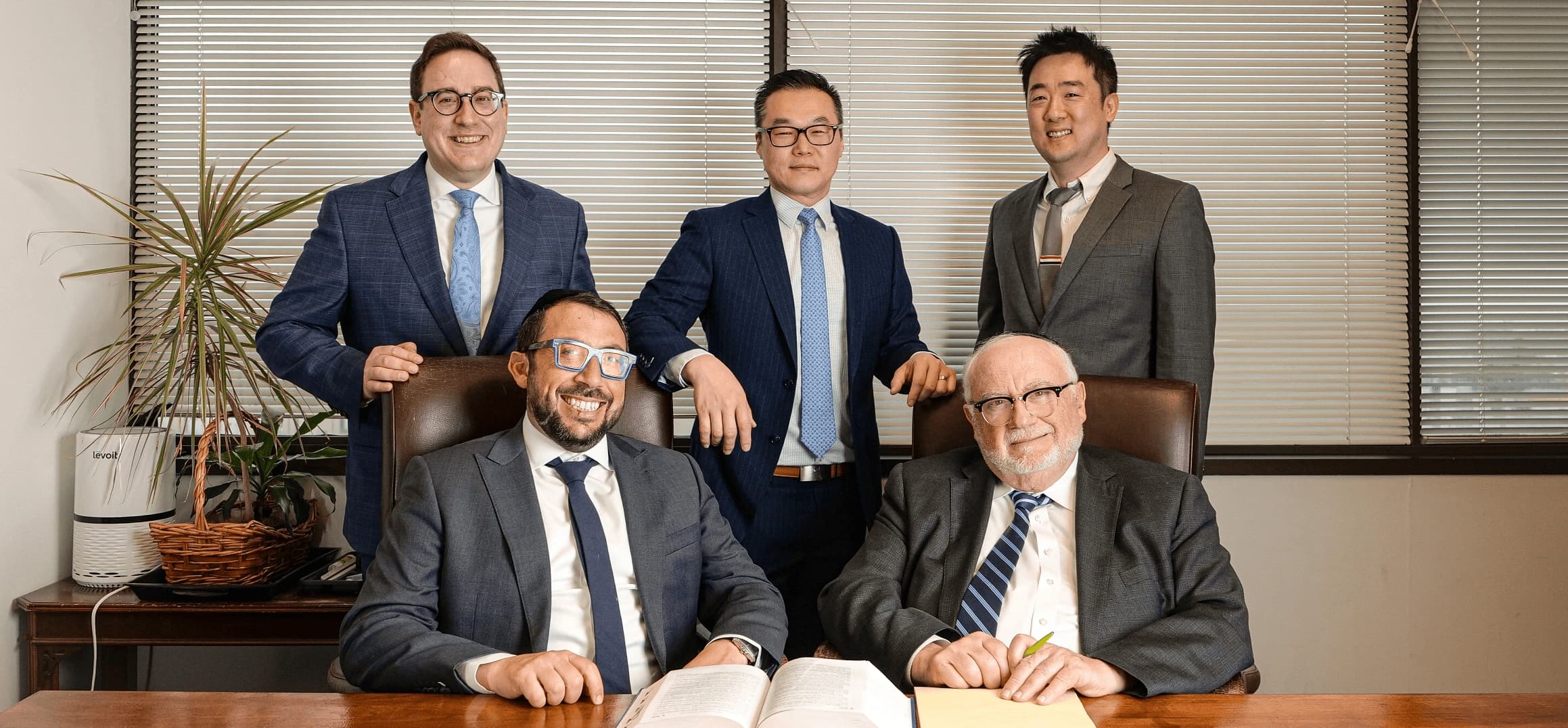
Maurice Vaturi, Avi Vaturi, Jun Ki Lee, Allan Weiss, and Kate Min Kwon each bring their own languages and community ties into how the firm shows up. Between them they work in Hebrew, English, French and Korean. The community page that follows is built around partnerships, but the work behind those partnerships is run by the same lawyers who handle paid files. There is no separate "community team." Pro bono Korean intake is taken by the same partner who would handle a paid file in the same area.

What we built around it
A firm structured to make community work possible
A community-service commitment is easy to write into a brochure. It is difficult to operationalise unless the firm is built to support it. Three structural choices at VC Lawyers exist specifically because the partnerships above exist.
Multilingual representation as the default. Korean, Hebrew, French, Spanish, Cantonese, Mandarin, and Nepali are working languages, not afterthoughts. Roughly one in three of our clients does not speak English as a first language. A community partner referring a Korean speaker can be confident the call is answered in Korean, by a lawyer, the same day.
A 24/7 hotline that reaches a lawyer. After-hours arrests, hospital admissions, and emergency detentions don't follow business hours. The hotline routes to a lawyer directly, not to voicemail and not to an answering service. This matters disproportionately for Consulate referrals, which are almost always urgent.
Costs explained before anything starts. We set out what a matter will cost, in your language, before you decide whether to retain us, and we put it in writing. For someone in a vulnerable position, a newcomer, a worker in a wage dispute, a woman in a domestic crisis, not knowing what a lawyer will cost is itself a barrier.
Partner organizations
Four Korean-Canadian organizations we work with
The four partnerships described below are operational. VC Lawyers takes calls, intakes, and consultations referred through each of them. The work overlaps substantially with our paid practice areas, which is why we can sustain it.
Korean Legal Clinic
A non-profit clinic founded by Korean-Canadian lawyers in Toronto to improve access to justice for the Korean-Canadian community in Ontario. The clinic operates as a referral network. Qualifying clients are screened by the clinic, which routes substantive matters to volunteer lawyers in private practice. VC Lawyers is one of the firms the clinic refers Korean-language matters to. Substantive areas covered include workers' rights, immigration, family law, contract and small-claims disputes. All of those intersect with our paid practice areas, so the same intake process applies whether the file is referred by KLC or comes in directly.Consulate General of the Republic of Korea in Toronto
The Consulate General provides consular services to Korean nationals across Ontario and Manitoba: passports, visas, civil affairs, and assistance for nationals in legal distress. We maintain a working referral relationship with the Consulate so that when a Korean national is arrested, hospitalised after an accident, or otherwise needs urgent legal counsel in a language they speak, the Consulate can route them to a Toronto firm where the call will be answered in Korean by a lawyer rather than a generic intake desk. Most of these referrals are urgent personal-injury or criminal-defence matters where the first 24 hours matter.Love Toronto
Love Toronto (lovetoronto.org) is a Canadian non-profit established in 2016 to support Korean immigrants facing settlement difficulties. It provides referrals to medical care, psychotherapy, legal counsel, senior services, and acupuncture, alongside Korean-language educational resources. We participate as one of Love Toronto's referred legal-counsel options for Korean newcomers who need legal help but aren't sure where to start. The settlement issues that come through this referral channel are typically employment, housing, or accident-related. In those areas an early conversation in Korean is often the difference between a person knowing their rights and not.KCWA Korean Canadian Women's Association
KCWA (Family and Social Services) is a Korean newcomer-serving non-profit in Ontario, founded in 1985 by women concerned about the challenges Korean newcomer women and families faced. It still operates today out of 5075 Yonge Street in North York. Their work covers domestic violence support, settlement counselling, family programs, seniors' programs, and youth programs. We support KCWA's clients with Korean-language family-law and domestic-protection consultations referred through their counsellors. Those matters include separation and divorce, restraining orders, child custody and support, and immigration questions that arise in the context of family breakdown.
Professional bodies
Memberships within the Ontario and Canadian legal profession
Beyond the four community partnerships above, every lawyer at VC Lawyers is a member in good standing with the Law Society of Ontario, the regulator that licenses and oversees lawyers in the province. The firm holds active membership in four additional Ontario and Canadian legal bodies, listed below.
Memberships are not decorative. They are how broader access-to-justice work, continuing legal education, and pro bono advocacy actually get done in the Ontario legal profession. Bar associations administer pro bono panels, fund clinical legal education programs, advocate to the legislature on access-to-justice reforms, and provide the continuing education that keeps lawyers current on the law their clients rely on. The firm's participation in those bodies is part of the same logic as our community partnerships: the profession works better when lawyers contribute to the institutions that hold it together. That holds for our clients and for everyone else's clients.
The body that represents Ontario plaintiffs' counsel, the lawyers who act for accident victims. OTLA leads access-to-justice advocacy on automobile-insurance reform, SABS, and tort caps. The firm's personal-injury practice is anchored in this membership.
Toronto's local bar association. It runs the Toronto courthouse libraries, administers continuing legal education, and coordinates pro bono panels for Toronto-area lawyers.
The national body for Canadian lawyers. CBA leads federal advocacy on access to justice, immigration policy, and rule-of-law issues.
The CBA's Ontario branch. Section-specific continuing legal education, pro bono coordination, and provincial-level advocacy.
How we choose what to take on
Three principles behind the partnerships
A few principles guide which community work the firm takes on, and which it doesn't. They are not negotiable, and they are the reason this page lists four partner organizations rather than forty.
First, every partnership has to map to a practice area we already staff at senior level. We refuse community work the firm cannot do well. A volunteer lawyer who is unfamiliar with SABS appeals is not a help to a Korean-speaking accident victim. That lawyer is a different kind of barrier. Korean Legal Clinic, the Consulate, Love Toronto, and KCWA each refer matters that fall squarely inside areas Jae, Jun, Avi, Allan, or Kate handle every day in their paid practice.
Second, the partnership has to be operational, not promotional. We do not put a logo on our page in exchange for a logo on theirs. The relationships listed above are the ones where the firm picks up phone calls, takes intakes, sees clients, and writes letters. That work runs through the same intake desk and the same lawyers as our paid files.
Third, the door is the same regardless of how a client got to it. A Korean newcomer referred by Love Toronto receives the same lawyer attention as someone who found us through a search. If a referred matter turns into a paid file, we apply the same retainer terms we would for a direct intake. Lawyer attention is not metered by referral source.
Connecting community organizations
If you run a Korean-Canadian community organization
We are open to additional referral relationships with Korean-Canadian non-profits, faith communities, settlement agencies, and educational organizations whose members would benefit from access to Korean-language legal counsel. Reach out via the contact page below and ask for Jae Hyon Cho. He handles community-partnership intake personally.
Get in touch
Looking for legal help? Speak directly with a lawyer
Tell us what happened and a lawyer will personally review your case. Personal injury consultations are free and there are no fees unless we win. For all other practice areas, a consultation fee applies.
- $30M+ recovered for injury clients
- Available 24/7, including weekends
- Service in English, Korean, and 6+ more languages
Prefer to call? (416) 661-4529
Talk to a lawyer
Talk to a lawyer in your language
Whether you came through a community-partner referral or found us directly, the first conversation is confidential and in the language you prefer. Senior lawyer on the call. Korean and English service available. We tell you what the matter will cost before you decide anything.
Toronto office hours, 24/7 emergency hotline, no obligation.
Continue reading