VC·Lawyers®
North York premises liability lawyer, VC Lawyers

North York

North York Premises Liability Lawyers

Toronto Lawyers Association
Ontario Trial Lawyers Association (OTLA)
The Canadian Bar Association
Love Toronto
Consulate General of the Republic of Korea in Toronto
Korean Legal Clinic
Ontario Bar Association
Toronto Lawyers Association
Ontario Trial Lawyers Association (OTLA)
The Canadian Bar Association
Love Toronto
Consulate General of the Republic of Korea in Toronto
Korean Legal Clinic
Ontario Bar Association
Toronto Lawyers Association
Ontario Trial Lawyers Association (OTLA)
The Canadian Bar Association
Love Toronto
Consulate General of the Republic of Korea in Toronto
Korean Legal Clinic
Ontario Bar Association

Trusted by accident victims and businesses across Ontario

Overview

Premises liability claims in North York

Injured on someone else's property in North York? Our experienced premises liability lawyers in North York hold property owners and occupiers accountable, across every kind of premises this part of the city contains. Our team has recovered over $30M+ for injury victims across North York, Ontario and the GTA, including for clients injured by exactly these hazards. This whole practice rests on one rule of Ontario law: whoever controls a property owes everyone on it reasonable safety. When they fail, the cost of the injury is theirs, not yours.

The property types cover the whole area. The grocery store and mall floors of Yorkdale, Fairview, and every plaza between. The restaurants and bars along Yonge and the corridors, including cases where a bar or restaurant over-serves alcohol to a patron who then causes harm (commercial host liability). The apartment buildings and rental houses where landlords defer the maintenance tenants pay for. The condo towers of the Yonge and Sheppard corridor, with their boards, property managers, and layers of contractors.

North York Premises Liability Lawyers, VC Lawyers

How premises claims are actually won

The list continues. The parking lots and garages where poor lighting and untreated ice cause most of the falls. The gyms, arenas, and entertainment venues. The private homes of friends and family, where the homeowner's insurance, not the friendship, answers. And the falling-object and structural-failure cases: the collapsing railing, the failing sign, the tree limb that should have been cut.

Start with the law itself, briefly, because it shapes everything. Premises liability in Ontario runs through the Occupiers' Liability Act. Every "occupier" owes a statutory duty to take reasonable care to keep people reasonably safe while on the premises. The word is defined broadly. It means not just owners, but anyone in physical possession or with responsibility for and control over a property, whether the landlord, the tenant business, the property manager, or the maintenance contractor.

A claim here is a negligence claim built on that statute, and three things have to be proven: that the occupier owed you a duty, that the occupier breached that duty by failing to meet it, and that the breach caused your injury. The breach question almost always turns on systems. Did the occupier know, or should they have known, about the hazard? Did they take the reasonable steps that reasonable occupiers take, such as inspection schedules, maintenance logs, cleaning protocols, lighting audits, and winter contracts?

That is why these cases are won on records. The inspection log that doesn't exist. The complaint emails the landlord ignored. The maintenance contract nobody enforced. The incident reports showing the same stair claimed three victims before you. It is also why multiple defendants is the norm, not the exception. The owner blames the property manager, who blames the cleaning company, who blames the snow contractor. We answer that finger-pointing the only reliable way: sue every occupier with control, let them sort out their shares among themselves, and make sure the one person who never absorbs the loss is the one who got hurt.

Three more points every premises victim should know. First, the deadlines are unforgiving. The general lawsuit limitation is two years, but premises cases carry much shorter notice periods on top of it. Slip-and-falls on snow or ice against private occupiers and their winter contractors require written notice within 60 days. City of Toronto sidewalk and municipal-property claims require notice within 10 days. Those windows close while victims are still in physiotherapy. That is why the first phone call matters more in this practice area than almost any other, and why we serve protective notices immediately, free, even before you've decided to claim.

Second, your own share of the blame reduces a claim but never blocks it. Under Ontario's comparative negligence rules, the occupier's favourite defence, "you should have watched your step", only cuts your compensation by your share of the fault. It cannot wipe the claim out. We've recovered for clients who were partly at fault, because partial fault still leaves the occupier's larger share payable.

Third, warning signs aren't immunity. The wet-floor cone deployed after the fall. The "use at own risk" plaque on the broken stair. Signage is one factor in reasonableness, not a defence in itself. The occupier who warns instead of fixing has documented their knowledge of the very hazard that hurt you.

This page is the property-side hub of our injury practice. Behind it sit the dedicated practice pages: slip and fall (the main one, with the winter ice rules), occupiers' liability (the statute explained in depth), swimming pool and drowning, balcony and deck collapse, dog bites and animal attacks (strict liability's different rules), and the child injury practice for the victims premises law protects most carefully.

Whatever the property, and whatever fell, failed, or was never fixed, the framework is the same and the firm is ready. We work on contingency: no win, no fee, with free consultations 24/7. Home and hospital visits are available across the GTA, in 8+ languages, from our office at 1110 Finch Ave W, in the middle of North York, whose premises we know block by block.

Get in touch

Looking for legal help? Speak directly with a lawyer

Tell us what happened and a lawyer will personally review your case. Personal injury consultations are free and there are no fees unless we win. For all other practice areas, a consultation fee applies.

  • $30M+ recovered for injury clients
  • Available 24/7, including weekends
  • Service in English, Korean, and 6+ more languages

Prefer to call? (416) 661-4529

A VC Lawyers lawyer in consultation with a client at the North York office

Background

Premises liability in North York: what you need to know, property by property

The area is a premises-liability map. Retail at every scale, thousands of rental and condo buildings, restaurant corridors, industrial yards, and the private homes where most of life, and a surprising share of injuries, happens. The duty is the same everywhere. The evidence, defendants, and tactics shift by property type.

Retail, grocery, and malls. These are the classic cases: the spill that sat, the produce-aisle grape, the just-mopped floor without the cone, the parking-lot ice. The battleground is the inspection system: how often the floor was checked, logged, and by whom. The law judges stores by their systems, not their intentions. The defendants are the retailer, the mall owner, the cleaning contractor, and the winter-maintenance company. The evidence is sweep logs, CCTV (demanded fast), incident reports, and the prior-falls history the same aisle often hides.

Restaurants, bars, and entertainment venues. The premises hazards are familiar: greasy floors, dark stairs to the washrooms, and crowded exits. Then comes the rule the hospitality industry answers to: commercial host liability. It comes from the Supreme Court's bar-overservice cases, and it makes a bar, restaurant, or other venue that serves alcohol answerable when it over-serves a patron who then hurts themselves or others. The fight is records again: service tallies, staff training, security logs.

Apartments and rental housing. The landlord's duty doesn't transfer with the rent cheque. Common areas, stairs, halls, lobbies, walkways, and laundry rooms stay the landlord's responsibility. The deferred-maintenance file, whether the broken handrail reported twice, the burned-out stairwell light, or the lobby ice, is this practice's steady work. Tenants and their guests both claim. The complaint history is gold: the emails, the texts to the super, the tenant-group thread. The dark-stairway case our firm has run before is the standard example.

Condominiums. The modern tower multiplies occupiers: the corporation, the property manager, the cleaning and winter contractors, and sometimes the unit owner. Each has insurance, and each points elsewhere. Status documents, board minutes, and management contracts map who controlled what. We sue accordingly and let the cost-sharing provisions in their contracts settle who ultimately pays.

Parking lots and garages. Ice, potholes, wheel stops, and bad lighting meet pedestrians at their least visible. Negligent security claims also live here: the assault in the unlit garage the owner knew was a problem, the broken cameras, the absent patrols. Lighting audits and crime-history records turn "random crime" into foreseeable failure.

Private homes. The friend's stair, the relative's icy walk, the backyard deck: the claims people hesitate to bring because the occupier is someone they love. Here is the reframe that matters. Homeowner's insurance exists for precisely this, and the claim is against the policy. The alternative is you absorbing the cost of someone else's broken railing. Our pool, deck, and dog bite practices cover the residential hazards in detail.

Falling and failing things. These are the premises cases nobody plans for: the sign that drops, the railing that gives, the ceiling fixture, the rotten tree limb, the stair tread that lets go. Structural and arboricultural negligence, the inspection never done and the rot visible for years, is proven with engineers. The defendant is the owner who kept up appearances instead of maintaining the structure. Our own case history includes exactly this kind of claim. There is nothing unusual about it. It is deferred maintenance that finally hurt someone.

By the numbers

Premises liability facts every North York victim should know

The duty, the deadlines, and the defendants.

  • The duty is statutory and broad

    Ontario's Occupiers' Liability Act requires every occupier to take reasonable care to keep entrants reasonably safe. That includes the owner, tenant, landlord, property manager, or contractor: anyone with possession or control. Control, not title, creates the duty.
  • Cases are won on systems and records

    The breach question is whether the occupier knew or should have known about the hazard, and whether they acted reasonably. It is proven through inspection logs, maintenance records, complaint histories, and incident reports, including the ones showing you weren't the first.
  • Multiple defendants is the norm

    Owner, manager, tenant, cleaning company, and winter contractor often all share responsibility. We answer the finger-pointing by suing everyone with control and letting the defendants sort out their shares among themselves.
  • The notice deadlines are short and easy to miss

    Snow-and-ice falls require 60 days' written notice against private occupiers and contractors. City sidewalk claims require 10 days' notice. Those windows close during recovery, which is why protective notice goes out the first week, free.
  • Partial fault reduces, never bars

    Comparative negligence discounts your claim by your share of fault. The "watch your step" defence shrinks recoveries. It does not erase them.
  • Warning signs aren't immunity

    The cone, the plaque, and the wording of a waiver are factors in reasonableness, not shields. A warning is also an admission the occupier knew.
  • Falling and failing things count too

    Premises liability covers more than floors. Collapsing railings and decks, failing signs and fixtures, falling trees and limbs, broken stairs and elevators, and negligent security and lighting all belong here.
  • The homeowner's policy answers, not the homeowner

    Claims at private homes, whether the friend's stair or the relative's icy walk, are paid by insurance bought for exactly this. The claim threatens the policy, not the relationship.
A VC Lawyers lawyer meeting a client at the North York office

Every property has an occupier

Why people hesitate to call, and what the answers actually are

Most premises victims talk themselves out of calling. It was probably my fault. It's my friend's house. It's just a store, they'll have a process. I'll see how the knee feels in a month.

Hear the answers in order. Partial fault only discounts, never erases. Your friend's insurance, not your friend, pays the claim. The store's "process" is an adjuster building the file against you. And the month you wait is the month the footage overwrites and the 60-day window closes.

The consultation costs nothing, the notices cost nothing, and the decision stays entirely yours, preserved instead of forfeited. At Finch and Keele, in your language, this week.

The deadlines here are shorter than most people expect.

Step by step

What to do after a premises injury

  1. 01

    Photograph the hazard now

    The spill, the ice, the broken step, from angles with scale. It will be fixed, salted, or mopped by morning.
  2. 02

    Report it before you leave

    Tell the manager, landlord, or owner, and get the incident report's existence on record (photo of it if possible).
  3. 03

    Get witnesses' names and numbers

    The other shopper who saw the puddle sit is worth more than any argument.
  4. 04

    Seek medical care the same day

    Describe the mechanism precisely. The record born today anchors causation forever.
  5. 05

    Preserve the physical evidence

    The shoes you wore (unaltered), the clothes, the receipts proving you were there.
  6. 06

    Don't give recorded statements

    Not to the occupier's insurer. The friendly call exists to seed the "watch your step" file.
  7. 07

    Write your account tonight

    Cover the surface, the lighting, your footwear, and what was said, while it's exact.
  8. 08

    Mind the deadlines

    60 days for ice-and-snow notice, 10 days for the City. Let us serve them this week regardless of your decision.
  9. 09

    Track everything after

    Symptoms, expenses, missed work, and the help your family provides. The damages are built from this diary.
  10. 10

    Call a North York premises liability lawyer immediately

    The consultation is free, the notices are urgent, and the evidence is on the property's schedule, not yours.

Our process

How our North York premises liability lawyers handle your case

  1. 01

    Free consultation, and protective notice the same week

    We take the facts wherever you are: at the office, at home, or in hospital. We identify everyone with control of the property, with title searched, management identified, and contractors flagged. Then we serve the notices immediately: the 60-day snow-and-ice letters, the 10-day municipal notice, and the preservation demands for footage that overwrites in days. Even if you haven't decided to claim, the notices keep the decision yours. We serve them free.
  2. 02

    The evidence preserved

    We document the scene before it changes. The hazard is photographed, measured, mapped, and re-photographed after the suspiciously prompt repair. Surveillance footage is demanded inside retention windows. Witnesses are found and their statements taken. Then we go after the records: inspection logs, maintenance and cleaning schedules, winter contracts, complaint histories, and prior-incident reports, the paper that proves what the occupier knew and didn't do. Where engineering matters, whether stair geometry, friction coefficients, lighting levels, or a failed railing's metallurgy, we retain and fund the experts.
  3. 03

    Every occupier sued, the injuries documented

    Every occupier with possession or control is named, so the finger-pointing stops working as a defence and starts working as an admission. We document your injuries in full. A fracture is valued on the recovery you actually have. A head injury is treated as seriously as it deserves, and chronic pain is proven, not left open to doubt. We then add up every type of compensation that can be claimed, including pain and suffering, income loss, future care, housekeeping, and the separate claims your family members can bring in their own right. Then we negotiate from documented strength, or litigate in the Superior Court when fair value is refused, through the same trial practice that runs every injury file in this firm.
  4. 04

    Resolution, and what we are paid out of

    The claim resolves against the occupiers' insurers who always stood behind them, and the recovery is paid to you. Our fee is then drawn from that recovery at the percentage set out in the written contingency fee agreement you sign at the start. If the claim does not succeed, no legal fee is payable, and we go through how the disbursements are handled before you sign.

Important

Premises deadlines are the shortest in personal injury. Municipal claims require notice within 10 days. Snow-and-ice claims require notice within 60 days. Surveillance is overwritten in days to weeks, and hazards are repaired the morning after. Every one of those clocks runs while you're still injured. Whatever the property, and however unsure you are about claiming, get the notices served now. They cost nothing and preserve everything. Contact a premises liability lawyer in North York this week.

Every situation is different. Yours deserves a specific answer.

Know their playbook

Occupier and insurer tactics in premises claims, and how we answer them

  • The morning-after repair

    The hazard is fixed, salted, or repainted before breakfast, and the scene now supports the defence. We answer with your photos from the day, our preservation demands, and the repair itself entering evidence as what it is.
  • The missing footage

    "The cameras weren't working." "It's been overwritten." We answer with demand letters inside retention windows, legal consequences when footage disappears after we demanded its preservation, and a witness canvass that doesn't need the tape.
  • The phantom inspection log

    Sweep sheets produced late, suspiciously complete. We answer with metadata, staffing records, and cross-examination. A made-up system does not survive that.
  • The "watch where you're going" file

    Your footwear, your phone, your pace, with comparative negligence pushed far past what the law will allow. We answer with the law: partial fault discounts and never bars. And the hazard's share is the larger one when the records show it sat.
  • The warning-sign shield

    The cone, the plaque, the disclaimer. We answer them as the admissions they are: the occupier knew, and warned instead of fixing.
  • The finger-pointing circle

    Owner blames manager, manager blames contractor, and each adjuster waits out the others. We answer by suing all of them. Every occupier with control is named, so they argue over shares while your claim proceeds.

In the news

Winter, wear, and the records that decide

Premises litigation tracks the local calendar and construction. The winter slip-and-fall season fills emergency rooms each freeze-thaw cycle, and the notice-period law has tightened around it. That has made the 60-day snow-and-ice letter the claim-saving step most victims never hear about in time.

The aging building stock adds its own docket, as deferred maintenance surfaces in failing railings, stairs, and balconies. Across the case law, the judicial message is steady: occupiers are judged on systems, meaning inspection schedules kept and logged, not on good intentions recited after the fact. The duty itself is set out in Ontario's Occupiers' Liability Act. Toronto's own sidewalk and municipal-property claims add the 10-day layer the public learns about, almost always, eleven days too late.

For North York's residents the takeaway is simple. The law is on the injured person's side, but only for those whose notices went out on time and whose evidence outlived the morning-after repair.

Rather ask someone who handles these matters every week?

Why VC Lawyers

Why hire a premises liability lawyer in North York at VC Lawyers

  • Every occupier identified, not guessed at

    Owner, manager, tenant, and contractor: every party with possession or control is identified and noticed, so the ones pointing fingers pay instead of escaping.
  • The short notice deadlines covered first

    The 60-day and 10-day windows are covered by protective notices served in week one, free. That step saves more premises claims than any other.
  • The fight for the records, run properly

    Inspection systems, maintenance logs, complaint histories, and prior incidents: the documentary case that turns "reasonable care" from their slogan into your evidence.
  • Contingency fee basis

    No upfront legal fees and a free consultation. Our fee is an agreed percentage of the recovery and is payable only if the claim succeeds.
  • The dedicated practice pages behind this hub

    Slip and fall, occupiers' liability, pools, balconies, dog bites, and child injuries. Each has its own page, vocabulary, and tactics, all under one roof.
  • Engineering when it matters

    Stair geometry, friction testing, lighting audits, and structural failure analysis, funded by us. A hazard is hard to prove until an expert measures it.
  • Multilingual service

    English, Korean (한국어), Hebrew, Mandarin, and more, 24/7, with home and hospital visits across North York.

Choosing wisely

How to choose the right premises liability lawyer in North York

Before hiring any firm, ask a few questions. Will they serve the 60-day and 10-day notices immediately, free, before you've even decided? Do they identify and sue every occupier with control, or just the obvious owner? Will they fight for the records, meaning inspection logs, complaint histories, and prior incidents, and fund the engineers when structure and friction matter? Do they know how each property type works, from retail systems to landlord common areas, condo management structures, and negligent security? Is it genuinely no-win-no-fee? And is there real trial strength behind the demand letters?

At VC Lawyers, the answer to each is yes. We work from an office in the heart of North York, on a contingency fee agreed in writing, in your language.

Still weighing what to do next? That is what a first conversation is for.

Testimonials

What our North York clients say

4.8★★★★★·140 on Google
After my car accident, I went through an incredibly challenging time. Thanks to Lawyer Jun Lee and his exceptional team, I received tremendous support and strength.

Jay Kim

Personal Injury Client

When my mother suffered a serious head injury, I was devastated. After meeting Lawyer Jae Hyon Cho, my family was able to receive substantial compensation.

Minkyung Park

Personal Injury Client

Avi Vaturi was professional, responsive, and thorough. When the transaction became complex, his calm communication and practical solutions navigated us to a smooth close.

Jordan Glaser

Real Estate Co-Counsel

Mr. Avi Vaturi did a fantastic job. The whole process was seamless — timely, detailed, and professional from start to finish.

Howard Huang

Real Estate Client

He helped me with both my car accident case and the buying and selling of my home. Everything was handled professionally and efficiently.

Yoon Jung

Personal Injury & Real Estate Client

Jae Cho was great to deal with and very attentive to my case. His associate Sunny was also very helpful. I would highly recommend.

Jordan Ungerman

Personal Injury Client

Their professionalism, attention to detail, and commitment to clients truly stand out. Whether handling urgent matters or guiding me through complex issues, the team delivered.

Charles Hong

Long-time Client

It has been my pleasure to work with Jae Cho and his team. Knowledgeable, clear in their explanations, and the process was smooth and stress-free.

Joanne Jeong

Real Estate Client

Vaturi & Cho LLP is an outstanding law firm. They explain even complex matters clearly, and their dedication to achieving the best outcomes is truly impressive.

Jong Ko

Client

The team was not only knowledgeable but also very kind and attentive throughout the entire process. Highly recommended.

Tobi

Client

After my car accident, I went through an incredibly challenging time. Thanks to Lawyer Jun Lee and his exceptional team, I received tremendous support and strength.

Jay Kim

Personal Injury Client

When my mother suffered a serious head injury, I was devastated. After meeting Lawyer Jae Hyon Cho, my family was able to receive substantial compensation.

Minkyung Park

Personal Injury Client

Avi Vaturi was professional, responsive, and thorough. When the transaction became complex, his calm communication and practical solutions navigated us to a smooth close.

Jordan Glaser

Real Estate Co-Counsel

Mr. Avi Vaturi did a fantastic job. The whole process was seamless — timely, detailed, and professional from start to finish.

Howard Huang

Real Estate Client

He helped me with both my car accident case and the buying and selling of my home. Everything was handled professionally and efficiently.

Yoon Jung

Personal Injury & Real Estate Client

Jae Cho was great to deal with and very attentive to my case. His associate Sunny was also very helpful. I would highly recommend.

Jordan Ungerman

Personal Injury Client

Their professionalism, attention to detail, and commitment to clients truly stand out. Whether handling urgent matters or guiding me through complex issues, the team delivered.

Charles Hong

Long-time Client

It has been my pleasure to work with Jae Cho and his team. Knowledgeable, clear in their explanations, and the process was smooth and stress-free.

Joanne Jeong

Real Estate Client

Vaturi & Cho LLP is an outstanding law firm. They explain even complex matters clearly, and their dedication to achieving the best outcomes is truly impressive.

Jong Ko

Client

The team was not only knowledgeable but also very kind and attentive throughout the entire process. Highly recommended.

Tobi

Client

After my car accident, I went through an incredibly challenging time. Thanks to Lawyer Jun Lee and his exceptional team, I received tremendous support and strength.

Jay Kim

Personal Injury Client

When my mother suffered a serious head injury, I was devastated. After meeting Lawyer Jae Hyon Cho, my family was able to receive substantial compensation.

Minkyung Park

Personal Injury Client

Avi Vaturi was professional, responsive, and thorough. When the transaction became complex, his calm communication and practical solutions navigated us to a smooth close.

Jordan Glaser

Real Estate Co-Counsel

Mr. Avi Vaturi did a fantastic job. The whole process was seamless — timely, detailed, and professional from start to finish.

Howard Huang

Real Estate Client

He helped me with both my car accident case and the buying and selling of my home. Everything was handled professionally and efficiently.

Yoon Jung

Personal Injury & Real Estate Client

Jae Cho was great to deal with and very attentive to my case. His associate Sunny was also very helpful. I would highly recommend.

Jordan Ungerman

Personal Injury Client

Their professionalism, attention to detail, and commitment to clients truly stand out. Whether handling urgent matters or guiding me through complex issues, the team delivered.

Charles Hong

Long-time Client

It has been my pleasure to work with Jae Cho and his team. Knowledgeable, clear in their explanations, and the process was smooth and stress-free.

Joanne Jeong

Real Estate Client

Vaturi & Cho LLP is an outstanding law firm. They explain even complex matters clearly, and their dedication to achieving the best outcomes is truly impressive.

Jong Ko

Client

The team was not only knowledgeable but also very kind and attentive throughout the entire process. Highly recommended.

Tobi

Client

After my car accident, I went through an incredibly challenging time. Thanks to Lawyer Jun Lee and his exceptional team, I received tremendous support and strength.

Jay Kim

Personal Injury Client

When my mother suffered a serious head injury, I was devastated. After meeting Lawyer Jae Hyon Cho, my family was able to receive substantial compensation.

Minkyung Park

Personal Injury Client

Avi Vaturi was professional, responsive, and thorough. When the transaction became complex, his calm communication and practical solutions navigated us to a smooth close.

Jordan Glaser

Real Estate Co-Counsel

Mr. Avi Vaturi did a fantastic job. The whole process was seamless — timely, detailed, and professional from start to finish.

Howard Huang

Real Estate Client

He helped me with both my car accident case and the buying and selling of my home. Everything was handled professionally and efficiently.

Yoon Jung

Personal Injury & Real Estate Client

Jae Cho was great to deal with and very attentive to my case. His associate Sunny was also very helpful. I would highly recommend.

Jordan Ungerman

Personal Injury Client

Their professionalism, attention to detail, and commitment to clients truly stand out. Whether handling urgent matters or guiding me through complex issues, the team delivered.

Charles Hong

Long-time Client

It has been my pleasure to work with Jae Cho and his team. Knowledgeable, clear in their explanations, and the process was smooth and stress-free.

Joanne Jeong

Real Estate Client

Vaturi & Cho LLP is an outstanding law firm. They explain even complex matters clearly, and their dedication to achieving the best outcomes is truly impressive.

Jong Ko

Client

The team was not only knowledgeable but also very kind and attentive throughout the entire process. Highly recommended.

Tobi

Client

Our team

Meet your North York legal team

Our lawyers bring decades of combined experience holding occupiers here to account, from retail to rental, condo to private home. These cases demand notice discipline, a hard fight over records, and trial strength, and we bring all three. Every client at VC Lawyers works with a dedicated North York premises liability lawyer, from the first protective notice to the final cheque.

Who handles your file

The people on your matter

  • Avi Vaturi, Partner

    Senior injury counsel litigating serious premises claims: structural failures, negligent security, and claims against multiple occupiers.
  • Jae Hyon Cho, Co-Managing Partner

    Experienced counsel serving North York's communities, including Korean-speaking clients, across premises and injury matters.
  • Jun Ki Lee, Associate

    Dedicated associate handling notices, evidence preservation, records demands, and litigation across North York and the GTA.
  • Allan Weiss, Associate

    Experienced lawyer providing strategic guidance on liability theories, apportionment, and trial preparation.

Not sure where you stand? One conversation will tell you.

Key metrics

In the numbers

Recovered for injury victims
$30M+
Personal injury cases handled
4,000+
Years combined experience
70+
No fee, contingency basis
No Win
VC Lawyers Toronto legal team, Vaturi & Cho LLP

Talk to us

The notice windows are short, the evidence is vanishing, and the consultation is free

Injured on any property? A store, a rental, a condo, a parking lot, or a friend's front step, it all counts. Bring the where, the when, and whatever photos exist. We'll identify every occupier responsible for the property and serve the protective notices the deadlines demand, free and immediately. Then we'll tell you honestly what the claim is worth and what proving it takes.

No fee unless we win. Available 24/7, with home and hospital visits.

Book Free Consultation

Frequently asked questions

We answered all

  • What exactly is premises liability, and is it the same as "occupiers' liability"?
    They are the same law under two names. Premises liability is the everyday term, and Ontario's statute is the Occupiers' Liability Act. It requires everyone with possession or control of a property, including owners, tenants, landlords, managers, and contractors, to take reasonable care to keep people reasonably safe. When they fail and you're hurt by the floor, the stair, the ice, the railing, the lighting, or the dog, that failure is this claim. Our occupiers' liability page explains the statute in depth. This page walks through the property types.
  • I fell in a store / mall. What do I have to prove?
    You must prove three things: the store owed you a duty (automatic, because you were an entrant), it breached reasonable care, and the breach caused your injuries. The breach fight is about systems: how long the hazard sat, what the inspection schedule was, and whether it was followed and logged. That is why the sweep sheets, the CCTV, and the prior-incident history matter more than anything said at the scene. We demand all three in week one.
  • The property fixed the hazard the next day. Doesn't that destroy my case?
    No, and the quick fix often helps your case. Your photos from the day, the witnesses, or the footage we demand before it overwrites prove the hazard existed. The prompt repair proves how easily the occupier could have prevented it. What the morning-after fix really destroys is the unprepared claim: no photos, no notice, no preservation letter. Hence the rule: document today, call this week.
  • I was hurt at a friend's / relative's home. I don't want to sue them, so what are my options?
    You claim against their homeowner's insurance, not against them personally. That policy was bought for exactly this, and insurers, not friends, pay these claims. The alternative is you personally absorbing the cost of an injury their property caused. We handle these claims with the discretion family situations deserve. The relationship survives far more often than the untreated knee does.
  • My landlord ignored complaints about the broken stair / dark hallway for months. Does that matter?
    Yes, it is the heart of the case. Landlords keep responsibility for common areas, meaning stairs, halls, walkways, and lighting, regardless of the lease. A complaint history, whether your texts to the super, the emails, or the tenant-group thread, converts "we didn't know" into "we knew and deferred." Preserve every message tonight. The documented ignored complaint is the strongest single document in rental premises law.
  • What are these 10-day and 60-day deadlines I keep hearing about?
    They are the short notice deadlines built into premises law. Slip-and-falls on snow or ice require written notice to the occupier and winter contractor within 60 days. Injuries on City of Toronto property, meaning sidewalks, parks, and municipal buildings, require notice within 10 days. Miss them and the claim can die regardless of merit. Narrow exceptions exist but are fought over. Notices cost nothing and preserve everything, so we serve them immediately, even for clients still deciding whether to claim.
  • The store says I should have watched where I was going. Is my claim dead?
    No. Ontario's comparative negligence regime means your share of fault, if any, reduces the recovery proportionately and bars nothing. A claim worth $200,000 with 25% contributory fault still pays $150,000. The "watch your step" defence is the occupier's favourite precisely because it scares people out of calling. Records showing the hazard sat unlogged for hours have a way of shrinking your "share" dramatically.
  • There was a warning sign / I signed a waiver. Now what?
    Neither is the shield occupiers pretend. A warning sign is one factor in reasonableness, and simultaneously an admission that the occupier knew about the hazard it warned of instead of fixing. Waivers are read narrowly by the courts. One can fail because its wording is unclear, or because it was never properly put in front of you, and it only applies to the risks its wording clearly covers. Bring us the sign photo or the waiver text. Their actual legal force is usually much smaller than it looks.
  • I was assaulted in a poorly lit parking garage. Is the property responsible for a crime someone else committed?
    Potentially yes. Negligent security is premises liability's sharpest edge. Occupiers who know, or should know, about foreseeable risks, whether the crime history, the broken lights and cameras, or the absent patrols, owe reasonable protective measures. Their failure makes the "random" crime a property failure. These cases run on lighting audits, incident histories, and security records. They are harder than slip-and-falls and entirely winnable with the right evidence, which we fund.
  • A sign / railing / tree limb fell on me. Is that a premises case too?
    Yes, fully. These are the falling-and-failing-things cases. Structural elements, fixtures, and trees all carry inspection and maintenance duties, and their failures are proven with engineers and arborists reading the rot, rust, and fatigue that accumulated in plain sight. Our own case history includes precisely this kind of claim. The deferred-maintenance defendant rarely looks negligent until the engineering report arrives. After that, it is hard to see them any other way.
  • What is my premises claim actually worth?
    It is worth what the injury actually costs. Unlike car accidents, where a statutory deductible comes off a pain and suffering award and those damages are only available if the injury meets the statutory threshold (death, permanent serious disfigurement, or permanent serious impairment of an important physical, mental or psychological function), premises cases carry no statutory deductible or threshold on pain and suffering, so every dollar awarded is payable. On top of that, add the income you have lost and will lose, medical, rehab, and future care costs, housekeeping, and the claims your close family can bring under the Family Law Act. Severity, permanence, and documentation drive the range. Serious premises injuries, like the fractured hip on the ice or the head injury on the stair, regularly support six- and seven-figure recoveries when built properly.
  • How much does a premises liability lawyer cost in North York?
    Nothing upfront, and nothing unless we win. VC Lawyers works on a contingency fee basis: no win, no fee, including the engineers, records fights, and litigation these files demand. The urgent notices are served free from day one, and the consultation is free, 24/7, with home and hospital visits across the area. The property has insurance and adjusters behind it. A contingency retainer is what lets an injured person answer that without money up front.

North York premises liability lawyers

The property had a duty. The hazard had a history. The claim has a deadline. Start free.

Premises claims are decided in the first weeks, usually while the victim is still deciding whether to call. The 10-day municipal window, the 60-day ice notice, the footage that overwrites, and the hazard that gets fixed by morning all see to that. Decide nothing yet. Preserve everything now: the notices served free, the evidence locked down, every occupier identified, and the choice to proceed kept entirely, safely yours. The first consultation is free, and you pay no legal fees unless we win your case.

Toronto Office

Vaturi & Cho LLP

1110 Finch Ave W #310
North York, ON M3J 2T2
info@vclawyers.ca
VC Lawyers service area map, Toronto and the Greater Toronto Area, with our North York office marked

Service areas

North York premises liability lawyers serving every neighbourhood
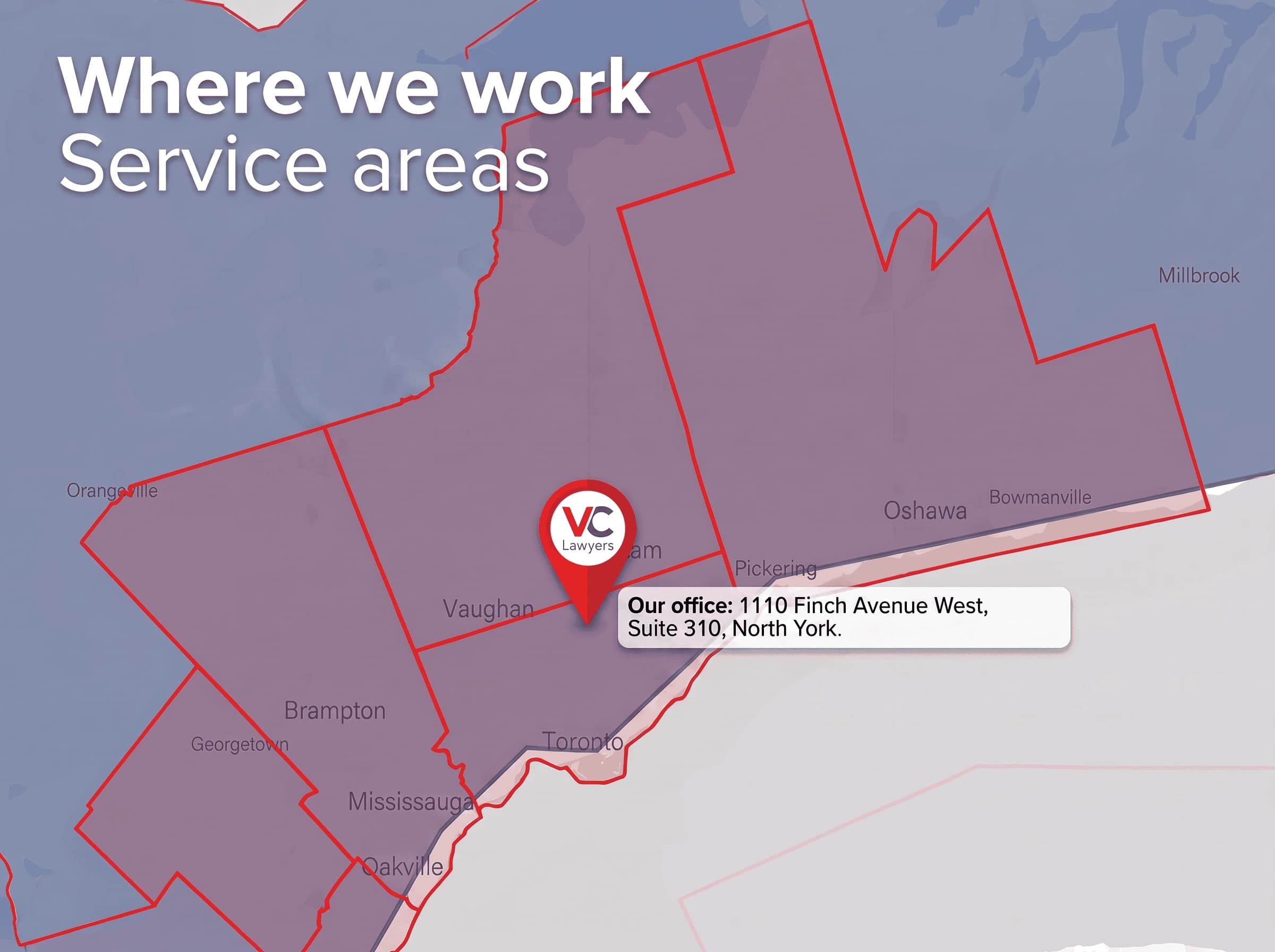
From our office at Finch Ave W and Keele, we represent premises injury victims across all of North York. That includes Willowdale, Don Mills, Downsview, York Mills, Bathurst Manor, Lansing, Newtonbrook, Bayview Village, Flemingdon Park, Jane and Finch, Yorkdale and Glen Park, Clanton Park, Parkwoods, and Victoria Village. We also serve neighbouring communities in Vaughan, Thornhill, Richmond Hill, Markham, Scarborough, Etobicoke, and Downtown Toronto.

It may have happened at a Yorkdale retailer, a Finch plaza, a Willowdale condo, a Downsview rental, a Yonge-corridor restaurant, or a private home anywhere in the area. Wherever it was, our North York premises liability lawyers know the property types, the parties responsible, and the deadlines. We offer office, video, home, and hospital meetings, with parking and TTC access (Finch West Station) at our office.

Our office is at 1110 Finch Ave W #310, near Finch and Keele, with parking on site. By transit, take the Finch West LRT or the bus network connecting from Finch West Station on Line 1. If your injuries or circumstances make travel difficult, we come to you at home or in hospital, anywhere in North York.

Related practice areas

Continue exploring