VC·Lawyers®
North York shareholder agreement lawyer, VC Lawyers

North York

North York Shareholder Agreement Lawyer

Toronto Lawyers Association
Ontario Trial Lawyers Association (OTLA)
The Canadian Bar Association
Love Toronto
Consulate General of the Republic of Korea in Toronto
Korean Legal Clinic
Ontario Bar Association
Toronto Lawyers Association
Ontario Trial Lawyers Association (OTLA)
The Canadian Bar Association
Love Toronto
Consulate General of the Republic of Korea in Toronto
Korean Legal Clinic
Ontario Bar Association
Toronto Lawyers Association
Ontario Trial Lawyers Association (OTLA)
The Canadian Bar Association
Love Toronto
Consulate General of the Republic of Korea in Toronto
Korean Legal Clinic
Ontario Bar Association

Trusted by accident victims and businesses across Ontario

Overview

Shareholder agreements in North York

Need a shareholder agreement in North York, or stuck inside one that's failing? Our experienced shareholder agreement lawyers in North York draft, negotiate, review, and enforce the document that matters most in any multi-owner corporation: the contract between the partners themselves. We act for founders documenting a new venture, incumbent owners admitting an investor or key employee, and families formalizing the business that was always "understood." We act for 50/50 partners who finally want a tiebreaker, minorities who want protection before they invest, and, through our litigation practice, the shareholders enforcing or escaping agreements when the partnership breaks. Based at 1110 Finch Ave W, our team brings 70+ years of combined legal experience to corporations here. Most of them have everything documented except the one relationship that ends companies: the one between the owners.

Start with what the document is, because everything the law leaves unsaid is the whole argument for having one. Without a shareholder agreement, your co-ownership runs on the law's default rules instead of rules you chose. Shares are freely transferable under the corporation's basic rules: your partner can sell to a stranger, or a competitor, and you meet your new co-owner at the next meeting. Decisions run on simple majority votes: 50/50 companies deadlock with no exit, and minority owners get outvoted on everything from profit distribution to issuing new shares that shrink their ownership.

North York Shareholder Agreement Lawyer, VC Lawyers

Written while you still agree, and built to work when you don't

Then come the five triggers every partnership eventually meets: death, disability, divorce, default, and departure. The defaults handle them with no mechanism at all. Shares pass to an estate, and you find yourself in business with your late partner's family. A shareholder's divorce puts the value of those shares into the family-law accounting. And the partner who walked out last year still owns half the company.

A shareholder agreement replaces every one of those defaults with rules you chose. Governance covers board composition, voting thresholds, and the reserved matters that need special or unanimous consent, such as new debt, new shares, selling the business, and changing the business. Money covers dividend and distribution policy, settled in writing, ending the annual reinvest-versus-pay fight. Transfers cover rights of first refusal (so existing owners can match any outside offer before a stranger gets in), exceptions for transfers to family trusts, and outright prohibitions where the ownership list must stay closed.

Liquidity and sale are handled by drag-along rights, so a minority can't block the company's sale, and tag-along or piggyback rights, so a minority can't be left behind when the majority sells. Protection comes from non-competition, non-solicitation, and confidentiality during and after ownership. And the exit provisions, meaning the buy-sell terms, valuation methods, and funding mechanics, turn the five Ds from existential crises into administered transactions.

Two mechanisms deserve their own paragraphs, because they're famous and dangerous in equal measure. First, the shotgun clause: one shareholder names a price, and the other must either sell at it or buy at it. It is crude, final, and deadlock-proof by design, and it ends the standoff in one move.

Its virtue is finality; its vice is asymmetry. The shotgun favours whoever has cash, information, and timing. The partner who runs the books and can finance a buyout can name a low price, knowing the other side can't pull the trigger back. We draft shotguns with the safeguards that keep them honest. And we tell some clients, candidly, that a shotgun is the wrong tool for their imbalance. Instead we recommend valuation-based buy-sells, put/call options (one side has the right to buy, the other has the right to sell), or staged mechanisms.

Second, the unanimous shareholder agreement (USA): an instrument Ontario's statute recognizes, and it can do more than an ordinary contract can. It can lawfully restrict the directors' powers, in whole or in part, and hand those powers to the shareholders. It binds both current and future shareholders. Whatever powers move across, the legal duties and liabilities that come with them move too, so the shareholders now carry them. For owner-managed companies, the USA makes the law match the reality: the owners are the management. It's also precisely why template agreements are dangerous. A downloaded "USA" that reallocates director liability to shareholders who never read that part is worse than no agreement at all.

Here is the discipline that separates our drafting: agreements built to work under stress, not just in theory. The exit clauses work as one connected system: the right of first refusal, the shotgun, the valuation method, and the drag-along and tag-along. They are tested against exactly one scenario, the worst one, with lawyers on both sides reading for gaps. Our litigation practice fights shareholder disputes, including oppression claims, deadlocks, and buy-out applications. That means our drafting side knows the predictable failures: deadlock provisions that don't actually break deadlocks, shotguns manipulable through valuation asymmetry, buy-sell mechanisms that fail precisely when liquidity matters, valuation clauses that name no method, and insurance-funded buyouts where nobody bought the insurance.

The agreement is cheap and the dispute is not. When governance fails without paper, the remedies are Ontario's oppression remedy (a court action protecting shareholders from unfair conduct), lawsuits brought on the company's behalf, court-ordered buy-outs at fair value, and, in intractable cases, a court order to shut the company down and divide its assets. Those remedies are powerful, slow, expensive, and public. The agreement exists so your exit is a clause, not a courtroom.

Consultations are billed, and what the drafting costs depends on the complexity of your structure, set out in writing before any work begins. With service in 8+ languages, VC Lawyers documents local partnerships while everyone still likes each other, and stands behind the paper when they don't.

Get in touch

Looking for legal help? Speak directly with a lawyer

Tell us what happened and a lawyer will personally review your case. Personal injury consultations are free and there are no fees unless we win. For all other practice areas, a consultation fee applies.

  • $30M+ recovered for injury clients
  • Available 24/7, including weekends
  • Service in English, Korean, and 6+ more languages

Prefer to call? (416) 661-4529

A VC Lawyers lawyer in consultation with a client at the North York office

Background

Shareholder agreements in North York: what you need to know

The area's multi-owner corporations are this practice's docket. The two founders above a Willowdale storefront, equal partners with no tiebreaker. The three siblings who inherited the Keele-corridor business and the assumptions that came with it. The clinic admitting the associate to equity.

Then the plaza holding company owned across two generations and three households, and the operating company taking an investor whose term sheet assumes protections nobody's drafted. Different companies, identical exposure: relationships doing the work that documents should.

The clause inventory, from governance through to the exit

Governance and reserved matters. Board composition and nomination rights. Voting thresholds tuned past simple majority where it matters. And the reserved-matter list requiring special or unanimous consent: borrowing, issuing new shares (which would shrink existing owners' percentages), selling or fundamentally changing the business, related-party transactions, and compensation. That list is a minority shareholder's real protection, and it is deliberately a brake on the company, so it has to be calibrated: enough consent to protect, not so much that nothing can be decided.

Distributions. The dividend policy goes in writing: when profits distribute, when they reinvest, and how working shareholders' salaries and non-working shareholders' returns coexist. Settling that once, on paper, keeps it from being reargued at every year-end.

Transfer restrictions. The right of first refusal, so insiders match any outside offer before a stranger appears on the share register. Permitted transferees: the family trust yes, anyone else no. Outright restrictions where the register stays closed. And the family-law interface, meaning the provisions that, within the law's limits, keep shares from becoming the contested asset in a shareholder's divorce.

Liquidity: drag and tag. Drag-along lets the selling majority require the minority to sell on the same terms, so one holdout can't kill the company's sale. Tag-along (piggyback) lets the minority join the majority's sale on identical terms, so nobody's left behind as the minority partner of an unknown buyer. Opposite protections, same clause family, both usually needed.

The buy-sell provisions. Triggers first: the five Ds, each defined, disability especially, with medical definitions and waiting periods. Then the valuation method: fixed formulas with annual updates, third-party appraisal with selection mechanics, fair-value definitions, and the minority-discount question answered in advance.

Funding and mechanics finish the job. Life and disability insurance required and reviewed, payment schedules and security for lifetime buyouts, and mechanics that actually run, including notices, timelines, and defaults. A buy-sell that needs a court to interpret it has already failed.

The shotgun, honestly. Deadlock-proof, fast, final, and asymmetric: it favours cash, information, and timing, which in most private companies means it favours one identifiable partner. Drafted well, with timing restrictions, information rights, and financing windows, it's a legitimate last resort. Drafted naively, it's a transfer of the company to whoever can afford to pull first. We'll tell you which yours would be.

Protective covenants. Non-competition and non-solicitation scoped to enforceability in time, territory, and activity, and confidentiality that survives exit. These are the clauses that keep a departing shareholder from taking the business across the street, drafted by the litigators who test such covenants in court.

Dispute resolution. The ladder before the litigation: negotiation periods, mediation, arbitration where privacy and speed matter, and the mechanisms (put/call options, auctions, shotguns) that resolve deadlock without either.

Not sure where you stand? One conversation will tell you.

A VC Lawyers lawyer meeting a client at the North York office

The USA, specifically

Ontario's Business Corporations Act recognizes the unanimous shareholder agreement as more than a contract. With every shareholder's consent, it can restrict the directors' powers to manage the corporation, in whole or in part, transferring those powers to the shareholders. It binds future shareholders who acquire shares, and it moves the duties and liabilities that attach to the powers. For owner-managed companies it's the honest structure: the people running the business hold the legal authority to run it.

The caveats are real. Liability follows power, so shareholders exercising director powers carry director-style exposure for them, and the drafting must be deliberate. That is why the downloaded "USA template" is the most dangerous document in Canadian small business: it reallocates liabilities its signatories never read.

By the numbers

Shareholder agreement facts every North York business owner should know

The defaults, the clauses, and the mechanisms.

  • No agreement means the statute's defaults

    Freely transferable shares, so your partner can sell to a stranger. Simple-majority rule, so minorities are outvoted and 50/50s deadlock. And the five Ds (death, disability, divorce, default, departure) with no mechanism, so estates, ex-spouses, and departed partners all end up on the share register.
  • The standard clauses are the same; the details aren't

    Governance and decision-making rules, dividend policy, transfer restrictions (rights of first refusal, approved transferees), drag-along and tag-along rights, non-competes and confidentiality, and the buy-sell exit provisions. Every company needs the list; every company needs it tuned differently.
  • The shotgun is a duel, not a default

    One names the price, and the other buys or sells at it. It is deadlock-proof and final, but it structurally favours the partner with cash, information, and timing. We draft it with safeguards, or replace it with valuation-based mechanisms where the imbalance would let one partner use it against the other.
  • The USA is a different legal instrument

    Ontario's statute lets a unanimous shareholder agreement restrict directors' powers and move them to shareholders, binding future holders and reallocating the liabilities that follow the powers. It is the owner-managed company's tool, and the template-download's biggest trap.
  • Valuation is the clause that decides the money

    A buy-sell clause has to say how the shares get priced: a formula, the appraisal mechanics such as who picks the appraiser and who pays, what fair value means, and whether discounts apply. Leave that out and you are inviting a court fight over the price. It is the most commonly missing piece in the agreements we're asked to fix.
  • Funding makes buy-sells real

    The obligation to buy out an estate means nothing without money. That is why insurance-funded death and disability buyouts, payment terms, and security are drafted into the mechanism, not assumed.
  • Tag and drag protect opposite parties

    Drag-along lets a selling majority deliver the whole company, with no minority holdout. Tag-along/piggyback lets the minority sell on the same terms, with no being left behind with a new controlling stranger. Most agreements need both.
  • Without an agreement, your only option is court

    Oppression claims, lawsuits on the company's behalf, court-ordered buy-outs at fair value, and court-ordered shutdown. Real protection, at litigation prices, on litigation timelines, in public.
Boardroom at VC Lawyers, 1110 Finch Avenue West, North York

Partners, on paper

What the agreement is really for, and what it isn't

Most of the partnerships in this part of the city started the same way: two people, one idea, equal shares, and total confidence that they'd figure things out. And they did, daily, for years, right up until the thing that couldn't be figured out: the diagnosis, the divorce, the burnout, the offer one wanted to take and one didn't.

Writing the agreement is not a sign that you distrust each other. It is the ordinary maintenance a partnership needs, and doing it early is a favour to every person who signs it, because it can only be done properly while everyone involved still wants the same things. Have the conversation once, honestly, while you're still the people who built this together, so that the difficult day arrives with a mechanism to follow instead of a gap. One meeting at Finch and Keele, in whichever of our 8+ languages the partnership actually speaks, and the understanding finally matches the paper.

The deadlines here are shorter than most people expect.

Step by step

What to do, step by step

  1. 01

    Count your shareholders honestly

    Including the spouse who was added for tax purposes and the trust that was never properly set up. The agreement must bind everyone actually on the share register.
  2. 02

    Map the imbalances

    Who works in it, who funds it, who could finance a buyout, who runs the books. These are the design inputs that decide which mechanisms are safe.
  3. 03

    Have the five-Ds conversation now

    Death, disability, divorce, default, and departure, while they're hypotheticals. Partners negotiate honestly only while nobody knows which side of the deal they'll be on.
  4. 04

    Choose a valuation method you could actually run this year

    And test it. If the formula needs numbers nobody keeps, it's not a method; it's a fight.
  5. 05

    Get insurance quotes alongside the drafting

    The death and disability buyout is only as real as its funding, and insurability is a fact to learn early.
  6. 06

    Decide the deadlock answer deliberately

    Whether shotgun, put/call option, or mediation ladder, based on your actual differences in cash and information.
  7. 07

    Settle the dividend policy in writing

    The reinvest-versus-distribute fight is the most common slow poison in family and partner companies.
  8. 08

    Coordinate with your personal estate plan

    The shareholder agreement, the wills (including a dual-will structure that can reduce probate tax on business shares), and any marriage or separation agreements should tell one consistent story.
  9. 09

    Get new shareholders to sign on before they get shares

    Every new shareholder signs a joining agreement before the shares move, not after.
  10. 10

    Bring it to a North York shareholder agreement lawyer this month

    The agreement gets written while the partners still agree, or litigated expensively once they don't. The same office does both, and strongly prefers the drafting.

Our process

How our North York shareholder agreement lawyers build your agreement

  1. 01

    The consultation, and the partnership mapped

    The real picture comes first. Who owns what, who works in the business and who doesn't, who has money and who has information, what the families and estates look like, and where the relationship actually stands. The design follows the facts: ordinary agreement or USA, which reserved matters, and which exit tools fit your imbalances. The consultation is billed, and the cost of the drafting is set out in writing before it starts.
  2. 02

    Designed around the five Ds, and funded

    The exit provisions are built as the interconnected system they are. Triggers are defined: death, disability with real definitions and waiting periods, divorce and the family-law interface, default and its cure periods, and voluntary departure and retirement. We choose and draft a valuation method you can actually run, whether that is a formula, third-party appraisal mechanics, or fair-value language, and we address minority discounts. We make the funding real: insurance is quoted and required for death and disability buyouts, and payment terms and security cover the rest. And we pick the deadlock answer honestly, whether a shotgun with safeguards, put/call structures, or a mediate-first-then-trigger sequence. We match it to your structure instead of pulling it from a template.
  3. 03

    Negotiated among partners, candidly

    We draft for the company and tell every shareholder plainly where interests diverge. When independent advice is warranted, we say so. The majority's control against the minority's protections. The working shareholder's sweat against the investor's capital. The founder's legacy against the buyer's flexibility. All of it is negotiated in peacetime, documented precisely, executed properly, and filed where it lives, with the corporate records our governance practice keeps current.
  4. 04

    Maintained, and enforced

    Agreements age. New shareholders sign accession agreements, valuations and insurance get reviewed on the calendar, and amendments track the company's life: the investor admitted, the generation transitioning. When the partnership breaks anyway, the same office enforces. The buy-sell is run as drafted, the shotgun's mechanics are policed, and, where there's no agreement or a failed one, our courtroom practice carries the oppression and buy-out litigation.

Important

Shareholder agreements have one deadline that matters and no calendar for it: before the trigger. The diagnosis, the falling-out, the divorce filing, the death: each arrives unscheduled and closes the window in which the agreement could be written. Partners negotiate mechanisms honestly only while nobody knows which side of them they'll be on. If your company has partners and no paper, the right week is this one. Contact a shareholder agreement lawyer in North York today.

Every situation is different. Yours deserves a specific answer.

Know the pitfalls

Where shareholder agreements go wrong, and how we keep yours from joining them

  • The template USA

    Downloaded, signed, never understood, with director liabilities reallocated to shareholders who skipped that section. Answered by USA drafting with the consequences explained, or an ordinary agreement where that's the honest fit.
  • The unrunnable valuation

    "Fair market value as agreed by the parties": no formula, no appraiser mechanics, no number when the trigger fires. Answered by methods tested against your actual books before signing.
  • The unfunded buyout

    The estate must be bought out; nobody bought the insurance. Answered by funding drafted into the mechanism, with policies required, reviewed, and named.
  • The naive shotgun

    Deadlock-proof on paper, a weapon in fact, pulled by the partner with the cash against the one without. Answered by safeguards, or by honest advice that your imbalance needs a different tool.
  • The missing tag

    Drag-along for the majority, nothing for the minority, who wakes up partnered with a stranger. Answered by the pair drafted together, because they're one system.
  • The unsigned accession

    New shares issued, new partner aboard, agreement never extended, and unenforceable against the one shareholder it now matters for. Answered by accession discipline: signature before shares, every time.

In the news

Partnerships under pressure and the paper that decides them

The case reports tell the same story every year. Oppression applications between former friends, court-ordered buy-outs where no mechanism existed, shotgun clauses litigated for manipulation, and estates suing over buyouts nobody funded. These are the predictable endings of partnerships that ran on goodwill until the goodwill ran out, resolved under Ontario's Business Corporations Act.

The succession wave sharpens it. As a generation of owners exits, the companies with real agreements transfer cleanly: the buy-sell runs, the valuation method produces a number, the insurance pays. The handshake companies discover that their most important contract was never written.

For North York's multi-owner businesses, the read is unambiguous. The statute's remedies work, but they cost years and fortunes. The agreement costs a few honest conversations and a fee you know in advance, and every trigger it exists for arrives unscheduled.

Rather ask someone who handles these matters every week?

Why VC Lawyers

Why hire a shareholder agreement lawyer in North York at VC Lawyers

  • Drafted by litigators

    Our courtroom practice fights oppression claims, deadlocks, and buy-out disputes. Our agreements are built to function under stress, against the failures we see weekly: unrunnable valuations, manipulable shotguns, unfunded buyouts.
  • Designed to your imbalances

    The shotgun recommended, or recommended against, based on who actually holds cash, information, and timing. Mechanisms matched to the partnership you have, not a template's assumption.
  • The five Ds, funded

    Death and disability buyouts backed by required insurance, with payment terms and security drafted in. An obligation with no money behind it is just a lawsuit waiting to happen.
  • USA fluency

    Director powers moved to shareholders lawfully, with the liability consequences explained before anyone signs. It is the owner-managed company's structure, done with eyes open.
  • Candour about divergent interests

    Majority and minority, worker and investor, told plainly where they split, with independent advice flagged when it's warranted.
  • Costs confirmed up front, relationships maintained

    The scope and cost of the work are set out in writing before drafting begins. Accessions, amendments, and scheduled reviews are handled as the company lives, alongside the minute book our governance practice keeps.
  • Multilingual service

    English, Korean (한국어), Hebrew, Mandarin, and more, for partnerships negotiated in the language they actually operate in.

Choosing wisely

How to choose the right shareholder agreement lawyer in North York

Before hiring any firm, ask a few questions. Do they litigate shareholder disputes, so the drafting anticipates the failures? Will they design to your actual imbalances, including advising against the shotgun where it's a weapon? Is the valuation method runnable and the buyout funded, with insurance required rather than assumed? Do they know the USA's liability consequences cold? Will they flag divergent interests candidly and recommend independent advice where warranted? And is the fee set out in writing before the work starts, with accessions and reviews handled as the company lives?

At VC Lawyers, the answer to each is yes, from an office in the heart of North York, with fees confirmed in writing before we begin, in your language.

Still weighing what to do next? That is what a first conversation is for.

Testimonials

What our North York clients say

4.8★★★★★·140 on Google
After my car accident, I went through an incredibly challenging time. Thanks to Lawyer Jun Lee and his exceptional team, I received tremendous support and strength.

Jay Kim

Personal Injury Client

When my mother suffered a serious head injury, I was devastated. After meeting Lawyer Jae Hyon Cho, my family was able to receive substantial compensation.

Minkyung Park

Personal Injury Client

Avi Vaturi was professional, responsive, and thorough. When the transaction became complex, his calm communication and practical solutions navigated us to a smooth close.

Jordan Glaser

Real Estate Co-Counsel

Mr. Avi Vaturi did a fantastic job. The whole process was seamless — timely, detailed, and professional from start to finish.

Howard Huang

Real Estate Client

He helped me with both my car accident case and the buying and selling of my home. Everything was handled professionally and efficiently.

Yoon Jung

Personal Injury & Real Estate Client

Jae Cho was great to deal with and very attentive to my case. His associate Sunny was also very helpful. I would highly recommend.

Jordan Ungerman

Personal Injury Client

Their professionalism, attention to detail, and commitment to clients truly stand out. Whether handling urgent matters or guiding me through complex issues, the team delivered.

Charles Hong

Long-time Client

It has been my pleasure to work with Jae Cho and his team. Knowledgeable, clear in their explanations, and the process was smooth and stress-free.

Joanne Jeong

Real Estate Client

Vaturi & Cho LLP is an outstanding law firm. They explain even complex matters clearly, and their dedication to achieving the best outcomes is truly impressive.

Jong Ko

Client

The team was not only knowledgeable but also very kind and attentive throughout the entire process. Highly recommended.

Tobi

Client

After my car accident, I went through an incredibly challenging time. Thanks to Lawyer Jun Lee and his exceptional team, I received tremendous support and strength.

Jay Kim

Personal Injury Client

When my mother suffered a serious head injury, I was devastated. After meeting Lawyer Jae Hyon Cho, my family was able to receive substantial compensation.

Minkyung Park

Personal Injury Client

Avi Vaturi was professional, responsive, and thorough. When the transaction became complex, his calm communication and practical solutions navigated us to a smooth close.

Jordan Glaser

Real Estate Co-Counsel

Mr. Avi Vaturi did a fantastic job. The whole process was seamless — timely, detailed, and professional from start to finish.

Howard Huang

Real Estate Client

He helped me with both my car accident case and the buying and selling of my home. Everything was handled professionally and efficiently.

Yoon Jung

Personal Injury & Real Estate Client

Jae Cho was great to deal with and very attentive to my case. His associate Sunny was also very helpful. I would highly recommend.

Jordan Ungerman

Personal Injury Client

Their professionalism, attention to detail, and commitment to clients truly stand out. Whether handling urgent matters or guiding me through complex issues, the team delivered.

Charles Hong

Long-time Client

It has been my pleasure to work with Jae Cho and his team. Knowledgeable, clear in their explanations, and the process was smooth and stress-free.

Joanne Jeong

Real Estate Client

Vaturi & Cho LLP is an outstanding law firm. They explain even complex matters clearly, and their dedication to achieving the best outcomes is truly impressive.

Jong Ko

Client

The team was not only knowledgeable but also very kind and attentive throughout the entire process. Highly recommended.

Tobi

Client

After my car accident, I went through an incredibly challenging time. Thanks to Lawyer Jun Lee and his exceptional team, I received tremendous support and strength.

Jay Kim

Personal Injury Client

When my mother suffered a serious head injury, I was devastated. After meeting Lawyer Jae Hyon Cho, my family was able to receive substantial compensation.

Minkyung Park

Personal Injury Client

Avi Vaturi was professional, responsive, and thorough. When the transaction became complex, his calm communication and practical solutions navigated us to a smooth close.

Jordan Glaser

Real Estate Co-Counsel

Mr. Avi Vaturi did a fantastic job. The whole process was seamless — timely, detailed, and professional from start to finish.

Howard Huang

Real Estate Client

He helped me with both my car accident case and the buying and selling of my home. Everything was handled professionally and efficiently.

Yoon Jung

Personal Injury & Real Estate Client

Jae Cho was great to deal with and very attentive to my case. His associate Sunny was also very helpful. I would highly recommend.

Jordan Ungerman

Personal Injury Client

Their professionalism, attention to detail, and commitment to clients truly stand out. Whether handling urgent matters or guiding me through complex issues, the team delivered.

Charles Hong

Long-time Client

It has been my pleasure to work with Jae Cho and his team. Knowledgeable, clear in their explanations, and the process was smooth and stress-free.

Joanne Jeong

Real Estate Client

Vaturi & Cho LLP is an outstanding law firm. They explain even complex matters clearly, and their dedication to achieving the best outcomes is truly impressive.

Jong Ko

Client

The team was not only knowledgeable but also very kind and attentive throughout the entire process. Highly recommended.

Tobi

Client

After my car accident, I went through an incredibly challenging time. Thanks to Lawyer Jun Lee and his exceptional team, I received tremendous support and strength.

Jay Kim

Personal Injury Client

When my mother suffered a serious head injury, I was devastated. After meeting Lawyer Jae Hyon Cho, my family was able to receive substantial compensation.

Minkyung Park

Personal Injury Client

Avi Vaturi was professional, responsive, and thorough. When the transaction became complex, his calm communication and practical solutions navigated us to a smooth close.

Jordan Glaser

Real Estate Co-Counsel

Mr. Avi Vaturi did a fantastic job. The whole process was seamless — timely, detailed, and professional from start to finish.

Howard Huang

Real Estate Client

He helped me with both my car accident case and the buying and selling of my home. Everything was handled professionally and efficiently.

Yoon Jung

Personal Injury & Real Estate Client

Jae Cho was great to deal with and very attentive to my case. His associate Sunny was also very helpful. I would highly recommend.

Jordan Ungerman

Personal Injury Client

Their professionalism, attention to detail, and commitment to clients truly stand out. Whether handling urgent matters or guiding me through complex issues, the team delivered.

Charles Hong

Long-time Client

It has been my pleasure to work with Jae Cho and his team. Knowledgeable, clear in their explanations, and the process was smooth and stress-free.

Joanne Jeong

Real Estate Client

Vaturi & Cho LLP is an outstanding law firm. They explain even complex matters clearly, and their dedication to achieving the best outcomes is truly impressive.

Jong Ko

Client

The team was not only knowledgeable but also very kind and attentive throughout the entire process. Highly recommended.

Tobi

Client

Our team

Meet your North York legal team

Our lawyers bring decades of combined experience to the agreements between the community's business partners: written early, maintained through the company's life, and enforced when partnerships break. Every client at VC Lawyers works with a North York shareholder agreement lawyer who designs to the real imbalances and drafts for the day the agreement is finally needed.

Who handles your file

The people on your matter

  • Avi Vaturi, Partner

    Senior counsel drafting and litigating shareholder arrangements: the mechanisms designed by someone who's seen them fail.
  • Jae Hyon Cho, Co-Managing Partner

    Experienced counsel serving North York's partnerships, including Korean-speaking owners, across agreements, successions, and disputes.
  • Jun Ki Lee, Associate

    Dedicated associate handling drafting, accessions, valuations coordination, and amendments across North York and the GTA.
  • Allan Weiss, Associate

    Experienced lawyer providing strategic guidance on USAs, complex structures, and high-stakes buy-sell design.

Not sure where you stand? One conversation will tell you.

Key metrics

In the numbers

Years combined legal experience
70+
Languages served
8+
Drafting & enforcement under one roof
Both
Fees set out before work begins
Written
VC Lawyers Toronto legal team, Vaturi & Cho LLP

Talk to us

The best time to write the agreement was incorporation. The second-best time is before the disagreement

Bring your share register, your partners' situations, and the honest state of the relationship. We'll map the agreement your company actually needs: ordinary or USA, the right exit provisions, the funding. The cost of the work is confirmed in writing before we begin. Already in a dispute? Bring the agreement (or its absence) and we'll map the remedies instead.

Office, video, or at your place of business across North York and the GTA.

Book a Consultation

Frequently asked questions

We answered all

  • We're 50/50 partners and we get along great. Do we really need this?
    Yes, and you're the company that needs it most. A 50/50 structure has no statutory tiebreaker: genuine deadlock has no default exit short of court. "Getting along great" is precisely the window in which honest mechanisms can be negotiated, because neither of you knows which side of the buy-sell you'll someday be on. The agreement is a few candid conversations and a cost you know in advance, against oppression litigation or a court-ordered shutdown of the company later. Every deadlocked partnership we litigate got along great once.
  • What happens if we have no agreement and things go wrong?
    You are left with the statute's defaults. Shares are freely transferable (subject to the articles), majorities rule, and disputes are resolved through Ontario's oppression remedy, which protects reasonable expectations against unfair conduct, plus lawsuits brought on the company's behalf, court-ordered buy-outs at fair value, and, where the relationship is truly dead, a court order to shut the company down and divide its assets. It works. It is also slow, expensive, public, and outcome-uncertain. The agreement exists to replace all of it with a clause.
  • What's the difference between an ordinary shareholder agreement and a USA?
    An ordinary agreement is a contract among shareholders covering transfers, exits, dividends, and covenants; the directors' legal authority stays intact. A unanimous shareholder agreement is the statute's special instrument. With every shareholder signing, it can restrict the directors' powers and transfer them to the shareholders, binding even future shareholders, and moving the liabilities that follow the powers. Owner-managed companies often want the USA; investor-and-founder structures often don't. It's a design decision we make deliberately, consequences explained.
  • How does a shotgun clause actually work, and should we have one?
    One shareholder serves notice naming a price; the recipient must either sell at that price or buy the offeror's shares at the same price. It is fast, final, and deadlock-proof. Whether you should have one depends on your symmetry, because shotguns favour the partner with cash, information, and timing. Between a moneyed partner and a sweat partner, a naive shotgun is a transfer mechanism disguised as fairness. We draft them with safeguards, or recommend valuation-based buy-sells and put/call structures instead. The honest answer is partnership-specific, and it's part of the initial consultation.
  • What are drag-along and tag-along rights?
    They are the sale-day pair of protections. Drag-along lets a selling majority require minorities to sell on the same terms, so a buyer can acquire 100% and one holdout can't kill the deal. Tag-along (piggyback) lets minorities join a majority's sale on identical terms, so the majority can't exit and leave you partnered with a stranger. They protect opposite parties and belong in the same agreement, calibrated to your thresholds.
  • How should we set the buyout valuation?
    Choose a method you could actually run this year. A formula, meaning earnings or revenue multiples updated annually by resolution, is simple, though stale formulas fight. Third-party appraisal works with the selection mechanics drafted in: who appoints, who pays, single appraiser or panel. Hybrids exist too. Either way, the drafting answers the questions that otherwise litigate: fair market value or fair value, minority discounts applied or excluded, and the valuation date. A buy-sell without a runnable method is the most common defect in the agreements we're asked to repair.
  • What makes a death or disability buyout actually work?
    Funding makes it work. The obligation to buy an estate out at fair value means nothing if the surviving partner can't write the cheque. Real agreements require the insurance, life and disability with definitions matching the trigger, name the policies, mandate reviews as values grow, and back the uninsurable balance with payment terms and security. We coordinate the insurance conversation alongside the drafting; the insurer's quote is a design input, not an afterthought.
  • Can the agreement protect the company in a shareholder's divorce?
    It can help, within the law's limits. Transfer restrictions keep shares from moving outside the group, valuation provisions inform (though don't bind) family-law processes, and buyout triggers can fire on relationship breakdown. All of it is coordinated with each shareholder's own domestic contracts and our estates practice's planning, so the corporate paper, the wills, and the family agreements tell one story. What it cannot do is override family law, which is why the coordination matters more than any single clause.
  • We have an agreement, from a template, years ago, before two new shareholders joined. Is it still good?
    Probably not, and your sentence contains three red flags. Templates calibrate to nobody. Aged agreements drift from the company: valuations stale, insurance unreviewed, clauses superseded by reality. And shareholders who never signed accession agreements may not be bound at all, often the exact people the agreement now matters for. The review is quick, and it tells you what holds, what's broken, and what the amendment or restatement will cost. Bring it in before the trigger does.
  • One shareholder is being squeezed out / the majority just stopped paying dividends to starve a minority. What are the options?
    You have options under the agreement or under the statute. If the agreement covers it: enforcement, with the mechanisms run as drafted. If it doesn't, or doesn't exist, Ontario's oppression remedy protects shareholders' reasonable expectations against unfairly prejudicial conduct. Squeeze-outs, starvation dividends, and diverted opportunities are its classic fact patterns, with remedies up to court-ordered buy-outs at fair value. Our litigation practice carries both sides of these claims. Bring the facts and the paper, or its absence, and we'll map the realistic path.
  • When is the right time to put an agreement in place?
    At incorporation, ideally. Before the next shareholder joins, necessarily. And before any trigger, absolutely, because the negotiation only works while nobody knows whether they'll be the buyer or the seller, the survivor or the estate. Companies sign agreements in good times and litigate their absence in bad ones. If you have partners and no paper, the answer to "when" is now.
  • What does a shareholder agreement cost?
    It depends on the matter and the situation, and you have the figure in writing before any work begins. The consultation is billed, and the drafting is scoped to your structure: two-partner agreements price differently than five-shareholder USAs with insurance-funded buy-sells. Reviews, amendments, and accessions are priced as the company grows. Against the cost of one oppression application, or one unfunded buyout, it's the best-priced document in corporate law.

North York shareholder agreement lawyers
Book a consultation with a North York lawyer

Every multi-owner company is one unscheduled day away from discovering whether its partners have a mechanism or a void: a diagnosis, a divorce filing, an offer, a falling-out. The mechanism is a few honest conversations, had now, while you're still the people who built this together. The void is oppression litigation, a court-priced buyout, and a partnership's worth of goodwill spent in discovery. One conversation tells you which document your company needs and what it will cost. Consultations are billed, and the cost depends on the complexity of the matter. Fees are set out in writing before work begins.

Toronto Office

Vaturi & Cho LLP

1110 Finch Ave W #310
North York, ON M3J 2T2
info@vclawyers.ca
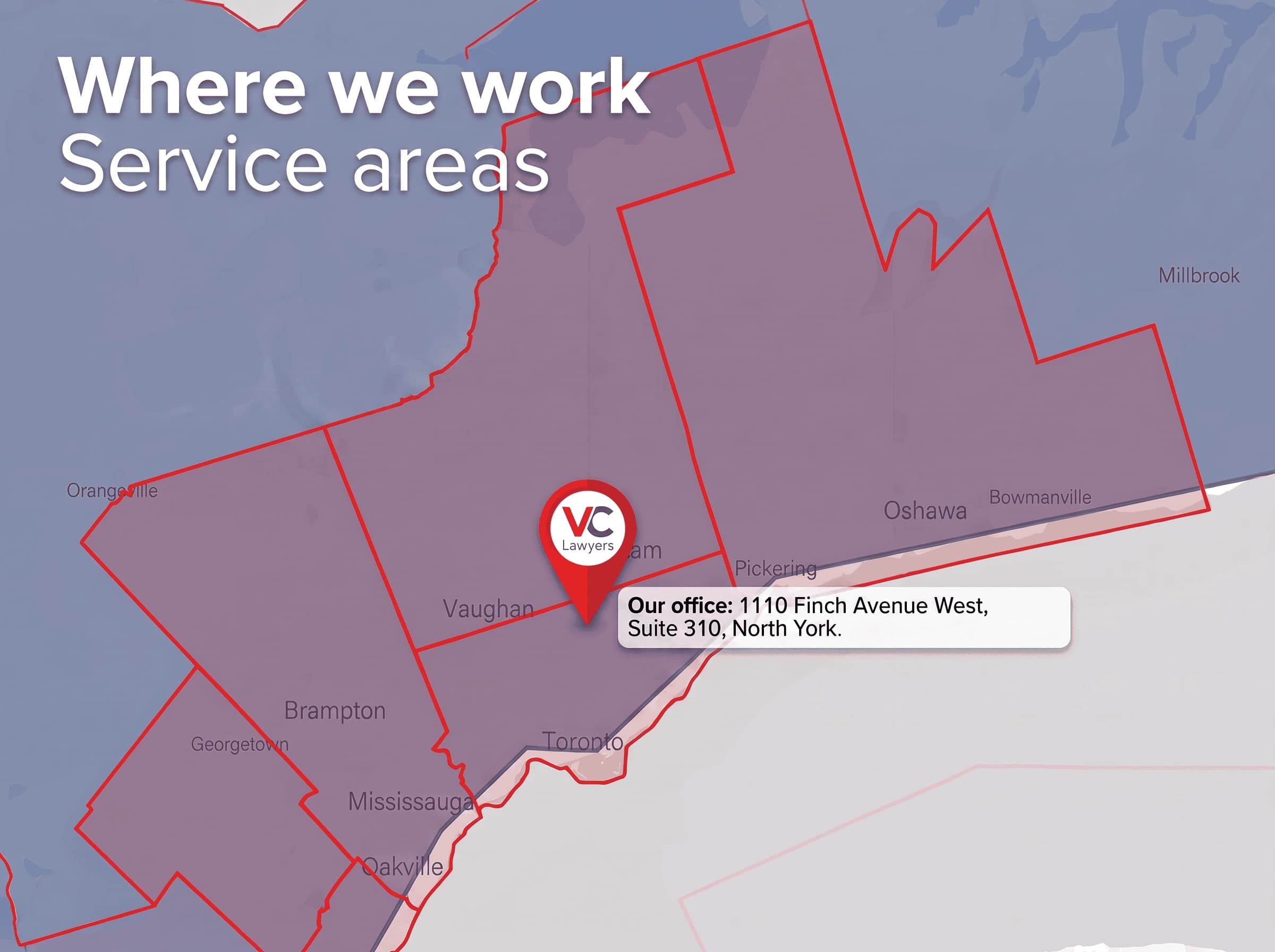
VC Lawyers service area map, Toronto and the Greater Toronto Area, with our North York office marked

Service areas

North York shareholder agreement lawyers serving every corridor

From our office at Finch Ave W and Keele, we draft and enforce shareholder agreements across all of North York, including Willowdale, Don Mills, Downsview, York Mills, Bathurst Manor, Lansing, Newtonbrook, Bayview Village, Flemingdon Park, Jane and Finch, Yorkdale and Glen Park, Clanton Park, Parkwoods, and Victoria Village, plus neighbouring communities in Vaughan, Thornhill, Richmond Hill, Markham, Scarborough, Etobicoke, and Downtown Toronto.

Whether it's two founders in Willowdale, three siblings on the Keele corridor, a clinic admitting an associate on Sheppard, or a family holding company spanning generations anywhere in the area, our North York shareholder agreement lawyers design for the real partnership. Office, video, and on-site meetings are available, with parking and TTC access (Finch West Station) at our office.

Our office is at 1110 Finch Ave W #310, near Finch and Keele, with parking on site. By transit, take the Finch West LRT or the bus network connecting from Finch West Station on Line 1. If your injuries or circumstances make travel difficult, we come to you at home or in hospital, anywhere in North York.

Related practice areas

Continue exploring