VC·Lawyers®
North York child custody lawyer, VC Lawyers

North York

North York Child Custody Lawyer

Toronto Lawyers Association
Ontario Trial Lawyers Association (OTLA)
The Canadian Bar Association
Love Toronto
Consulate General of the Republic of Korea in Toronto
Korean Legal Clinic
Ontario Bar Association
Toronto Lawyers Association
Ontario Trial Lawyers Association (OTLA)
The Canadian Bar Association
Love Toronto
Consulate General of the Republic of Korea in Toronto
Korean Legal Clinic
Ontario Bar Association
Toronto Lawyers Association
Ontario Trial Lawyers Association (OTLA)
The Canadian Bar Association
Love Toronto
Consulate General of the Republic of Korea in Toronto
Korean Legal Clinic
Ontario Bar Association

Trusted by accident victims and businesses across Ontario

Overview

Child custody and parenting arrangements in North York

Facing a custody matter in North York? Our experienced child custody lawyers in North York handle the issue separating parents care about most and fear most: the children. We negotiate, mediate, and litigate parenting arrangements. We draft parenting plans precisely enough to prevent the next five years of disputes. We run relocation cases under the modern notice regime, and enforcement when parenting time is denied. And we carry the high-conflict cases, including alienation claims, family-violence histories, and urgent motions, that demand courtroom strength alongside a steady hand. Our office is at 1110 Finch Ave W, and our team brings 70+ years of combined legal experience to families here. One principle governs every parenting matter we take, from the friendliest schedule negotiation to the hardest trial: the best interests of the child.

Start with the vocabulary, because the law deliberately changed it, and the change is the strategy. Ontario and Canada no longer speak of "custody" and "access." Since the 2021 reforms, the law allocates decision-making responsibility, meaning who makes the major calls about education, health care, religion, and significant extracurriculars. It also allocates parenting time, meaning the schedule of the children's lives across two homes.

North York Child Custody Lawyer, VC Lawyers

The test, the plan, and the status quo

The renaming was not cosmetic. The old words made children sound like property to be won, and the old fights followed the words. The new framework separates two questions parents routinely conflate. Decision-making and time are independent.

Decision-making can be joint, with both parents on the major calls, the default aspiration where communication permits. It can be sole, where one parent decides, typically because communication has genuinely broken down or safety demands it. Or it can be split by domain, with one parent on education and the other on health, a tailored arrangement that is less common and sometimes exactly right.

Parenting time runs its own track. It ranges from shared arrangements approaching equal time, through primary-residence structures with defined schedules, to supervised time where protection requires it. You can have joint decision-making with very unequal time, or sole decision-making with a generous schedule. Understanding that independence collapses half the fights before they start.

Now the test, because every decision in your case runs through it. Every parenting decision, whether negotiated, mediated, arbitrated, or ordered, must serve the best interests of the child. Courts do not judge that by instinct. They weigh a specific set of factors the law sets out.

Those factors start with the child's needs given age and stage, and the stability of their world, meaning home, school, community, and siblings. They include each parent's history of caregiving and capacity to meet the child's needs. They include the child's relationships with each parent, with siblings, and with the extended family that fills North York's multigenerational households.

The child's own views are given weight as age and maturity grow, heard through assessments and the Office of the Children's Lawyer (OCL), not by putting children in the middle. Each parent's willingness to support the child's relationship with the other parent is the factor parents underestimate most, because courts read undermining as a parenting deficit in the underminer. Communication and cooperation capacity count, and so does any history of family violence, which the modern law weighs explicitly and seriously.

Two structural truths sit behind the factors. First, the law starts from the premise that children benefit from meaningful relationships with both parents, absent genuine risk. A parent who sets out to erase the other is arguing against the law's own starting point.

Second, the law is gender-neutral and outcome-open. Fathers obtain primary residence and sole decision-making where the best-interests evidence points there. Nobody "automatically" gets anything, and the evidence, meaning the caregiving record, the stability, and the restraint, outweighs the advocacy every time.

Three more parts of the modern practice matter. The first is the parenting plan, which is what we actually produce. It sets the regular schedule, and it alternates holidays and summers with precision. It also covers travel and passport consents, how the two homes communicate, and how each parent keeps in touch with the child during the other parent's time.

It also sets exchange logistics, new-partner introductions where warranted, and dispute-resolution ladders for the disagreements that will come. Drafted properly, year three's questions have answers instead of motions.

The second is relocation, which has its own rules. A parent planning a move that materially affects the arrangement must give written notice, generally 60 days. If the other parent objects, a court decides on the children's best interests. Moving first and litigating later is the gravest unforced error in parenting law.

The third is the status quo, which is a strategic issue in itself. Courts protect stability, so the arrangements of the first months after separation harden into the baseline courts preserve. That makes early advice, before the "temporary" schedule sets, worth more than any motion afterward.

Most parenting files should resolve through negotiation, mediation, or the parenting plan inside a separation agreement, and ours mostly do, because the children live inside whatever conflict the process creates. But where litigation is necessary, such as denial of time, urgent safety motions, relocation fights, or genuine alienation, we litigate fully, with the evidence discipline these cases reward.

Consultations are billed and confidential, with the fee depending on the complexity of the matter, and our fees are set out in writing before work begins.

With service in 8+ languages, VC Lawyers protects what this work is actually about: the children's two relationships, and your place in their lives.

Get in touch

Looking for legal help? Speak directly with a lawyer

Tell us what happened and a lawyer will personally review your case. Personal injury consultations are free and there are no fees unless we win. For all other practice areas, a consultation fee applies.

  • $30M+ recovered for injury clients
  • Available 24/7, including weekends
  • Service in English, Korean, and 6+ more languages

Prefer to call? (416) 661-4529

A VC Lawyers lawyer in consultation with a client at the North York office

Background

Parenting law in North York: what you need to know

North York's parenting cases reflect the community itself. Two-household schedules are built around school catchments from Willowdale to Downsview. Multigenerational families make the extended-family factor real, because grandparents are daily caregivers.

Dual-career parents negotiate shift work and travel into schedules. Cross-border families raise relocation questions that span continents. And the conflict runs the full range, from cooperative parents who need one good plan, to the high-conflict minority that needs everything the court can do.

The framework, factor by factor

Decision-making responsibility covers the major calls about education, health care, religion, and significant extracurriculars. It can be allocated jointly, the default aspiration, with both parents on the big decisions and day-to-day calls made by whoever has the children. It can be allocated solely, where communication has truly failed or safety requires. Or it can be split by domain, a tailored allocation for families where one division genuinely fits.

Two laws now use the same language: the Divorce Act for married couples, and Ontario's Children's Law Reform Act alongside it. Which court has authority over your case follows the child's habitual residence, meaning the settled centre of the child's life, which an unauthorized move does not change.

Parenting time is the schedule, in all its real-world forms. Alternating-week and 2-2-3 shared arrangements. Primary-residence structures with weekend-and-midweek time. Long-distance schedules built around school calendars and travel. Supervised time and supervised exchanges where protection or de-escalation requires.

Shared parenting time and joint decision-making stay distinct throughout. Equal time does not require joint decisions, and joint decisions do not require equal time.

Here is what the best-interests factors look like in practice. The factors listed in the law get decided on the evidence. Stability means the home, school, and routine that your proposed arrangement keeps in place. Caregiving history means the calendar of who fed, drove, attended, and nursed, which is why the record matters more than the rhetoric.

The child's views enter through assessments and the OCL, weighted by age and maturity, so a teenager's settled preference matters while a seven-year-old is not asked to choose. Sibling relationships matter too, and split residence of siblings is rare and reasoned.

Willingness to support the other relationship quietly decides close cases, because the parent who facilitates reads as safe and the parent who obstructs reads as the risk. Family violence is weighed explicitly, with the safety measures the law now orders without apology: supervised time, exchanges through third parties, and protective terms.

Relocation runs on a modern regime. It requires written notice, generally 60 days, of a move that would materially affect the arrangement. It gives objection rights. And it ends in a best-interests adjudication that weighs the move's reasons, the impact on the child's relationships, and the workability of revised schedules.

There are two unforced errors, one in each direction. Moving without notice is treated by courts as self-help. Reflexively objecting to every move is read against the objector when the move was sound.

Enforcement and variation close the framework. Parenting time denied without lawful reason is enforceable, and a pattern of denial damages the denier's own position, because obstruction is a best-interests factor against them. Arrangements vary as lives do. Material changes such as moves, schedules, and the children's evolving needs ground variation, done properly through agreement or motion, not unilateral drift.

By the numbers

Parenting law facts every North York parent should know

The framework, the factors, and the modern rules.

  • The words changed on purpose

    "Custody" and "access" are now decision-making responsibility, covering the major calls about education, health, religion, and extracurriculars, and parenting time, covering the schedule. The language was built to make children the subject of care, not the object of victory.
  • Decision-making and time are independent tracks

    Joint, sole, or split-by-domain decision-making can pair with shared, primary-residence, or supervised time in any combination. Knowing they are separate questions collapses half the fights.
  • One test governs everything

    The best interests of the child weighs needs and stability, caregiving history, and relationships with parents, siblings, and extended family. It weighs the child's views with age, each parent's willingness to support the other relationship, and cooperation capacity. Any family violence is weighed explicitly.
  • Both-parent relationships are the starting premise

    Absent genuine risk, the law presumes children benefit from meaningful time with both parents. It reads undermining of the other relationship as a deficit in the underminer.
  • The law is gender-neutral

    No parent "automatically" gets the children. The caregiving evidence decides, for fathers and mothers alike.
  • Relocation runs on notice

    A move materially affecting the arrangement generally requires 60 days' written notice. Objection sends it to court on the children's best interests, and moving first is the error no later motion fully repairs.
  • The status quo hardens fast

    Courts protect stability, so the first months' "temporary" arrangements become the baseline. That makes early advice worth more than any motion afterward.
  • Children's voices enter properly

    They enter through assessments and the Office of the Children's Lawyer as age and maturity warrant. They never enter by deputizing the child as messenger, witness, or prize.
A VC Lawyers lawyer meeting a client at the North York office

Two homes, one childhood

How we advocate for North York's separating parents

Here is the thing the process makes easy to forget, and the thing every good outcome remembers: your children will have one childhood, lived across two homes, and they will remember how the crossing felt. The schedule matters; the tone of the schedule matters more.

Our parenting practice is built on that truth. We advocate in a way that protects your place in their lives without burning the bridge they walk across twice a week. We draft plans precise enough that the logistics stop being the battlefield. And where the other side makes the fight unavoidable, we build a courtroom case on the record of you simply being the parent you are. At Finch and Keele, in your family's language, the children come first, which, in this area of law, is also how their parents win.

The deadlines here are shorter than most people expect.

Step by step

What to do in a parenting dispute

  1. 01

    Get advice before the first "temporary" arrangement

    The status quo you concede in month one is the baseline courts preserve in month twelve.
  2. 02

    Start the parenting log today

    Keep it factual, dated, and restrained, covering exchanges, time, and incidents. It is a record, never a weapon.
  3. 03

    Stay deeply in the children's daily lives

    Stay involved in school, medical, and activities, and stay visible. The caregiving record is the case.
  4. 04

    Communicate as if a judge is reading

    In contested cases, one will. Keep it brief, civil, and child-focused, in writing where conflict runs high.
  5. 05

    Never put the children in the middle

    No messages carried, no questions about the other home, no interrogations after visits. Courts read it instantly, and against you.
  6. 06

    Facilitate the other relationship visibly

    Offer the makeup time and the flexible exchange. This is the factor that decides close cases, and it is documented by your own conduct.
  7. 07

    Do not deny time without legal advice

    That holds even where you have grievances. Unilateral denial converts your complaints into their evidence.
  8. 08

    Handle relocation by the book

    Notice in writing, inside the windows, with the plan that shows the children's interests were the planning.
  9. 09

    Stay off social media about any of it

    Every post about the other parent is an exhibit with a timestamp.
  10. 10

    Bring it to a North York child custody lawyer early

    Before positions harden, before the status quo sets, while the cooperative outcome is still available.

Our process

How our North York child custody lawyers handle your case

  1. 01

    Consultation, the map and the early moves

    We take the full picture, confidentially: the children and their routines, the caregiving history of who did what and how it was documented, the current arrangements and how they arose, the conflict's real level, and any safety dimensions. You leave with the best-interests assessment of your facts, the realistic range of outcomes, and the path recommendation. You also leave with the early-moves list, covering what to start documenting, what arrangements not to concede, and what never to put in writing.
  2. 02

    The record built, because these cases run on evidence

    Parenting cases are decided on demonstrated reality. We assemble the caregiving record, covering school and medical involvement, routines, and the calendar of who actually does what. We have you maintain a parenting log going forward, factual, dated, and restrained. Communications are conducted as if a judge will read them, because one may. We identify third-party anchors, including teachers, doctors, and the objective voices. Where the case warrants, we use the formal tools: assessments, the Office of the Children's Lawyer for the child's properly heard voice, and supervised-exchange resources where conflict demands a buffer.
  3. 03

    Resolution at the right temperature

    The agreement track carries most files. Parenting plans are negotiated or mediated and written to be used day to day, covering schedules, holidays, travel, communication, and dispute ladders, inside a separation agreement or standalone, enforceable either way. The court track carries the ones that need it. We bring urgent motions, which are fast requests to a judge, where time is denied, relocation threatens, or safety requires. We take case conferences seriously. These are the early court dates where a judge narrows the issues and can make orders. We fight hard over interim orders, the temporary orders that hold while the case runs, because they shape the status quo. Trials are prepared fully where the children's arrangements genuinely demand adjudication, with family-violence evidence presented with the seriousness the modern law gives it.
  4. 04

    The plan that keeps working

    Orders and plans are implemented and maintained. Schedules are administered. Enforcement is pursued where parenting time is denied, and defended where denial is alleged. Variations are brought as lives change, including the new job, the new school, and the relocation request done properly with notice. We keep the file open, because parenting arrangements last as long as childhood does.

Important

Parenting cases have the quietest urgent clock in family law: the status quo. Courts preserve stability, so every month a lopsided "temporary" arrangement runs, it hardens toward permanence. Denied parenting time compounds. Relocation notice windows run, and children's routines set. The right time for advice is before the first informal arrangement, and the second-best time is now. Contact a child custody lawyer in North York this week.

Every situation is different. Yours deserves a specific answer.

Know the pitfalls

Where parenting cases go wrong, and how we keep yours from joining them

  • The conceded status quo

    The "just for now" schedule that ran eight months and became the baseline. We answer with early advice and deliberate interim arrangements, so temporary means temporary.
  • The self-help move

    Relocating first and litigating after, read by courts as the children taken, not the job taken. We answer by running the notice regime properly, with the plan that proves the children were the planning.
  • The denial spiral

    Time withheld over grievances, converting legitimate complaints into the other side's best evidence. We answer with one rule: concerns go to lawyers and judges, never into the exchange schedule.
  • The deputized child

    Messages carried, loyalty tested, and preferences coached. Assessors see it instantly, and it is devastating to the coach. We answer with the discipline: the children stay out of it, and their voices enter through the OCL and assessments, properly.
  • The written record you wrote

    The texts, emails, and posts composed in anger, read in court. We answer with a standing instruction: communicate as if a judge is reading, because one will.
  • The war that becomes the harm

    Years of litigation that damaged the children more than any schedule could. We answer with temperature control as strategy. Resolution is pressed where possible, court is reserved for what needs it, and we are candid throughout about what the fight is costing whom.

In the news

The law that renamed the fight, and meant it

The 2021 reforms were family law's most deliberate cultural intervention. Custody and access, the vocabulary of ownership and visitation, were replaced nationally with decision-making responsibility and parenting time.

The best-interests factors were codified in detail, with family violence named and weighted explicitly for the first time. The relocation notice regime was built to end move-first-litigate-later, and Ontario's Children's Law Reform Act now speaks the same language as the Divorce Act.

The courts' practice has moved with it, through conference-driven resolution, children's voices entering through proper channels, and a consistent judicial message that the parent who feeds conflict is arguing against themselves.

For North York's parents, the modern law's read is consistent and freeing. The system is not scoring who wins the children. It is protecting the children's two relationships, and it rewards the parent who demonstrably does the same. The strongest case has always been the same thing as the best parenting, and now the statute says so.

Rather ask someone who handles these matters every week?

Why VC Lawyers

Why hire a child custody lawyer in North York at VC Lawyers

  • Child-centred by conviction, not slogan

    Strategy is built on the best-interests factors courts actually weigh. That protects your case and your children at the same time, because in this area they are the same thing.
  • De-escalation as advocacy

    The parent who lowers conflict, supports the other relationship, and documents with restraint wins on the factors. We coach exactly that, and we litigate fully when the other side will not reciprocate.
  • Status-quo strategy from day one

    The early arrangements harden into baselines. We shape them deliberately instead of letting them be conceded accidentally.
  • Evidence discipline

    The caregiving record, the parenting log, and the communications conducted for the judicial reader are built from the first meeting. These cases run on demonstrated reality.
  • The hard cases handled

    Relocation fights, denied time, alienation dynamics, and family-violence evidence get the courtroom strength our litigation practice brings, with the sensitivity these files demand.
  • Plans written for daily use

    Schedules, holidays, travel consents, communication protocols, and dispute ladders make the parenting plan that answers year three's questions without a motion.
  • Multilingual service

    English, Korean (한국어), Hebrew, Mandarin, and more, for the area's families, in the language your children's lives actually run in.

Choosing wisely

How to choose the right child custody lawyer in North York

Before hiring any firm, ask a few hard questions. Is the strategy built on the best-interests factors courts actually weigh, or on your grievances? Will they coach the conduct that wins these cases, meaning de-escalation, facilitation, and the documented record, and litigate fully when the other side will not reciprocate? Do they know the modern rules cold, including the relocation regime, the OCL, and enforcement?

Then keep going. Are the parenting plans detailed enough to keep working for years? Will they handle family-violence evidence with seriousness and false allegations with rigour? And will they tell you honestly when the fight you want is not the fight your children need?

At VC Lawyers, the answer to each is yes, from an office in the heart of North York, in your family's language.

Still weighing what to do next? That is what a first conversation is for.

Testimonials

What our North York clients say

4.8★★★★★·140 on Google
After my car accident, I went through an incredibly challenging time. Thanks to Lawyer Jun Lee and his exceptional team, I received tremendous support and strength.

Jay Kim

Personal Injury Client

When my mother suffered a serious head injury, I was devastated. After meeting Lawyer Jae Hyon Cho, my family was able to receive substantial compensation.

Minkyung Park

Personal Injury Client

Avi Vaturi was professional, responsive, and thorough. When the transaction became complex, his calm communication and practical solutions navigated us to a smooth close.

Jordan Glaser

Real Estate Co-Counsel

Mr. Avi Vaturi did a fantastic job. The whole process was seamless — timely, detailed, and professional from start to finish.

Howard Huang

Real Estate Client

He helped me with both my car accident case and the buying and selling of my home. Everything was handled professionally and efficiently.

Yoon Jung

Personal Injury & Real Estate Client

Jae Cho was great to deal with and very attentive to my case. His associate Sunny was also very helpful. I would highly recommend.

Jordan Ungerman

Personal Injury Client

Their professionalism, attention to detail, and commitment to clients truly stand out. Whether handling urgent matters or guiding me through complex issues, the team delivered.

Charles Hong

Long-time Client

It has been my pleasure to work with Jae Cho and his team. Knowledgeable, clear in their explanations, and the process was smooth and stress-free.

Joanne Jeong

Real Estate Client

Vaturi & Cho LLP is an outstanding law firm. They explain even complex matters clearly, and their dedication to achieving the best outcomes is truly impressive.

Jong Ko

Client

The team was not only knowledgeable but also very kind and attentive throughout the entire process. Highly recommended.

Tobi

Client

After my car accident, I went through an incredibly challenging time. Thanks to Lawyer Jun Lee and his exceptional team, I received tremendous support and strength.

Jay Kim

Personal Injury Client

When my mother suffered a serious head injury, I was devastated. After meeting Lawyer Jae Hyon Cho, my family was able to receive substantial compensation.

Minkyung Park

Personal Injury Client

Avi Vaturi was professional, responsive, and thorough. When the transaction became complex, his calm communication and practical solutions navigated us to a smooth close.

Jordan Glaser

Real Estate Co-Counsel

Mr. Avi Vaturi did a fantastic job. The whole process was seamless — timely, detailed, and professional from start to finish.

Howard Huang

Real Estate Client

He helped me with both my car accident case and the buying and selling of my home. Everything was handled professionally and efficiently.

Yoon Jung

Personal Injury & Real Estate Client

Jae Cho was great to deal with and very attentive to my case. His associate Sunny was also very helpful. I would highly recommend.

Jordan Ungerman

Personal Injury Client

Their professionalism, attention to detail, and commitment to clients truly stand out. Whether handling urgent matters or guiding me through complex issues, the team delivered.

Charles Hong

Long-time Client

It has been my pleasure to work with Jae Cho and his team. Knowledgeable, clear in their explanations, and the process was smooth and stress-free.

Joanne Jeong

Real Estate Client

Vaturi & Cho LLP is an outstanding law firm. They explain even complex matters clearly, and their dedication to achieving the best outcomes is truly impressive.

Jong Ko

Client

The team was not only knowledgeable but also very kind and attentive throughout the entire process. Highly recommended.

Tobi

Client

After my car accident, I went through an incredibly challenging time. Thanks to Lawyer Jun Lee and his exceptional team, I received tremendous support and strength.

Jay Kim

Personal Injury Client

When my mother suffered a serious head injury, I was devastated. After meeting Lawyer Jae Hyon Cho, my family was able to receive substantial compensation.

Minkyung Park

Personal Injury Client

Avi Vaturi was professional, responsive, and thorough. When the transaction became complex, his calm communication and practical solutions navigated us to a smooth close.

Jordan Glaser

Real Estate Co-Counsel

Mr. Avi Vaturi did a fantastic job. The whole process was seamless — timely, detailed, and professional from start to finish.

Howard Huang

Real Estate Client

He helped me with both my car accident case and the buying and selling of my home. Everything was handled professionally and efficiently.

Yoon Jung

Personal Injury & Real Estate Client

Jae Cho was great to deal with and very attentive to my case. His associate Sunny was also very helpful. I would highly recommend.

Jordan Ungerman

Personal Injury Client

Their professionalism, attention to detail, and commitment to clients truly stand out. Whether handling urgent matters or guiding me through complex issues, the team delivered.

Charles Hong

Long-time Client

It has been my pleasure to work with Jae Cho and his team. Knowledgeable, clear in their explanations, and the process was smooth and stress-free.

Joanne Jeong

Real Estate Client

Vaturi & Cho LLP is an outstanding law firm. They explain even complex matters clearly, and their dedication to achieving the best outcomes is truly impressive.

Jong Ko

Client

The team was not only knowledgeable but also very kind and attentive throughout the entire process. Highly recommended.

Tobi

Client

After my car accident, I went through an incredibly challenging time. Thanks to Lawyer Jun Lee and his exceptional team, I received tremendous support and strength.

Jay Kim

Personal Injury Client

When my mother suffered a serious head injury, I was devastated. After meeting Lawyer Jae Hyon Cho, my family was able to receive substantial compensation.

Minkyung Park

Personal Injury Client

Avi Vaturi was professional, responsive, and thorough. When the transaction became complex, his calm communication and practical solutions navigated us to a smooth close.

Jordan Glaser

Real Estate Co-Counsel

Mr. Avi Vaturi did a fantastic job. The whole process was seamless — timely, detailed, and professional from start to finish.

Howard Huang

Real Estate Client

He helped me with both my car accident case and the buying and selling of my home. Everything was handled professionally and efficiently.

Yoon Jung

Personal Injury & Real Estate Client

Jae Cho was great to deal with and very attentive to my case. His associate Sunny was also very helpful. I would highly recommend.

Jordan Ungerman

Personal Injury Client

Their professionalism, attention to detail, and commitment to clients truly stand out. Whether handling urgent matters or guiding me through complex issues, the team delivered.

Charles Hong

Long-time Client

It has been my pleasure to work with Jae Cho and his team. Knowledgeable, clear in their explanations, and the process was smooth and stress-free.

Joanne Jeong

Real Estate Client

Vaturi & Cho LLP is an outstanding law firm. They explain even complex matters clearly, and their dedication to achieving the best outcomes is truly impressive.

Jong Ko

Client

The team was not only knowledgeable but also very kind and attentive throughout the entire process. Highly recommended.

Tobi

Client

Our team

Meet your North York legal team

Our lawyers bring decades of combined experience to parenting matters in this part of the city, with plans negotiated, relocations resolved, time enforced, and the hard matters litigated, always on the best-interests framework, always with the children's two relationships in view. Every parent works with a dedicated North York child custody lawyer who protects the case and the childhood at once.

Who handles your file

The people on your matter

  • Avi Vaturi, Partner

    Senior counsel handling high-conflict parenting litigation, including relocation, enforcement, and alienation dynamics, with courtroom strength and strategic restraint.
  • Jae Hyon Cho, Co-Managing Partner

    Experienced counsel guiding North York's families, including the Korean-speaking community, through parenting arrangements with steadiness.
  • Jun Ki Lee, Associate

    Dedicated associate handling parenting plans, motions, OCL coordination, and enforcement across North York and the GTA.
  • Allan Weiss, Associate

    Experienced lawyer providing strategic guidance on complex parenting litigation and appeals.

Not sure where you stand? One conversation will tell you.

Key metrics

In the numbers

Years combined legal experience
70+
Languages served
8+
First, best-interests advocacy throughout
Child
Fees set out before work begins
Written
VC Lawyers Toronto legal team, Vaturi & Cho LLP

Talk to us

The children come first, and so does the first conversation, confidential from the start

Bring the current arrangements, the points of conflict, and your goals. We will map the realistic outcomes on the best-interests factors and the path that fits your conflict level, whether agreement, mediation, or court. We will set out the early moves that matter most, including the ones to avoid. Urgent situations such as denied time, threatened relocation, or safety concerns get same-week attention.

Office, video, or phone. Evening accommodations for parenting schedules.

Book a Consultation

Frequently asked questions

We answered all

  • What happened to "custody" and "access", and does the new language actually change anything?
    They were replaced. Since the 2021 reforms, the law allocates decision-making responsibility, covering the major calls about education, health, religion, and significant extracurriculars, and parenting time, covering the schedule. And yes, it changes things. The framework separates decisions from time, so you can have one without the other. It codifies the best-interests factors in detail, weighs family violence explicitly, and strips out the win/lose vocabulary that fuelled the old fights. Lawyers still get asked for "custody"; what we build is parenting arrangements under the modern law.
  • Who gets the kids, and does the mother automatically have the advantage?
    Nobody "gets" the children, and no, the law is gender-neutral. Every arrangement runs on the best interests of the child, decided on evidence such as caregiving history, stability, each parent's capacity, the relationships, and the child's views with age. Fathers obtain primary residence and sole decision-making where the evidence points there, and mothers likewise. The advantage belongs to whichever parent has the demonstrated caregiving record and the documented restraint, which is buildable, starting now.
  • What is the difference between joint decision-making and shared parenting time?
    They are independent tracks, and that is the single most clarifying fact in this area. Joint decision-making means both parents make the major calls together, which works where communication works. Shared parenting time means the children spend substantial to equal time in both homes, which works where logistics and the children's needs support it. You can have joint decisions with a primary residence, sole decisions with generous time, or both shared. Most "custody fights" dissolve partway once parents see the two questions separately.
  • Will the court listen to what my child wants?
    With age and maturity, yes, through the proper channels. Assessments and the Office of the Children's Lawyer give the child a voice without putting them on a witness stand or in the middle. A teenager's settled, independent preference carries real weight. A young child is not asked to choose between parents, and a child who arrives sounding coached damages the coach. The rule for parents is absolute: the children's voices enter properly, or they hurt whoever deputized them.
  • My ex wants to move away with the children. Can they?
    Not unilaterally. A move that would materially affect the arrangement generally requires written notice, typically 60 days. If you object, a court decides on the children's best interests, weighing the move's reasons, the impact on relationships, and the workability of revised schedules and travel. Two warnings, one each way. A parent who moves without notice has committed the error courts forgive least. A parent who reflexively blocks every move can find the objection weighed against them when the move was sound. Either way: advice first, the regime followed, the plan documented.
  • My ex keeps denying my parenting time. What can I actually do?
    Enforce it, and document while you do. Parenting time under an agreement or order is enforceable, courts treat unjustified denial seriously, and a pattern of obstruction becomes a best-interests factor against the denier. That is the willingness-to-support-the-other-relationship factor with teeth. Keep the factual log, request makeup time in writing, and never retaliate in kind. Bring us the record. Remedies run from compliance orders to, in persistent cases, revisiting the arrangement itself.
  • Things are bad. Can I just stop sending the kids?
    Not without legal advice. The exception is genuine immediate risk, in which case call us the same day and the proper protective steps, including urgent motions and supervised structures, get taken properly. Unilateral denial over grievances is the classic self-inflicted wound. It converts your complaints into their evidence and reframes you as the obstruction. Concerns go to lawyers and courts, and the exchange schedule is not the venue.
  • There has been family violence. How does the law handle that?
    Explicitly, since the reforms. Family violence is a named best-interests factor, weighed for its nature, pattern, and impact on the child and the other parent. The toolkit is real: supervised parenting time, supervised or third-party exchanges, protective terms, and sole decision-making where joint contact is unsafe. We handle these cases with the evidence care and urgency they demand, and we defend against false or inflated allegations with the same rigour, because both failures harm children.
  • What is a parenting plan, and how detailed should it be?
    It is the operating manual for two-household parenting, and it should be detailed. It covers the regular schedule, holidays, birthdays, and summers alternated with precision, travel and passport consents, communication protocols between homes and with the children, exchange logistics, school and activity decision mechanics, new-partner and relocation provisions, and a dispute-resolution ladder for the disagreements that will come. Detail is kindness. The plan that answers year three's question without a motion is the plan that was drafted right, and it lives enforceably inside a separation agreement or order.
  • Do we have to go to court over this?
    Usually not, and usually you should not. Most parenting matters resolve through negotiation or mediation into a plan, and even filed cases mostly settle at conferences. Court is the right tool for the cases that need it, such as urgent safety, denied time, relocation, and intractable conflict, and we litigate those fully. The constant across both paths: the parent who lowered the temperature and built the record arrives stronger everywhere, including the courtroom.
  • Can grandparents or other family members seek time with the children?
    Yes, in appropriate cases. Ontario law allows persons other than parents, grandparents prominently, to seek contact or even decision-making responsibility, on the same best-interests test. In North York's multigenerational families, where grandparents are often daily caregivers, these claims are real and sometimes vital. The analysis is fact-driven. Bring us the caregiving reality and we will map it.
  • How do arrangements change as the kids grow?
    Through variation, properly done. Material changes such as the children's evolving needs and schedules, moves, and work changes ground revised arrangements, by agreement or motion. What does not work is unilateral drift, with the paper saying one thing while life does another, because when conflict returns, the paper governs. Good plans anticipate growth through built-in reviews and age-staged schedules, and good practice updates them before the gap becomes the dispute.

North York child custody lawyers

Book a consultation with a North York lawyer

Between the status quo quietly hardening, the schedule conceded "for now," the texts written in anger, and the move announced without notice, parenting cases are mostly decided by conduct, months before any judge weighs in. The conduct that wins is learnable, and the record that decides is buildable. Both start with one conversation: your facts against the best-interests factors, the realistic outcomes, and the early moves that matter most. Confidential and child-first, because in this area of law, that is also what winning looks like. Consultations are billed, and the cost depends on the complexity of the matter. Fees are set out in writing before work begins.

Toronto Office

Vaturi & Cho LLP

1110 Finch Ave W #310
North York, ON M3J 2T2
info@vclawyers.ca
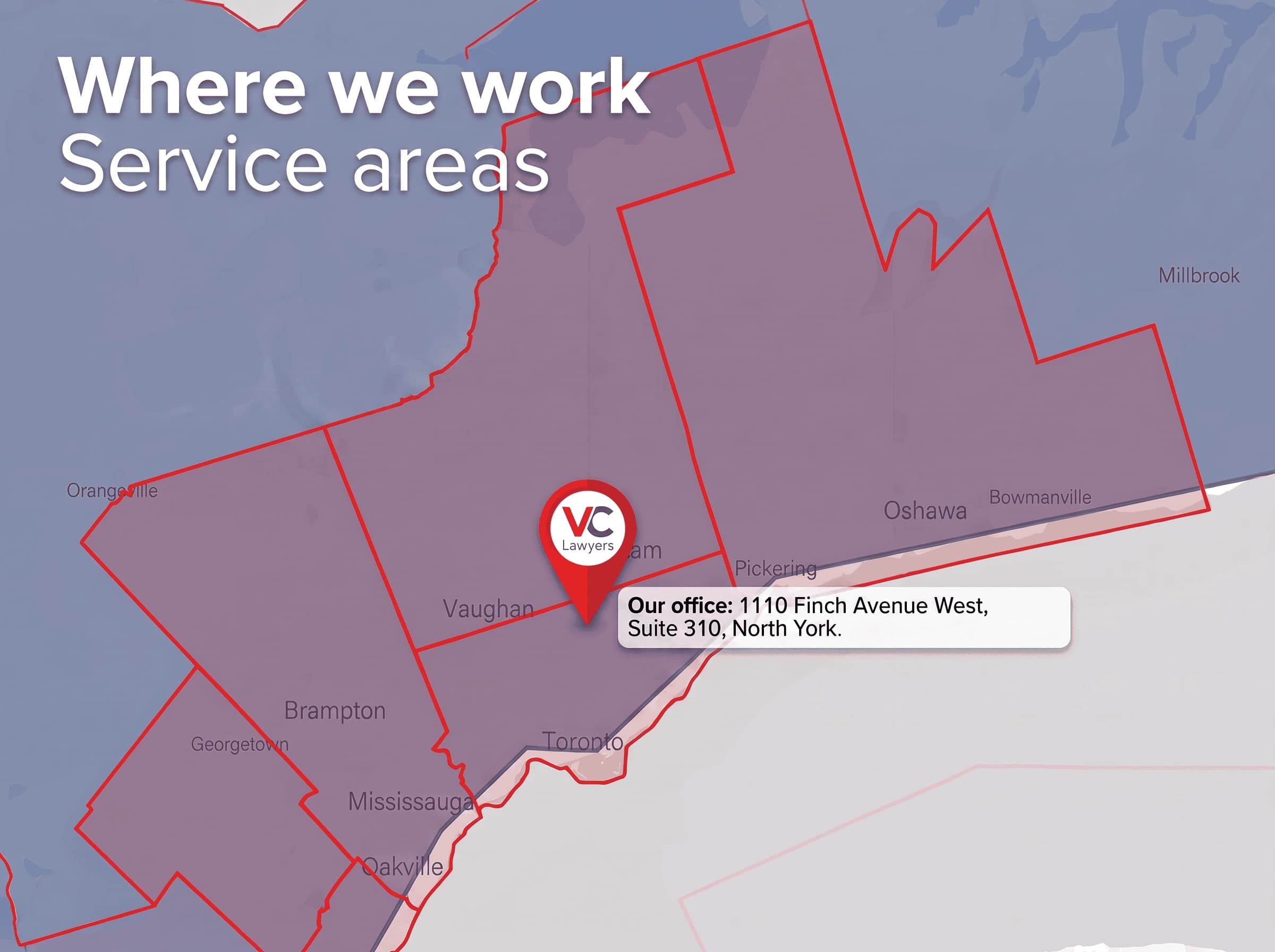
VC Lawyers service area map, Toronto and the Greater Toronto Area, with our North York office marked

Service areas

North York child custody lawyers serving every neighbourhood

From our office at Finch Ave W and Keele, we represent parents across all of North York, including Willowdale, Don Mills, Downsview, York Mills, Bathurst Manor, Lansing, Newtonbrook, Bayview Village, Flemingdon Park, Jane and Finch, Yorkdale and Glen Park, Clanton Park, Parkwoods, and Victoria Village. We also serve neighbouring communities in Vaughan, Thornhill, Richmond Hill, Markham, Scarborough, Etobicoke, and Downtown Toronto.

Whether it is a parenting plan across two Willowdale addresses, a relocation question spanning continents, denied time anywhere in the area, or a grandparent's claim in a multigenerational household, our North York child custody lawyers protect the children's relationships and yours. Office, video, and phone meetings are all available.

Our office is at 1110 Finch Ave W #310, near Finch and Keele, with parking on site. By transit, take the Finch West LRT or the bus network connecting from Finch West Station on Line 1. If your injuries or circumstances make travel difficult, we come to you at home or in hospital, anywhere in North York.

Related practice areas

Continue exploring